



Europe Blood Culture Test Market, By Product Type (Automated blood culture systems, Culture media, Reagents & Consumables), By Method (Automated, Manual), By Application (Bacteremia, Septicemia, Fungemia, Others), By End-User (Hospitals, Diagnostic Laboratories, Others), and By Country (Germany, France, U.K., Netherlands, Switzerland, Belgium, Russia, Italy, Spain, Turkey, Rest of Europe) – Industry Trends and Forecast to 2032.
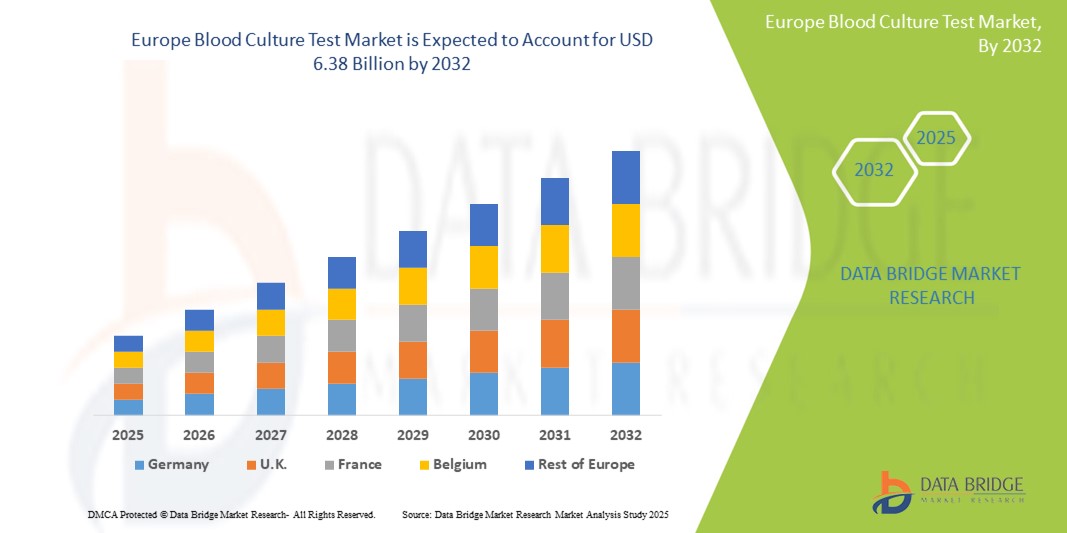
Blood Culture Test Market Size
- The Europe Blood Culture Test market size was valued at USD 3.8 billion in 2024 and is projected to reach USD 6.38 billion by 2032, exhibiting a CAGR of 6.7% during the forecast period of 2025-2032.
- Furthermore, the increasing incidence of bloodstream infections and the growing emphasis on early and accurate diagnosis are establishing blood culture tests as essential tools in clinical practice.
- These converging factors are accelerating the adoption of blood culture tests, thereby significantly boosting the industry's growth in the region.
Blood Culture Test Market Analysis
- Blood culture tests, crucial for identifying bloodstream infections and guiding appropriate antimicrobial therapy, are increasingly vital components of modern diagnostic practices in both hospital and laboratory settings due to their ability to improve patient outcomes and reduce mortality.
- The escalating demand for blood culture tests is primarily fueled by the rising prevalence of infectious diseases, the growing awareness of antibiotic resistance necessitating accurate pathogen identification, and technological advancements leading to faster and more sensitive testing methods.
- U.K. dominates the Blood Culture Test market with the largest revenue share of 56.71 % in 2025, due to a well-established healthcare system, high healthcare expenditure, and a large volume of diagnostic testing.
- The Automated blood culture systems segment is expected to dominate the Blood Culture Test market with a market share of 48.34% in 2025, driven by the recurring need for culture media and associated disposables in routine testing procedures.
Report Scope and Blood Culture Test Market Segmentation
|
Attributes |
Blood Culture Test Key Market Insights |
|
Segments Covered |
|
|
Countries Covered |
Europe
|
|
Key Market Players |
|
|
Market Opportunities |
|
|
Value Added Data Infosets |
In addition to the insights on market scenarios such as market value, growth rate, segmentation, geographical coverage, and major players, the market reports curated by the Data Bridge Market Research also include in-depth expert analysis, pricing analysis, brand share analysis, consumer survey, demography analysis, supply chain analysis, value chain analysis, raw material/consumables overview, vendor selection criteria, PESTLE Analysis, Porter Analysis, and regulatory framework. |
Blood Culture Test Market Trends
“Increasing Adoption of Rapid Diagnostic Tests and Automation”
- A significant trend in the Europe blood culture test market is the growing adoption of rapid diagnostic tests (RDTs) and automation technologies. These advancements enable faster turnaround times for results, which is crucial for timely initiation of appropriate antimicrobial therapy and improved patient outcomes.
- For instance, the development of molecular diagnostic techniques that can directly detect pathogens and resistance markers from blood samples is gaining traction, reducing the reliance on traditional culture-based methods that require longer incubation periods.
- Furthermore, the increasing integration of automation in blood culture workflows, from sample loading to result interpretation, is enhancing efficiency, reducing the risk of human error, and improving the overall throughput of diagnostic laboratories.
- The development of user-friendly and compact automated blood culture systems is also facilitating their adoption in smaller hospitals and clinics.
Blood Culture Test Market Dynamics
Driver
“Rising Prevalence of Bloodstream Infections and Sepsis”
- The increasing incidence of bloodstream infections (BSIs) and sepsis across Europe is a significant driver for the heightened demand for blood culture tests.
- For instance, factors such as the aging population, the growing number of patients with compromised immune systems due to chronic diseases or medical treatments, and the rise of antibiotic-resistant bacteria are contributing to a higher burden of BSIs. Sepsis, a life-threatening condition resulting from the body's overwhelming response to an infection, often requires blood culture testing for diagnosis and management.
- As the prevalence of these conditions continues to rise, the demand for rapid and accurate blood culture testing is expected to increase substantially.
- Furthermore, increasing awareness among healthcare professionals about the critical role of early diagnosis in improving sepsis outcomes is driving greater utilization of blood culture tests.
Restraint/Challenge
“Challenges Related to Contamination and False Negatives”
- Despite advancements in blood culture testing, challenges related to contamination and the occurrence of false-negative results can restrain market growth.
- For instance, contamination during blood collection or processing can lead to false-positive results, necessitating additional testing and potentially delaying appropriate treatment.
- Additionally, factors such as prior antibiotic administration or low bacterial load in the bloodstream can result in false-negative results, potentially leading to underdiagnosis and delayed treatment.
- Addressing these challenges through improved blood collection techniques, enhanced quality control measures in laboratories, and the development of more sensitive detection methods will be crucial for maximizing the clinical utility of blood culture tests.
- While ongoing research and technological advancements are focused on minimizing these issues, they remain significant considerations for market growth.
Blood Culture Test Market Scope
The market is segmented on the basis of product type, method, application, and end-user.
By Product Type
On the basis of product type, the blood culture test market can be segmented into automated blood culture systems, culture media, reagents & consumables. The automated blood culture systems segment is anticipated to hold the market share of 48.34% in 2025 due to their efficiency and high throughput capabilities.
The culture media segment is anticipated to hold the market share of 38.45% in 2025 due to the continuous development of specialized media for different types of microorganisms.
By Method
On the basis of method, the market is segmented into conventional/manual blood culture and automated blood culture. The conventional/manual blood culture media segment is anticipated to hold the market share in 2025 due to the advantages of faster turnaround times and reduced contamination risk.
However, the automated blood culture segment is gaining rapid traction due to its ability to deliver faster and more accurate detection of bloodstream infections. The increasing demand for timely diagnosis of sepsis and other critical infections is driving adoption in hospitals and diagnostic laboratories. Technological advancements in automated systems are improving sensitivity, reducing contamination, and streamlining workflow.
By Application
On the basis of application, the market is segmented into bacteremia, septicemia, fungemia, and mycobacterial detection. The bacteremia segment is anticipated to hold the market share in 2025 due to the increasing incidence of severe bloodstream infections.
しかし、血流感染症および敗血症関連合併症の世界的な発生率増加により、敗血症分野は急速に注目を集めています。病原体の早期かつ正確な検出に対する緊急のニーズが高まり、敗血症診断における血液培養検査の利用が促進されています。培地と自動化システムの進歩により、検出速度と信頼性が向上しています。
エンドユーザー別
エンドユーザーに基づいて、市場は病院、診断検査室、リファレンス検査室、その他に分類されます。診断検査のアウトソーシングの増加により、病院セグメントは2025年も市場シェアを維持すると予想されます。
しかし、診断検査部門は、ハイスループット、正確性、そして費用対効果の高い血液培養検査を提供できることから、急速に成長を遂げています。血流感染症の集中検査と迅速な診断に対する需要の高まりは、医療ネットワーク全体での利用を促進しています。
血液培養検査市場の地域分析
- 英国は、感染症の蔓延率の高さ、高度な医療インフラ、大手診断企業の存在に牽引され、2025年には56.71%という最大の収益シェアで血液培養検査市場を独占するでしょう。
- この大きな市場シェアは、有利な償還ポリシーと高度な診断技術の高い導入率によってさらに支えられています。
ドイツの血液培養検査市場の洞察
ドイツの血液培養検査市場は、確立された医療システムと感染症のタイムリーな診断の重要性に対する意識の高まりを背景に、予測期間中に注目すべきCAGRで成長すると予想されています。診断能力の向上に向けた政府の取り組みと、先進技術の導入増加が市場拡大に貢献しています。
フランスの血液培養検査市場の洞察
フランスの血液培養検査市場は、医療費の増加と診断インフラの改善への関心の高まりにより、予測期間中に大幅なCAGRで拡大すると予想されています。感染症の発生率の上昇と、より優れた診断ツールへのニーズが、血液培養検査の需要を押し上げています。
血液培養検査の市場シェア
血液培養検査業界は、主に、次のような定評のある企業によって牽引されています。
- ベクトン・ディッキンソン・アンド・カンパニー(BD)(米国)
- アクセラレート・ダイアグノスティックス(米国)
- バイオジェニックス社(インド)
- コパン(イタリア)
- ビオメリューSA(フランス)
- サーモフィッシャーサイエンティフィック社(米国)
- アボットラボラトリーズ(米国)
- ブルカーコーポレーション(米国)
- F. ホフマン・ラ・ロシュ社(スイス)
- ダナハーコーポレーション(米国)
- ルミネックスコーポレーション(米国)
- T2バイオシステムズ社(米国)
- DiaSorin SpA(イタリア)
- グリフォルスSA(スペイン)
- ラジオメーターメディカルApS(デンマーク)
- シンラボグループ(ドイツ)
- セフェイド社(米国)
- IRIDICA(旧アボット・モレキュラー社)(米国)
欧州血液培養検査市場の最新動向
- 2025年4月、DiaSorinは、Liaison Plexグラム陰性血液培養アッセイがFDA 510(k)承認を取得したと発表しました。これは、Liaison Plexプラットフォーム上で血液培養中の病原体同定を目的とした3つのマルチプレックス分子パネルのうち2つ目です。このアッセイは、大腸菌、肺炎桿菌、緑膿菌など、19種のグラム陰性細菌と8種の主要耐性遺伝子標的を含む27種の病原体を検出します。
- 2025年3月、Accelerate DiagnosticsはWAVEシステムとグラム陰性菌検査キットをFDA 510(k)承認申請しました。このシステムは、血液培養から直接、約4.5時間で迅速な抗菌薬感受性試験(AST)結果を提供し、同一シフトでの標的治療を可能にします。これは、敗血症(年間4,900万人の患者、1,100万人の死亡)と抗菌薬耐性(年間132万人の死亡)への対応となり、医療費削減(米国における敗血症による年間負担620億ドル)につながる可能性があります。WAVEは、Phenoシステム(7時間AST)やArcシステム(自動サンプル調製)といった既存のFDA承認ソリューションを補完し、検査室の効率と患者の転帰を向上させます。
- 2025年2月、バイオジェニックス社は、微生物学研究室向けに32ポジションの培養機能を備えた全自動血液培養装置「Bugz32」を発表しました。迅速、正確、かつ信頼性の高い結果を提供するよう設計されたBugz32は、同社の幅広い診断装置およびキットのポートフォリオの一部です。
- 2024 年 11 月、Copan はサンプルの転送と追跡を自動化することで、陽性血液培養の処理を最適化するために開発された自動化システムである HEMO を導入しました。
SKU-
世界初のマーケットインテリジェンスクラウドに関するレポートにオンラインでアクセスする

- インタラクティブなデータ分析ダッシュボード
- 成長の可能性が高い機会のための企業分析ダッシュボード
- カスタマイズとクエリのためのリサーチアナリストアクセス
- インタラクティブなダッシュボードによる競合分析
- 最新ニュース、更新情報、トレンド分析
- 包括的な競合追跡のためのベンチマーク分析のパワーを活用
調査方法
データ収集と基準年分析は、大規模なサンプル サイズのデータ収集モジュールを使用して行われます。この段階では、さまざまなソースと戦略を通じて市場情報または関連データを取得します。過去に取得したすべてのデータを事前に調査および計画することも含まれます。また、さまざまな情報ソース間で見られる情報の不一致の調査も含まれます。市場データは、市場統計モデルと一貫性モデルを使用して分析および推定されます。また、市場シェア分析と主要トレンド分析は、市場レポートの主要な成功要因です。詳細については、アナリストへの電話をリクエストするか、お問い合わせをドロップダウンしてください。
DBMR 調査チームが使用する主要な調査方法は、データ マイニング、データ変数が市場に与える影響の分析、および一次 (業界の専門家) 検証を含むデータ三角測量です。データ モデルには、ベンダー ポジショニング グリッド、市場タイムライン分析、市場概要とガイド、企業ポジショニング グリッド、特許分析、価格分析、企業市場シェア分析、測定基準、グローバルと地域、ベンダー シェア分析が含まれます。調査方法について詳しくは、お問い合わせフォームから当社の業界専門家にご相談ください。
カスタマイズ可能
Data Bridge Market Research は、高度な形成的調査のリーダーです。当社は、既存および新規のお客様に、お客様の目標に合致し、それに適したデータと分析を提供することに誇りを持っています。レポートは、対象ブランドの価格動向分析、追加国の市場理解 (国のリストをお問い合わせください)、臨床試験結果データ、文献レビュー、リファービッシュ市場および製品ベース分析を含めるようにカスタマイズできます。対象競合他社の市場分析は、技術ベースの分析から市場ポートフォリオ戦略まで分析できます。必要な競合他社のデータを、必要な形式とデータ スタイルでいくつでも追加できます。当社のアナリスト チームは、粗い生の Excel ファイル ピボット テーブル (ファクト ブック) でデータを提供したり、レポートで利用可能なデータ セットからプレゼンテーションを作成するお手伝いをしたりすることもできます。











