



欧州の磁気共鳴画像(MRI)装置市場の細分化、タイプ別:従来型、バイオベース、磁場強度別:高磁場磁気共鳴画像(MRI)システム(1.5t~3t)、低~中磁場磁気共鳴画像(MRI)システム(
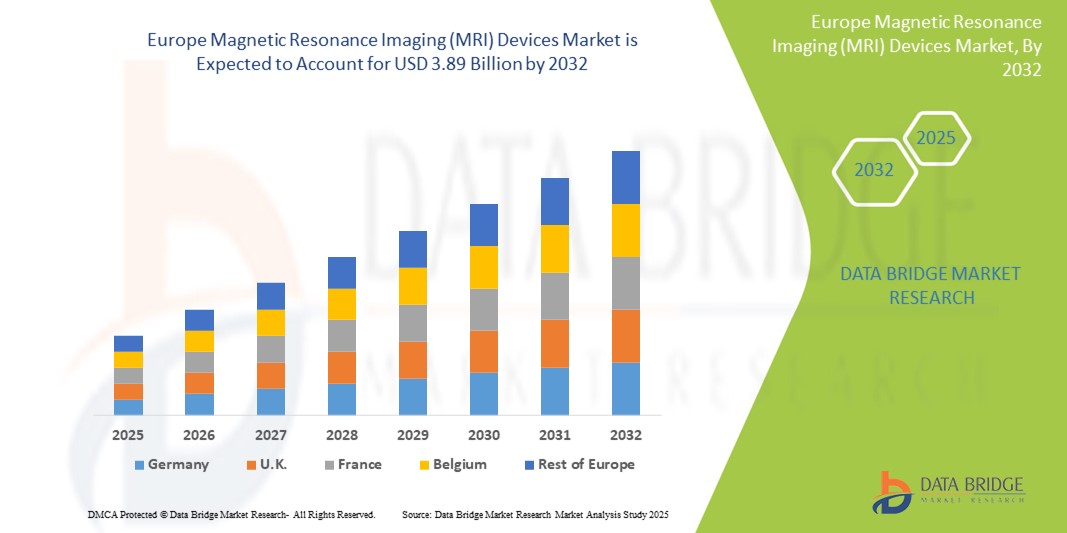
磁気共鳴画像(MRI)装置市場規模
- 欧州の磁気共鳴画像(MRI)装置市場規模は2024年に26億7000万米ドルと評価され、予測期間中に7.20%のCAGRで成長し、2032年には38億9000万米ドル に達すると予想されています 。
- 市場の成長は主に、高齢化人口の増加、慢性疾患の増加、早期診断の重要性の高まりによって促進されています。
- さらに、ハイブリッド MRI システムの導入と欧州における国民皆保険制度の導入により、人々は定期的に検査や治療を受けるようになり、業界の成長が大きく促進されています。
磁気共鳴画像(MRI)装置市場分析
- 市場の成長は主に、高齢化人口の増加、慢性疾患の増加、早期診断の重要性の高まりによって促進されています。
- さらに、ハイブリッド MRI システムの導入と欧州における国民皆保険制度の導入により、人々は定期的に検査や治療を受けるようになり、業界の成長が大きく促進されています。
- 磁気共鳴画像(MRI)装置市場では、高齢化人口の増加、慢性疾患の罹患率の上昇、早期診断の重要性の高まりにより、ドイツが2024年に54.5%という最大の収益シェアを占め、市場をリードしています。
- 磁気共鳴画像(MRI)装置市場において、従来型セグメントは2024年に59.99%の市場シェアを獲得し、市場を席巻すると予想されています。これは、婦人科、泌尿器科、歯科、心臓病学、筋骨格系、がん、骨盤・腹部など、様々な分野でMRI装置の利用が増加しているためです。また、MRIスキャンを含む診断用画像サービスは、英国などの他の欧州諸国と比較して費用対効果が高いのも特徴です。
レポートの範囲と磁気共鳴画像(MRI)装置市場のセグメンテーション
|
属性 |
磁気共鳴画像(MRI)装置の主要な市場洞察 |
|
対象セグメント |
|
|
対象国 |
ヨーロッパ
|
|
主要な市場プレーヤー |
|
|
市場機会 |
|
|
付加価値データ情報セット |
データブリッジマーケットリサーチがまとめた市場レポートには、市場価値、成長率、セグメンテーション、地理的範囲、主要プレーヤーなどの市場シナリオに関する洞察に加えて、専門家による詳細な分析、価格設定分析、ブランドシェア分析、消費者調査、人口統計分析、サプライチェーン分析、バリューチェーン分析、原材料/消耗品の概要、ベンダー選択基準、PESTLE分析、ポーター分析、規制の枠組みも含まれています。 |
磁気共鳴画像(MRI)装置市場動向
「デジタルおよびAI搭載MRIシステムの進歩」
- 欧州の磁気共鳴画像(MRI)装置市場における重要なトレンドの一つは、デジタルおよびAIを活用したMRIシステムの急速な進歩と導入です。これらのイノベーションは、画質、スキャン速度、診断精度の向上によって業界に革命をもたらしています。
- 例えば、2024年2月、富士フイルム ヘルスケア ヨーロッパは、AIを活用したディープラーニングにより画像の鮮明度とスキャン速度を向上させた、1.5テスラの新型超伝導MRIスキャナー「Echelon Synergy」を発売しました。同様に、2023年11月には、ロイヤル フィリップスが初のモバイルMRIシステム「BlueSeal MR Mobile」を発売しました。これはヘリウムフリーの運用を特徴としており、患者中心のMRIサービスを最優先に考え、アクセスしやすく、持続可能で、ヘリウムフリーのMRI検査を様々な場所で提供することを目指しています。
- The integration of AI in MRI systems facilitates automated image reconstruction, noise reduction, and intelligent workflow optimization, leading to more efficient examinations and better patient outcomes.
- Furthermore, remote scanning capabilities, as highlighted by Philips' Radiology Operations Command Center Console receiving its EU Medical Device Regulation (MDR) certificate in February 2025, are enabling expert radiologists to assist technologists on-site by remotely controlling scans, improving efficiency and access to specialized care across Europe.
Magnetic Resonance Imaging (MRI) Devices Market Dynamics
Driver
“Rising Prevalence of Chronic Diseases and Aging Population”
- The increasing prevalence of chronic diseases such as cancer, neurological disorders (e.g., dementia, Alzheimer's, Parkinson's), cardiovascular diseases, and musculoskeletal conditions, coupled with a rapidly aging population in Europe, is a major driver for the MRI devices market.
- For instance, as per Eurostats Statistics in February 2022, over one-fifth (20.8%) of European citizens were 65 years of age or older in 2021, and this proportion is projected to increase to 14.6% by 2100 for those aged 80 or older. This demographic shift significantly increases the demand for diagnostic imaging as older individuals are more susceptible to age-related health issues requiring MRI scans for accurate diagnosis and monitoring.
- MRI's ability to provide detailed soft tissue contrast makes it invaluable for the early detection and management of these complex conditions. Universal health coverage in many European countries also makes MRI scans more accessible and affordable, further encouraging their use.
- Furthermore, advancements in MRI technology, such as the introduction of hybrid systems and personalized care approaches, continue to expand its utility in diagnosing and managing a broader spectrum of chronic illnesses.
Restraint/Challenge
“High Cost of MRI Systems and Declining Helium Availability”
- The high initial acquisition and installation costs of MRI systems, coupled with ongoing maintenance expenses, pose a significant restraint on market growth, particularly for smaller healthcare facilities or those with limited budgets.
- For instance, advanced high-field MRI systems require substantial capital investment, making them less accessible in some regions or for certain healthcare providers. Moreover, the scarcity and fluctuating prices of helium, a critical cryogenic gas essential for cooling superconducting MRI magnets, present a significant challenge. This supply chain vulnerability can increase operating costs and potentially disrupt MRI services.
- While advancements in helium-free or low-helium MRI technologies are emerging to mitigate this issue, the transition can be costly and time-consuming.
- Additionally, stringent regulatory frameworks and the need for highly skilled personnel to operate and maintain MRI devices further contribute to the overall operational complexities and costs, challenging widespread adoption, especially in regions with limited healthcare resources.
Magnetic Resonance Imaging (MRI) Devices Market Scope
The market is segmented on the basis of type, field strength, architecture, modality, application, and end-user.
By Type
On the basis of type, the Europe magnetic resonance imaging (MRI) devices market is segmented into conventional and bio-based. The conventional segment is anticipated to hold the market share of 48.34% in 2025 driven by their increasing use in advanced research and specialized clinical applications, particularly in neurology and oncology.
The bio-based segment is anticipated to hold the market share of 38.45% in 2025 driven by the increasing demand for patient comfort, especially for claustrophobic, obese, geriatric, and pediatric patients.
By Field Strength
On the basis of field strength, the Europe magnetic resonance imaging (MRI) devices market is segmented into high-field magnetic resonance imaging (MRI) systems (1.5t to 3t), low-to-mid-field magnetic resonance imaging (MRI) systems (<1.5t), and very-high-field magnetic resonance imaging (MRI) systems (4t and above). The high-field MRI systems (1.5T to 3T) segment is estimated to hold a significant share due to their superior image quality and diagnostic capabilities, making them widely adopted for various clinical applications.
The very-high-field MRI systems (4T and above) segment is expected to witness substantial growth, driven by their increasing use in advanced research and specialized clinical applications, particularly in neurology and oncology.
By Architecture
On the basis of architecture, the Europe magnetic resonance imaging (MRI) devices market is segmented into closed magnetic resonance imaging (MRI), standard bore magnetic resonance imaging (MRI), wide-bore magnetic resonance imaging (MRI), and open magnetic resonance imaging (MRI). The closed MRI systems segment holds a significant share due to their widespread installation base and ability to produce high-quality images.
The open magnetic resonance imaging (MRI) segment is anticipated to grow with a high CAGR, driven by the increasing demand for patient comfort, especially for claustrophobic, obese, geriatric, and pediatric patients.
By Modality
On the basis of modality, the Europe magnetic resonance imaging (MRI) devices market is segmented into stationary system, portable/mobile system, and point-of-care (POC) system. The stationary system segment is expected to hold the largest share due to its established presence in hospitals and diagnostic centers for comprehensive imaging needs.
The portable/mobile system segment is anticipated to grow with a high CAGR, driven by the increasing need for flexible and accessible MRI services in various healthcare settings, including remote areas and emergency situations.
By Application
On the basis of application, the Europe magnetic resonance imaging (MRI) devices market is segmented into oncology, neurology, cardiology, gastroenterology, musculoskeletal, and other applications. The neurology segment is expected to dominate, owing to the rising prevalence of neurological disorders and the indispensable role of MRI in brain and spinal cord imaging.
The oncology segment is anticipated to grow with a high CAGR, driven by the increasing use of MRI for cancer detection, staging, and treatment monitoring.
By End-User
On the basis of end-user, the Europe magnetic resonance imaging (MRI) devices market is segmented into hospitals, imaging centers, ambulatory surgical centers, and other end users. The hospitals segment is expected to hold the largest market share, attributed to their extensive infrastructure, high patient volume, and the need for comprehensive diagnostic capabilities.
The imaging centers segment is anticipated to grow with a high CAGR, driven by their specialization in diagnostic services and increasing patient referrals for various imaging procedures.
Magnetic Resonance Imaging (MRI) Devices Market Regional Analysis
- Germany dominates the Magnetic Resonance Imaging (MRI) Devices market with the largest revenue share of 54.5% in 2024, due to its sophisticated healthcare system, strong emphasis on research and development activities, and a high volume of MRI procedures performed for various conditions.
- The country's extensive network of doctors and hospitals, even in remote areas, ensures widespread access to advanced medical imaging services.
France Magnetic Resonance Imaging (MRI) Devices Market Insight
The France Magnetic Resonance Imaging (MRI) Devices market is driven by significant healthcare expenditure and a focus on integrating advanced imaging technologies. The country's robust healthcare infrastructure and increasing awareness among the population regarding early disease diagnosis are key factors fueling market growth.
U.K. Magnetic Resonance Imaging (MRI) Devices Market Insight
The U.K. Magnetic Resonance Imaging (MRI) Devices market is driven by the presence of a sophisticated healthcare system, such as the National Health Services (NHS), coupled with a growing geriatric population and increasing prevalence of chronic diseases. The rising demand for early and accurate diagnosis contributes to market growth in the U.K.
Magnetic Resonance Imaging (MRI) Devices Market Share
The Magnetic Resonance Imaging (MRI) Devices industry is primarily led by well-established companies, including:
- BD (U.S.)
- bioMérieux SA (France)
- Thermo Fisher Scientific Inc. (U.S.)
- Bruker Corporation (U.S.)
- Danaher Corporation (U.S.)
- Roche Diagnostics (Switzerland)
- T2 Biosystems (U.S.)
- Luminex Corporation (U.S.)
- シーメンス・ヘルシニアーズAG(ドイツ)
- アボットラボラトリーズ(米国)
- Koninklijke Philips NV (オランダ)
- GEヘルスケア(米国)
- 富士フイルム株式会社(日本)
- キヤノンメディカルシステムズ株式会社(日本)
欧州の磁気共鳴画像(MRI)装置市場の最新動向
- 2023年11月、Koninklijke Philips NVはSyntheticMRとのパートナーシップ契約を拡大し、SyMRI 3Dの導入を目指します。これにより、同社のイメージング製品のラインナップはさらに拡大することになります。
- GEヘルスケアは2023年11月、1.5テスラのワイドボア磁気共鳴画像(MRI)システム「SIGNA Champion」を発売しました。このシステムは、高度なAIと革新的な機能を統合し、より高速で高精度なMRIスキャンを可能にすることで、患者のケア水準を向上させることを目指しています。
- 富士フイルム株式会社は、2023年8月にディープラーニングによる画像再構成技術を搭載した1.5テスラMRIシステム「ECHELON Synergy」を発売しました。この先進技術により、画質と患者満足度の向上が期待されます。
- キヤノンメディカルシステムズ株式会社は、2023年4月にMRI計画時間を短縮するAI自動MRI計画ソリューションを発表しました。このシステムは、機械学習とディープラーニングを活用し、前立腺、肝臓、脊椎全体の検査における診断画像の品質向上を実現します。
SKU-
世界初のマーケットインテリジェンスクラウドに関するレポートにオンラインでアクセスする

- インタラクティブなデータ分析ダッシュボード
- 成長の可能性が高い機会のための企業分析ダッシュボード
- カスタマイズとクエリのためのリサーチアナリストアクセス
- インタラクティブなダッシュボードによる競合分析
- 最新ニュース、更新情報、トレンド分析
- 包括的な競合追跡のためのベンチマーク分析のパワーを活用
調査方法
データ収集と基準年分析は、大規模なサンプル サイズのデータ収集モジュールを使用して行われます。この段階では、さまざまなソースと戦略を通じて市場情報または関連データを取得します。過去に取得したすべてのデータを事前に調査および計画することも含まれます。また、さまざまな情報ソース間で見られる情報の不一致の調査も含まれます。市場データは、市場統計モデルと一貫性モデルを使用して分析および推定されます。また、市場シェア分析と主要トレンド分析は、市場レポートの主要な成功要因です。詳細については、アナリストへの電話をリクエストするか、お問い合わせをドロップダウンしてください。
DBMR 調査チームが使用する主要な調査方法は、データ マイニング、データ変数が市場に与える影響の分析、および一次 (業界の専門家) 検証を含むデータ三角測量です。データ モデルには、ベンダー ポジショニング グリッド、市場タイムライン分析、市場概要とガイド、企業ポジショニング グリッド、特許分析、価格分析、企業市場シェア分析、測定基準、グローバルと地域、ベンダー シェア分析が含まれます。調査方法について詳しくは、お問い合わせフォームから当社の業界専門家にご相談ください。
カスタマイズ可能
Data Bridge Market Research は、高度な形成的調査のリーダーです。当社は、既存および新規のお客様に、お客様の目標に合致し、それに適したデータと分析を提供することに誇りを持っています。レポートは、対象ブランドの価格動向分析、追加国の市場理解 (国のリストをお問い合わせください)、臨床試験結果データ、文献レビュー、リファービッシュ市場および製品ベース分析を含めるようにカスタマイズできます。対象競合他社の市場分析は、技術ベースの分析から市場ポートフォリオ戦略まで分析できます。必要な競合他社のデータを、必要な形式とデータ スタイルでいくつでも追加できます。当社のアナリスト チームは、粗い生の Excel ファイル ピボット テーブル (ファクト ブック) でデータを提供したり、レポートで利用可能なデータ セットからプレゼンテーションを作成するお手伝いをしたりすることもできます。











