Global AI Store Manager Tool Market Size, Share, and Trends Analysis Report
Market Size in USD Billion
CAGR :
%
USD
9.09 Billion
USD
50.50 Billion
2024
2032
| 2025 –2032 | |
| USD 9.09 Billion | |
| USD 50.50 Billion | |
|
|
|
|
Global AI Store Manager Tool Market Segmentation, By Solution (AI Store Manager Software and Services), Application (Inventory Management, POS systems, Employee Scheduling, Task Management, and Others), Enterprise Size (Small Offices (1-9 employees), Small Enterprises (10-99 employees), Medium-sized Enterprise (100-499 employees), Large Enterprises (500-999 employees), and Very Large Enterprises (1,000+ employees)), End User (Supermarkets, Specialty Retail Stores, Grocery Stores, Retail Pharmacies, and Others) - Industry Trends and Forecast to 2032
What is the Global AI Store Manager Tool Market Size and Growth Rate?
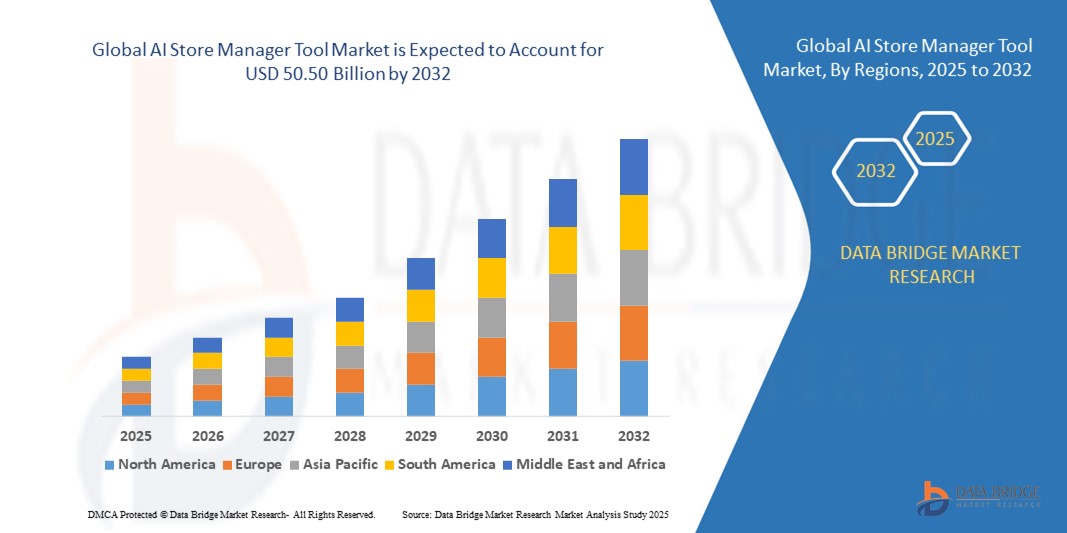
- The global AI store manager tool market size was valued at USD 9.09 billion in 2024 and is expected to reach USD 50.50 billion by 2032, at a CAGR of 23.90% during the forecast period
- The AI store manager tool revolutionizes retail operations by offering advanced applications tailored to streamline various aspects of store management. Its applications span inventory management, POS systems, employee scheduling, task management, and more, empowering retailers with efficient solutions to enhance operational efficiency, optimize resource allocation, and elevate customer experiences
- Its ability to bind the power of artificial intelligence, this tool enables predictive analytics, personalized recommendations, and real-time insights, fundamentally reshaping how retailers operate in today's dynamic market landscape. Its importance lies in its capacity to drive cost savings, improve decision-making processes, and foster innovation in retail management, ultimately positioning businesses to stay competitive and agile in an ever-evolving industry
What are the Major Takeaways of AI Store Manager Tool Market?
- The rising need for enhanced operational efficiency serves as a key driver fueling the growth of the global AI store manager tool market. As businesses strive to remain competitive in an increasingly dynamic market landscape, AI-powered solutions offer unparalleled capabilities to streamline operations, optimize resource allocation, and improve decision-making processes
- By leveraging advanced algorithms and data analytics, AI store manager tools enable retailers to automate routine tasks, predict consumer preferences, and optimize inventory management, ultimately leading to increased productivity and cost savings. Consequently, the demand for AI store manager tools is projected to surge as organizations prioritize efficiency gains, driving significant market expansion
- North America dominated the AI store manager tool market with the largest revenue share of 39.08% in 2024, driven by the growing adoption of AI-driven retail management solutions and digital store automation
- Asia-Pacific AI store manager tool market is poised to grow at the fastest CAGR of 8.2% from 2025 to 2032, driven by rapid urbanization, increasing retail modernization, and technological adoption in countries such as China, Japan, and India
- The AI Store Manager Software segment dominated the market with a largest revenue share of 52.4% in 2024, driven by its ability to provide real-time insights, predictive analytics, and centralized control over store operations
Report Scope and AI Store Manager Tool Market Segmentation
|
Attributes |
AI Store Manager Tool Key Market Insights |
|
Segments Covered |
|
|
Countries Covered |
North America
Europe
Asia-Pacific
Middle East and Africa
South America
|
|
Key Market Players |
|
|
Market Opportunities |
|
|
Value Added Data Infosets |
In addition to the insights on market scenarios such as market value, growth rate, segmentation, geographical coverage, and major players, the market reports curated by the Data Bridge Market Research also include in-depth expert analysis, pricing analysis, brand share analysis, consumer survey, demography analysis, supply chain analysis, value chain analysis, raw material/consumables overview, vendor selection criteria, PESTLE Analysis, Porter Analysis, and regulatory framework. |
What is the Key Trend in the AI Store Manager Tool Market?
Enhanced Convenience Through AI and Automation
- A major trend in the global AI store manager tool market is the increasing adoption of artificial intelligence (AI) for automating store operations, inventory management, and customer engagement, enhancing overall retail efficiency
- For instance, RetailAI Solutions leverages AI to optimize stock levels, forecast demand, and provide actionable insights for store managers, while OmniRetail AI integrates AI-powered dashboards for real-time sales analytics
- AI-driven tools enable predictive analytics, personalized promotions, and intelligent task prioritization, allowing managers to make informed decisions quickly and reduce operational inefficiencies
- Integration with cloud platforms and mobile applications allows centralized control over multiple stores, facilitating streamlined communication, task management, and reporting across retail chains
- Companies such as ShopMind AI are developing AI Store Manager Tools that offer automated workforce scheduling, dynamic pricing recommendations, and customer behavior tracking, reflecting the trend towards data-driven retail management
- The demand for AI-powered store management tools is rising across both small and large retailers as businesses prioritize operational efficiency, customer experience, and real-time analytics
What are the Key Drivers of AI Store Manager Tool Market?
- The growing need for operational efficiency and cost optimization in retail is a key driver of AI store manager tool adoption
- In March 2024, StoreGenie Technologies launched an AI-driven solution for real-time inventory tracking and automated replenishment, helping retailers reduce stockouts and overstocks
- Retailers increasingly rely on AI tools to analyze consumer behavior, optimize product placement, and enhance in-store and online customer experiences
- The rising adoption of omnichannel retailing and digital transformation strategies is boosting demand for AI-powered store management platforms that integrate sales, inventory, and workforce management
- Features such as predictive analytics, automated reporting, and actionable insights improve decision-making and store performance, making AI Store Manager Tools essential for modern retail operations
Which Factor is Challenging the Growth of the AI Store Manager Tool Market?
- The complexity of AI implementation and integration with existing retail systems poses a challenge, particularly for small and medium-sized retailers
- High initial costs for deploying AI platforms and training staff can limit adoption, especially in developing markets
- Data privacy concerns related to customer behavior tracking and analytics may create resistance from both consumers and regulatory authorities
- Vendor dependency and lack of standardization in AI Store Manager Tools can lead to compatibility issues and slow adoption across multi-brand retail chains
- Overcoming these challenges requires cost-effective, user-friendly solutions, strong cybersecurity measures, and clear ROI demonstration to encourage widespread adoption in the retail sector
How is the AI Store Manager Tool Market Segmented?
The market is segmented on the basis of solution, application, enterprise size, and end user.
- By Solution
On the basis of solution, the AI store manager tool market is segmented into AI Store Manager Software and Services. The AI Store Manager Software segment dominated the market with a largest revenue share of 52.4% in 2024, driven by its ability to provide real-time insights, predictive analytics, and centralized control over store operations. Retailers increasingly rely on AI-powered dashboards to optimize inventory, manage sales data, and streamline workforce management.
The Services segment is expected to witness the fastest CAGR of 23.1% from 2025 to 2032, fueled by growing demand for professional implementation, consulting, and maintenance support. Service providers offer deployment assistance, customization, and training, enabling retailers to leverage AI tools effectively. The combination of software and services allows for a comprehensive store management solution, making AI adoption accessible for both small and large retailers seeking operational efficiency and data-driven decision-making.
- By Application
On the basis of application, the AI store manager tool market is segmented into inventory management, POS systems, employee scheduling, task management, and others. The inventory management segment dominated the market with 48.7% revenue share in 2024, due to retailers’ need to optimize stock levels, reduce waste, and improve order fulfillment efficiency. AI-powered inventory management tools provide predictive insights and real-time tracking, ensuring optimal product availability and cost control.
The employee scheduling segment is expected to witness the fastest CAGR of 21.9% from 2025 to 2032, driven by retailers’ need to automate shift planning, optimize workforce allocation, and reduce labor costs. AI solutions in employee scheduling help streamline operations, improve staff productivity, and adapt quickly to changing customer traffic patterns, particularly in dynamic retail environments.
- By Enterprise Size
On the basis of enterprise size, the AI store manager tool market is segmented into small offices (1–9 employees), small enterprises (10–99 employees), medium-sized enterprises (100–499 employees), large enterprises (500–999 employees), and very large enterprises (1,000+ employees). The medium-sized enterprise segment dominated the market with a 45.3% revenue share in 2024, benefiting from sufficient resources to invest in AI tools while requiring scalable solutions to manage multiple stores or departments.
The large enterprise segment is projected to witness the fastest CAGR of 22.4% from 2025 to 2032, as large-scale retail chains increasingly adopt AI tools for centralized operations, real-time reporting, and workforce optimization across multiple locations. AI Store Manager Tools help enterprises improve operational efficiency, reduce human error, and maintain consistent customer experiences across all outlets.
- By End User
On the basis of end user, the AI store manager tool market is segmented into supermarkets, specialty retail stores, grocery stores, retail pharmacies, and others. The supermarket segment dominated the market with 42.8% revenue share in 2024, driven by high inventory turnover, complex product assortments, and the need for efficient store operations. AI tools provide supermarkets with predictive analytics, real-time inventory monitoring, and enhanced customer engagement.
The specialty retail stores segment is expected to witness the fastest CAGR of 23.5% from 2025 to 2032, fueled by the growing adoption of AI tools to personalize customer experiences, manage niche inventory, and optimize staff scheduling. AI solutions enable specialty retailers to enhance operational efficiency while catering to unique consumer preferences.
Which Region Holds the Largest Share of the AI Store Manager Tool Market?
- North America dominated the AI store manager tool market with the largest revenue share of 39.08% in 2024, driven by the growing adoption of AI-driven retail management solutions and digital store automation
- Retailers in the region highly value the convenience, operational efficiency, and real-time analytics offered by AI store manager tools, which help optimize inventory, workforce, and sales performance
- Widespread adoption is further supported by technologically advanced retail infrastructure, high digital literacy, and strong investments in AI-enabled solutions, establishing AI store manager tools as a preferred choice across supermarkets, specialty stores, and large retail chains
U.S. AI Store Manager Tool Market Insight
U.S. AI store manager tool market captured the largest revenue share of 81% in 2024 within North America, fueled by rapid digital transformation in retail operations and the adoption of AI for inventory optimization, task automation, and customer engagement. Retailers increasingly rely on predictive analytics, automated scheduling, and sales forecasting. The growing preference for cloud-based and mobile-accessible AI store manager tools further propels market growth. Moreover, the expansion of omnichannel retail strategies and advanced e-commerce infrastructure continues to drive adoption across both small and large retail enterprises.
Europe AI Store Manager Tool Market Insight
Europe AI store manager tool market is projected to expand at a substantial CAGR during the forecast period, supported by the need for efficient store operations, regulatory compliance, and enhanced data-driven decision-making. Increasing urbanization, rising adoption of retail analytics, and the shift toward digital retail solutions are boosting market demand. AI store manager tools are being implemented across new retail outlets and renovation projects, offering inventory management, POS integration, and workforce optimization, driving growth across residential and commercial retail spaces.
U.K. AI Store Manager Tool Market Insight
U.K. AI store manager tool market is expected to grow at a noteworthy CAGR, driven by the trend of smart retail solutions, digitalization of store management, and the need for operational efficiency. Retailers are adopting AI solutions for inventory control, employee scheduling, and sales analytics. The U.K.’s robust retail infrastructure, technological adoption, and demand for advanced, automated store management tools are key growth drivers.
Germany AI Store Manager Tool Market Insight
Germany AI store manager tool market is anticipated to expand at a considerable CAGR, fueled by technological innovation, awareness of AI-enabled retail solutions, and the emphasis on efficiency in retail operations. Germany’s well-developed retail infrastructure and focus on digital transformation are promoting the adoption of AI store manager tools, particularly in supermarkets, specialty stores, and large commercial chains. AI integration with existing POS and inventory systems is increasingly prevalent, supporting data-driven decision-making.
Which Region is the Fastest Growing in the AI Store Manager Tool Market?
Asia-Pacific AI store manager tool market is poised to grow at the fastest CAGR of 8.2% from 2025 to 2032, driven by rapid urbanization, increasing retail modernization, and technological adoption in countries such as China, Japan, and India. The rise of smart retail concepts, supported by government digitalization initiatives, is encouraging adoption. APAC’s position as a manufacturing and technology hub for AI solutions ensures affordability and accessibility, expanding the market across various retail sectors.
Japan AI Store Manager Tool Market Insight
Japan AI store manager tool market is gaining traction due to advanced retail technologies, high-tech consumer culture, and the need for streamlined store operations. Retailers are increasingly deploying AI tools for inventory tracking, sales optimization, and employee scheduling. The integration of AI store manager tools with IoT systems enhances operational efficiency and supports multi-store management, driving market growth.
China AI Store Manager Tool Market Insight
China AI store manager tool market accounted for the largest revenue share in Asia-Pacific in 2024, driven by the expanding retail sector, urbanization, and adoption of digital retail technologies. AI tools are widely used for inventory management, POS integration, and predictive sales analytics. Government initiatives promoting smart retail and the presence of strong domestic solution providers further accelerate market growth, making China a key hub for AI store manager tool adoption.
Which are the Top Companies in AI Store Manager Tool Market?
The AI store manager tool industry is primarily led by well-established companies, including:
- RetailAI Solutions (U.S.)
- StoreGenie Technologies (Canada)
- ShopMind AI (U.S.)
- OmniRetail AI (U.K.)
- StoreIQ Solutions (Australia)
- IntelliStore Solutions (Germany)
- AI Retail Manager (France)
- StoreSense AI (Singapore)
- SmartStore Solutions (Netherlands)
- AI-StoreTech (Japan)
What are the Recent Developments in Global AI Store Manager Tool Market?
- In January 2024, Microsoft introduced new AI capabilities for retailers, enabling the integration of generative AI throughout the shopper journey, enhancing store associate support, improving retail media campaigns, and overall transforming the shopping experience in a data-driven manner
- In January 2024, Lenovo presented AI-powered retail solutions at NRF, highlighting AI’s role in predicting shopper demands and improving user experiences, offering retailers a complete end-to-end transformation, thereby driving operational efficiency and customer satisfaction
- In October 2023, Domino’s Pizza partnered with Microsoft to deploy AI technology for store managers, using Microsoft Cloud and Azure OpenAI Service to streamline operations and enhance the customer experience, marking a significant step toward AI-enabled retail management
- In January 2023, Google Cloud launched four new and updated AI tools designed to enhance the online shopping experience for customers and support retailers in optimizing operations, providing smoother navigation and personalized recommendations, thereby improving efficiency and shopper satisfaction
- In September 2022, SymphonyAI, in collaboration with Microsoft, rolled out retail AI software applications using Microsoft Azure OpenAI service, including Category Manager and Demand Planner Copilot systems, to help retailers and CPGs make faster and more accurate data-driven decisions, promoting smarter operational strategies
SKU-
世界初のマーケットインテリジェンスクラウドに関するレポートにオンラインでアクセスする

- インタラクティブなデータ分析ダッシュボード
- 成長の可能性が高い機会のための企業分析ダッシュボード
- カスタマイズとクエリのためのリサーチアナリストアクセス
- インタラクティブなダッシュボードによる競合分析
- 最新ニュース、更新情報、トレンド分析
- 包括的な競合追跡のためのベンチマーク分析のパワーを活用
調査方法
データ収集と基準年分析は、大規模なサンプル サイズのデータ収集モジュールを使用して行われます。この段階では、さまざまなソースと戦略を通じて市場情報または関連データを取得します。過去に取得したすべてのデータを事前に調査および計画することも含まれます。また、さまざまな情報ソース間で見られる情報の不一致の調査も含まれます。市場データは、市場統計モデルと一貫性モデルを使用して分析および推定されます。また、市場シェア分析と主要トレンド分析は、市場レポートの主要な成功要因です。詳細については、アナリストへの電話をリクエストするか、お問い合わせをドロップダウンしてください。
DBMR 調査チームが使用する主要な調査方法は、データ マイニング、データ変数が市場に与える影響の分析、および一次 (業界の専門家) 検証を含むデータ三角測量です。データ モデルには、ベンダー ポジショニング グリッド、市場タイムライン分析、市場概要とガイド、企業ポジショニング グリッド、特許分析、価格分析、企業市場シェア分析、測定基準、グローバルと地域、ベンダー シェア分析が含まれます。調査方法について詳しくは、お問い合わせフォームから当社の業界専門家にご相談ください。
カスタマイズ可能
Data Bridge Market Research は、高度な形成的調査のリーダーです。当社は、既存および新規のお客様に、お客様の目標に合致し、それに適したデータと分析を提供することに誇りを持っています。レポートは、対象ブランドの価格動向分析、追加国の市場理解 (国のリストをお問い合わせください)、臨床試験結果データ、文献レビュー、リファービッシュ市場および製品ベース分析を含めるようにカスタマイズできます。対象競合他社の市場分析は、技術ベースの分析から市場ポートフォリオ戦略まで分析できます。必要な競合他社のデータを、必要な形式とデータ スタイルでいくつでも追加できます。当社のアナリスト チームは、粗い生の Excel ファイル ピボット テーブル (ファクト ブック) でデータを提供したり、レポートで利用可能なデータ セットからプレゼンテーションを作成するお手伝いをしたりすることもできます。