



Global Biometric as a Service in Healthcare Market Segmentation, By Modality (Unimodal and Multimodal), Component (Software and Services), Recognition Type (Fingerprint Recognition, Iris Recognition, Palm Recognition, Facial Recognition, Voice Recognition, and Others), Application (Pharmacy Dispensing, Care Provider Authentication, Medical Record Security and Data Centre Security, Patient Identification and Tracking, Home/Remote Patient Access, Narcotic Security, Counter Insurance Frauds, and Others), End-User (Hospitals & Clinics, Long Term Care Centers and Home Care Settings, Ambulatory Surgical Centers, and Others)- Industry Trends and Forecast to 2032
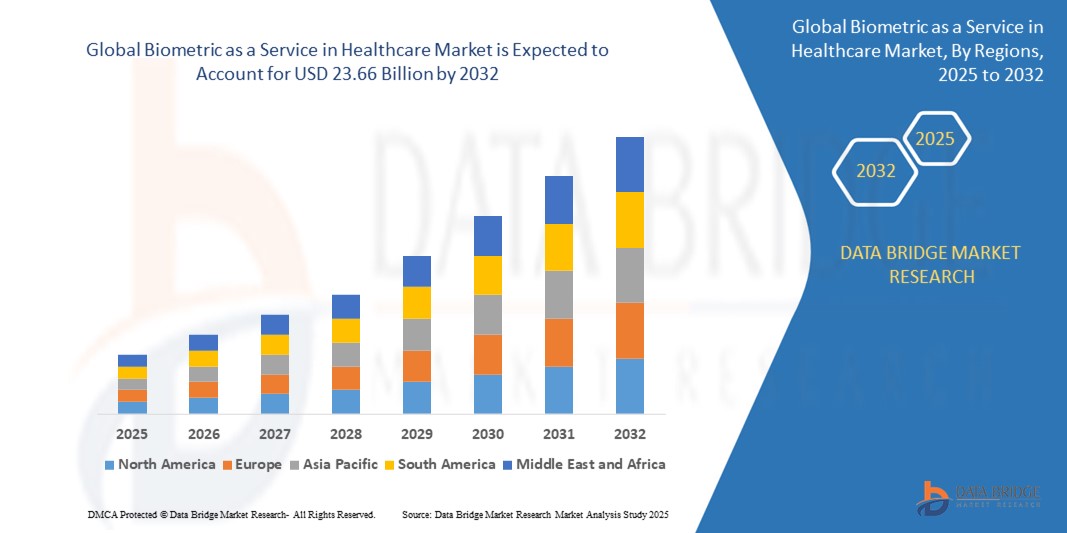
Biometric as a Service in Healthcare Market Size
- The global biometric as a service in healthcare market size was valued at USD 4.41 billion in 2024 and is expected to reach USD 23.66 billion by 2032, at a CAGR of 23.35% during the forecast period
- The market growth is largely fueled by increasing use of biometric technologies to ensure secure and accurate patient identification in healthcare settings
- Healthcare providers are increasingly adopting biometric technologies such as fingerprint and facial recognition to ensure accurate patient identification. This helps reduce errors and safeguard sensitive medical data against unauthorized access
- The rising incidence of medical identity fraud has heightened the need for secure authentication methods. In addition, healthcare organizations must comply with strict data privacy regulations such as hipaa, further driving biometric adoption
Biometric as a Service in Healthcare Market Analysis
- The biometric as a service in healthcare market is rapidly evolving as healthcare providers increasingly adopt biometric systems to enhance patient identification accuracy and streamline access to medical records
- Multimodal biometric systems, which combine multiple biometric traits such as fingerprint and facial recognition, are gaining traction for their improved security and reliability in healthcare environments
- North America dominates the biometric as a service in healthcare market with the largest revenue share of 48.12% in 2024, driven by a by a strong emphasis on digital health infrastructure and early adoption of advanced patient identification technologies that enhance accuracy, streamline workflows, and ensure compliance with healthcare data regulations
- Asia-pacific is expected to be the fastest growing region in the biometric as a service in healthcare market during the forecast period due to increasing urbanization and rising disposable incomes
- 指紋認識セグメントは、信頼性、使いやすさ、費用対効果、医療施設内の患者識別やアクセス制御を含むさまざまなセキュリティアプリケーションでの確立された実績により、49.09%の最大の収益シェアで市場を支配すると予測されています。
レポートの範囲とヘルスケア市場におけるサービスとしての生体認証のセグメンテーション
|
属性 |
ヘルスケアにおけるバイオメトリクス・アズ・ア・サービスの主な市場洞察 |
|
対象セグメント |
|
|
対象国 |
北米
ヨーロッパ
アジア太平洋
中東およびアフリカ
南アメリカ
|
|
主要な市場プレーヤー |
|
|
市場機会 |
|
|
付加価値データ情報セット |
データブリッジ市場調査チームがまとめた市場レポートには、市場価値、成長率、市場セグメント、地理的範囲、市場プレーヤー、市場シナリオなどの市場洞察に加えて、専門家による詳細な分析、輸入/輸出分析、価格分析、生産消費分析、乳棒分析が含まれています。 |
ヘルスケア市場におけるバイオメトリクス・アズ・ア・サービス(BaaS)のトレンド
「AIの統合により医療における生体認証の精度が向上」
- 現在のヘルスケア市場では、患者の識別に使用される生体認証システムの性能を向上させるために、人工知能が着実に導入されている。
- AIを活用した生体認証ツールは、特に病院や診療所などのペースの速い環境において、より迅速かつ正確な認証を可能にしています。
- これらのスマートシステムは、新しいデータ入力から学習できるようになり、時間の経過とともにさまざまなユーザーの行動や物理的な変化に適応できるようになりました。
- 医療提供者は、異なる部門間での重複を減らし、IDの精度を向上させるために、AI主導のマルチモーダル生体認証にますます依存するようになっている。
- AIの統合により、生体認証入力とアクセス行動パターンの不一致を特定することで不正検出も強化されます。
- 例えば、2024年にヘルスケアテクノロジー企業がAIを統合した顔と音声認識ソリューションを立ち上げ、患者のチェックインを効率化し、手動認証手順を排除しました。
- 生体認証サービスにおける人工知能の利用拡大は、ユーザーの利便性を損なうことなく、本人確認の自動化、業務効率の向上、セキュリティ基準の向上を実現することで、医療サービスの提供を変革しています。
ヘルスケア市場のダイナミクスにおけるサービスとしての生体認証
ドライバ
「医療における安全な患者識別への注目の高まり」
- 医療システムでは、患者の識別精度を高め、エラーを減らすために、指紋、顔、虹彩認証などの生体認証技術を採用するケースが増えています。
- IDカードやパスワードなどの従来の身分証明方法は、誤認や不正アクセスの危険性が高いため、置き換えられつつある。
- 2025年初頭、大手病院ネットワークは、患者のチェックインを効率化し、手作業によるID確認への依存を排除するために手のひら認識技術を導入しました。
- 別の医療機関は最近、本人確認を改善し、重複した医療記録を最小限に抑えるために顔認識システムを導入した。
- 結論として、生体認証システムは、迅速、安全、正確な識別を可能にすることで、患者の安全性とケアの質を向上させるために不可欠であることが証明されている。
抑制/挑戦
「初期コストが高く、インフラが複雑」
- ヘルスケアにおける生体認証サービスの導入は、ハードウェア、ソフトウェア、安全なシステム統合のための初期投資要件が高いために遅れることが多い。
- 小規模な診療所や資金不足の医療施設は、限られた予算と拡張可能なデジタルインフラの欠如により課題に直面しています。
- 従来の電子医療記録システムとの互換性の問題により、統合の複雑さとコストが増加し、広範な導入が遅れています。
- 2024年には、いくつかの地域の病院が、ITサポートの不足と訓練を受けた人員の不足により、生体認証の導入計画が遅れていると報告した。
- 結論として、長期的な価値にもかかわらず、生体認証システムは初期費用とインフラの要求のために広く導入することが依然として困難である。
ヘルスケア市場におけるバイオメトリクス・アズ・ア・サービスの範囲
市場は、モダリティ、コンポーネント、認識タイプ、アプリケーション、エンドユーザーに基づいてセグメント化されています。
モダリティ別
On the basis of modality, the biometric as a service in healthcare market is segmented into unimodal and multimodal. The unimodal segment is anticipated to hold the largest market revenue share. This dominance stems from its simplicity and lower initial deployment costs, making it a more accessible entry point for healthcare providers adopting biometric solutions. Fingerprint recognition, for instance, is a widely understood and cost-effective unimodal biometric, leading to its prevalent use in various healthcare settings.
The multimodal segment is expected to witness the fastest CAGR. This growth is driven by the enhanced security and accuracy offered by combining multiple biometric modalities, such as fingerprint and iris recognition. Healthcare facilities are increasingly seeking robust authentication methods to protect sensitive patient data and ensure higher levels of access control, making multimodal solutions more appealing despite their higher complexity and cost.
By Component
On the basis of component, the biometric as a service in healthcare market is segmented into software and services. The services segment is expected to hold the largest market revenue share. This is attributed to the increasing demand for specialized expertise in implementing, managing, and maintaining complex biometric systems. Healthcare organizations often lack the in-house capabilities for such specialized tasks, leading them to rely on third-party service providers for deployment, integration, and ongoing support.
The software segment is anticipated to witness the fastest CAGR. This growth is fueled by continuous advancements in biometric software, including improved algorithms for faster and more accurate recognition, enhanced integration capabilities with existing healthcare it infrastructure, and the development of more user-friendly interfaces. The shift towards cloud-based biometric solutions also drives the demand for scalable and flexible software offerings.
By Recognition Type
On the basis of recognition type, the biometric as a service in healthcare market is segmented into fingerprint recognition, iris recognition, palm recognition, facial recognition, voice recognition, and others. The fingerprint recognition segment is projected to dominate the market with the largest revenue share of 49.09% is due to its reliability, ease of use, cost-effectiveness, and established track record in various security applications, including patient identification and access control within healthcare facilities.
The facial recognition segment is expected to witness the fastest CAGR. This growth is driven by advancements in facial recognition technology, its contactless nature, and its increasing integration with mobile devices and cameras. In healthcare, it offers convenient and hygienic authentication methods for patient check-ins, staff access, and remote patient monitoring, making it a rapidly adopted solution.
By Application
On the basis of application, the biometric as a service in healthcare market is segmented into pharmacy dispensing, care provider authentication, medical record security and data centre security, patient identification and tracking, home/remote patient access, narcotic security, counter insurance frauds, and others. The medical record security and data centre security segment is anticipated to hold the largest market revenue share. This is primarily driven by the critical need to protect highly sensitive patient data and comply with stringent regulatory requirements such as hipaa, making robust biometric security solutions indispensable for data integrity and confidentiality.
The patient identification and tracking segment is expected to witness the fastest CAGR. This growth is fueled by the imperative to enhance patient safety, reduce medical errors, and streamline administrative processes in healthcare settings. Biometric solutions offer accurate and efficient identification, improving patient care coordination and minimizing risks associated with misidentification, especially in large hospitals and emergency care.
By End-User
On the basis of end-user, the biometric as a service in healthcare market is segmented into hospitals & clinics, long term care centers and home care settings, ambulatory surgical centers, and others. The hospitals & clinics segment is expected to account for the largest market revenue share. This is due to the large volume of patients, staff, and sensitive data managed by these institutions, necessitating comprehensive biometric solutions for secure access, patient identification, and data protection across various departments.
The long term care centers and home care settings segment is anticipated to witness the fastest CAGR. This growth is driven by the increasing demand for remote patient monitoring, secure access for caregivers, and efficient management of patient records in distributed care environments. Biometric solutions offer enhanced security and convenience for both patients and healthcare providers in these evolving care models.
Biometric as a Service in Healthcare Market Regional Analysis
- North America dominates the Biometric as a Service in Healthcare market with the largest revenue share of 48.12% in 2024, driven by a by a strong emphasis on digital health infrastructure and early adoption of advanced patient identification technologies that enhance accuracy, streamline workflows, and ensure compliance with healthcare data regulations
- Hospitals and healthcare systems across the U.S. and Canada are increasingly implementing biometric technologies such as facial, iris, and palm recognition to reduce cases of patient misidentification, eliminate duplicate medical records, and improve the accuracy of treatment decisions
- Technology partnerships between major healthcare providers and software vendors are fostering the development of cloud-based biometric platforms, enabling seamless integration with electronic health records and enhancing operational efficiency without major disruptions to existing IT frameworks
U.S. Biometric as a Service in Healthcare Market Insight
The U.S. Biometric as a service in healthcare market captured a significant revenue share in 2024 across north America, fueled by the growing need for advanced patient identification and data protection. With increasing implementation of electronic health records and telehealth platforms, healthcare providers are integrating biometric systems to enhance security and streamline operations. The U.S. Market is further bolstered by regulatory frameworks such as hipaa, which mandate strict data privacy compliance, and by the rapid adoption of cloud-based it solutions across hospitals and clinics.
Europe Biometric as a Service in Healthcare Market Insigh
The Europe biometric as a service in healthcare market is poised for stable growth during the forecast period, driven by stringent data protection regulations such as GDPR and an increasing emphasis on healthcare digitalization. The demand for secure authentication methods in hospitals and public health systems is promoting the adoption of biometric-as-a-service models. European countries are also witnessing a rise in telemedicine, necessitating reliable identity verification for remote patient access and virtual consultations, which enhances the market potential.
U.K. Biometric as a Service in Healthcare Market Insight
The U.K. Biometric as a service in healthcare market is expected to grow at a healthy CAGR, supported by the national health service’s (NHS) ongoing digital transformation efforts. With a focus on improving patient safety, reducing medical errors, and curbing identity fraud, biometric authentication is gaining traction across public and private healthcare sectors. In addition, the integration of ai-powered biometric tools is enhancing operational efficiency and regulatory compliance, making the U.K. A prominent market for healthcare biometrics.
Germany Biometric as a Service in Healthcare Market Insight
Germany’s biometric as a service in healthcare market is witnessing steady growth, driven by a strong emphasis on data security and a tech-savvy healthcare infrastructure. Germany's digital health strategy, known as "health innovation hub," promotes the use of secure, innovative technologies, encouraging widespread deployment of biometric solutions. The demand for GDPR-compliant biometric services and Germany's leadership in medical technology adoption make it a strategic market for service providers focusing on healthcare digitalization.
Asia-Pacific Biometric as a Service in Healthcare Market Insight
アジア太平洋地域のヘルスケアにおける生体認証サービス市場は、医療インフラの拡大、デジタルヘルスへの投資の増加、クラウドベースプラットフォームの導入拡大により、2025年から2032年にかけて最も高いCAGRで成長すると予測されています。中国、インド、日本などの国々は、政府主導の医療サービスデジタル化の取り組みにより、この成長を牽引しています。また、この地域の人口規模と高齢化は、正確な患者識別のニーズを高めており、特にリソースが限られた環境において、生体認証ソリューションはこうしたニーズに応えるのに最適です。
ヘルスケア市場におけるバイオメトリクス・アズ・ア・サービスに関する日本の市場洞察
日本のヘルスケア市場におけるバイオメトリクス・アズ・ア・サービス(BaaS)は、高齢化とテクノロジー先進の医療環境を背景に、急速に成長を続けています。政府の医療ITへの重点的な取り組みと、病院におけるAIと生体認証システムの統合が、その導入を後押ししています。生体認証ソリューションは、正確な患者識別と個別化されたケアの提供を支援するために導入されています。さらに、ロボット工学と自動化における日本の主導的な役割は、臨床ワークフローへの生体認証技術の統合を補完するものです。
中国のヘルスケア市場におけるバイオメトリクス・アズ・ア・サービスに関する洞察
中国のヘルスケア分野における生体認証サービス市場は、ヘルステック系スタートアップ企業の急増、スマート病院への政府投資、モバイルヘルスアプリの普及に後押しされ、2024年にはアジア太平洋地域で最大のシェアを占めました。顔認証と指紋認証のヘルスケアシステムへの統合は、特に都市部において標準的な手法になりつつあります。中国国内の強力な技術力と政府主導のデジタルヘルス改革は、ヘルスケア分野における生体認証サービス市場の成長をさらに促進すると期待されます。
ヘルスケア市場におけるバイオメトリクス・アズ・ア・サービス(BaaS)のシェア
ヘルスケア業界におけるバイオメトリクス・アズ・ア・サービスは、主に次のような定評ある企業によって主導されています。
- タレスグループ(フランス)
- Agnitio A/S(デンマーク)
- BioAXS株式会社(韓国)
- Cenmetrix (Pvt) Ltd.(スリランカ)
- 富士通(日本)
- HIDグローバルコーポレーション(米国)
- 日立製作所(日本)
- 統合生体認証(米国)
- Innovatrics(スロバキア)
- IRITECH社(米国)
- レーザーロックインターナショナル社(米国)
- M2SYSテクノロジー(米国)
- IDEMIA(フランス)
- ニュアンス・コミュニケーションズ社(米国)
- クアルコム・テクノロジーズ(米国)
- セキュジェン・コーポレーション(米国)
- ユニフォア(インド)
- ルーメンボックス(米国)
- Verint VoiceVault 音声認証(米国)
ヘルスケア市場におけるグローバルな生体認証サービス(BaaS)の最新動向
- 2024年2月、VerifiNowは、遠隔医療提供者向けにカスタマイズされた最先端の患者本人確認ソリューション「PatientVerifi」を発表しました。この技術は、高度な生体認証チェックポイントを活用し、正確な患者認証を保証し、処方箋の誤用や保険金詐欺のリスクを最小限に抑え、医療規制の遵守を強化します。
- 2024年2月、Imprivataは医療機関向けに特別に設計された革新的な顔認識ソリューション「Imprivata Biometric Patient Identity」を発表しました。この新技術は、厳格なプライバシー要件を遵守しながら、正確かつ効率的な患者認証を提供することで、患者の誤認という重大な問題に対処します。
- 2024年3月、HIDとImprivataは、医療分野向けにカスタマイズされた生体認証キオスクの新プラットフォームを発表しました。これは、患者の本人確認を効率化し、医療データへの安全なアクセスを実現することを目的としています。HIDは、Certify HealthおよびCTSと共同で、顔認証機能を搭載したセルフサービス型の患者エンゲージメントキオスクを発売しました。これらのキオスクは、本人確認プロセスを自動化することで、患者のチェックインを効率化し、医療業務の安全性を確保することを目指しています。
SKU-
世界初のマーケットインテリジェンスクラウドに関するレポートにオンラインでアクセスする

- インタラクティブなデータ分析ダッシュボード
- 成長の可能性が高い機会のための企業分析ダッシュボード
- カスタマイズとクエリのためのリサーチアナリストアクセス
- インタラクティブなダッシュボードによる競合分析
- 最新ニュース、更新情報、トレンド分析
- 包括的な競合追跡のためのベンチマーク分析のパワーを活用
調査方法
データ収集と基準年分析は、大規模なサンプル サイズのデータ収集モジュールを使用して行われます。この段階では、さまざまなソースと戦略を通じて市場情報または関連データを取得します。過去に取得したすべてのデータを事前に調査および計画することも含まれます。また、さまざまな情報ソース間で見られる情報の不一致の調査も含まれます。市場データは、市場統計モデルと一貫性モデルを使用して分析および推定されます。また、市場シェア分析と主要トレンド分析は、市場レポートの主要な成功要因です。詳細については、アナリストへの電話をリクエストするか、お問い合わせをドロップダウンしてください。
DBMR 調査チームが使用する主要な調査方法は、データ マイニング、データ変数が市場に与える影響の分析、および一次 (業界の専門家) 検証を含むデータ三角測量です。データ モデルには、ベンダー ポジショニング グリッド、市場タイムライン分析、市場概要とガイド、企業ポジショニング グリッド、特許分析、価格分析、企業市場シェア分析、測定基準、グローバルと地域、ベンダー シェア分析が含まれます。調査方法について詳しくは、お問い合わせフォームから当社の業界専門家にご相談ください。
カスタマイズ可能
Data Bridge Market Research は、高度な形成的調査のリーダーです。当社は、既存および新規のお客様に、お客様の目標に合致し、それに適したデータと分析を提供することに誇りを持っています。レポートは、対象ブランドの価格動向分析、追加国の市場理解 (国のリストをお問い合わせください)、臨床試験結果データ、文献レビュー、リファービッシュ市場および製品ベース分析を含めるようにカスタマイズできます。対象競合他社の市場分析は、技術ベースの分析から市場ポートフォリオ戦略まで分析できます。必要な競合他社のデータを、必要な形式とデータ スタイルでいくつでも追加できます。当社のアナリスト チームは、粗い生の Excel ファイル ピボット テーブル (ファクト ブック) でデータを提供したり、レポートで利用可能なデータ セットからプレゼンテーションを作成するお手伝いをしたりすることもできます。











