


世界の Bluetooth Low Energy 市場のセグメンテーション、ネットワーク トポロジ タイプ (中央デバイス、周辺機器、デバイス)、最終用途タイプ (製造、自動車、通信、家電製品、その他)、製品タイプ (モジュールとチップセット)、モード (シングル モードとデュアル モード) – 2032 年までの業界動向と予測
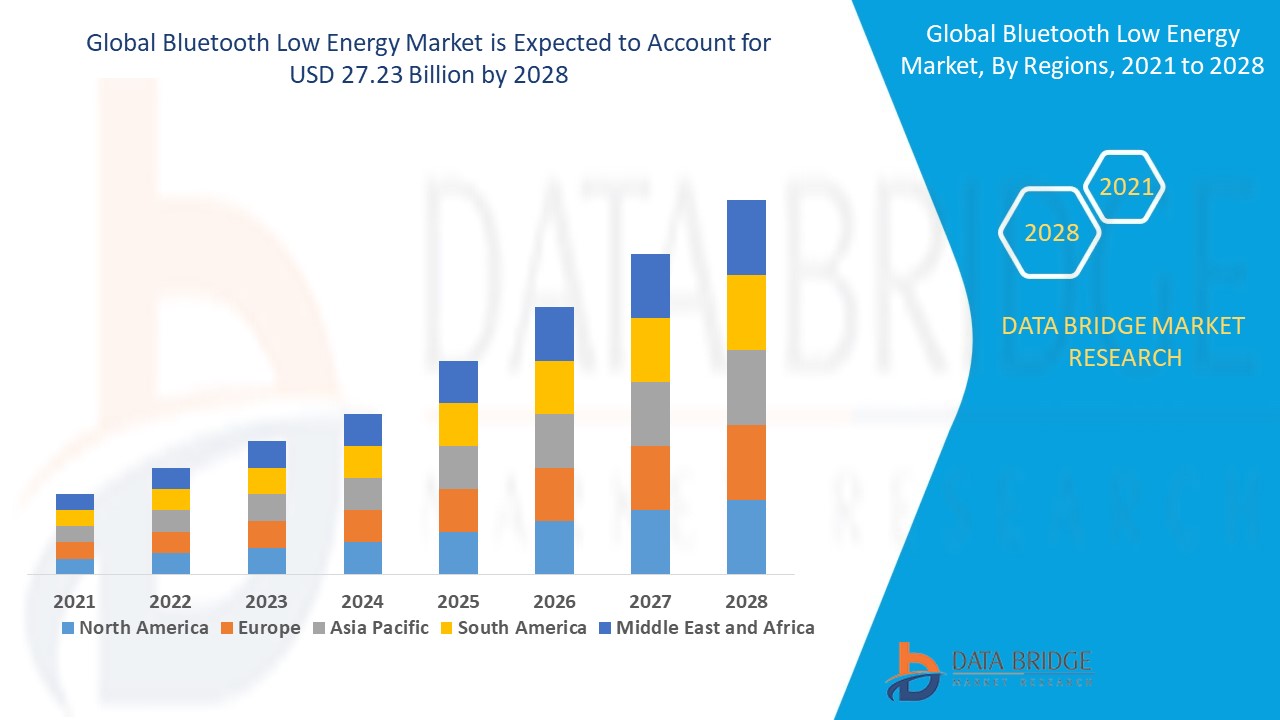
Bluetooth 低エネルギー市場分析
Bluetooth Low Energy 市場は、エネルギー効率の高い通信機能により大幅な成長を遂げており、医療、自動車、民生用電子機器、産業オートメーションのアプリケーションに最適です。Bluetooth Low Energy により、ウェアラブル デバイス、スマート ホームデバイス、医療機器などの小型デバイスのバッテリー寿命が長くなり、採用が促進されています。最近の開発には、Bluetooth 5.0 の進歩があり、データ転送速度、範囲、ブロードキャスト機能が向上しているほか、スマート シティや IoT システムでの大規模な接続を実現する Bluetooth Low Energy メッシュ ネットワークの革新も進んでいます。接続デバイスとスマート テクノロジーの統合に対する需要が高まる中、Bluetooth Low Energy はさまざまな業界で継続的な成長が見込まれ、効率的なワイヤレス通信のためのコスト効率の高いソリューションを提供します。
Bluetooth Low Energy市場規模
世界の Bluetooth 低エネルギー市場規模は 2024 年に 133 億米ドルと評価され、2025 年から 2032 年の予測期間中に 19.62% の CAGR で成長し、2032 年には 557 億 5,000 万米ドルに達すると予測されています。市場価値、成長率、セグメンテーション、地理的範囲、主要プレーヤーなどの市場シナリオに関する洞察に加えて、Data Bridge Market Research がまとめた市場レポートには、詳細な専門家分析、患者の疫学、パイプライン分析、価格分析、規制の枠組みも含まれています。
Bluetooth Low Energy 市場動向
「スマートホームデバイスの導入」
Bluetooth Low Energy 市場は、IoT デバイスの採用の増加とエネルギー効率の高い通信技術の需要に牽引され、大きな革新を遂げています。Bluetooth Low Energy は消費電力が少なく、バッテリー寿命が長いため、ウェアラブル、スマート ホーム デバイス、ヘルスケアなどのアプリケーションに最適です。重要なトレンドの 1 つは、Bluetooth Low Energy メッシュ ネットワーキングの台頭です。これにより、スマート ビルディングや産業オートメーション システムのスケーラブルな接続が可能になります。このテクノロジにより、デバイスはより広いエリアで通信でき、信頼性が向上します。Bluetooth Low Energy が進化を続ける中、Bluetooth 5.0 の進歩により範囲、速度、接続性が向上し、民生用電子機器やヘルスケアなど、さまざまな分野でこの市場の成長に貢献しています。
レポートの範囲とBluetooth Low Energy 市場のセグメンテーション
|
属性 |
Bluetooth Low Energy の主要市場分析 |
|
対象セグメント |
|
|
対象国 |
北米では米国、カナダ、メキシコ、ヨーロッパではドイツ、フランス、英国、オランダ、スイス、ベルギー、ロシア、イタリア、スペイン、トルコ、その他のヨーロッパ、ヨーロッパでは中国、日本、インド、韓国、シンガポール、マレーシア、オーストラリア、タイ、インドネシア、フィリピン、アジア太平洋地域 (APAC) ではその他のアジア太平洋地域 (APAC)、中東およびアフリカ (MEA) の一部としてサウジアラビア、UAE、南アフリカ、エジプト、イスラエル、中東およびアフリカ (MEA) の一部としてその他の中東およびアフリカ (MEA)、南米の一部としてブラジル、アルゼンチン、その他の南米 |
|
主要な市場プレーヤー |
Infineon Technologies AG(ドイツ)、Telefonaktiebolaget LM Ericsson(スウェーデン)、Intel Corporation(米国)、Motorola Solutions, Inc(米国)、InsightSIP(フランス)、Nordic Semiconductor(ノルウェー)、Silicon Laboratories(米国)、STMicroelectronics(スイス)、Texas Instruments Incorporated(米国)、Telink(中国)、ルネサス エレクトロニクス株式会社(日本)、NXP Semiconductors(オランダ)、東芝株式会社(日本) |
|
市場機会 |
|
|
付加価値データ情報セット |
データブリッジマーケットリサーチがまとめた市場レポートには、市場価値、成長率、セグメンテーション、地理的範囲、主要企業などの市場シナリオに関する洞察に加えて、専門家による詳細な分析、地理的に表された企業別の生産量と生産能力、販売業者とパートナーのネットワークレイアウト、詳細かつ最新の価格動向分析、サプライチェーンと需要の不足分析も含まれています。 |
Bluetooth Low Energy 市場の定義
Bluetooth Low Energy は、デバイス間の短距離、低電力データ伝送用に設計された無線通信技術です。Bluetooth 標準の一部であり、信頼性の高い接続を維持しながら最小限のエネルギー消費に最適化されています。この技術は、長いバッテリー寿命と効率的な通信が重要なウェアラブル、ヘルス モニター、スマート ホームデバイス、その他のモノのインターネット (IoT) デバイスなどのアプリケーションでよく使用されます。従来の Bluetooth とは異なり、Bluetooth Low Energy は少量のデータを断続的に送信する必要があるデバイスに最適で、長時間使用しても大幅なエネルギー節約を実現します。
Bluetooth Low Energy 市場の動向
ドライバー
- IoTデバイスの導入増加
The growing prevalence of Internet of Things (IoT) devices, including smart home gadgets, wearables, and health monitors, is a major driver of the bluetooth low energy market. As the number of connected devices continues to rise, the demand for efficient, low-power communication technologies has increased. Bluetooth low energy is particularly well-suited for IoT applications due to its ability to offer reliable connectivity with minimal power consumption, extending battery life and reducing maintenance needs. This makes it the preferred choice for devices that require constant or intermittent data transfer, driving widespread adoption in industries such as healthcare, fitness, and home automation.
- Wearables and Healthcare Demand
The growing demand for wearable health devices, fitness trackers, and remote patient monitoring systems is significantly driving the adoption of bluetooth low energy. These devices require continuous or frequent data transmission while maintaining long battery life, making bluetooth low energy the ideal choice due to its efficient power consumption. The ability to transmit small amounts of data over extended periods without draining the battery allows these devices to remain functional for days or even weeks on a single charge. As health and fitness tracking technology becomes more integrated into everyday life, bluetooth low energy is increasingly recognized as a crucial enabler for these innovations.
Opportunities
- Expansion in Healthcare Applications
The increasing demand for wearable health devices, remote patient monitoring, and fitness trackers is driving the adoption of bluetooth low energy due to its reliable, energy-efficient connectivity. These devices require constant data transmission while maintaining long battery life, making bluetooth low energy the ideal solution. As the focus on health and wellness continues to grow, BLE is being increasingly integrated into medical devices for applications such as real-time health monitoring, chronic disease management, and fitness tracking. This surge in health-conscious consumers and the expansion of telemedicine create a significant market opportunity for bluetooth low energy in the medical device industry.
- Advancements in Bluetooth Technology
Innovations such as bluetooth 5.0 are unlocking new opportunities for bluetooth low energy by enhancing its performance. With increased range, faster data speeds, and more efficient broadcasting capabilities, bluetooth 5.0 expands the potential applications of BLE, particularly in environments where higher performance and extended connectivity are essential. These advancements make bluetooth low energy more suitable for a broader range of industries, including smart homes, industrial automation, and large-scale IoT networks. As businesses and consumers demand more reliable, faster, and longer-range connectivity, the improved capabilities of bluetooth 5.0 present a significant market opportunity for the adoption of bluetooth low energy in various sectors.
Restraints/Challenges
- Interference and Compatibility Issues
Bluetooth low energy operates in the crowded 2.4 GHz frequency band, which is also shared by various other wireless technologies, such as Wi-Fi, Zigbee, and microwave devices. This overlapping spectrum can lead to interference, resulting in connectivity issues and reduced performance, particularly in environments with high device density. Furthermore, compatibility issues may arise when BLE devices need to interact with older Bluetooth versions or other wireless standards that are not fully compatible with the latest BLE advancements. These challenges could limit the seamless operation of BLE devices in multi-device ecosystems, posing a significant obstacle to widespread adoption.
- Limited Range
Despite advancements with bluetooth 5.0, the range of bluetooth low energy remains relatively limited compared to other wireless technologies such as Wi-Fi or Zigbee. BLE typically offers a communication range of up to 100 meters in ideal conditions, which may not be sufficient for applications that require long-range connectivity, such as large-scale industrial IoT networks or wide-area smart city systems. This limitation can hinder the widespread adoption of bluetooth low energy in scenarios where extended range is essential. As industries demand more robust and far-reaching wireless solutions, the range constraint remains a key market restraint for BLE technology.
This market report provides details of new recent developments, trade regulations, import-export analysis, production analysis, value chain optimization, market share, impact of domestic and localized market players, analyses opportunities in terms of emerging revenue pockets, changes in market regulations, strategic market growth analysis, market size, category market growths, application niches and dominance, product approvals, product launches, geographic expansions, technological innovations in the market. To gain more info on the market contact Data Bridge Market Research for an Analyst Brief, our team will help you take an informed market decision to achieve market growth.
Bluetooth Low Energy Market Scope
市場は、ネットワーク トポロジ タイプ、最終用途タイプ、製品タイプ、およびモードに基づいてセグメント化されています。これらのセグメントの成長は、業界のわずかな成長セグメントの分析に役立ち、ユーザーに貴重な市場の概要と市場の洞察を提供し、コア市場アプリケーションを特定するための戦略的決定を下すのに役立ちます。
ネットワークトポロジータイプ
- 中央装置
- 周辺
- デバイス
最終用途タイプ
- 製造業
- 自動車
- 通信
- 家電製品
- その他
製品タイプ
- モジュール
- チップセット
モード
- シングルモード
- デュアルモード
Bluetooth Low Energy 市場の地域分析
市場は分析され、市場規模の洞察と傾向は、上記のように国、ネットワーク トポロジの種類、最終用途の種類、製品の種類、およびモード別に提供されます。
市場レポートでカバーされている国は、北米では米国、カナダ、メキシコ、ヨーロッパではドイツ、フランス、英国、オランダ、スイス、ベルギー、ロシア、イタリア、スペイン、トルコ、その他のヨーロッパ諸国、アジア太平洋地域 (APAC) では中国、日本、インド、韓国、シンガポール、マレーシア、オーストラリア、タイ、インドネシア、フィリピン、その他のアジア太平洋地域 (APAC)、中東およびアフリカ (MEA) の一部としてサウジアラビア、UAE、南アフリカ、エジプト、イスラエル、その他の中東およびアフリカ (MEA)、南米の一部としてブラジル、アルゼンチン、その他の南米です。
アジア太平洋地域は、BLE 技術の採用拡大、メンテナンスの手間が少なく電力効率に優れたワイヤレス センサーの需要増加、モノのインターネット (IoT) 分野の大幅な進歩により、Bluetooth 低エネルギー市場をリードしています。この地域の急速な技術成長と IoT インフラストラクチャへの投資により、さまざまな業界での BLE 採用がさらに促進されています。大規模な製造拠点とスマート デバイスへの重点的な取り組みにより、アジア太平洋地域は世界の Bluetooth 低エネルギー市場で主導的な地位を占めています。
北米は、Bluetooth Low Energy 市場で最も急成長している地域です。この成長は、IoT アプリケーションの急速な導入とスマート ホーム テクノロジーの進歩によって推進されています。主要なテクノロジー企業の強力な存在が、市場の拡大をさらに後押ししています。
レポートの国別セクションでは、市場の現在および将来の動向に影響を与える国内市場における個別の市場影響要因と規制の変更も提供しています。下流および上流のバリュー チェーン分析、技術動向、ポーターの 5 つの力の分析、ケース スタディなどのデータ ポイントは、各国の市場シナリオを予測するために使用される指標の一部です。また、国別データの予測分析を提供する際には、グローバル ブランドの存在と可用性、および地元および国内ブランドとの競争が激しいか少ないために直面する課題、国内関税と貿易ルートの影響も考慮されます。
Bluetooth Low Energy の市場シェア
市場競争環境では、競合他社ごとの詳細が提供されます。詳細には、会社概要、会社の財務状況、収益、市場の可能性、研究開発への投資、新しい市場への取り組み、世界的なプレゼンス、生産拠点と施設、生産能力、会社の強みと弱み、製品の発売、製品の幅と広さ、アプリケーションの優位性などが含まれます。提供される上記のデータ ポイントは、市場に関連する会社の焦点にのみ関連しています。
市場で活動している Bluetooth Low Energy のマーケットリーダーは次のとおりです。
- インフィニオンテクノロジーズAG(米国)
- Telefonaktiebolaget LM Ericsson (スウェーデン)
- インテルコーポレーション(米国)
- モトローラソリューションズ社(米国)
- InsightSIP(フランス)
- ノルディックセミコンダクター(ノルウェー)
- シリコンラボラトリーズ(米国)
- STマイクロエレクトロニクス(スイス)
- テキサス・インスツルメンツ社(米国)
- テリンク(中国)
- ルネサスエレクトロニクス株式会社(日本)
- NXPセミコンダクターズ(オランダ)
- 東芝(日本)
Bluetooth Low Energy市場の最新動向
- 2021年3月、ShotTrackerはハーストベンチャーズから200万ドルの投資を獲得し、主要なバスケットボール放送局向けのサービスを強化しました。この資金により、同社はプレーヤーの手首の動きとボールがネットに及ぼす影響を追跡するBluetooth低エネルギーウェアラブルデバイスなどの技術を改良することができました。この革新的なソリューションはリアルタイムのデータを提供し、バスケットボールファンとアナリストの両方の視聴体験を向上させます。
- 2020年10月、サムスン電子は、ユーザーがGalaxyデバイスを簡単に見つけられるように設計された追跡ソリューションであるSmartThings Findをリリースしました。このサービスは、Bluetooth低エネルギーと超広帯域技術を活用して、スマートフォン、タブレット、スマートウォッチ、イヤホンなどのデバイスを正確に特定して追跡します。この革新は、紛失または置き忘れたGalaxy製品を効率的かつ確実に見つける方法を提供することで、ユーザーエクスペリエンスを向上させます。
SKU-
世界初のマーケットインテリジェンスクラウドに関するレポートにオンラインでアクセスする

- インタラクティブなデータ分析ダッシュボード
- 成長の可能性が高い機会のための企業分析ダッシュボード
- カスタマイズとクエリのためのリサーチアナリストアクセス
- インタラクティブなダッシュボードによる競合分析
- 最新ニュース、更新情報、トレンド分析
- 包括的な競合追跡のためのベンチマーク分析のパワーを活用
調査方法
データ収集と基準年分析は、大規模なサンプル サイズのデータ収集モジュールを使用して行われます。この段階では、さまざまなソースと戦略を通じて市場情報または関連データを取得します。過去に取得したすべてのデータを事前に調査および計画することも含まれます。また、さまざまな情報ソース間で見られる情報の不一致の調査も含まれます。市場データは、市場統計モデルと一貫性モデルを使用して分析および推定されます。また、市場シェア分析と主要トレンド分析は、市場レポートの主要な成功要因です。詳細については、アナリストへの電話をリクエストするか、お問い合わせをドロップダウンしてください。
DBMR 調査チームが使用する主要な調査方法は、データ マイニング、データ変数が市場に与える影響の分析、および一次 (業界の専門家) 検証を含むデータ三角測量です。データ モデルには、ベンダー ポジショニング グリッド、市場タイムライン分析、市場概要とガイド、企業ポジショニング グリッド、特許分析、価格分析、企業市場シェア分析、測定基準、グローバルと地域、ベンダー シェア分析が含まれます。調査方法について詳しくは、お問い合わせフォームから当社の業界専門家にご相談ください。
カスタマイズ可能
Data Bridge Market Research は、高度な形成的調査のリーダーです。当社は、既存および新規のお客様に、お客様の目標に合致し、それに適したデータと分析を提供することに誇りを持っています。レポートは、対象ブランドの価格動向分析、追加国の市場理解 (国のリストをお問い合わせください)、臨床試験結果データ、文献レビュー、リファービッシュ市場および製品ベース分析を含めるようにカスタマイズできます。対象競合他社の市場分析は、技術ベースの分析から市場ポートフォリオ戦略まで分析できます。必要な競合他社のデータを、必要な形式とデータ スタイルでいくつでも追加できます。当社のアナリスト チームは、粗い生の Excel ファイル ピボット テーブル (ファクト ブック) でデータを提供したり、レポートで利用可能なデータ セットからプレゼンテーションを作成するお手伝いをしたりすることもできます。











