


世界のコヒーレント光機器市場のセグメンテーション、テクノロジー別 (100G、200G、400G+、400G ZR)、機器別 (波長分割多重装置、モジュール/チップ、テストおよび測定機器、光増幅器、光スイッチ、その他)、アプリケーション別 (ネットワーキング、Fiber-to-the-Building/Premises (FTTB/P) 光ネットワーク、Fiber-to-the-Home (FTTH) 光ネットワーク、データセンター、OEM)、エンドユーザー別 (サービスプロバイダー、公共部門、業界)、コンポーネント別 (レーザー、DSP、送信機、受信機、変調器) – 2032 年までの業界動向と予測
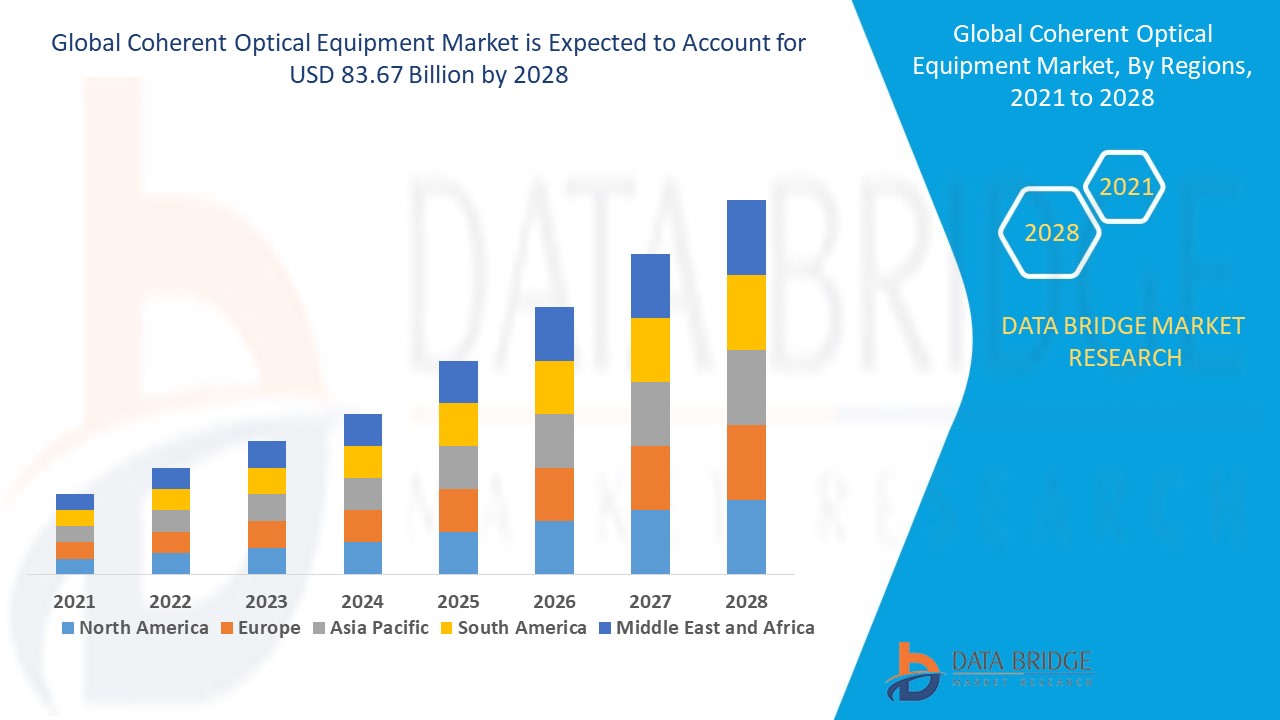
コヒーレント光学機器市場分析
コヒーレント光機器市場は、特に通信およびデータ センター アプリケーションにおける技術と方法の進歩により、大幅な成長を遂げています。注目を集めている最新の方法は、コヒーレント光におけるデジタル信号処理 (DSP) の使用です。これにより、より高度な変調形式が可能になり、光信号の帯域幅効率と伝送距離が向上します。このイノベーションは、高度な光集積回路 (PIC) と組み合わされ、サイズと消費電力を削減しながらパフォーマンスを向上させるのに役立ちます。
さらに、ネットワーク最適化における機械学習 (ML) と人工知能(AI)の統合は、コヒーレント光システムのパフォーマンスを最大化する上で重要な役割を果たします。これらのテクノロジーにより、予測メンテナンス、リアルタイム監視、適応変調が可能になり、システム全体の信頼性が向上します。
クラウド コンピューティングの成長、高帯域幅サービスに対する需要の拡大、5G の展開は、いずれもコヒーレント光機器市場を牽引しています。より高速で効率的なデータ伝送の需要により、次世代コヒーレント光技術への投資が促進され、大手通信会社は長距離光ファイバー通信にこれらのソリューションを活用しています。これらの技術が成熟するにつれて、市場は引き続き成長すると予想されます。
コヒーレント光学機器市場規模
世界のコヒーレント光機器市場規模は、2024年に587億9,000万米ドルと評価され、2025年から2032年の予測期間中に9.22%のCAGRで成長し、2032年には1,190億5,000万米ドルに達すると予測されています。市場価値、成長率、セグメンテーション、地理的範囲、主要プレーヤーなどの市場シナリオに関する洞察に加えて、Data Bridge Market Researchがまとめた市場レポートには、詳細な専門家の分析、地理的に表された企業別の生産と生産能力、販売業者とパートナーのネットワークレイアウト、詳細で最新の価格動向分析、サプライチェーンと需要の不足分析も含まれています。
コヒーレント光学機器市場動向
「高速インターネットとデータ伝送の需要の高まり」
コヒーレント光機器市場の成長を牽引する重要なトレンドの 1 つは、高速インターネットとデータ伝送の需要の増加です。クラウド コンピューティング、5G ネットワーク、ビデオ ストリーミング サービスによって促進されたデータ消費の急増により、通信プロバイダーはインフラストラクチャのアップグレードを迫られています。高度な変調形式やデジタル信号処理などのコヒーレント光技術により、長距離でのより高速で効率的な伝送が可能になります。たとえば、Huawei や Nokia などの企業は、高帯域幅を必要とする 5G の展開をサポートするためにコヒーレント光システムに投資しています。世界がより接続され、データ量の多い環境に移行するにつれて、この傾向は続くと予想されます。
レポートの範囲とコヒーレント光学機器市場のセグメンテーション
|
属性 |
コヒーレント光学機器の主要市場分析 |
|
対象セグメント |
|
|
対象国 |
北米では米国、カナダ、メキシコ、ヨーロッパではドイツ、フランス、英国、オランダ、スイス、ベルギー、ロシア、イタリア、スペイン、トルコ、その他のヨーロッパ、ヨーロッパでは中国、日本、インド、韓国、シンガポール、マレーシア、オーストラリア、タイ、インドネシア、フィリピン、アジア太平洋地域 (APAC) ではその他のアジア太平洋地域 (APAC)、中東およびアフリカ (MEA) の一部としてサウジアラビア、UAE、南アフリカ、エジプト、イスラエル、中東およびアフリカ (MEA) の一部としてその他の中東およびアフリカ (MEA)、南米の一部としてブラジル、アルゼンチン、その他の南米 |
|
主要な市場プレーヤー |
Ciena Corporation(米国)、Huawei Technologies Co., Ltd.(中国)、Cisco Systems, Inc.(米国)、Nokia(フィンランド)、Infinera Corporation(米国)、FUJITSU OPTICAL COMPONENTS LIMITED(日本)、Ribbon Communications Operating Company, Inc.(米国)、ZTE Corporation(中国)、ADVA Optical Networking(ドイツ)、Telefonaktiebolaget LM Ericsson(スウェーデン)、NEC Corporation(日本)、Carl Zeiss Meditec AG(ドイツ)、Zygo Corporation(米国) |
|
市場機会 |
|
|
付加価値データ情報セット |
In addition to the insights on market scenarios such as market value, growth rate, segmentation, geographical coverage, and major players, the market reports curated by the Data Bridge Market Research also include in-depth expert analysis, geographically represented company-wise production and capacity, network layouts of distributors and partners, detailed and updated price trend analysis and deficit analysis of supply chain and demand. |
Coherent Optical Equipment Market Definition
Coherent optical equipment refers to devices used in optical communication systems that rely on coherent light sources, such as lasers, to transmit data. These systems use the phase, amplitude, and frequency of light to encode and decode information, enabling higher data transmission rates and longer distances compared to traditional optical systems. Coherent optical equipment includes components such as modulators, detectors, and receivers, which are key in enabling advanced technologies such as coherent wavelength division multiplexing (CWDM) and coherent optical transmission networks. These systems are vital in applications such as high-capacity fiber-optic communication, data centers, and long-haul telecommunications.
Coherent Optical Equipment Market Dynamics
Drivers
- Growing Cloud Computing
The rapid growth of cloud computing has significantly increased the demand for high-capacity optical networks to support the massive data storage and processing needs of cloud data centers. Coherent optical systems, which provide high bandwidth and long-distance transmission with reduced power consumption, are crucial for managing this influx of data. For instance, Amazon Web Services (AWS) and Microsoft Azure rely on coherent optical networks to ensure seamless, fast, and scalable connectivity between their global data centers. As more businesses migrate to the cloud and expand their digital infrastructure, the demand for coherent optical equipment continues to rise, driving market growth.
- Expansion of 5G Networks
The expansion of 5G networks is a key driver for the coherent optical equipment market. 5G’s promise of faster data speeds and lower latency necessitates advanced optical transmission systems that can handle the significantly higher bandwidth required. Coherent optical technology, which enables efficient transmission over long distances with minimal loss, plays a crucial role in supporting 5G backhaul networks. For instance, companies such as Huawei and Ciena have been instrumental in deploying coherent optical equipment to support the global 5G rollout, ensuring that network operators can deliver high-speed, reliable connections. As 5G networks expand, the demand for coherent optical solutions to meet these needs continues to rise, driving market growth.
Opportunities
- Advancements in Optical Technology
Continued innovations in coherent optical technology, particularly in modulation formats and digital signal processing (DSP), are significantly enhancing the performance of optical systems. These advancements allow for higher data transmission rates, improved signal quality over long distances, and more efficient power consumption. For instance, technologies such as 400G and 800G coherent optical modules are being adopted in next-generation data centers to meet the growing demand for bandwidth. These innovations also enable telecom companies to upgrade their networks to 5G, allowing for faster, more reliable connections. As a result, the increased capability and efficiency of coherent optical systems are opening up new opportunities across industries such as telecommunications, cloud computing, and data centers.
- Support for IoT Expansion
The rapid growth of the Internet of Things (IoT) is generating massive volumes of data, requiring advanced and efficient data transmission systems. Coherent optical systems offer a solution by enabling high-capacity and low-latency networks, essential for handling the large amounts of data produced by interconnected devices. For instance, in smart cities, where millions of sensors and devices generate real-time data, coherent optical equipment ensures seamless communication between devices and cloud servers. This rising demand for robust data infrastructure creates significant opportunities for the coherent optical equipment market, as industries and governments seek to implement scalable, high-speed transmission systems to support IoT ecosystems effectively.
Restraints/Challenges
- High Implementation Costs
High implementation costs are a significant restraint for the coherent optical equipment market. Coherent optical technology demands advanced infrastructure and specialized components, which result in substantial initial investments. In addition, ongoing maintenance costs further add to the financial burden. These expenses make it challenging for organizations, particularly in cost-sensitive regions, to adopt and implement coherent optical systems. As a result, the high cost of entry can delay or prevent the widespread deployment of these technologies, limiting market growth. This financial barrier particularly affects small and medium-sized enterprises (SMEs), hindering the potential for market expansion in regions with lower budgets or in industries focused on cost-cutting measures.
- Limited Availability of Skilled Labor
The limited availability of skilled labor is a significant challenge in the coherent optical equipment market. The demand for professionals with expertise in advanced optical technologies, system integration, and maintenance far exceeds the available supply. This skills gap creates difficulties for businesses looking to adopt and operate these complex systems. The shortage of qualified technicians and engineers hampers the efficient deployment and ongoing maintenance of coherent optical systems. As a result, organizations may face delays in implementation and higher operational costs, which further constrains market growth. The lack of skilled labor impedes the widespread adoption of these technologies, limiting the potential of the market.
This market report provides details of new recent developments, trade regulations, import-export analysis, production analysis, value chain optimization, market share, impact of domestic and localized market players, analyses opportunities in terms of emerging revenue pockets, changes in market regulations, strategic market growth analysis, market size, category market growths, application niches and dominance, product approvals, product launches, geographic expansions, technological innovations in the market. To gain more info on the market contact Data Bridge Market Research for an Analyst Brief, our team will help you take an informed market decision to achieve market growth.
Coherent Optical Equipment Market Scope
The market is segmented on the basis of technology, equipment, application and end user. The growth amongst these segments will help you analyze meagre growth segments in the industries and provide the users with a valuable market overview and market insights to help them make strategic decisions for identifying core market applications.
Technology
- 100G
- 200G
- 400G+
- 400G ZR
Equipment
- Wavelength-Division Multiplexer
- Modules/Chips
- Test and Measurement Equipment
- Optical Amplifiers
- Optical Switches
- Others
- Optical Fiber
- Optical Splitters
- Fiber Optic Circulators
- Optical Transceivers
Application
- Networking
- Fiber-to-the-Building/Premises (FTTB/P) Optical Network
- Fiber-to-the-Home (FTTH) Optical Network
- Data Center
- OEMs
End User
- Service Provider
- Internet Service Provider
- Telecom Service Provider
- Public Sector
- Industries
- Aviation
- Energy
- Railways
Component
- Laser
- DSP
- Transmitter
- Receiver
- Modulator
Coherent Optical Equipment Market Regional Analysis
The market is analyzed and market size insights and trends are provided by technology, equipment, application and end user as referenced above.
The countries covered in the market report are U.S., Canada, Mexico in North America, Germany, Sweden, Poland, Denmark, Italy, U.K., France, Spain, Netherland, Belgium, Switzerland, Turkey, Russia, Rest of Europe in Europe, Japan, China, India, South Korea, New Zealand, Vietnam, Australia, Singapore, Malaysia, Thailand, Indonesia, Philippines, Rest of Asia-Pacific (APAC) in Asia-Pacific (APAC), Brazil, Argentina, Rest of South America as a part of South America, U.A.E, Saudi Arabia, Oman, Qatar, Kuwait, South Africa, Rest of Middle East and Africa (MEA) as a part of Middle East and Africa (MEA).
North America is expected to dominate the coherent optical equipment market due to its large base of existing users and high internet usage. The region benefits from significant investments in infrastructure and advanced technology adoption, which drive the demand for high-speed data transmission, supporting growth in the coherent optical equipment sector.
Asia-Pacific is expected to expand at a significant growth rate in the coherent optical equipment market over the forecast period, driven by increased investments in research and development. These investments are focused on introducing advanced technologies and innovations, enabling the region to lead in the adoption of cutting-edge optical equipment solutions.
The country section of the report also provides individual market impacting factors and changes in market regulation that impact the current and future trends of the market. Data points such as down-stream and upstream value chain analysis, technical trends and porter's five forces analysis, case studies are some of the pointers used to forecast the market scenario for individual countries. Also, the presence and availability of global brands and their challenges faced due to large or scarce competition from local and domestic brands, impact of domestic tariffs and trade routes are considered while providing forecast analysis of the country data.
Coherent Optical Equipment Market Share
The market competitive landscape provides details by competitor. Details included are company overview, company financials, revenue generated, market potential, investment in research and development, new market initiatives, global presence, production sites and facilities, production capacities, company strengths and weaknesses, product launch, product width and breadth, application dominance. The above data points provided are only related to the companies' focus related to market.
Coherent Optical Equipment Market Leaders Operating in the Market Are:
- Ciena Corporation (U.S.)
- Huawei Technologies Co., Ltd. (China)
- Cisco Systems, Inc. (U.S.)
- Nokia (Finland)
- Infinera Corporation (U.S.)
- FUJITSU OPTICAL COMPONENTS LIMITED (Japan)
- Ribbon Communications Operating Company, Inc. (U.S.)
- ZTE Corporation (China)
- ADVA Optical Networking (Germany)
- Telefonaktiebolaget LM Ericsson (Sweden)
- NEC Corporation (Japan)
- Carl Zeiss Meditec AG (Germany)
- Zygo Corporation (U.S.)
コヒーレント光学機器市場の最新動向
- 2023年10月、情報通信技術ソリューションの大手プロバイダーであるZTEコーポレーションは、フランスのパリで開催されたNetwork X展示会で、テラビットレベルの決定論的全光アクセスプラットフォームであるZXA10 C600Eを発表しました。このプラットフォームは、Fiber to the X(FTTx)サービスの革新を推進し、世界の光ファイバー技術の成長を促進することを目的としています。
- ノキアは2023年2月、ネットワークの消費電力を60%削減する第6世代のスーパーコヒーレント光サービスエンジンであるPSE-6sを発表しました。この製品は独自のチップツーチップインターフェースを備えており、業界初の2.4Tb/sコヒーレントトランスポートソリューションをペアで導入でき、光ネットワークの効率を大幅に向上させます。
- 2023年6月、ADVA Optical Networkingは、ヨーロッパの通信サービスプロバイダーからXGS-PONコヒーレント光トランスポートポートフォリオの大型注文を受けました。この注文には、FSP 3000 XGS-PONトランスポンダーとA1000コヒーレント光ネットワークマネージャーが含まれており、高速で信頼性の高いブロードバンドサービスに対する需要の高まりに対応するプロバイダーの能力を強化します。
- ノキアは2023年6月、光ネットワークソリューションプロバイダーであるAdtranの買収を完了しました。この戦略的買収により、ノキアは世界のコヒーレント光機器市場での地位を強化し、ポートフォリオを拡大し、光ネットワーク向けのより幅広いソリューションを提供できるようになり、競争力がさらに高まります。
- 2021年3月、シスコは高速光相互接続技術を専門とするマサチューセッツ州の企業であるアカシアコミュニケーションズの買収を完了しました。この買収により、シスコはデータセンター、メトロ、地域、長距離、海底ネットワークの提供を強化し、高帯域幅接続の需要の高まりに対応する光ソリューションのポートフォリオを拡大することができます。
- 2020年8月、WindstreamとCienaは提携を発表し、WindstreamはCienaのフォトニック、コヒーレント光、インテリジェントソフトウェアプラットフォームを活用して、National Converged Optical Networkを開発します。このネットワークは、デジタル時代のリモートワーク、クラウドコンピューティング、ビデオストリーミング、その他の帯域幅を大量に消費するアプリケーションによって高まる帯域幅の需要を満たすのに役立ちます。
- ノキアは2020年5月、5Gとクラウド環境の高まる需要に対応するために設計されたWaveFabric Elements光製品群を発表しました。ポートフォリオには、第5世代のコヒーレントデジタル信号プロセッサであるPhotonic Service Engine Vなどのフォトニックチップ、デバイス、サブシステムが含まれており、5Gなどの次世代テクノロジーをサポートする効率的で大容量の光ネットワークを実現します。
SKU-
世界初のマーケットインテリジェンスクラウドに関するレポートにオンラインでアクセスする

- インタラクティブなデータ分析ダッシュボード
- 成長の可能性が高い機会のための企業分析ダッシュボード
- カスタマイズとクエリのためのリサーチアナリストアクセス
- インタラクティブなダッシュボードによる競合分析
- 最新ニュース、更新情報、トレンド分析
- 包括的な競合追跡のためのベンチマーク分析のパワーを活用
調査方法
データ収集と基準年分析は、大規模なサンプル サイズのデータ収集モジュールを使用して行われます。この段階では、さまざまなソースと戦略を通じて市場情報または関連データを取得します。過去に取得したすべてのデータを事前に調査および計画することも含まれます。また、さまざまな情報ソース間で見られる情報の不一致の調査も含まれます。市場データは、市場統計モデルと一貫性モデルを使用して分析および推定されます。また、市場シェア分析と主要トレンド分析は、市場レポートの主要な成功要因です。詳細については、アナリストへの電話をリクエストするか、お問い合わせをドロップダウンしてください。
DBMR 調査チームが使用する主要な調査方法は、データ マイニング、データ変数が市場に与える影響の分析、および一次 (業界の専門家) 検証を含むデータ三角測量です。データ モデルには、ベンダー ポジショニング グリッド、市場タイムライン分析、市場概要とガイド、企業ポジショニング グリッド、特許分析、価格分析、企業市場シェア分析、測定基準、グローバルと地域、ベンダー シェア分析が含まれます。調査方法について詳しくは、お問い合わせフォームから当社の業界専門家にご相談ください。
カスタマイズ可能
Data Bridge Market Research は、高度な形成的調査のリーダーです。当社は、既存および新規のお客様に、お客様の目標に合致し、それに適したデータと分析を提供することに誇りを持っています。レポートは、対象ブランドの価格動向分析、追加国の市場理解 (国のリストをお問い合わせください)、臨床試験結果データ、文献レビュー、リファービッシュ市場および製品ベース分析を含めるようにカスタマイズできます。対象競合他社の市場分析は、技術ベースの分析から市場ポートフォリオ戦略まで分析できます。必要な競合他社のデータを、必要な形式とデータ スタイルでいくつでも追加できます。当社のアナリスト チームは、粗い生の Excel ファイル ピボット テーブル (ファクト ブック) でデータを提供したり、レポートで利用可能なデータ セットからプレゼンテーションを作成するお手伝いをしたりすることもできます。











