Global Commercial Juicer Market Size, Share, and Trends Analysis Report
Market Size in USD Billion
CAGR :
%
USD
1.47 Billion
USD
21.31 Billion
2024
2032
| 2025 –2032 | |
| USD 1.47 Billion | |
| USD 21.31 Billion | |
|
|
|
|
Global Commercial Juicer Market Segmentation, By Type (Vertical Auger Commercial Masticating Juicer and Horizontal Auger Commercial Masticating Juicer), Category Type (Manual Juicers and Electric Juicers), Application (Hotels and Restaurants, Bars, Shops, and Others) - Industry Trends and Forecast to 2032
What is the Global Commercial Juicer Market Size and Growth Rate?
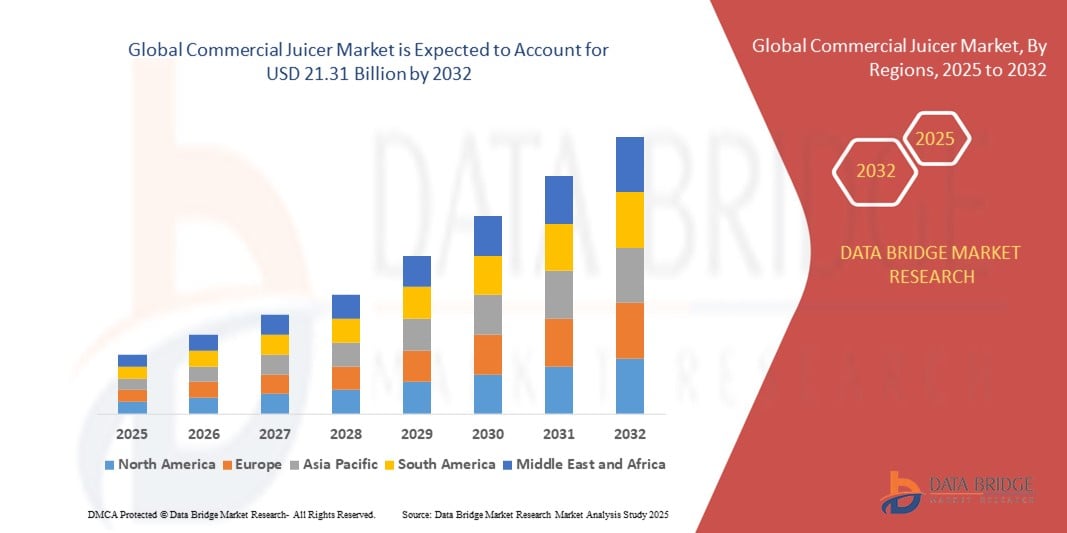
- The global commercial juicer market size was valued at USD 1.47 billion in 2024 and is expected to reach USD 21.31 billion by 2032, at a CAGR of 5.80% during the forecast period
- The essential factors contributing to the growth of the global commercial juicer market in the forecast period including the increasing demand for fresh and natural beverages due to health and wellness trends. Expansion of the foodservice industry, particularly in emerging markets, presents opportunities for growth
- Technological advancements in juicing efficiency, smart features, and design innovation contribute to market expansion. Moreover, urbanization, rising disposable incomes, and the growing preference for convenience foods and beverages further fuel the demand for commercial juicers, and propelling the market growth
What are the Major Takeaways of Commercial Juicer Market?
- The expansion of the foodservice industry, including restaurants, juice bars, cafes, hotels, and catering services, is driving the growth of the global commercial juicer market. As the hospitality sector grows and consumer preferences evolve, there is a greater need for establishments to differentiate themselves by offering unique and high-quality beverages
- Commercial juicers provide businesses with the capability to offer freshly squeezed juices and customized juice blends, thereby enhancing their beverage menus and overall customer experience. This expansion of the foodservice industry fuels the demand for commercial juicers as businesses strive to meet the varied preferences of their clientele and stay competitive in the market
- Europe dominated the commercial juicer market with the largest revenue share of 38.7% in 2024, supported by rising demand for sustainable food preparation equipment, stringent energy-efficiency regulations, and the strong presence of leading juicer manufacturers
- Asia-Pacific commercial juicer market is poised to grow at the fastest CAGR of 8.14% between 2025 and 2032, driven by rapid urbanization, rising disposable incomes, and growing adoption of modern kitchen appliances
- The Vertical Auger segment dominated the market with the largest revenue share of 58.4% in 2024, attributed to its compact design, efficient juicing capacity, and suitability for high-volume commercial environments such as juice bars and restaurants
Report Scope and Commercial Juicer Market Segmentation
|
Attributes |
Commercial Juicer Key Market Insights |
|
Segments Covered |
|
|
Countries Covered |
North America
Europe
Asia-Pacific
Middle East and Africa
South America
|
|
Key Market Players |
|
|
Market Opportunities |
|
|
Value Added Data Infosets |
In addition to the insights on market scenarios such as market value, growth rate, segmentation, geographical coverage, and major players, the market reports curated by the Data Bridge Market Research also include in-depth expert analysis, pricing analysis, brand share analysis, consumer survey, demography analysis, supply chain analysis, value chain analysis, raw material/consumables overview, vendor selection criteria, PESTLE Analysis, Porter Analysis, and regulatory framework. |
What is the Key Trend in the Commercial Juicer Market?
Smart, Automated, and Connected Juicing Solutions
- A major trend in the global commercial juicer market is the adoption of smart and automated juicing technologies integrated with IoT and touchless controls. These innovations are designed to improve efficiency, reduce food waste, and provide consistent juice quality in commercial settings
- For instance, leading companies are developing automatic juicers with self-cleaning functions and app connectivity that allow operators to monitor performance, track usage data, and receive maintenance alerts remotely
- Integration of AI-based controls enables features such as real-time monitoring of fruit load, automatic adjustment of juicing speed, and predictive maintenance to reduce downtime in high-demand outlets
- Touchless and sensor-based operation is also gaining popularity in restaurants, hotels, and cafés, as it enhances hygiene and customer safety in food service environments
- Companies such as Zumex Group and Zummo are at the forefront of introducing digital and automated juicing machines tailored for supermarkets, juice bars, and quick-service restaurants
- This trend is redefining user expectations in the foodservice industry, pushing demand for intelligent, efficient, and hygienic juicer solutions across global markets
What are the Key Drivers of Commercial Juicer Market?
- Rising demand for fresh and healthy beverages in restaurants, cafés, hotels, and supermarkets is a primary driver fueling the adoption of commercial juicers worldwide
- For instance, in March 2024, Zumex Group launched new automatic juicers with improved extraction systems for supermarkets and high-volume venues, targeting the global demand for fresh juice-on-the-go
- Growing consumer preference for nutrient-rich diets is encouraging foodservice providers to offer freshly prepared juice options, boosting equipment installations
- The rapid expansion of juice bars, quick-service restaurants, and supermarkets globally is creating steady demand for high-capacity and durable juicers
- Features such as self-cleaning technology, energy efficiency, and compact design are further driving adoption, especially among businesses aiming to reduce labor costs and improve operational efficiency
- The increasing trend of healthy living, urbanization, and premiumization in food services is expected to accelerate growth in the commercial juicer industry
Which Factor is Challenging the Growth of the Commercial Juicer Market?
- The high initial cost of advanced commercial juicers, coupled with regular maintenance requirements, remains a significant barrier for small-scale businesses and startups
- For instance, advanced automatic juicers from leading brands such as Santos and Ceado come with premium pricing, making them less affordable for smaller juice bars or cafés
- Operational challenges, such as machine downtime, spare part availability, and technical know-how for handling automated models, can also hinder adoption in developing regions
- Concerns related to hygiene and food safety compliance put additional pressure on operators, especially in busy outlets, as juicers require frequent cleaning and strict maintenance
- Moreover, the presence of low-cost manual and semi-automatic alternatives in local markets limits the penetration of advanced commercial juicers in price-sensitive regions
- Overcoming these challenges will require manufacturers to focus on cost-efficient models, aftersales service networks, and durable, easy-to-maintain designs to ensure sustained global adoption
How is the Commercial Juicer Market Segmented?
The market is segmented on the basis of type, category type, and application.
- By Type
On the basis of type, the commercial juicer market is segmented into Vertical Auger Commercial Masticating Juicer and Horizontal Auger Commercial Masticating Juicer. The Vertical Auger segment dominated the market with the largest revenue share of 58.4% in 2024, attributed to its compact design, efficient juicing capacity, and suitability for high-volume commercial environments such as juice bars and restaurants. Vertical juicers are also preferred for their ease of cleaning and space-saving design, making them highly practical in commercial kitchens with limited space.
The Horizontal Auger segment is projected to witness the fastest CAGR of 19.6% from 2025 to 2032, driven by its ability to extract higher juice yield with minimal oxidation. Its multifunctional capability, including processing leafy greens and wheatgrass, is fueling demand in specialized juice outlets and health-focused businesses. The growing trend toward cold-pressed, nutrient-rich juices is expected to further accelerate horizontal auger adoption.
- By Category Type
On the basis of category type, the commercial juicer market is segmented into Manual Juicers and Electric Juicers. The Electric Juicer segment dominated the market with the largest revenue share of 72.3% in 2024, owing to its speed, efficiency, and ability to handle large-scale juicing operations in hotels, cafes, and restaurants. Electric juicers provide consistent output and reduced manual effort, aligning with the growing demand for time-saving and energy-efficient commercial equipment. Their advanced features such as automatic pulp ejection and multiple speed options further enhance operational convenience.
The Manual Juicer segment is expected to witness the fastest CAGR of 18.1% from 2025 to 2032, driven by its low cost, portability, and suitability for small-scale shops, bars, and businesses offering fresh, customized servings. The rising demand for authentic, slow-extracted juice experiences is fostering adoption in niche markets, especially where power supply may be inconsistent or limited.
- By Application
On the basis of application, the commercial juicer market is segmented into Hotels and Restaurants, Bars, Shops, and Others. The Hotels and Restaurants segment dominated the market with the largest revenue share of 46.7% in 2024, supported by the high demand for freshly prepared beverages, increasing preference for premium dining experiences, and rising adoption of healthy, fresh-pressed juice options in hotel breakfast and restaurant menus. The growing hospitality sector worldwide, particularly in emerging economies, has further boosted demand.
The Bars segment is anticipated to register the fastest CAGR of 20.4% from 2025 to 2032, driven by the surging popularity of cocktails and mocktails infused with freshly pressed juices. Bars are increasingly adopting commercial juicers to enhance flavor authenticity and meet customer preferences for fresh, customized drinks. Rising global nightlife culture and increasing consumer spending on premium beverages will significantly drive this growth segment.
Which Region Holds the Largest Share of the Commercial Juicer Market?
- Europe dominated the commercial juicer market with the largest revenue share of 38.7% in 2024, supported by rising demand for sustainable food preparation equipment, stringent energy-efficiency regulations, and the strong presence of leading juicer manufacturers
- Consumers in Europe are increasingly prioritizing healthy lifestyles, fresh juice consumption, and eco-friendly appliances, fueling widespread adoption across both residential and commercial sectors
- This growth is reinforced by Europe’s technological innovation, robust retail network, and strong hospitality sector, positioning the region as a global leader in the Commercial Juicer industry
Germany Commercial Juicer Market Insight
Germany commercial juicer market captured the largest revenue share in Europe in 2024, driven by the country’s innovation in kitchen appliances and sustainability-focused policies. German consumers show strong preference for high-performance, energy-efficient juicers that integrate with modern hospitality and food service environments. The presence of global and local premium brands, combined with a strong export-oriented manufacturing base, further supports market expansion.
U.K. Commercial Juicer Market Insight
U.K. commercial juicer market is expected to grow at a robust CAGR during the forecast period, driven by rising health-conscious consumers and expanding juice bar culture. Growing demand from cafés, hotels, and quick-service restaurants, coupled with the U.K.’s strong e-commerce infrastructure, supports the easy availability of juicers. In addition, customized juice offerings and wellness-driven diets are further boosting adoption in both residential and commercial spaces.
France Commercial Juicer Market Insight
France commercial juicer market is anticipated to expand considerably, supported by the nation’s strong culinary culture, emphasis on fresh produce, and growing hospitality sector. With rising juice consumption in cafés and restaurants, along with consumer awareness of energy-efficient appliances, French manufacturers are focusing on design, performance, and durability. Integration of stylish, compact, and multifunctional juicers is also gaining traction among urban consumers.
Which Region is the Fastest Growing Region in the Commercial Juicer Market?
Asia-Pacific commercial juicer market is poised to grow at the fastest CAGR of 8.14% between 2025 and 2032, driven by rapid urbanization, rising disposable incomes, and growing adoption of modern kitchen appliances. Countries such as China, India, and Japan are leading this shift, supported by strong government initiatives promoting digitalization, the emergence of smart kitchens, and expanding juice bar chains across metropolitan cities. Furthermore, APAC’s role as a manufacturing hub for cost-efficient juicer components is increasing accessibility and affordability, expanding adoption among both households and commercial users.
China Commercial Juicer Market Insight
China accounted for the largest revenue share in the Asia-Pacific market in 2024, supported by its expanding middle class, strong domestic brands, and growing juice consumption trends. The rise of smart cities and urban café culture, along with the government’s focus on modernizing food service infrastructure, is accelerating market penetration. Competitive pricing by local manufacturers has further boosted affordability and accessibility across residential and commercial sectors.
Japan Commercial Juicer Market Insight
Japan commercial juicer market is witnessing rapid growth due to the nation’s tech-driven culture, urban lifestyle, and preference for premium appliances. Japanese consumers value compact, energy-efficient juicers integrated with smart kitchen technologies and IoT features. In addition, Japan’s aging population is creating higher demand for easy-to-use and health-oriented juicing solutions, particularly in residential and healthcare food service segments.
Which are the Top Companies in Commercial Juicer Market?
The commercial juicer industry is primarily led by well-established companies, including:
- Omega Products (U.S.)
- Robot Coupe (France)
- Santos (France)
- Waring (U.S.)
- Crown Pacific Global (Singapore)
- Ceado (Italy)
- Champion Juicer (U.S.)
- Nutrifaster (U.S.)
- Sammic (Spain)
- Samson Life (U.S.)
- Semak Australia (Australia)
- Zumex Group (Spain)
- Zummo (Spain)
What are the Recent Developments in Global Commercial Juicer Market?
- In February 2023, Angela Juicers introduced their newly developed website, providing customers with an online platform to explore juicers, accessories, and recipes. The store now offers a wide range of juicers, including masticating and centrifugal types, along with complementary accessories, ensuring customers have access to a complete juicing solution
- In January 2023, Prestige rolled out its latest innovation, the Prestige Plus Atlas 750 W Juicer Mixer Grinder, equipped with a secure locking system and a 1.5-liter liquidizing jar. This launch highlights the company’s commitment to delivering user-friendly and efficient appliances tailored to modern kitchen needs
- In July 2022, Hamilton Beach Professional revealed its strategic initiative to introduce a professional juicer mixer grinder (JMG) in the Indian market. This move reinforced the company’s ambition to tap into India’s growing demand for high-performance kitchen appliances
SKU-
世界初のマーケットインテリジェンスクラウドに関するレポートにオンラインでアクセスする

- インタラクティブなデータ分析ダッシュボード
- 成長の可能性が高い機会のための企業分析ダッシュボード
- カスタマイズとクエリのためのリサーチアナリストアクセス
- インタラクティブなダッシュボードによる競合分析
- 最新ニュース、更新情報、トレンド分析
- 包括的な競合追跡のためのベンチマーク分析のパワーを活用
調査方法
データ収集と基準年分析は、大規模なサンプル サイズのデータ収集モジュールを使用して行われます。この段階では、さまざまなソースと戦略を通じて市場情報または関連データを取得します。過去に取得したすべてのデータを事前に調査および計画することも含まれます。また、さまざまな情報ソース間で見られる情報の不一致の調査も含まれます。市場データは、市場統計モデルと一貫性モデルを使用して分析および推定されます。また、市場シェア分析と主要トレンド分析は、市場レポートの主要な成功要因です。詳細については、アナリストへの電話をリクエストするか、お問い合わせをドロップダウンしてください。
DBMR 調査チームが使用する主要な調査方法は、データ マイニング、データ変数が市場に与える影響の分析、および一次 (業界の専門家) 検証を含むデータ三角測量です。データ モデルには、ベンダー ポジショニング グリッド、市場タイムライン分析、市場概要とガイド、企業ポジショニング グリッド、特許分析、価格分析、企業市場シェア分析、測定基準、グローバルと地域、ベンダー シェア分析が含まれます。調査方法について詳しくは、お問い合わせフォームから当社の業界専門家にご相談ください。
カスタマイズ可能
Data Bridge Market Research は、高度な形成的調査のリーダーです。当社は、既存および新規のお客様に、お客様の目標に合致し、それに適したデータと分析を提供することに誇りを持っています。レポートは、対象ブランドの価格動向分析、追加国の市場理解 (国のリストをお問い合わせください)、臨床試験結果データ、文献レビュー、リファービッシュ市場および製品ベース分析を含めるようにカスタマイズできます。対象競合他社の市場分析は、技術ベースの分析から市場ポートフォリオ戦略まで分析できます。必要な競合他社のデータを、必要な形式とデータ スタイルでいくつでも追加できます。当社のアナリスト チームは、粗い生の Excel ファイル ピボット テーブル (ファクト ブック) でデータを提供したり、レポートで利用可能なデータ セットからプレゼンテーションを作成するお手伝いをしたりすることもできます。