


標的薬物送達のためのグローバルナノロボティクス市場:タイプ別(3Dモーションナノマシン、バクテリア駆動ナノボット、バイオチップ、ヌボット、ナノロケットなど)、推進方法別(内因性および外因性)、用途別(化学療法、放射線療法、in vitroおよびin vivoアプリケーション)、エンドユーザー別(製薬会社、バイオテクノロジー企業、研究機関) - 2032年までの業界動向と予測
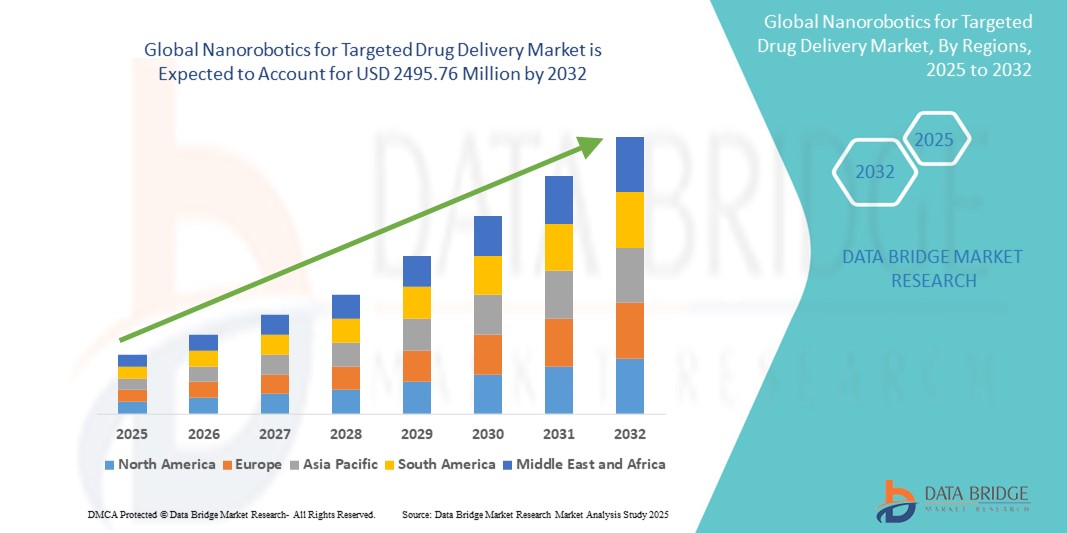
標的薬物送達のためのナノロボティクス市場規模
- 標的薬物送達のための世界ナノロボティクス市場規模は、2024年に3億1,749万米ドルと評価され、予測期間中に29.40%のCAGRで成長し、2032年には2億4,9576万米ドルに達すると予想されています。
- 市場の成長は、標的を絞った効率的な薬物送達を必要とする癌、心血管疾患、神経疾患などの慢性疾患の罹患率の増加と、これらの疾患にかかりやすい高齢者人口の世界的な増加によって主に推進されている。
- ナノマテリアルの合成、ナノロボットの設計、遠隔制御機構における技術の進歩は、これらのシステムの精度、有効性、安全性を向上させています。従来の化学療法やその他の全身療法と比較して、全身毒性を軽減し、患者の転帰を改善する低侵襲性治療選択肢への関心が高まっていることも、重要な推進力となっています。
標的薬物送達のためのナノロボティクス市場分析
- 標的薬物送達のためのナノロボティクスは、ナノスケールのロボット(1~100nm)を用いて、治療薬を特定の部位に正確に輸送・放出する技術です。これは、薬剤を高精度に送達し、全体的な副作用を軽減できるため、現代の医療においてますます重要になっています。
- この技術の使用が増えている主な理由は、局所的な治療を必要とする疾患の増加、従来の薬物送達の欠点に対する理解の高まり、そしてより効果的で侵襲性の低い治療法への要望の高まりである。
- 北米は、ナノテクノロジーとナノロボティクスの研究開発への多額の投資と、高度な治療法の採用を促進する確立された医療インフラにより、標的薬物送達市場におけるナノロボティクスの38.0%のシェアで優位に立つと予想されています。
- アジア太平洋地域は、医療とバイオテクノロジーへの投資の増加、高度な医療へのアクセスが向上した中流階級人口の増加、中国、日本、韓国、インドなどの国での医療費の増加により、予測期間中に標的薬物送達市場向けナノロボティクスで最も急速に成長する地域になると予想されています。
- バイオチップセグメントは、精密な薬物送達、バイオマーカー検出、診断ツールとの統合を強化する上で重要な役割を果たし、腫瘍学および個別化医療アプリケーションで非常に効果的であるため、28.5%の市場シェアで市場を支配すると予想されています。
レポートの範囲と標的薬物送達市場セグメンテーションのためのナノロボティクス
|
属性 |
標的薬物送達のためのナノロボティクスの主要市場洞察 |
|
対象セグメント |
|
|
対象国 |
北米
ヨーロッパ
アジア太平洋
中東およびアフリカ
南アメリカ
|
|
主要な市場プレーヤー |
|
|
市場機会 |
|
|
付加価値データ情報セット |
Data Bridge Market Research がまとめた市場レポートには、市場価値、成長率、セグメンテーション、地理的範囲、主要プレーヤーなどの市場シナリオに関する洞察に加えて、専門家による詳細な分析、患者の疫学、パイプライン分析、価格分析、規制の枠組みも含まれています。 |
標的薬物送達のためのナノロボティクス市場動向
「精密医療への注目が高まる」
- A significant and accelerating trend in the global Nanorobotics for Targeted Drug Delivery market is the increasing focus on precision medicine, aiming to deliver therapies specifically to diseased cells or tissues while minimizing harm to healthy areas
- For instance, major players in the pharmaceutical and biotechnology industries, such as Novartis AG and AstraZeneca, are actively exploring and investing in nanorobotics and nanoparticle-based drug delivery systems to achieve higher precision in their treatments. Similarly, companies such as Johnson & Johnson and Merck & Co., Inc. are engaged in research and development to leverage nanotechnology for targeted drug delivery in areas such as oncology and immunology
- This heightened focus enables the development of nanorobots capable of recognizing specific biomarkers on target cells, ensuring that therapeutic payloads are delivered directly to the site of disease. This approach significantly reduces the exposure of healthy tissues to drugs, thereby minimizing side effects and improving treatment efficacy
- The growing emphasis on personalized medicine, where treatments are tailored to individual patient needs and disease characteristics, further fuels the demand for precise drug delivery methods such as nanorobotics. Healthcare professionals are increasingly recognizing the potential of this technology to enhance treatment outcomes and improve patient quality of life
- This trend towards greater precision in medicine, coupled with the advancements in nanotechnology and the involvement of leading companies such as Pfizer Inc. and Sanofi S.A. in exploring nanorobotic solutions, is fundamentally reshaping the landscape of drug delivery
- The demand for Nanorobotics for Targeted Drug Delivery is growing rapidly across various therapeutic areas, as the focus on precision medicine encourages the development and adoption of these innovative technologies. This targeted approach to treatment is vital for improving therapeutic outcomes and reducing the burden of diseases, significantly boosting the Nanorobotics for Targeted Drug Delivery market
Nanorobotics for Targeted Drug Delivery Market Dynamics
Driver
“Increased Awareness of Nanotechnology”
- The increasing awareness of nanotechnology across various sectors, including healthcare, is a significant driver for the heightened demand for Nanorobotics for Targeted Drug Delivery
- For instance, scientific literature published in journals such as Nature Nanotechnology and ACS Nano, alongside media coverage by organizations such as the National Nanotechnology Initiative (NNI), consistently highlight the potential of nanotechnology to revolutionize medicine, including targeted drug delivery
- As the understanding of nanotechnology's capabilities in medicine expands, Nanorobotics for Targeted Drug Delivery offers a potentially superior approach compared to conventional drug administration by promising increased efficacy and reduced side effects
- Furthermore, the growing recognition of the limitations of traditional drug delivery methods and the potential of nanotechnology to overcome these limitations is prompting more research and development in this field. This increased awareness, driven by scientific advancements and the potential for personalized medicine, further fuels the demand for nanorobotics solutions
- The increasing accessibility of information about nanotechnology and its applications in targeted drug delivery, coupled with the growing interest from researchers, clinicians, and patients, makes it an attractive area for innovation and investment. The trend towards more advanced and personalized medical treatments and the desire for therapies with improved outcomes are also key factors propelling the adoption and development of Nanorobotics for Targeted Drug Delivery
Restraint/Challenge
“Navigating Biological Barriers”
- Effectively navigating the intricate biological barriers within the human body presents a significant challenge to the widespread adoption of nanorobotics for targeted drug delivery. While the potential for precision is high, the complexity of biological systems poses hurdles for these nanoscale devices
- For instance, the blood-brain barrier, a highly selective membrane protecting the brain, restricts the passage of many therapeutic agents. Developing nanorobots capable of traversing this barrier efficiently and delivering drugs specifically to brain tumors or neurological disease sites remains a complex task for researchers at institutions and companies such as Novartis AG exploring neurodegenerative disease therapies
- Addressing these navigational challenges requires the development of sophisticated nanorobot designs, surface modifications to prevent immune system clearance, and precise control mechanisms to guide them through dense tissues
- While the potential long-term benefits of overcoming these barriers such as highly targeted cancer therapy with minimized side effects or effective treatment of previously inaccessible diseases, are substantial, the current limitations in reliably navigating these biological complexities hinder broader clinical translation and market growth
- Overcoming these challenges through innovations in material science, bioengineering, and remote control technologies by companies such as research-focused entities and emerging nanorobotics firms will be vital for realizing the full potential of targeted drug delivery in the Nanorobotics sector
Nanorobotics for Targeted Drug Delivery Market Scope
The market is segmented on the basis of type, propulsion methods, application, and end-user.
- By Type
On the basis of type, the market is segmented into 3D-motion nanomachines, bacteria powered nanobots, biochips, nubots, nanorockets, and others. The biochips segment dominates the largest market revenue share of 28.5% in 2025, driven by their critical role in enhancing precision drug delivery, biomarker detection, and integration with diagnostic tools, making them highly effective in oncology and personalized medicine applications.
The bacteria powered nanobots segment is expected to witness the fastest CAGR from 2025 to 2032, driven by growing interest in bio-hybrid nanorobots for targeted therapies, particularly in environments where chemical propulsion is less effective or biocompatibility is essential.
- By Propulsion Methods
On the basis of propulsion methods, the market is segmented into endogenous and exogenous. The exogenous segment dominates the largest market revenue share in 2025, driven by its established control mechanisms using external stimuli such as magnetic fields or ultrasound, which enhance precision in targeted delivery.
The endogenous segment is expected to witness the fastest CAGR from 2025 to 2032, driven by increasing research into autonomous nanorobots powered by biochemical reactions within the human body, offering higher biocompatibility and efficiency.
- By Application
On the basis of application, the market is segmented into chemotherapy, radiotherapy, in-vitro, and in-vivo applications. The chemotherapy segment dominates the largest market revenue share in 2025, driven by the critical demand for targeted nanorobotics to reduce systemic toxicity and enhance therapeutic precision in cancer treatment.
The in-vivo segment is expected to witness the fastest CAGR from 2025 to 2032, driven by advancements in real-time navigation and deployment of nanorobots within the human body for diagnostics, monitoring, and localized treatment.
- By End-User
On the basis of end-user, the market is segmented into pharmaceutical, biotechnology firms, and research laboratories. The pharmaceutical segment dominates the largest market revenue share in 2025, driven by major investments in nanotechnology-based drug delivery systems to improve pipeline efficiency and therapeutic outcomes.
The research laboratories segment is expected to witness the fastest CAGR from 2025 to 2032, driven by increasing academic and institutional R&D activities focusing on innovative propulsion methods, biocompatible materials, and novel applications for nanorobotics in medicine.
Nanorobotics for Targeted Drug Delivery Market Regional Analysis
- North America dominates the nanorobotics for targeted drug delivery market with the largest revenue share of 38.0% in 2024, driven by significant investment in research and development within nanotechnology and nanorobotics, alongside a well-established healthcare infrastructure that facilitates the adoption of advanced treatment modalities
- The high prevalence of chronic diseases requiring targeted therapies further contributes to the region's market leadership. The strong presence of leading pharmaceutical and biotechnology companies actively investing in innovative drug delivery technologies also plays a crucial role
- Businesses in the region prioritize advanced medical solutions to enhance patient outcomes, supported by favorable funding landscapes and a proactive approach to managing various diseases
U.S. Nanorobotics for Targeted Drug Delivery Market Insight
U.S. nanorobotics for targeted drug delivery market is expected to capture the largest revenue share within North America in 2025. This is fueled by a substantial patient population seeking more effective and less invasive treatment options, particularly for cancer and other chronic conditions. The increasing emphasis on precision medicine and the active research and development of sophisticated nanorobotic systems for targeted drug release are key drivers. Moreover, the growing awareness of the benefits of minimizing systemic drug exposure through targeted delivery is contributing to greater adoption.
Europe Nanorobotics for Targeted Drug Delivery Market Insight
The European nanorobotics for targeted drug delivery market is projected to expand at a substantial CAGR throughout the forecast period. This regional market growth is largely due to increasing investments in nanotechnology research and development and a growing preference for advanced and targeted therapeutic approaches. Consequently, research institutions and biotechnology firms across Europe are increasingly focusing on developing and implementing nanorobotic drug delivery systems. Furthermore, rising government initiatives and funding aimed at promoting innovation in healthcare and providing advanced treatment options are fueling the need for effective and patient-friendly solutions such as nanorobotics.
U.K. Nanorobotics for Targeted Drug Delivery Market Insight
U.K. nanorobotics for targeted drug delivery market is anticipated to grow at a noteworthy CAGR during the forecast period, driven by increasing diagnosis rates of chronic diseases and a growing demand for innovative and targeted treatment alternatives to conventional drug administration. In addition, the rising recognition of the potential of nanotechnology in revolutionizing medicine and the presence of strong research institutions and pharmaceutical companies are encouraging greater adoption. The U.K.'s well-established healthcare system and increasing focus on personalized medicine are expected to continue to stimulate market growth.
Germany Nanorobotics for Targeted Drug Delivery Market Insight
ドイツの標的薬剤送達用ナノロボティクス市場は、従来の薬剤送達方法の限界に対する認識の高まりと、技術的に高度で患者固有の治療選択肢への需要の高まりを背景に、予測期間中に大幅なCAGRで拡大すると予想されています。ドイツは高品質の医療機器に力を入れており、研究・産業インフラも整備されているため、高度なナノロボティクスシステムの開発と導入が促進されています。ナノテクノロジーの医薬品研究への統合、そして低侵襲かつ高効果な介入への関心も高まっています。
アジア太平洋地域における標的薬物送達用ナノロボティクス市場の洞察
アジア太平洋地域の標的薬剤送達用ナノロボティクス市場は、ヘルスケアとバイオテクノロジーへの投資増加、先進医療へのアクセス向上による中流階級人口の増加、そして中国、日本、韓国、インドなどの国々における医療費の増加に牽引され、2025年には23.7%という最も高いCAGRで成長すると見込まれています。この地域では、医療インフラの改善と最先端医療技術の導入に重点が置かれており、ナノロボティクスによる薬剤送達の導入が進んでいます。さらに、アジア太平洋地域は技術革新の中心地として台頭し、人口も豊富であることから、市場拡大の可能性は大きくなっています。
標的薬物送達市場におけるナノロボティクスの日本市場洞察
日本の標的薬物送達用ナノロボティクス市場は、先進的な医療制度、医療におけるナノテクノロジーの利点に対する認識の高まり、そして高効率かつ低侵襲な治療ソリューションへの需要の高まりにより、急速に成長しています。日本市場は精度と患者の転帰を重視しており、個別化治療へのニーズの高まりが高度なナノロボティクスシステムの導入を牽引しています。研究機関、政府機関、製薬業界間の緊密な連携が、成長を牽引しています。
中国における標的薬物送達用ナノロボティクス市場の洞察
中国の標的薬物送達用ナノロボティクス市場は、2025年にアジア太平洋地域最大の市場収益シェアを占めると予想されています。これは、同国の人口規模の大きさ、標的介入を必要とする疾患の増加、医療へのアクセス拡大、そしてナノテクノロジーと先進医療研究への政府による多額の投資に起因しています。中国は医療機器と革新的治療法の重要な市場であり、ナノロボティクスは標的薬物送達の有望なアプローチとしてますます認知されつつあります。医療インフラへの投資増加と、医療におけるナノテクノロジーの可能性に対する国民の意識の高まりが、中国市場の成長を牽引する主要な要因となっています。
標的薬物送達用ナノロボティクス市場シェア
標的薬物送達業界向けナノロボティクスは、主に以下を含む定評のある企業によって主導されています。
- ノバルティスAG(スイス)
- アストラゼネカ(英国)
- ファイザー社(米国)
- サノフィSA(フランス)
- アッヴィ(米国)
- 日立製作所(日本)
- ブルカーコーポレーション(米国)
- ジョンソン・エンド・ジョンソン(米国)
- メルク社(米国)
- サーモフィッシャーサイエンティフィック社(米国)
- イミナテクノロジーズ(スイス)
- Klocke Nanotechnik GmbH (インド)
- Kleindiek Nanotechnik GmbH (ドイツ)
- ナノニクスイメージング社(イスラエル)
- ハミングバード・サイエンティフィック(米国)
標的薬物送達市場における世界のナノロボティクスの最新動向
- 2024年7月、スウェーデンのカロリンスカ研究所の研究者らは、致死性ペプチドを隠蔽したナノロボットを開発しました。マウスを用いた試験では、これらのナノロボットは健康な組織に影響を与えずにがん細胞を特異的に標的とし、除去しました。この試験では、腫瘍の増殖を70%抑制する効果が得られました。
- 2024年4月、香港中文大学(CUHK)は、画期的なナノロボットを発表しました。これらのナノロボットは回収可能で、標的を絞った強力な血栓溶解療法を目的として設計されています。これにより、脳卒中患者の脳損傷を防ぐ可能性が示唆されています。
- 2023年12月、ニューヨークと中国の寧波の大学の研究者らが、小型ロボットの開発を発表しました。このロボットはDNAから作られ、自己複製が可能です。将来的には、この画期的な成果は、薬物送達や分子診断への応用が期待されます。
SKU-
世界初のマーケットインテリジェンスクラウドに関するレポートにオンラインでアクセスする

- インタラクティブなデータ分析ダッシュボード
- 成長の可能性が高い機会のための企業分析ダッシュボード
- カスタマイズとクエリのためのリサーチアナリストアクセス
- インタラクティブなダッシュボードによる競合分析
- 最新ニュース、更新情報、トレンド分析
- 包括的な競合追跡のためのベンチマーク分析のパワーを活用
調査方法
データ収集と基準年分析は、大規模なサンプル サイズのデータ収集モジュールを使用して行われます。この段階では、さまざまなソースと戦略を通じて市場情報または関連データを取得します。過去に取得したすべてのデータを事前に調査および計画することも含まれます。また、さまざまな情報ソース間で見られる情報の不一致の調査も含まれます。市場データは、市場統計モデルと一貫性モデルを使用して分析および推定されます。また、市場シェア分析と主要トレンド分析は、市場レポートの主要な成功要因です。詳細については、アナリストへの電話をリクエストするか、お問い合わせをドロップダウンしてください。
DBMR 調査チームが使用する主要な調査方法は、データ マイニング、データ変数が市場に与える影響の分析、および一次 (業界の専門家) 検証を含むデータ三角測量です。データ モデルには、ベンダー ポジショニング グリッド、市場タイムライン分析、市場概要とガイド、企業ポジショニング グリッド、特許分析、価格分析、企業市場シェア分析、測定基準、グローバルと地域、ベンダー シェア分析が含まれます。調査方法について詳しくは、お問い合わせフォームから当社の業界専門家にご相談ください。
カスタマイズ可能
Data Bridge Market Research は、高度な形成的調査のリーダーです。当社は、既存および新規のお客様に、お客様の目標に合致し、それに適したデータと分析を提供することに誇りを持っています。レポートは、対象ブランドの価格動向分析、追加国の市場理解 (国のリストをお問い合わせください)、臨床試験結果データ、文献レビュー、リファービッシュ市場および製品ベース分析を含めるようにカスタマイズできます。対象競合他社の市場分析は、技術ベースの分析から市場ポートフォリオ戦略まで分析できます。必要な競合他社のデータを、必要な形式とデータ スタイルでいくつでも追加できます。当社のアナリスト チームは、粗い生の Excel ファイル ピボット テーブル (ファクト ブック) でデータを提供したり、レポートで利用可能なデータ セットからプレゼンテーションを作成するお手伝いをしたりすることもできます。











