Global Phytosterol
Market Size in USD Billion
CAGR :
%
USD
200.64 Million
USD
303.09 Million
2024
2032
| 2025 –2032 | |
| USD 200.64 Million | |
| USD 303.09 Million | |
|
|
|
|
Global Phytosterol-Fortified Margarine Market Segmentation, By Usage (Spreadable and Non-spreadable), Distribution Channel (Retail, Food Sector, and Industrial)- Industry Trends and Forecast to 2032
Phytosterol-Fortified Margarine Market Size
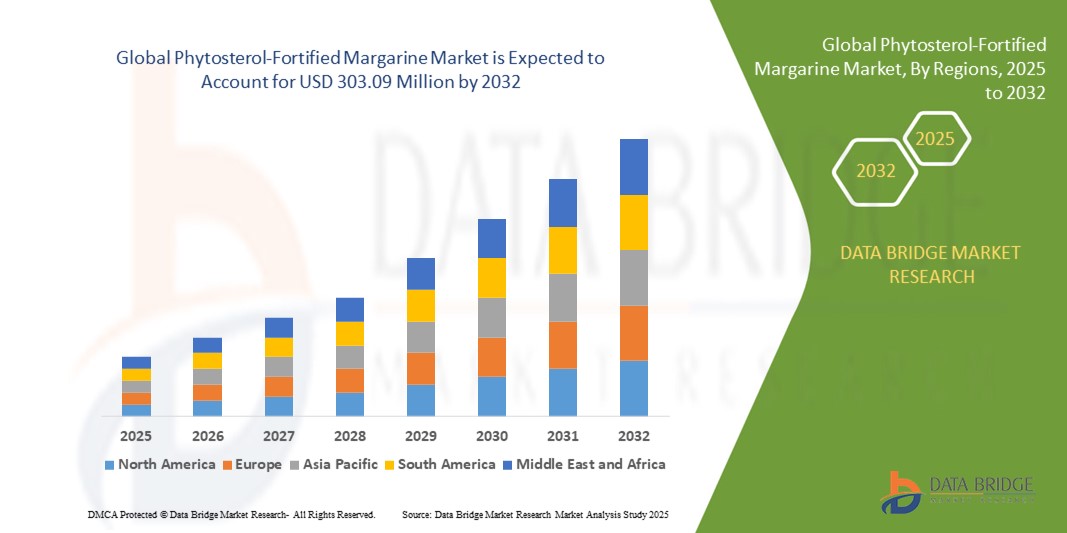
- The global phytosterol-fortified margarine market size was valued at USD 200.64 million in 2024 and is expected to reach USD 303.09 million by 2032, at a CAGR of 8.60% during the forecast period
- The market growth is largely fuelled by the increasing consumer focus on heart health, rising prevalence of cardiovascular diseases, and growing demand for functional foods that help in lowering cholesterol levels
- Rising awareness of plant-based diets and clean-label products is further accelerating consumer acceptance of phytosterol-fortified margarine as a healthier alternative to conventional spreads
Phytosterol-Fortified Margarine Market Analysis
- The market is experiencing significant traction as consumers increasingly prefer margarine fortified with phytosterols due to its proven ability to reduce LDL cholesterol levels
- Growing awareness about preventive healthcare, coupled with the rising trend of health-conscious dietary choices, is boosting adoption
- Europe dominated the phytosterol-fortified margarine market with the largest revenue share of 43% in 2024, driven by high consumer awareness of cardiovascular health and the strong presence of functional food products in the region
- Asia-Pacific region is expected to witness the highest growth rate in the global phytosterol-fortified margarine market, driven by rising disposable incomes, urbanization, and government initiatives promoting healthier dietary choices
- The spreadable segment held the largest market revenue share in 2024, supported by its wide adoption as a daily household food product and its ease of incorporation into bread, snacks, and regular meals. Spreadable fortified margarine is also marketed as a convenient functional food option for cholesterol-conscious consumers, boosting its demand
Report Scope and Phytosterol-Fortified Margarine Market Segmentation
|
Attributes |
Phytosterol-Fortified Margarine Key Market Insights |
|
Segments Covered |
|
|
Countries Covered |
North America
Europe
Asia-Pacific
Middle East and Africa
South America
|
|
Key Market Players |
|
|
Market Opportunities |
|
|
Value Added Data Infosets |
In addition to the insights on market scenarios such as market value, growth rate, segmentation, geographical coverage, and major players, the market reports curated by the Data Bridge Market Research also include in-depth expert analysis, pricing analysis, brand share analysis, consumer survey, demography analysis, supply chain analysis, value chain analysis, raw material/consumables overview, vendor selection criteria, PESTLE Analysis, Porter Analysis, and regulatory framework. |
Phytosterol-Fortified Margarine Market Trends
Rising Demand For Heart-Healthy Functional Foods
- The increasing consumer focus on heart health is driving demand for phytosterol-fortified margarine, which helps lower LDL cholesterol levels. With cardiovascular diseases remaining a leading global health concern, consumers are actively seeking functional food options that deliver proven health benefits without compromising taste
- Growing health awareness is pushing food manufacturers to expand product portfolios with fortified spreads. Easy incorporation into daily diets makes phytosterol-fortified margarine a practical choice for households, particularly among middle-aged and elderly consumers who are more prone to cholesterol-related conditions
- The rising popularity of clean-label and plant-based products is further accelerating adoption, as phytosterols are naturally derived from plants and align with the preferences of vegan and vegetarian consumers. This makes fortified margarine a healthier alternative to traditional spreads
- For instance, in 2024, several European food companies launched new margarine variants enriched with higher phytosterol content, marketed as heart-friendly options under preventive healthcare campaigns. These launches attracted significant consumer attention and boosted retail sales across supermarkets
- While the trend is gaining momentum, its long-term impact depends on continuous innovation, consumer education, and affordable pricing. Manufacturers must invest in awareness programs and product diversification strategies to maximize growth potential in the functional food space
Phytosterol-Fortified Margarine Market Dynamics
Driver
Increasing Prevalence Of Cardiovascular Diseases And Rising Consumer Awareness
- The rising global incidence of cardiovascular diseases is fueling the demand for cholesterol-lowering food products such as phytosterol-fortified margarine. Consumers are turning to functional spreads as a preventive measure to reduce health risks associated with high cholesterol
- Awareness campaigns by health organizations and endorsements from nutrition experts are strengthening consumer confidence in phytosterols. This has led to higher adoption among health-conscious buyers seeking non-pharmaceutical approaches to cholesterol management
- Governments and health authorities are actively promoting functional foods through dietary guidelines and supportive policies. Subsidies, health labeling, and regulatory approvals are helping expand the fortified margarine market
- For instance, in 2023, the U.S. Food and Drug Administration reinforced its health claim authorization for plant sterols and heart disease risk reduction, which directly supported product positioning and consumer trust in fortified margarines
- While awareness and institutional support are driving growth, there remains a need for wider retail penetration, stronger marketing communication, and targeted product development to ensure adoption across diverse consumer segments
Restraint/Challenge
High Cost Of Fortified Products And Limited Awareness In Developing Regions
- The relatively higher price of phytosterol-fortified margarine compared to regular margarine limits its accessibility among price-sensitive consumers, particularly in developing markets. Cost remains a significant barrier for mass adoption
- In many emerging regions, limited consumer awareness about the health benefits of phytosterols restricts demand. Without sufficient education, consumers often view fortified margarine as an unnecessary premium product
- Distribution challenges in rural and semi-urban areas further limit availability, as fortified margarine is often concentrated in modern trade outlets and urban supermarkets. This prevents wider adoption across broader populations
- For instance, in 2023, consumer surveys in parts of Asia-Pacific revealed that less than 30% of respondents were aware of the cholesterol-lowering benefits of phytosterols, highlighting the gap in health education and product communication
- While fortified spreads present strong potential, addressing affordability, raising awareness, and strengthening distribution networks will be essential to ensure wider market penetration and long-term growth
Phytosterol-Fortified Margarine Market Scope
The market is segmented on the basis of usage and distribution channel.
- By Usage
On the basis of usage, the phytosterol-fortified margarine market is segmented into spreadable and non-spreadable. The spreadable segment held the largest market revenue share in 2024, supported by its wide adoption as a daily household food product and its ease of incorporation into bread, snacks, and regular meals. Spreadable fortified margarine is also marketed as a convenient functional food option for cholesterol-conscious consumers, boosting its demand.
The non-spreadable segment is expected to witness the fastest growth rate from 2025 to 2032, driven by its increasing application in cooking, baking, and processed food manufacturing. Food companies are incorporating non-spreadable phytosterol-fortified margarine into packaged products to enhance health appeal, creating strong opportunities for growth in the industrial food sector.
- By Distribution Channel
On the basis of distribution channel, the market is segmented into retail, food sector, and industrial. The retail segment held the largest market revenue share in 2024, attributed to strong supermarket and hypermarket presence and the growing popularity of fortified functional foods among individual consumers. Expanding e-commerce platforms are also contributing to higher product visibility and accessibility in this segment.
The food sector segment is expected to witness the fastest growth from 2025 to 2032, driven by rising usage of fortified margarine in restaurants, bakeries, and catering services. Increasing consumer demand for healthier menu options is encouraging foodservice providers to integrate phytosterol-fortified margarine into their offerings, accelerating adoption across the sector.
Phytosterol-Fortified Margarine Market Regional Analysis
- Europe dominated the phytosterol-fortified margarine market with the largest revenue share of 43% in 2024, driven by high consumer awareness of cardiovascular health and the strong presence of functional food products in the region
- Favorable regulations supporting cholesterol-lowering claims and widespread distribution through supermarkets have further strengthened adoption across households
- Consumers in Europe highly value plant-based, heart-healthy spreads that align with preventive healthcare trends and lifestyle choices. The strong retail infrastructure and emphasis on healthy eating habits continue to sustain the region’s leadership in the market
U.K. Phytosterol-Fortified Margarine Market Insight
The U.K. market captured a substantial revenue share in 2024, driven by growing demand for cholesterol-lowering functional foods and the rising adoption of plant-based diets. Consumers are increasingly seeking fortified margarine as an everyday spread that supports heart health, while retailers continue to expand product availability in both offline and online channels. Preventive healthcare campaigns are also boosting awareness, contributing to steady market growth.
Germany Phytosterol-Fortified Margarine Market Insight
The Germany market is expected to witness the fastest growth from 2025 to 2032, supported by high consumer preference for fortified foods with scientifically backed health benefits. Germany’s focus on nutrition, combined with innovation in food technology and sustainability, is accelerating the adoption of phytosterol-fortified margarine. The integration of these spreads into both traditional diets and modern plant-based lifestyles positions Germany as a key growth hub.
North America Phytosterol-Fortified Margarine Market Insight
The North America market is expected to witness the fastest growth from 2025 to 2032, driven by rising cases of cardiovascular diseases and strong consumer interest in cholesterol-lowering foods. The region’s established functional food sector and high healthcare expenditure are pushing demand for phytosterol-enriched products. Growing collaborations between food manufacturers and healthcare institutions are further supporting the market’s expansion.
U.S. Phytosterol-Fortified Margarine Market Insight
The U.S. market is expected to witness the fastest growth from 2025 to 2032, supported by the FDA’s authorized health claims for phytosterols and consumer trust in functional foods. Increasing prevalence of obesity and cholesterol-related conditions has heightened demand for fortified spreads, while innovation in product formats and flavors is broadening consumer acceptance. Strong retail penetration and e-commerce channels further fuel growth.
Asia-Pacific Phytosterol-Fortified Margarine Market Insight
The Asia-Pacific market is expected to witness the fastest growth from 2025 to 2032, propelled by rising disposable incomes, rapid urbanization, and expanding awareness of preventive health solutions in countries such as China, Japan, and India. Growing demand for plant-based diets and supportive government initiatives promoting healthy food choices are creating strong opportunities for adoption across the region.
Japan Phytosterol-Fortified Margarine Market Insight
The Japan market is expected to witness the fastest growth from 2025 to 2032, driven by its health-conscious population and strong acceptance of functional foods. With cardiovascular health being a major concern, consumers are increasingly opting for fortified spreads as part of balanced diets. The integration of phytosterol-fortified margarine into modern foodservice channels and convenience-driven retail formats is further enhancing market presence.
China Phytosterol-Fortified Margarine Market Insight
China accounted for the largest revenue share in Asia-Pacific in 2024, supported by its expanding middle class, growing preference for healthy diets, and strong domestic production capabilities. Functional food adoption is rising rapidly, and fortified margarine is gaining traction in both urban households and commercial food sectors. The government’s push toward nutrition-focused health initiatives and the wide availability of affordable products are accelerating market growth in the country.
Phytosterol-Fortified Margarine Market Share
The Phytosterol-Fortified Margarine industry is primarily led by well-established companies, including:
- Bunge Limited (U.S.)
- BASF SE (Germany)
- Pharmachem Laboratories Inc (U.S.)
- DuPont (U.S.)
- Raisio Oyj (Finland)
- ADM (U.S.)
- Cargill, Incorporated (U.S.)
- Merck KGaA (Germany)
- Ashland (U.S.)
- Arboris LLC (U.S.)
- Hyphyto Inc. (U.S.)
- L'entreprise française DRT (France)
- PrimaPharma, Inc. (U.S.)
- Lipofoods SLU (Spain)
- Gustav Parmentier GmbH (Germany)
- The Lubrizol Corporation (U.S.)
- Unilever (U.K./Netherlands)
- Berkshire Hathaway Inc. (U.S.)
- Forbes Medi-Tech Inc. (Canada)
- Danone S.A. (France)
SKU-
世界初のマーケットインテリジェンスクラウドに関するレポートにオンラインでアクセスする

- インタラクティブなデータ分析ダッシュボード
- 成長の可能性が高い機会のための企業分析ダッシュボード
- カスタマイズとクエリのためのリサーチアナリストアクセス
- インタラクティブなダッシュボードによる競合分析
- 最新ニュース、更新情報、トレンド分析
- 包括的な競合追跡のためのベンチマーク分析のパワーを活用
調査方法
データ収集と基準年分析は、大規模なサンプル サイズのデータ収集モジュールを使用して行われます。この段階では、さまざまなソースと戦略を通じて市場情報または関連データを取得します。過去に取得したすべてのデータを事前に調査および計画することも含まれます。また、さまざまな情報ソース間で見られる情報の不一致の調査も含まれます。市場データは、市場統計モデルと一貫性モデルを使用して分析および推定されます。また、市場シェア分析と主要トレンド分析は、市場レポートの主要な成功要因です。詳細については、アナリストへの電話をリクエストするか、お問い合わせをドロップダウンしてください。
DBMR 調査チームが使用する主要な調査方法は、データ マイニング、データ変数が市場に与える影響の分析、および一次 (業界の専門家) 検証を含むデータ三角測量です。データ モデルには、ベンダー ポジショニング グリッド、市場タイムライン分析、市場概要とガイド、企業ポジショニング グリッド、特許分析、価格分析、企業市場シェア分析、測定基準、グローバルと地域、ベンダー シェア分析が含まれます。調査方法について詳しくは、お問い合わせフォームから当社の業界専門家にご相談ください。
カスタマイズ可能
Data Bridge Market Research は、高度な形成的調査のリーダーです。当社は、既存および新規のお客様に、お客様の目標に合致し、それに適したデータと分析を提供することに誇りを持っています。レポートは、対象ブランドの価格動向分析、追加国の市場理解 (国のリストをお問い合わせください)、臨床試験結果データ、文献レビュー、リファービッシュ市場および製品ベース分析を含めるようにカスタマイズできます。対象競合他社の市場分析は、技術ベースの分析から市場ポートフォリオ戦略まで分析できます。必要な競合他社のデータを、必要な形式とデータ スタイルでいくつでも追加できます。当社のアナリスト チームは、粗い生の Excel ファイル ピボット テーブル (ファクト ブック) でデータを提供したり、レポートで利用可能なデータ セットからプレゼンテーションを作成するお手伝いをしたりすることもできます。