



Middle East and Africa Hydrocolloids Market Segmentation, By Type (Gelatin, Pectin, Carrageenan, Xanthan Gum, Agar, and Others), Application (Food & Beverage, Pharmaceuticals, Personal Care & Cosmetics, and Others) – Industry Trends and Forecast to 2032
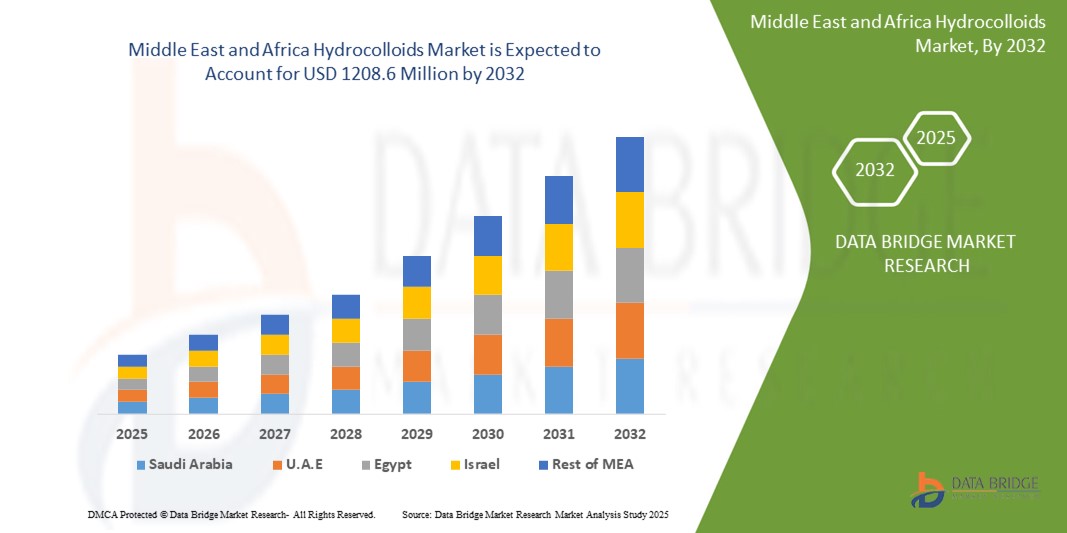
Hydrocolloids Market Size
- The Middle East and Africa hydrocolloids market size was valued at USD 690.5 million in 2024 and is expected to reach USD 1,208.6 million by 2032, growing at a CAGR of 7.20% during the forecast period.
- The market growth is primarily driven by rising demand in food and beverage processing, expanding pharmaceutical applications, and the shift toward natural, plant-based stabilizers and thickeners.
Hydrocolloids Market Analysis
- Hydrocolloids are a class of high-molecular-weight polymers widely used for their gelling, thickening, stabilizing, and emulsifying properties. They are critical in enhancing texture, shelf life, and quality in food, pharmaceutical, and cosmetic formulations.
- The market is witnessing robust growth across MEA, propelled by changing dietary habits, urbanization, and a growing health-conscious population seeking clean-label, plant-derived ingredients in processed foods and personal care products.
- Saudi Arabia is expected to dominate the MEA hydrocolloids market with a market share of 33.81%, owing to its expanding food processing sector, increasing pharmaceutical manufacturing, and strong investment in health and wellness products.
- South Africa is projected to be the fastest-growing country in the hydrocolloids market during the forecast period, driven by rising consumption of functional foods and beverages, increasing local production of dairy and meat products, and greater use of hydrocolloids in pharmaceutical delivery systems.
- The gelatin segment is expected to lead the market with a share of 29.65%, due to its versatility in applications ranging from food to capsules, and its ability to provide excellent gelling and stabilizing functions, especially in confectionery, dairy, and nutraceutical formulations.
Report Scope and Hydrocolloids Market Segmentation
|
Attributes |
Hydrocolloids Market Insights |
|
Segments Covered |
|
|
Countries Covered |
Middle East and Africa
|
|
Key Market Players |
|
|
Market Opportunities |
|
|
Value Added Data Infosets |
In addition to the insights on market scenarios such as market value, growth rate, segmentation, geographical coverage, and major players, the market reports curated by the Data Bridge Market Research also include in-depth expert analysis, pricing analysis, brand share analysis, consumer survey, demography analysis, supply chain analysis, value chain analysis, raw material/consumables overview, vendor selection criteria, PESTLE Analysis, Porter Analysis, and regulatory framework. |
Hydrocolloids Market Trends
“Shift Toward Clean Label and Plant-Based Hydrocolloids”
- A key trend in the MIDDLE EAST AND AFRICA hydrocolloids market is the increasing preference for clean-label and plant-based hydrocolloids, driven by evolving consumer preferences and health-conscious dietary choices.
- This trend is fueled by the rising demand for natural food ingredients, increased awareness about synthetic additives, and the growing vegan and flexitarian population across the region.
- For instance, major players like CP Kelco and Cargill are focusing on developing hydrocolloids such as pectin, guar gum, and xanthan gum derived from plant-based sources to cater to food and beverage manufacturers aiming for clean-label formulations.
- The trend also aligns with the regulatory push for transparency in food labeling and the demand for allergen-free, gluten-free, and additive-free alternatives.
- As consumers increasingly scrutinize product labels and opt for natural alternatives, clean-label hydrocolloids are expected to drive innovation and market expansion in the food, pharmaceutical, and personal care sectors.
Hydrocolloids Market Dynamics
Driver
“Rising Demand for Functional Ingredients in Food & Beverage Industry”
- The booming food and beverage sector in the MIDDLE EAST AND AFRICA is a key driver for the hydrocolloids market, as hydrocolloids play a vital role in texture modification, shelf-life extension, and stabilization of food products.
- Rapid urbanization, growing disposable incomes, and the increasing popularity of convenience and processed foods are fueling demand for hydrocolloids across dairy, bakery, confectionery, and ready-to-eat segments.
- For instance, companies such as DuPont Nutrition & Biosciences and Ingredion Incorporated are expanding their product lines to offer customized hydrocolloids for local taste preferences and functional needs in processed food applications.
- Additionally, rising health awareness has led to the use of hydrocolloids in low-fat, low-sugar, and fiber-enriched formulations, further boosting their demand.
- As regional food processors modernize operations and innovate product lines, the adoption of functional hydrocolloids is expected to accelerate, driving sustained market growth.
Restraint/Challenge
“High Cost of Natural and Specialty Raw Materials”
- The hydrocolloids market in MEA faces challenges due to price volatility and supply chain instability of key raw materials, such as guar, locust bean, seaweed, and citrus peels.
- As hydrocolloids are largely derived from agricultural or marine sources, fluctuations in weather conditions, crop yields, and geopolitical instability can significantly impact their availability and cost structure.
- For instance, disruptions in guar gum supply due to erratic monsoons in major producing countries like India can directly affect pricing and delivery timelines for MEA manufacturers and suppliers.
- Additionally, the reliance on imports for specific raw materials increases exposure to currency fluctuations and global trade dynamics, making it difficult for local manufacturers to maintain stable pricing.
- These factors pose a major restraint, particularly for small and medium-sized food and cosmetic producers seeking cost-effective hydrocolloid solutions, and may hinder broader adoption across price-sensitive segments.
Hydrocolloids Market Scope
The market is segmented on the basis of type, and application.
- By Type
On the basis of type, the Middle East and Africa Hydrocolloids Market is segmented into Gelatin, Pectin, Carrageenan, Xanthan Gum, Agar, and Others. The Gelatin segment dominates the largest market revenue share of 38.6% in 2025, owing to its widespread use in food & beverage, pharmaceutical, and personal care applications. Its excellent gelling, stabilizing, and emulsifying properties make it a preferred choice in confectionery, capsules, and cosmetics.
However, the Pectin segment is expected to grow at the highest CAGR of 7.35% during the forecast period of 2025–2032. This growth is primarily driven by the rising demand for clean-label, plant-based ingredients in jams, jellies, beverages, and dairy products, along with growing consumer preference for natural and vegan thickeners.
- By Application
On the basis of application, the Middle East and Africa Hydrocolloids Market is segmented into Food & Beverage, Pharmaceuticals, Personal Care & Cosmetics, and Others. The Food & Beverage segment held the largest market share of 46.9% in 2025, driven by increasing utilization of hydrocolloids as thickening, gelling, and stabilizing agents in dairy products, bakery items, sauces, and meat alternatives. The demand is further fueled by the trend towards plant-based and clean-label formulations in Middle East and Africa.
However, the Pharmaceuticals segment is expected to witness the highest CAGR of 6.87% during the forecast period. This is attributed to the expanding use of hydrocolloids in drug delivery systems, tablet binding, wound care, and capsule manufacturing, as the pharmaceutical industry increasingly adopts biocompatible and functional excipients to improve product performance and patient outcomes.
Middle East and Africa Hydrocolloids Market Insight
The MIDDLE EAST AND AFRICA hydrocolloids market is projected to grow steadily through 2025, supported by rising demand for processed food, increasing health awareness, and the region’s expanding food manufacturing capabilities. Growth in the bakery, dairy, beverage, and convenience foods sectors is driving adoption of hydrocolloids for their gelling, stabilizing, thickening, and emulsifying properties. Additionally, increased demand from pharmaceutical, cosmetics, and personal care industries for natural and plant-based ingredients is further boosting market penetration. Regulatory shifts toward clean-label and halal-certified products are also positively influencing hydrocolloid consumption patterns across the region.
- Saudi Arabia Hydrocolloids Market Insight
Saudi Arabia holds the largest market share in the MIDDLE EAST AND AFRICA hydrocolloids market, driven by its well-established food processing industry and strong demand for functional and clean-label ingredients. The country’s growing population, increasing urbanization, and rising health consciousness have accelerated the consumption of low-calorie, natural, and gluten-free food products, all of which rely on hydrocolloids for formulation.
Government-led initiatives under Vision 2030, which emphasize local food production, industrial diversification, and health sector development, are creating new avenues for hydrocolloid applications in nutraceuticals and pharmaceuticals. International ingredient players are also expanding their footprint in Saudi Arabia to tap into its evolving consumer landscape and robust manufacturing base.
- Italy Hydrocolloids Market Insight
The South Africa hydrocolloids market is set to witness significant CAGR growth, driven by increasing demand for packaged food, dairy products, and ready-to-eat meals. The country’s expanding middle class, coupled with growing supermarket penetration, has led to higher consumption of convenience foods, thereby driving the use of hydrocolloids as stabilizers and thickeners.
Furthermore, South Africa’s pharmaceutical and personal care industries are increasingly adopting hydrocolloids in formulations for topical creams, drug delivery systems, and clean-label cosmetics. The country is also seeing a rise in awareness about plant-based and allergen-free ingredients, prompting local manufacturers to reformulate products with natural hydrocolloids such as guar gum, carrageenan, and pectin.
貿易支援政策と地域販売業者の存在によりアクセス性が向上し、国内外の企業が南アフリカの消費者に合わせたハイドロコロイド ソリューションに投資することが奨励されています。
ハイドロコロイドの市場シェア
ハイドロコロイド市場業界は、主に次のような定評のある企業によって主導されています。
- エボニック インダストリーズ AG(ドイツ)
- ヘキシオン社(米国)
- ハンツマン・インターナショナルLLC(米国)
- カルドライト・コーポレーション(米国)
- BASF SE(ドイツ)
- アーネットポリマーズLLC(米国)
- アディティア・ビルラ・ケミカルズ(インド)
- モメンティブ・パフォーマンス・マテリアルズ(米国)
- ADEKA株式会社(日本)
- エアプロダクツ・アンド・ケミカルズ社(米国)
- 三菱ケミカル株式会社(日本)
- カーギル社(米国)
- ククドケミカル株式会社(韓国)
- ナガセケムテックス株式会社(日本)
- アトゥル株式会社(インド)
世界のハイドロコロイド市場の最新動向
- CPケルコは2025年3月、UAEとサウジアラビアを含む中東・アフリカの主要市場における流通ネットワークの拡大を発表しました。これは、地域の大手食品原料サプライヤーとの戦略的提携を通じたものです。この提携は、CPケルコの柑橘繊維、ペクチン、ジェランガムといったポートフォリオへのアクセスを向上させ、食品、飲料、パーソナルケア分野におけるクリーンラベルおよび機能性原料の需要の高まりに対応することを目的としています。
- イングレディオン・インコーポレーテッドは2025年1月、乳製品および菓子類におけるMEA用途向けに、オーガニック認証を受けた澱粉およびガムブレンドの新製品ラインを発売しました。これらの製品は、食感、安定性、そして天然由来成分といった地域特有のニーズを満たすよう特別に配合されており、ハラール、コーシャ、植物由来の配合に対する需要が高まる中、MEAハイドロコロイド市場におけるイングレディオンのプレゼンスを強化することが期待されます。
- 2024年10月、アッシュランド・グローバル・ホールディングス社は、南アフリカおよび湾岸地域で急成長を遂げているスキンケア・パーソナルケア市場をターゲットに、Natrosol™ブランドから新たなハイドロコロイドベースの増粘剤を発表しました。このイノベーションは、粘度コントロールと天然成分との適合性を向上させ、持続可能でナチュラルな化粧品処方を求める消費者のトレンドに合致しています。
- 2024年8月、カーギルは中東アフリカ(MEA)の乳製品および植物性飲料における天然テクスチャライザーの需要増加に対応し、海藻由来のカラギーナン製品のポートフォリオを拡大しました。また、北アフリカにおけるサプライチェーンの一部を現地化することで、供給の信頼性を高め、リードタイムを短縮する意向も発表し、急速に発展する同地域の食品加工セクターへのコミットメントを強化しました。
SKU-
世界初のマーケットインテリジェンスクラウドに関するレポートにオンラインでアクセスする

- インタラクティブなデータ分析ダッシュボード
- 成長の可能性が高い機会のための企業分析ダッシュボード
- カスタマイズとクエリのためのリサーチアナリストアクセス
- インタラクティブなダッシュボードによる競合分析
- 最新ニュース、更新情報、トレンド分析
- 包括的な競合追跡のためのベンチマーク分析のパワーを活用
調査方法
データ収集と基準年分析は、大規模なサンプル サイズのデータ収集モジュールを使用して行われます。この段階では、さまざまなソースと戦略を通じて市場情報または関連データを取得します。過去に取得したすべてのデータを事前に調査および計画することも含まれます。また、さまざまな情報ソース間で見られる情報の不一致の調査も含まれます。市場データは、市場統計モデルと一貫性モデルを使用して分析および推定されます。また、市場シェア分析と主要トレンド分析は、市場レポートの主要な成功要因です。詳細については、アナリストへの電話をリクエストするか、お問い合わせをドロップダウンしてください。
DBMR 調査チームが使用する主要な調査方法は、データ マイニング、データ変数が市場に与える影響の分析、および一次 (業界の専門家) 検証を含むデータ三角測量です。データ モデルには、ベンダー ポジショニング グリッド、市場タイムライン分析、市場概要とガイド、企業ポジショニング グリッド、特許分析、価格分析、企業市場シェア分析、測定基準、グローバルと地域、ベンダー シェア分析が含まれます。調査方法について詳しくは、お問い合わせフォームから当社の業界専門家にご相談ください。
カスタマイズ可能
Data Bridge Market Research は、高度な形成的調査のリーダーです。当社は、既存および新規のお客様に、お客様の目標に合致し、それに適したデータと分析を提供することに誇りを持っています。レポートは、対象ブランドの価格動向分析、追加国の市場理解 (国のリストをお問い合わせください)、臨床試験結果データ、文献レビュー、リファービッシュ市場および製品ベース分析を含めるようにカスタマイズできます。対象競合他社の市場分析は、技術ベースの分析から市場ポートフォリオ戦略まで分析できます。必要な競合他社のデータを、必要な形式とデータ スタイルでいくつでも追加できます。当社のアナリスト チームは、粗い生の Excel ファイル ピボット テーブル (ファクト ブック) でデータを提供したり、レポートで利用可能なデータ セットからプレゼンテーションを作成するお手伝いをしたりすることもできます。











