
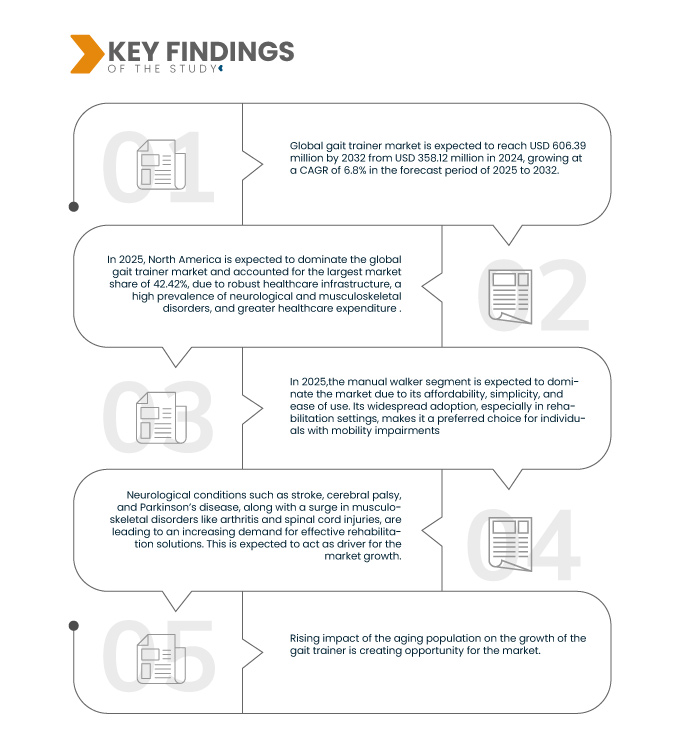
The growing prevalence of mobility disorders is a significant driver for the global gait trainer market. Neurological conditions such as stroke, cerebral palsy, and Parkinson’s disease, along with a surge in musculoskeletal disorders such as arthritis and spinal cord injuries, are leading to an increasing demand for effective rehabilitation solutions. As these conditions become more widespread, the healthcare system faces mounting pressure to provide effective and accessible treatments for patients suffering from limited mobility. Gait trainers, which offer specialized assistance in re-establishing motor control, enhancing posture, and improving walking patterns, have proven to be essential tools in rehabilitation settings. The rising incidence of these health conditions, combined with the growing need for advanced rehabilitation technologies, positions gait trainers as a key solution in improving the quality of life for affected individuals. This increased demand for gait training devices driven by the prevalence of mobility disorders directly fuels the growth and expansion of the global gait trainer market.
The growing incidence of mobility disorders, such as stroke, cerebral palsy, Parkinson’s disease, and musculoskeletal issues such as arthritis and spinal cord injuries, is driving the demand for gait trainers. These devices, which assist in restoring motor control and improving walking patterns, are becoming essential in rehabilitation. As these conditions rise, the need for effective, accessible treatment solutions boosts the growth of the global gait trainer market
Access Full Report @ https://www.databridgemarketresearch.com/reports/global-gait-trainer-market
Data Bridge Market Research analyzes that the Global Gait Trainer Market is expected to reach USD 606.39 million by 2032 from USD 358.12 million in 2024, growing at a CAGR of 6.8% in the forecast period of 2025 to 2032.
Key Findings of the Study
Technological Advancements in Gait Trainers
Technological advancements, particularly in Artificial Intelligence (AI) and robotics, have significantly enhanced the functionality and effectiveness of gait trainers. The integration of AI allows for real-time data analysis, enabling personalized rehabilitation programs that adjust to the patient’s progress and specific needs. Robotics further elevates the capabilities of gait trainers by providing precise, controlled movements that replicate natural walking patterns, improving both the quality of training and patient outcomes. These innovations not only make gait trainers more efficient in restoring mobility but also increase their appeal to healthcare providers seeking advanced, evidence-based solutions for patient rehabilitation. With healthcare systems increasingly prioritizing technology-driven treatments, the incorporation of AI and robotics in gait trainers has become a key factor in the market’s growth. As these technological advancements continue to improve the effectiveness and appeal of gait trainers, they act as a major driver for the global gait trainer market, attracting greater investment and widespread adoption across rehabilitation centers and clinics.
Advancements in AI and robotics have greatly improved gait trainers, making them more effective in rehabilitation. AI enables real-time, personalized programs that adapt to patient progress, while robotics ensure precise, natural movements, enhancing training quality and outcomes. These innovations make gait trainers more efficient and attractive to healthcare providers, driving market growth as technology-driven solutions gain priority in patient care.
Report Scope and Market Segmentation
Report Metric
|
Details
|
Forecast Period
|
2025 to 2032
|
Base Year
|
2024
|
Historic Year
|
2023 (Customizable 2017-2022)
|
Quantitative Units
|
Revenue in USD Billion
|
Segments Covered
|
Global Gait Trainner Market, By Product (Manual Walker, Treadmill, and Electric Walker), Type (Conventional/Standard Gait Trainer, Robot-Assisted Gait Trainer, and Others), Disorder (Orthopedic Disorders, Neurological Disorders, Stroke, Amputation, and Others), Age Group (Adults and Pediatric), End User (Into Hospitals, Rehabilitation Centers, Home Care Settings, Sports Centers, Trauma Centers, and Others), Distribution Channel (Direct Tenders, Retail Sales, and Others)
|
Countries Covered
|
U.S., Canada , Mexico, Germany, France, U.K., Italy, Spain, Russia, Netherlands, Switzerland, Turkey, Belgium, Austria, Ireland, Norway, Poland, Rest of Europe, Japan, China, India, South Korea, Australia, Singapore, Thailand, Malaysia, Indonesia, Vietnam, Philippines, Rest of Asia-Pacific, Brazil, Argentina, Peru, Rest of South America, South Africa, Saudi Arabia, U.A.E., Egypt, Kuwait, Israel, and Rest of Middle East & Africa
|
Market Players Covered
|
Ottobock (Germany), EKSO BIONICS (U.S.), ALTERG INC (U.S.), BIODEX (U.S.), and Cyberdyne Inc (Japan), HOCOMA (Switzerland), Rex Bionics Ltd (New Zealand), Reha-Stim Medtec (Germany), Sole Fitness (U.S.), Raincastle Communications (U.S.), Rifton Equipment (U.S.), Horizon Fitness (U.S.), and BIONIK (Canada), NordicTrack (U.S.), P&S Mechanics Co., Ltd. (Taiwan), Helius Medical Technologies Inc. (U.S.), and Spirit Fitness (U.S.)
|
Data Points Covered in the Report
|
In addition to the insights on market scenarios such as market value, growth rate, segmentation, geographical coverage, and major players, the market reports curated by the Data Bridge Market Research also include depth expert analysis, patient epidemiology, pipeline analysis, pricing analysis, and regulatory framework.
|
Segment Analysis
The global gait trainer markets segmented into six notable segments based on products, type, disorder, age group, end user, distribution channel.
- On the basis of product, the market is segmented into manual walker, treadmill, and electric walker
In 2025, the manual walker segment is expected to dominate the market with a market share of 49.18%
In 2025, the manual walker segment is expected to dominate the market with a market share of 49.18% due to manual walkers are cost-effective, easy to use, and provide essential mobility support, driving their dominance in the market.
- On the basis of type, the market is segmented into conventional/standard gait trainer, robot-assisted gait trainer, and others
In 2025, the conventional/standard gait trainer segment is expected to dominate the market with a market share of 54.61%
In 2025, the conventional/standard gait trainer segment is expected to dominate the market with a market share of 54.61% due to conventional gait trainers offer stable support, improved mobility, and are widely used in rehabilitation, leading to their market dominance.
- On the basis of disorder, the market is segmented into orthopedic disorders, neurological disorders, stroke, amputation, and others. In 2025, the orthopedic disorders segment is expected to dominate the market with a market share of 29.83%
- On the basis of age group, the market is segmented into adults and pediatric. In 2025, the adults segment is expected to dominate the market with a market share of 57.15%
- On the basis of end user, the market is segmented into hospitals, rehabilitation centers, home care settings, sports centers, trauma centers, and others. In 2025, the hospitals segment is expected to dominate the market with a market share of 32.69%
- On the basis of distribution channel, the market is segmented into direct tenders, retail sales, and others. The retail sales is further segmented into offline and online. In 2025, the direct tenders segment is expected to dominate the market with a market share of 54.44%
Major Players
Data Bridge Market Research analyzes Ottobock (Germany) , EKSO BIONICS (U.S.), ALTERG INC (U.S.), BIODEX (U.S.), and Cyberdyne Inc (Japan) as the major market players.
Market Development
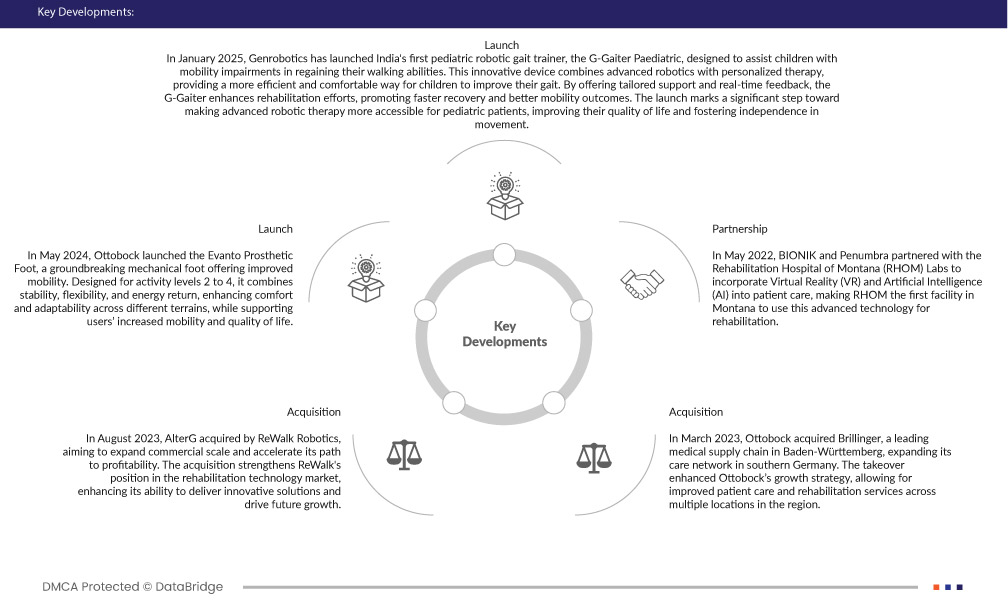
- In January 2025, Helius Medical Technologies, Inc. announced encouraging results from the PoNS Therapeutic Experience Program (PoNSTEP) study for individuals with Multiple Sclerosis (MS). The findings from this study reinforce existing evidence of PoNS' effectiveness, based on both clinical data and real-world use, by showing the lasting impact of the therapy and further supporting its long-term therapeutic benefits.
- In September 2024, Helius Medical Technologies, Inc. announced positive preliminary results from its Therapeutic Experience Program open-label observational study (PoNSTEP), which assesses the impact of subjects' adherence to the Portable Neuromodulation Stimulator (PoNS) Therapy program for treating gait deficits caused by multiple sclerosis (MS). The treatment phase of the study has been completed, and the ongoing post-treatment follow-up phase is expected to conclude by the end of the year, with full results anticipated in early 2025.
- In April 2024, Helius Medical Technologies, Inc. announced a partnership with Lovell Government Services, an SBA-certified Service-Disabled Veteran-Owned Small Business (SDVOSB), to offer the Company’s Portable Neuromodulation Stimulator (PoNS) device to federal healthcare systems. PoNS is approved in the U.S. for short-term Treatment Of Gait Deficits In Adults With Mild-To-Moderate Multiple sclerosis (MS) symptoms, when used alongside physical therapy.
- In February 2024, Horizon Fitness introduced the Horizon 7.0AT treadmill as a new addition to their Studio series. This state-of-the-art treadmill is equipped with Bluetooth connectivity, a free app to control workouts and sync with popular fitness platforms, and one-touch keys for quick adjustments to speed and incline. It features a 60-inch cushioned deck for a comfortable workout experience and a one-step hydraulic folding mechanism for convenient storage. Additionally, the treadmill is backed by a lifetime warranty on the frame and motor, offering long-lasting durability and reliability.
- In May 2024, the Johnson Health Tech broadened its global footprint by acquiring well-known fitness brands BowFlex, Schwinn, and JRNY. This acquisition aligns with their strategy to improve their product lineup and enhance customer service by incorporating some of the most trusted names in connected home fitness equipment.
Regional Analysis
Geographically, the countries covered in the global gait trainer market report are the U.S., Canada, Mexico, Germany, France, U.K., Italy, Spain, Russia, Netherlands, Switzerland, Turkey, Belgium, Austria, Ireland, Norway, Poland, Rest of Europe, Japan, China, India, South Korea, Australia, Singapore, Thailand, Malaysia, Indonesia, Vietnam, Philippines, Rest of Asia-Pacific, Brazil, Argentina, Peru, Rest of South America, South Africa, Saudi Arabia, U.A.E., Egypt, Kuwait, Israel, Rest of Middle East & Africa.
North America is expected to dominate the global gait trainer market
North America is expected to dominate the global gait trainer market due to advanced healthcare infrastructure, high demand for rehabilitation solutions, and a growing aging population. The region's focus on innovation and accessibility also drives the market.
The Asia-Pacific region is the fastest-growing in the gait trainer market, driven by a large aging population, increasing healthcare investments, and growing awareness of rehabilitation technologies in countries such as Japan, China, and India.
As per Data Bridge Market Research analysis:
For more detailed information about the global gait trainer market report, click here – https://www.databridgemarketresearch.com/reports/global-gait-trainer-market










