



Global AI-Driven Pathology Tools Market Segmentation, By Product Type (Software, Services), Technology (Machine Learning, Deep Learning, Natural Language Processing (NLP)), Mode of Deployment (On-premise, Cloud-based), Application (Diagnostic Pathology, Research & Drug Development, Forensic Pathology, Personalized Medicine), End User (Hospitals & Clinics, Research Laboratories, Diagnostic Laboratories, Forensic Institutions) – Industry Trends and Forecast to 2032
AI-Driven Pathology Tools Market Analysis
The global AI-driven pathology tools market is experiencing rapid growth driven by advancements in machine learning, deep learning, and image recognition technologies. AI tools are transforming pathology by enabling more accurate and faster diagnoses, especially in cancer detection, where AI has shown a diagnostic accuracy of over 90% in some studies. For instance, in breast cancer, AI-based pathology tools have demonstrated a 96% accuracy rate in identifying malignant tumors. The rising prevalence of cancer, with an estimated 19.3 million new cases globally in 2020 according to the World Health Organization (WHO), significantly contributes to the demand for these tools. Additionally, AI applications in pathology are expanding in research and drug development, with AI tools facilitating faster drug discovery processes, as evidenced by AI-driven analyses in genomic studies. With increasing adoption in both clinical and research settings, AI tools are becoming integral to improving patient outcomes and operational efficiencies in pathology.
AI-Driven Pathology Tools Market Size
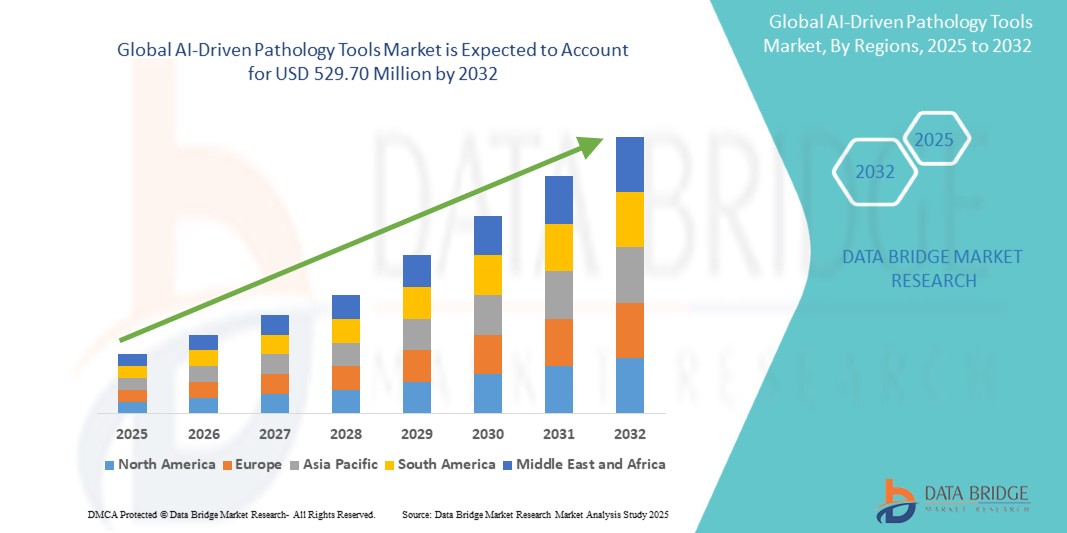
Global AI-driven pathology tools market size was valued at USD 156.82 million in 2024 and is projected to reach USD 529.70 million by 2032, with a CAGR of 16.40% during the forecast period of 2025 to 2032. In addition to the insights on market scenarios such as market value, growth rate, segmentation, geographical coverage, and major players, the market reports curated by the Data Bridge Market Research also include depth expert analysis, patient epidemiology, pipeline analysis, pricing analysis, and regulatory framework.
AI-Driven Pathology Tools Market Trends
“Focus on Cancer Diagnosis”
In oncology, the demand for AI pathology tools is increasingly focused on enhancing cancer diagnosis. AI is being integrated into cancer detection workflows, offering significant improvements in early diagnosis and tumor grading. These tools utilize deep learning algorithms to analyze pathology slides and imaging data, identifying patterns that may be difficult for human pathologists to detect. By accurately grading tumors and assessing their characteristics, AI tools help in determining the most appropriate treatment plans for patients. The growing prevalence of cancer globally, along with advancements in AI, is making these tools essential in oncology for providing faster, more accurate diagnoses, which are crucial for improving patient outcomes and survival rates.
Report Scope and AI-Driven Pathology Tools Market Segmentation
|
Attributes |
AI-Driven Pathology Tools Key Market Insights |
|
Segments Covered |
|
|
Countries Covered |
U.S., Canada, Mexico, Germany, France, U.K., Netherlands, Switzerland, Belgium, Russia, Italy, Spain, Turkey, Rest of Europe, China, Japan, India, South Korea, Singapore, Malaysia, Australia, Thailand, Indonesia, Philippines, Rest of Asia-Pacific, Saudi Arabia, U.A.E., South Africa, Egypt, Israel, Rest of Middle East and Africa, Brazil, Argentina, Rest of South America |
|
Key Market Players |
PathAI, Inc. (U.S.), Ibex Medical Analytics Ltd. (Israel), Tempus Labs, Inc. (U.S.), Proscia Inc. (U.S.), DeepLens, Inc. (U.S.), Paige.AI, Inc. (U.S.), Vuno Inc. (South Korea), FUJIFILM Corporation (Japan), Koninklijke Philips N.V. (Netherlands), IBM Corporation (U.S.), Zebra Medical Vision, Inc. (Israel), Pathcore Inc. (Canada), DXC Technology Company (U.S.), Qure.ai Technologies Pvt. Ltd. (India), Mindpeak GmbH (Germany), MetaSystems GmbH (Germany), Medical Informatics Corp. (U.S.), Huron Digital Pathology Inc. (Canada) among others. |
|
Market Opportunities |
|
|
Value Added Data Infosets |
In addition to the insights on market scenarios such as market value, growth rate, segmentation, geographical coverage, and major players, the market reports curated by the Data Bridge Market Research also include depth expert analysis, patient epidemiology, pipeline analysis, pricing analysis, and regulatory framework. |
AI-Driven Pathology Tools Market Definition
AI-driven pathology tools refer to advanced technologies that utilize artificial intelligence (AI) and machine learning algorithms to assist pathologists in diagnosing diseases, particularly cancer, by analyzing pathology slides and medical images. These tools automate tasks such as image recognition, tumor detection, classification, and grading, providing more accurate and efficient results compared to traditional methods. AI-driven pathology tools help in enhancing the speed, precision, and consistency of diagnoses, enabling pathologists to identify patterns that might be difficult to detect manually. These tools are integrated into clinical and research settings to improve patient outcomes and support personalized medicine.
AI-Driven Pathology Tools Market Dynamics
Drivers
- Rising Prevalence of Chronic Diseases and Cancer
The rising prevalence of chronic diseases, particularly cancer, is significantly driving the demand for AI-driven pathology tools. With cancer cases increasing globally, AI tools are being increasingly integrated into pathology workflows to assist in early diagnosis, more accurate tumor grading, and the development of personalized treatment plans. These tools can analyze complex medical images, detecting even the smallest abnormalities that may be overlooked by human eyes, thus aiding in early detection when treatments are most effective. AI-driven tools also play a critical role in grading tumors, providing more precise assessments of cancer stages, which directly impacts treatment decisions. As the incidence of chronic diseases, especially cancer, continues to rise, AI tools are becoming indispensable in improving diagnostic efficiency and accuracy.
The growing burden of chronic diseases, coupled with advancements in AI, is reshaping the landscape of pathology, enhancing both early diagnosis and personalized care for better patient outcomes.
- Advancements in Artificial Intelligence and Machine Learning
Advancements in artificial intelligence (AI) and machine learning (ML) are revolutionizing the field of pathology, leading to the development of more sophisticated tools capable of analyzing large datasets and enhancing diagnostic accuracy. As AI and ML technologies evolve, pathology tools can now process vast amounts of medical images with greater precision, identifying even the most subtle abnormalities that might be missed by human pathologists. These advancements enable AI-driven tools to significantly improve areas such as tumor detection, grading, and prognosis, providing more detailed and accurate insights for clinicians. Furthermore, AI algorithms can automate routine tasks like image classification, reducing the workload for pathologists and allowing them to focus on more complex cases. As these technologies continue to progress, the integration of AI-driven pathology tools into clinical workflows is expected to increase, improving both the speed and quality of diagnoses. Advancements in AI and ML are enhancing the capabilities of pathology tools, making them essential for more efficient and accurate disease diagnosis.
Opportunities
- Integration with Genomics and Personalized Medicine
The integration of AI-driven pathology tools with genomics and personalized medicine offers a significant opportunity to advance healthcare. By combining AI with genetic data and biomarker analysis, these tools can help create more tailored and precise treatment plans for individual patients. This is particularly crucial in oncology, where genetic mutations and molecular profiling play a key role in determining the most effective therapies. AI can analyze vast amounts of genetic information alongside pathology data, identifying patterns and correlations that may be difficult for clinicians to detect manually. As a result, this integration enables the development of better-targeted therapies, improving treatment outcomes and minimizing side effects. In addition, it helps facilitate the shift towards precision medicine, where care is personalized based on a patient’s unique genetic and clinical profile.
The synergy between AI-driven pathology tools and genomics has the potential to significantly enhance personalized healthcare, particularly in the treatment of complex diseases like cancer.
- Collaboration with Pharmaceutical and Biotech Companies
Collaboration between AI-driven pathology tools and pharmaceutical or biotechnology companies offers valuable opportunities to enhance drug development processes. By leveraging AI tools, these companies can accelerate the discovery of new drug targets and improve clinical trial outcomes. AI can streamline the analysis of pathology images and tissue samples, helping identify key biomarkers and disease patterns that might otherwise go unnoticed. This capability is particularly important in early-stage drug development, where AI can assist in selecting the right patient populations and predicting responses to therapies. In clinical trials, AI-driven pathology tools can also enhance data accuracy, enabling faster and more reliable assessments of drug efficacy and safety. Additionally, these tools can support biomarker discovery, which is essential for developing personalized treatments.
For instance,
- In November 2024, according to an article published by Deep Bio Inc., Deep Bio Inc. has partnered with PathAI to integrate its DeepDx Prostate cancer analysis solution with PathAI’s AISight1 Image Management System. This collaboration combines Deep Bio's AI technology with PathAI's platform, enhancing access to advanced diagnostic tools for prostate cancer. It presents an opportunity for both companies to further engage with pharmaceutical and biotech firms, aiding in drug development and clinical trials through improved diagnostic capabilities
Partnering with pharmaceutical and biotech companies allows AI-driven pathology tools to play a pivotal role in advancing drug research, clinical trials, and personalized medicine, improving overall drug development efficiency.
Restraints/Challenges
- High Cost of Implementation
The high cost of implementation is a significant restraint in the AI-driven pathology tools market. Developing, integrating, and maintaining AI-powered systems require considerable investment in technology, infrastructure, and skilled personnel. Healthcare institutions, especially those in emerging markets or regions with limited resources, may struggle to afford the expensive tools and software necessary for AI integration. The upfront costs also extend to the training of pathologists and healthcare professionals to effectively use these advanced systems. Additionally, regular updates, system maintenance, and the need for specialized staff to operate AI tools further contribute to ongoing expenses. This financial burden can slow the adoption of AI-driven pathology tools, particularly in hospitals and clinics with tight budgets.
The high costs associated with AI implementation and training present a barrier to market growth, especially in resource-constrained settings, limiting the widespread use of these technologies in pathology.
- Data Privacy and Security Concerns
Data privacy and security concerns represent a significant challenge for the AI-driven pathology tools market. These tools rely on the collection, analysis, and storage of sensitive patient data, such as medical images and genetic information, which heightens the risk of potential breaches and unauthorized access. With the increasing use of AI in healthcare, protecting this data from cyber threats becomes crucial. Healthcare institutions must adhere to strict regulations, such as GDPR in Europe and HIPAA in the U.S., to ensure patient data is handled securely. However, the complexity and cost of implementing these compliance measures can be a barrier. Moreover, the integration of AI systems into existing healthcare infrastructures raises additional concerns about securely transferring and storing patient data. A security breach could lead to legal issues, loss of patient trust, and ultimately hinder the adoption of AI-driven pathology tools. Addressing these data security challenges is vital to ensuring the successful growth and adoption of AI in pathology.
AI-Driven Pathology Tools Market Scope
The market is segmented on the basis of product type, technology, mode of deployment, application, and end user. The growth amongst these segments will help you analyze meagre growth segments in the industries and provide the users with a valuable market overview and market insights to help them make strategic decisions for identifying core market applications.
Product Type
- Software
- Services
Technology
- Machine Learning
- Deep Learning
- Natural Language Processing (NLP)
Mode of Deployment
- On-premise
- Cloud-based
Application
- Diagnostic Pathology
- Research & Drug Development
- Forensic Pathology
- Personalized Medicine
End User
- Hospitals & Clinics
- Research Laboratories
- Diagnostic Laboratories
- Forensic Institutions
AI-Driven Pathology Tools Market Regional Analysis
The market is analyzed and market size insights and trends are provided by country, product type, technology, mode of deployment, application, and end user as referenced above.
The countries covered in the market are U.S., Canada, Mexico, Germany, France, U.K., Netherlands, Switzerland, Belgium, Russia, Italy, Spain, Turkey, rest of Europe, China, Japan, India, South Korea, Singapore, Malaysia, Australia, Thailand, Indonesia, Philippines, rest of Asia-Pacific, Saudi Arabia, U.A.E., South Africa, Egypt, Israel, rest of Middle East and Africa, Brazil, Argentina, and rest of South America.
North America is expected to dominate the market due to its advanced healthcare infrastructure, high adoption rate of AI technologies, and strong presence of key players in the region.
Asia-Pacific is expected to be the fastest growing due to the increasing healthcare investments, rising prevalence of chronic diseases, and growing adoption of advanced technologies in countries like China and India.
The country section of the report also provides individual market impacting factors and changes in regulation in the market domestically that impacts the current and future trends of the market. Data points like down-stream and upstream value chain analysis, technical trends and porter's five forces analysis, case studies are some of the pointers used to forecast the market scenario for individual countries. Also, the presence and availability of global brands and their challenges faced due to large or scarce competition from local and domestic brands, impact of domestic tariffs and trade routes are considered while providing forecast analysis of the country data.
AI-Driven Pathology Tools Market Share
The market competitive landscape provides details by competitor. Details included are company overview, company financials, revenue generated, market potential, investment in research and development, new market initiatives, global presence, production sites and facilities, production capacities, company strengths and weaknesses, product launch, product width and breadth, application dominance. The above data points provided are only related to the companies' focus related to market.
AI-Driven Pathology Tools Market Leaders Operating in the Market Are:
- PathAI, Inc. (U.S.)
- Ibex Medical Analytics Ltd. (Israel)
- Tempus Labs, Inc. (U.S.)
- Proscia Inc. (U.S.)
- DeepLens, Inc. (U.S.)
- Paige.AI, Inc. (U.S.)
- Vuno Inc. (South Korea)
- FUJIFILM Corporation (Japan)
- Koninklijke Philips N.V. (Netherlands)
- IBM Corporation (U.S.)
- Zebra Medical Vision, Inc. (Israel)
- Pathcore Inc. (Canada)
- DXC Technology Company (U.S.)
- Qure.ai Technologies Pvt. Ltd. (India)
- Mindpeak GmbH (Germany)
- MetaSystems GmbH (Germany)
- Medical Informatics Corp. (U.S.)
- Huron Digital Pathology Inc. (Canada)
Latest Developments in Global AI-Driven Pathology Tools Market
- In November 2024, PathAI, has integrated AI products from top companies like Deep Bio, DoMore Diagnostics, Paige, and Visiopharm into its AISight1 Image Management System (IMS). This collaboration enhances AISight's versatility, reliability, and interoperability, allowing PathAI to offer a more comprehensive and seamless solution, strengthening its position in the market
- In November 2024, Deep Bio has partnered with PathAI to integrate its DeepDx Prostate solution for prostate cancer analysis with PathAI's AISight1 Image Management System (IMS). This collaboration combines Deep Bio's AI technology with PathAI's platform, enhancing access to advanced diagnostic tools for prostate cancer, and strengthening both companies' positions in the digital pathology market
- In November 2024, Aiforia and Paige have formed a non-exclusive partnership to integrate Paige’s Diagnostic AI applications into the Aiforia Platform, enhancing functionality and performance. This collaboration will improve laboratory efficiency, diagnostic accuracy, and patient care, helping both companies deliver advanced AI-powered solutions to their customers. This partnership strengthens their market presence and offers more comprehensive diagnostic tools
- In November 2024, Royal Philips expanded its strategic collaboration with Amazon Web Services (AWS) to offer its integrated diagnostics portfolio, including radiology, digital pathology, cardiology, and AI solutions, in the cloud. This collaboration will streamline diagnostic workflows, enhance access to critical insights, and improve clinical outcomes, further strengthening Philips’ position in the healthcare technology market
- In June 2024, Quest Diagnostics completed its acquisition of PathAI Diagnostics to accelerate the adoption of AI and digital pathology in cancer and disease diagnosis. This acquisition will enhance Quest's diagnostic capabilities, enabling more accurate and efficient disease detection through advanced AI technologies
- In February 2024, F. Hoffmann-La Roche Ltd entered into an exclusive agreement with PathAI to develop AI-enabled digital pathology algorithms for companion diagnostics through Roche Tissue Diagnostics (RTD). While RTD will collaborate solely with PathAI on these algorithms, it retains the ability to develop its own in-house algorithms. This partnership will enhance Roche’s diagnostic capabilities and accelerate the development of personalized treatments through advanced AI-powered solutions
SKU-
세계 최초의 시장 정보 클라우드 보고서에 온라인으로 접속하세요

- 대화형 데이터 분석 대시보드
- 높은 성장 잠재력 기회를 위한 회사 분석 대시보드
- 사용자 정의 및 질의를 위한 리서치 분석가 액세스
- 대화형 대시보드를 통한 경쟁자 분석
- 최신 뉴스, 업데이트 및 추세 분석
- 포괄적인 경쟁자 추적을 위한 벤치마크 분석의 힘 활용
연구 방법론
데이터 수집 및 기준 연도 분석은 대규모 샘플 크기의 데이터 수집 모듈을 사용하여 수행됩니다. 이 단계에는 다양한 소스와 전략을 통해 시장 정보 또는 관련 데이터를 얻는 것이 포함됩니다. 여기에는 과거에 수집한 모든 데이터를 미리 검토하고 계획하는 것이 포함됩니다. 또한 다양한 정보 소스에서 발견되는 정보 불일치를 검토하는 것도 포함됩니다. 시장 데이터는 시장 통계 및 일관된 모델을 사용하여 분석하고 추정합니다. 또한 시장 점유율 분석 및 주요 추세 분석은 시장 보고서의 주요 성공 요인입니다. 자세한 내용은 분석가에게 전화를 요청하거나 문의 사항을 드롭하세요.
DBMR 연구팀에서 사용하는 주요 연구 방법론은 데이터 마이닝, 시장에 대한 데이터 변수의 영향 분석 및 주요(산업 전문가) 검증을 포함하는 데이터 삼각 측량입니다. 데이터 모델에는 공급업체 포지셔닝 그리드, 시장 타임라인 분석, 시장 개요 및 가이드, 회사 포지셔닝 그리드, 특허 분석, 가격 분석, 회사 시장 점유율 분석, 측정 기준, 글로벌 대 지역 및 공급업체 점유율 분석이 포함됩니다. 연구 방법론에 대해 자세히 알아보려면 문의를 통해 업계 전문가에게 문의하세요.
사용자 정의 가능
Data Bridge Market Research는 고급 형성 연구 분야의 선두 주자입니다. 저희는 기존 및 신규 고객에게 목표에 맞는 데이터와 분석을 제공하는 데 자부심을 느낍니다. 보고서는 추가 국가에 대한 시장 이해(국가 목록 요청), 임상 시험 결과 데이터, 문헌 검토, 재생 시장 및 제품 기반 분석을 포함하도록 사용자 정의할 수 있습니다. 기술 기반 분석에서 시장 포트폴리오 전략에 이르기까지 타겟 경쟁업체의 시장 분석을 분석할 수 있습니다. 귀하가 원하는 형식과 데이터 스타일로 필요한 만큼 많은 경쟁자를 추가할 수 있습니다. 저희 분석가 팀은 또한 원시 엑셀 파일 피벗 테이블(팩트북)로 데이터를 제공하거나 보고서에서 사용 가능한 데이터 세트에서 프레젠테이션을 만드는 데 도움을 줄 수 있습니다.











