



Global AI-Powered Drug Delivery Systems Market Segmentation, By Drug Type (Small Molecule Drugs, Biologics, Gene Therapy Drugs, Protein Drugs, Others), Technology (Machine Learning (ML), Deep Learning (DL), Natural Language Processing (NLP), Neural Networks, Reinforcement Learning), Component (Hardware, Software, Services), Application (Cancer Treatment, Diabetes Management, Cardiovascular Diseases, Neurological Disorders, Pain Management, Respiratory Diseases, Others), Route of Administration (Oral, Injectable, Transdermal, Inhalation, Ocular, Others), End User (Hospitals, Research Institutions, Pharmaceutical Companies, Biotech Companies, Clinics, Others) – Industry Trends and Forecast to 2032
AI-Powered Drug Delivery Systems Market Analysis
The AI-powered drug delivery systems market is experiencing significant growth due to the increasing prevalence of chronic diseases and the need for personalized medicine. With conditions such as cancer, diabetes, and neurological disorders on the rise, AI-powered systems are transforming drug delivery methods by improving precision and optimizing therapeutic outcomes. For instance, the global cancer burden is expected to reach 30 million cases by 2040, driving the demand for innovative drug delivery solutions that can target tumors more effectively. Similarly, the prevalence of diabetes is anticipated to affect over 700 million people worldwide by 2045, further fueling the demand for AI-driven drug delivery technologies to manage and administer insulin with greater accuracy. Additionally, AI's ability to analyze vast datasets and predict patient responses is enhancing treatment efficacy and reducing side effects, particularly in complex diseases. With growing adoption in personalized healthcare and advancements in AI algorithms, these systems are poised to revolutionize medical treatment across various therapeutic areas.
AI-Powered Drug Delivery Systems Market Size
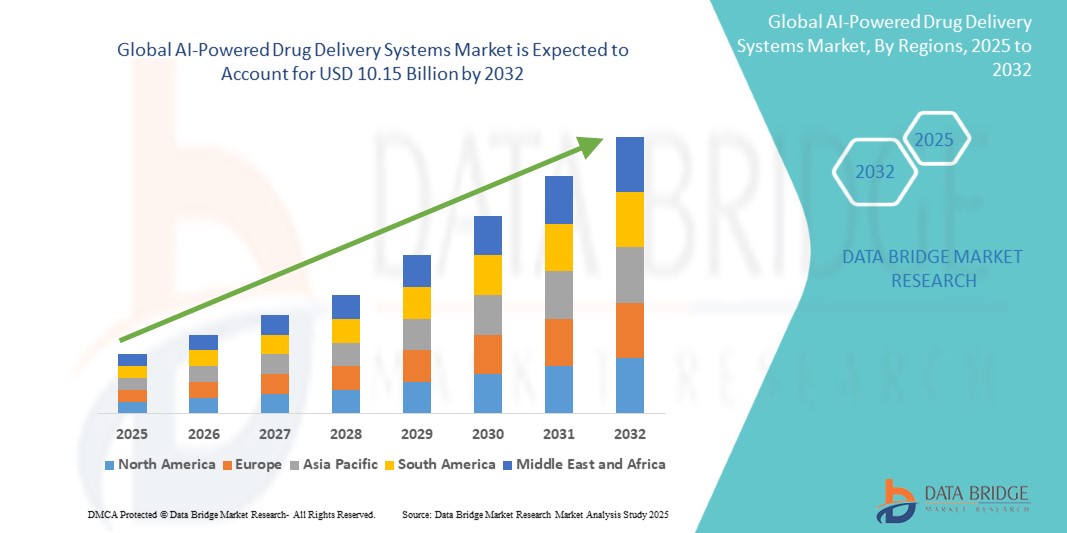
Global AI-powered drug delivery systems market size was valued at USD 2.05 billion in 2024 and is projected to reach USD 10.15 billion by 2032, with a CAGR of 22.10% during the forecast period of 2025 to 2032. In addition to the insights on market scenarios such as market value, growth rate, segmentation, geographical coverage, and major players, the market reports curated by the Data Bridge Market Research also include depth expert analysis, patient epidemiology, pipeline analysis, pricing analysis, and regulatory framework.
Global AI-Powered Drug Delivery Systems Market Trends
“Rising Focus on Non-Invasive Delivery Methods”
A notable trend in the AI-powered drug delivery systems market is the increasing reliance on non-invasive drug delivery methods, such as transdermal patches and inhalable drug delivery devices. These methods are gaining attention due to their ability to offer a more convenient and patient-friendly approach to medication administration. With the integration of AI, these systems are becoming more precise, allowing for better control over drug release and dosage, and enhancing treatment adherence. Unlike traditional invasive methods, which can carry higher risks of complications and discomfort, non-invasive systems minimize these issues, offering a more comfortable experience for patients. As these technologies evolve, they continue to meet the demand for effective, less intrusive, and more efficient drug delivery solutions in managing various chronic and acute conditions.
Report Scope and Global AI-Powered Drug Delivery Systems Market Segmentation
|
Attributes |
AI-Powered Drug Delivery Systems Key Market Insights |
|
Segments Covered |
|
|
Countries Covered |
U.S., Canada, Mexico, Germany, France, U.K., Netherlands, Switzerland, Belgium, Russia, Italy, Spain, Turkey, Rest of Europe, China, Japan, India, South Korea, Singapore, Malaysia, Australia, Thailand, Indonesia, Philippines, Rest of Asia-Pacific, Saudi Arabia, U.A.E., South Africa, Egypt, Israel, Rest of Middle East and Africa, Brazil, Argentina, Rest of South America |
|
Key Market Players |
BD (U.S.), Medtronic (Ireland), Insulet Corporation (U.S.), Novartis International AG (Switzerland), Johnson & Johnson Services, Inc. (U.S.), F. Hoffmann-La Roche Ltd (Switzerland), Pfizer Inc. (U.S.), AbbVie Inc. (U.S.), Zynerba Pharmaceuticals, Inc. (U.S.), Hikma Pharmaceuticals PLC (U.K.), Elanco Animal Health (U.S.), Cerus Corporation (U.S.), Siemens Healthineers (Germany), Stryker Corporation (U.S.), Dexcom, Inc. (U.S.), Huma Therapeutics (U.K.), Veeva Systems Inc. (U.S.), Intralytix, Inc. (U.S.), and Viatris Inc. (U.S.), among others. |
|
Market Opportunities |
|
|
Value Added Data Infosets |
In addition to the insights on market scenarios such as market value, growth rate, segmentation, geographical coverage, and major players, the market reports curated by the Data Bridge Market Research also include depth expert analysis, patient epidemiology, pipeline analysis, pricing analysis, and regulatory framework. |
AI-Powered Drug Delivery Systems Market Definition
AI-powered drug delivery systems refer to advanced drug delivery technologies that leverage artificial intelligence (AI) to enhance the precision, efficiency, and personalization of medication administration. These systems use AI algorithms, such as machine learning and data analytics, to optimize drug release mechanisms, monitor patient responses in real-time, and adjust dosing schedules. By integrating AI, these systems enable more targeted therapies, reduce side effects, improve patient compliance, and enable personalized treatment regimens based on individual patient data. AI-powered drug delivery methods include wearable devices, implantable systems, transdermal patches, and inhalable devices, all aimed at improving therapeutic outcomes.
AI-Powered Drug Delivery Systems Market Dynamics
Drivers
- Rising Prevalence of Chronic Diseases
The rising prevalence of chronic diseases, including diabetes, cardiovascular diseases, and cancer, is significantly driving the demand for more efficient and targeted drug delivery systems. These conditions often require long-term treatment regimens, which can be challenging in terms of patient adherence and proper drug administration. AI-powered drug delivery systems address these challenges by offering personalized, precise treatment solutions that optimize the timing, dosage, and method of drug delivery. AI technologies can continuously monitor patient data and adjust drug release, ensuring that the medication is delivered at the right time and in the correct amount. This ability to provide tailored therapies enhances treatment efficacy and reduces the risk of complications, which is crucial for managing chronic conditions. As the global burden of these diseases increases, AI-powered drug delivery systems are poised to play an essential role in improving patient outcomes, ensuring better management, and reducing healthcare costs associated with chronic disease treatments.
- Technological Advancements in Drug Formulation and Delivery Devices
Technological advancements in drug formulation and delivery devices are driving the growth of AI-powered drug delivery systems. The rise of complex drugs, such as biologics and novel molecules, requires innovative delivery methods that can ensure precision and effectiveness. AI-powered systems are particularly adept at handling these sophisticated formulations, optimizing the release and targeting of drugs to specific areas within the body. Smart devices, including wearable injectors, transdermal patches, and inhalers, are increasingly being integrated with AI to provide real-time monitoring and adjustments based on patient data. These devices can track a patient's response to treatment and automatically adjust drug delivery to maximize therapeutic benefits and minimize side effects.
As the complexity of drug formulations continues to evolve, AI-powered drug delivery solutions will be critical in ensuring the safe and efficient administration of these treatments. This trend underscores the growing importance of AI in improving treatment outcomes and advancing healthcare.
Opportunities
- Integration with Telemedicine and Remote Monitoring
The increasing adoption of telemedicine and remote patient monitoring presents a valuable opportunity for the growth of AI-powered drug delivery systems. By integrating AI-driven devices with telemedicine platforms, healthcare providers can remotely monitor patients' health, track medication adherence, and gather real-time data to make informed decisions. This integration allows for the continuous assessment of patient conditions, enabling providers to adjust drug regimens promptly to improve treatment outcomes. For instance, AI systems can alert healthcare professionals about missed doses, potential side effects, or required dosage changes, ensuring timely interventions. As remote healthcare management continues to expand, AI-powered drug delivery solutions can play a crucial role in enhancing the efficiency and accessibility of treatment, particularly for patients with chronic conditions or those living in underserved areas.
This opportunity highlights the growing intersection of AI, telemedicine, and drug delivery, paving the way for more personalized and responsive healthcare solutions.
- Collaborations and Partnerships with Pharmaceutical Companies
The growing focus on biologics, biosimilars, and precision medicine by pharmaceutical companies presents a significant opportunity for AI-powered drug delivery system companies to form collaborations and partnerships. These advanced therapies often require specialized and highly targeted delivery mechanisms, which can be optimized through AI-driven solutions. By partnering with AI technology firms, pharmaceutical companies can leverage AI to enhance drug delivery precision, improve patient outcomes, and reduce treatment-related complications. For instance, AI can help in designing drug release profiles that align with the pharmacokinetics of biologics, ensuring maximum therapeutic benefit. Additionally, AI-powered systems can enable personalized treatment plans based on patient-specific data, enhancing the efficacy of precision medicine. Such collaborations can accelerate the development and commercialization of innovative drug delivery solutions, leading to more effective and accessible therapies. This opportunity highlights the potential for AI to transform the future of drug delivery in the pharmaceutical industry.
Restraints/Challenges
- High Development and Implementation Costs
High development and implementation costs are a significant restraint for the Global AI-Powered Drug Delivery Systems Market. The integration of artificial intelligence with advanced drug delivery technologies requires substantial investment in research and development, cutting-edge infrastructure, and skilled professionals. This process can be costly, especially when developing sophisticated AI algorithms and precision drug delivery devices. Additionally, the manufacturing of AI-powered systems often involves complex components such as sensors, smart materials, and advanced software, which contribute to the high price point. These elevated costs can make it challenging for smaller healthcare providers or organizations in low-resource settings to adopt AI-powered drug delivery solutions. As a result, the accessibility and widespread adoption of these technologies may be limited, particularly in developing regions where healthcare budgets are constrained. This financial barrier could slow down the growth of the market, limiting the potential impact of AI-driven drug delivery systems on global healthcare.
- Regulatory and Compliance Issues
Regulatory and compliance challenges pose a significant hurdle for the Global AI-Powered Drug Delivery Systems Market. These systems combine advanced AI technologies with medical devices, requiring approval from regulatory bodies such as the FDA (U.S.), EMA (Europe), and other national health authorities. The process of obtaining regulatory approval can be lengthy, expensive, and uncertain, as health agencies must ensure that AI-powered systems are both safe and effective. Additionally, the rapid pace of innovation in AI technologies can make it difficult for existing regulatory frameworks to keep up. The evolving nature of AI raises concerns about the accuracy, transparency, and accountability of automated decision-making in drug delivery systems. This regulatory uncertainty can delay product launches, increase development costs, and discourage investment from stakeholders. As a result, navigating complex regulatory processes remains a significant challenge for companies looking to bring AI-powered drug delivery systems to market, potentially slowing down adoption and innovation in the sector.
AI-Powered Drug Delivery Systems Market Scope
The market is segmented on the basis of drug type, technology, component, application, route of administration, and end user. The growth amongst these segments will help you analyze meagre growth segments in the industries and provide the users with a valuable market overview and market insights to help them make strategic decisions for identifying core market applications.
Drug Type
- Small Molecule Drugs
- Biologics
- Gene Therapy Drugs
- Protein Drugs
- Others
Technology
- Machine Learning (ML)
- Deep Learning (DL)
- Natural Language Processing (NLP)
- Neural Networks
- Reinforcement Learning
Component
- Hardware
- Software
- Services
Application
- Cancer Treatment
- Diabetes Management
- Cardiovascular Diseases
- Neurological Disorders
- Pain Management
- Respiratory Diseases
- Others
Route of Administration
- Oral
- Injectable
- Transdermal
- Inhalation
- Ocular
- Others
End User
- Hospitals
- Research Institutions
- Pharmaceutical Companies
- Biotech Companies
- Clinics
- Others
AI-Powered Drug Delivery Systems Market Regional Analysis
The market is analyzed and market size insights and trends are provided by country, drug type, technology, component, application, route of administration, and end user as referenced above.
The countries covered in the market are U.S., Canada, Mexico, Germany, France, U.K., Netherlands, Switzerland, Belgium, Russia, Italy, Spain, Turkey, rest of Europe, China, Japan, India, South Korea, Singapore, Malaysia, Australia, Thailand, Indonesia, Philippines, rest of Asia-Pacific, Saudi Arabia, U.A.E., South Africa, Egypt, Israel, rest of Middle East and Africa, Brazil, Argentina, and rest of South America.
North America is expected to dominate the market due to its well-established healthcare infrastructure, advanced technological capabilities, and strong investment in AI and healthcare innovation. Additionally, the presence of key market players, along with favorable regulatory environments and growing demand for personalized medicine, supports the region’s leadership in this market.
Asia-Pacific is expected to be the fastest growing due to the rapid expansion of healthcare infrastructure and increasing adoption of advanced technologies in countries like China and India. Additionally, the rising prevalence of chronic diseases and growing demand for personalized and cost-effective treatment solutions contribute to the region's strong market growth potential.
The country section of the report also provides individual market impacting factors and changes in regulation in the market domestically that impacts the current and future trends of the market. Data points like down-stream and upstream value chain analysis, technical trends and porter's five forces analysis, case studies are some of the pointers used to forecast the market scenario for individual countries. Also, the presence and availability of global brands and their challenges faced due to large or scarce competition from local and domestic brands, impact of domestic tariffs and trade routes are considered while providing forecast analysis of the country data.
AI-Powered Drug Delivery Systems Market Share
The market competitive landscape provides details by competitor. Details included are company overview, company financials, revenue generated, market potential, investment in research and development, new market initiatives, global presence, production sites and facilities, production capacities, company strengths and weaknesses, product launch, product width and breadth, application dominance. The above data points provided are only related to the companies' focus related to market.
AI-Powered Drug Delivery Systems Market Leaders Operating in the Market Are:
- BD (U.S.)
- Medtronic (Ireland)
- Insulet Corporation (U.S.)
- Novartis International AG (Switzerland)
- Johnson & Johnson Services, Inc. (U.S.)
- F. Hoffmann-La Roche Ltd (Switzerland)
- Pfizer Inc. (U.S.)
- AbbVie Inc. (U.S.)
- Zynerba Pharmaceuticals, Inc. (U.S.)
- Hikma Pharmaceuticals PLC (U.K.)
- Elanco Animal Health (U.S.)
- Cerus Corporation (U.S.)
- Siemens Healthineers (Germany)
- Stryker Corporation (U.S.)
- Dexcom, Inc. (U.S.)
- Huma Therapeutics (U.K.)
- Veeva Systems Inc. (U.S.)
- Intralytix, Inc. (U.S.)
- Viatris Inc. (U.S.)
Latest Developments in Global AI-Powered Drug Delivery Systems Market
- In November 2024, Recursion and Exscientia completed their business combination, with Exscientia now a wholly owned subsidiary of Recursion, forming a vertically-integrated AI-powered drug discovery platform. Exscientia's ADSs will be delisted from Nasdaq. This merger will enhance the companies' ability to streamline and accelerate drug discovery through advanced technology and integrated capabilities.
- In September 2024, Gilead Sciences and Genesis Therapeutics formed a strategic collaboration to discover and develop novel small molecule therapies using the GEMS AI platform. The partnership will focus on generating and optimizing molecules for multiple targets. This collaboration will enhance the companies' ability to accelerate drug discovery and improve the efficiency of developing new therapies
- In September 2024, Insilico Medicine partnered with Inimmune to utilize its proprietary AI technology, Chemistry42, aiming to accelerate the discovery and development of next-generation immunotherapeutics. This collaboration will enhance Insilico's capabilities in designing and optimizing novel immunotherapies, potentially leading to more effective treatments for various diseases
- In July 2024, Exscientia plc expanded its collaboration with Amazon Web Services (AWS) to utilize AWS's artificial intelligence (AI) and machine learning (ML) services, enhancing its end-to-end drug discovery and automation platform. This integration will enable Exscientia to accelerate the design, synthesis, and testing of drug candidates, thereby reducing development timelines and costs
- In May 2024, Sanofi, Formation Bio, and OpenAI are partnering to create AI-powered software that will streamline drug development and accelerate the delivery of new medicines. By combining data, software, and tailored models, the collaboration aims to improve efficiency across the entire drug development process. This partnership will help the companies enhance their drug discovery capabilities, reducing time-to-market for new treatments
SKU-
세계 최초의 시장 정보 클라우드 보고서에 온라인으로 접속하세요

- 대화형 데이터 분석 대시보드
- 높은 성장 잠재력 기회를 위한 회사 분석 대시보드
- 사용자 정의 및 질의를 위한 리서치 분석가 액세스
- 대화형 대시보드를 통한 경쟁자 분석
- 최신 뉴스, 업데이트 및 추세 분석
- 포괄적인 경쟁자 추적을 위한 벤치마크 분석의 힘 활용
연구 방법론
데이터 수집 및 기준 연도 분석은 대규모 샘플 크기의 데이터 수집 모듈을 사용하여 수행됩니다. 이 단계에는 다양한 소스와 전략을 통해 시장 정보 또는 관련 데이터를 얻는 것이 포함됩니다. 여기에는 과거에 수집한 모든 데이터를 미리 검토하고 계획하는 것이 포함됩니다. 또한 다양한 정보 소스에서 발견되는 정보 불일치를 검토하는 것도 포함됩니다. 시장 데이터는 시장 통계 및 일관된 모델을 사용하여 분석하고 추정합니다. 또한 시장 점유율 분석 및 주요 추세 분석은 시장 보고서의 주요 성공 요인입니다. 자세한 내용은 분석가에게 전화를 요청하거나 문의 사항을 드롭하세요.
DBMR 연구팀에서 사용하는 주요 연구 방법론은 데이터 마이닝, 시장에 대한 데이터 변수의 영향 분석 및 주요(산업 전문가) 검증을 포함하는 데이터 삼각 측량입니다. 데이터 모델에는 공급업체 포지셔닝 그리드, 시장 타임라인 분석, 시장 개요 및 가이드, 회사 포지셔닝 그리드, 특허 분석, 가격 분석, 회사 시장 점유율 분석, 측정 기준, 글로벌 대 지역 및 공급업체 점유율 분석이 포함됩니다. 연구 방법론에 대해 자세히 알아보려면 문의를 통해 업계 전문가에게 문의하세요.
사용자 정의 가능
Data Bridge Market Research는 고급 형성 연구 분야의 선두 주자입니다. 저희는 기존 및 신규 고객에게 목표에 맞는 데이터와 분석을 제공하는 데 자부심을 느낍니다. 보고서는 추가 국가에 대한 시장 이해(국가 목록 요청), 임상 시험 결과 데이터, 문헌 검토, 재생 시장 및 제품 기반 분석을 포함하도록 사용자 정의할 수 있습니다. 기술 기반 분석에서 시장 포트폴리오 전략에 이르기까지 타겟 경쟁업체의 시장 분석을 분석할 수 있습니다. 귀하가 원하는 형식과 데이터 스타일로 필요한 만큼 많은 경쟁자를 추가할 수 있습니다. 저희 분석가 팀은 또한 원시 엑셀 파일 피벗 테이블(팩트북)로 데이터를 제공하거나 보고서에서 사용 가능한 데이터 세트에서 프레젠테이션을 만드는 데 도움을 줄 수 있습니다.











