



Global Biobanking Market Segmentation, By Product and Services (Equipment, Consumables, Service and Software), Sample Type (Blood Products, Human Tissue, Cell Lines, Nucleic Acids, Biological Fluids and Human Waste Products), Storage Type (Manual Storage and Automated Storage), Type of Biobank (Population based Biobanks and Disease- Oriented Biobanks), Ownership (National/Regional Agencies, Non-profit Organization, University and Private), Application (Regenerative Medicine, Life Science Research and Clinical Research)- Industry Trends and Forecast to 2032
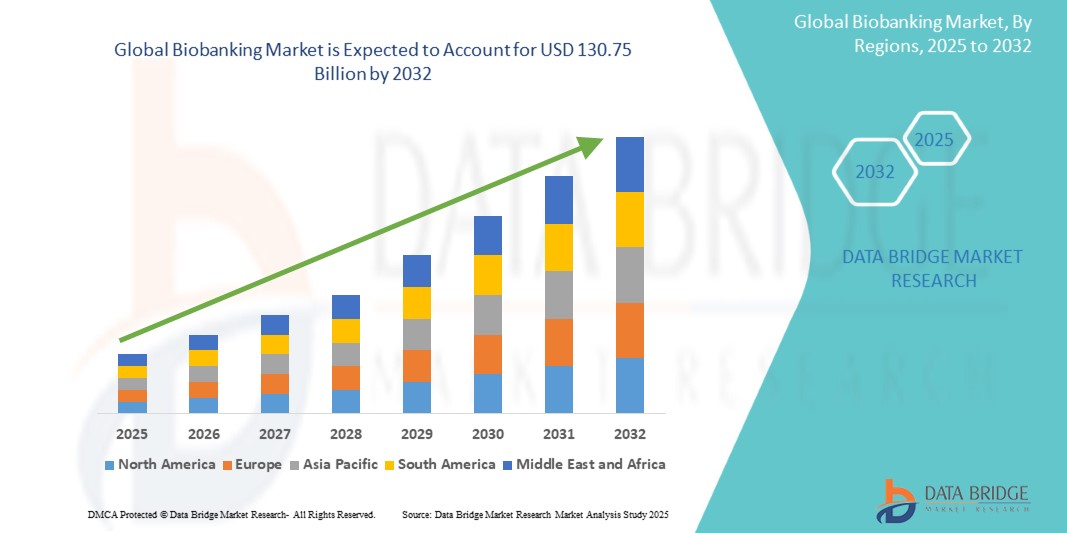
Biobanking Market Size
- The global Biobanking market was valued atUSD 81.42 billion in 2024and is expected to reachUSD 130.75 billion by 2032
- During the forecast period of 2025 to 2032 the market is likely to grow at aCAGR of 6.10 %primarily driven by the increased demand for personalized medicine and advancements in genomics and biotechnology
- This growth is driven by factors such as growing investment in research and development, increasing prevalence of chronic diseases, rising awareness about precision medicine, and the expanding role of biobanks in clinical trials and drug development
Biobanking Market Analysis
- Biobanking refers to the process of collecting, storing, and managing biological samples (such as blood, tissue, or DNA) for use in research, medical studies, and clinical applications
- The global biobanking market is experiencing substantial growth due to the increasing reliance on biological samples for research and medical advancements
- Biobanks store various biological samples such as blood, tissue, and DNA to support research in areas such as personalized medicine, drug development, and disease understanding
- As of recent reports, biobanks are central to advancements in genomics, with initiatives such as the UK Biobank, which houses genetic data from over500,000 participants, contributing significantly to medical research and personalized treatments
- The rise in genetic testing and precision medicine is boosting the demand for well-organized biobanks.
- For instances,large-scale initiatives such as the Human Genome Project rely on these samples to understand genetic predispositions to diseases
- Biobanks are critical for large-scale clinical trials and epidemiological studies
- For instance, The COVID-19 pandemic, where biobanks collaborated globally to provide samples that supported vaccine development and the understanding of the virus’s impact
- Technological advancements in storage and processing techniques, such as automated sample management systems, are increasing the efficiency of biobanks, allowing for better sample preservation and more streamlined research processes
- Partnerships between biobanks and pharmaceutical companies are growing
- For instance, Biobanks such as the National Cancer Institute’s biobank provide valuable specimens for cancer drug development and clinical research
- The market is expanding as biobanks play a crucial role in accelerating research in oncology, genomics, and infectious diseases, with both public and private sector investments contributing to growth in this field
Report Scope andBiobanking Market Segmentation
|
Attributes |
Biobanking KeyMarket Insights |
|
Segments Covered |
|
|
Countries Covered |
North America
Europe
Asia-Pacific
Middle East and Africa
South America
|
|
Key Market Players |
|
|
Market Opportunities |
|
|
Value Added Data Infosets |
In addition to the insights on market scenarios such as market value, growth rate, segmentation, geographical coverage, and major players, the market reports curated by the Data Bridge Market Research also include depth expert analysis, patient epidemiology, pipeline analysis, pricing analysis, and regulatory framework. |
Biobanking Market Trends
“Increasing Adoption of Automation and Digital Technologies in Biobanks”
- The adoption of automation and digital technologies in biobanks is transforming sample handling, improving efficiency, accuracy, and data management
- Automated systems are now used to manage various sample workflows, including collection, labeling, and storage of biological specimens
- For instance, Biobanks such as the Biobank of the Netherlands utilize automated robotic systems to improve the speed and accuracy of sample processing
- Robotics and automated sample tracking systems significantly reduce human error, increase throughput, and ensure the proper storage conditions of biological samples.
The Swiss Biobanking Platform uses automation to track and store samples under specific conditions, enhancing preservation for long-term research - Cloud-based data management systems are becoming integral in biobanks, enabling remote access to sample data, which improves collaboration and data sharing among researchers worldwide
- For instance, The UK Biobank has incorporated cloud storage to manage and share genetic data from over 500,000 participants, making it accessible to a global network of researchers
- Data analytics tools integrated into biobanks allow for the analysis of vast amounts of biological data quickly, helping researchers make new discoveries
- For instance, The use ofartificial intelligence by biobanks such as the National Cancer Institute to analyze cancer-related genetic data more efficiently
- The integration of digital record-keeping systems ensures detailed tracking of each sample’s history, from collection to usage, fostering compliance with ethical standards and regulations, and increasing transparency
The Finnish Biobank System employs digital technologies to ensure full traceability of samples, ensuring high levels of ethical compliance - Overall, automation and digital technologies are enhancing the operational capabilities of biobanks, making them more efficient, accessible, and valuable for advancing scientific research
Biobanking Market Dynamics
Driver
“Increasing Demand for Personalized Medicine”
- The growing shift towards personalized medicine is driving the biobanking market as healthcare increasingly focuses on treatments tailored to individual genetic profiles. This approach allows for more effective and precise medical interventions based on the genetic makeup of patients
- Biobanks are essential in providing critical biological samples, including blood, tissue, DNA, and genetic data, which are crucial for understanding disease mechanisms, identifying biomarkers, and developing targeted therapies
- For instance, Biobanks such as the UK Biobank have become instrumental in research that links genetic variations to disease risks and treatments
- Large-scale initiatives such as theUK Biobank, which stores genetic data from over500,000participants, have advanced our understanding of genetic predispositions to diseases. This initiative has directly contributed to the development of personalized treatments, helping to improve patient care through genetic insights.
- For instance, The biobank’s data is being used to study links between genetics and conditions such as heart disease and diabetes
- With the rise of genetic testing and the increased use of genomic data in decision-making for medical treatments, biobanks have become crucial in the development of therapies for diseases such as cancer, rare diseases, and chronic illnesses
- For instance, The National Cancer Institute’s biobank, which provides invaluable cancer-related samples that contribute to precision oncology treatments
- Pharmaceutical companies, research institutions, and healthcare providers increasingly rely on biobanks to support the development of targeted therapies and precision medicine
- For instance, Pfizer and other pharmaceutical companies partner with biobanks to accelerate the development of tailored drugs for conditions such as cancer, using genetic data stored in biobanks to refine their treatments
- The growing demand for genetic data and the ability to match treatments to a patient’s genetic makeup not only enhances the effectiveness of treatments but also helps minimize side effects. This shift is driving investment in the biobanking sector, as companies and research institutions recognize the value of genetic insights in improving patient outcomes
- For instance, Thermo Fisher Scientific has made significant investments in biobanking technologies to support genetic research and personalized medicine initiatives
Opportunity
“Growing Focus on Global Collaborations in Research and Healthcare”
- The growing focus on global collaborations in research and healthcare presents significant opportunities for biobanks, as organizations seek to address major health challenges such as cancer, genetic disorders, and infectious diseases
- Biobanks serve as central hubs for storing valuable biological samples. Collaborative efforts between biobanks and pharmaceutical companies, research institutions, and government agencies can accelerate medical discoveries and innovation
- For instance, The National Cancer Institute has partnered with various biobanks to create a comprehensive collection of cancer-related samples, driving advancements in cancer therapeutics and diagnostic methods
- Large-scale collaborative initiatives such as the Human Genome Project have relied heavily on biobank samples to map human genetic variation and its connections to diseases, providing valuable insights into the genetic factors behind numerous conditions
- The increasing emphasis on open-access research platforms and data sharing creates an opportunity for biobanks to expand their global reach. These platforms promote collaboration by enabling easy access to shared biological data, speeding up research and discovery processes
- For instance, Global Alliance for Genomics and Health, which promotes data sharing and standardization across biobanks worldwide
- Through these collaborations, biobanks can expand their sample collection and data repositories, contributing to more global health improvements and enabling faster medical breakthroughs. The partnership between the UK Biobank and international research institutions has led to new studies on cardiovascular disease and Alzheimer’s disease, enhancing global understanding and treatment options
- This shift towards international cooperation presents an opportunity for biobanks to expand both their services and impact, opening new markets and enhancing their role in advancing global healthcare
- For instance, The International Agency for Research on Cancer collaborates with biobanks across the world to study the links between lifestyle and genetic factors in cancer
Restraint/Challenge
“Ethical Standards and Regulatory Compliance”
- A significant challenge in the biobanking market is ensuring ethical standards and regulatory compliance when managing biological samples, particularly as the scope of biobank usage expands
- Biobanks must adhere to strict ethical guidelines and privacy laws to ensure that samples are used responsibly and that donor consent is maintained. This includes clear communication on how biological samples will be used for research and ensuring that consent is properly documented
- In regions such as the European Union, biobanks face complex legal frameworks surrounding the ownership and usage of biological materials
- For instance, The General Data Protection Regulation (GDPR) imposes stringent rules on data privacy, and biobanks must navigate these regulations carefully to ensure they are compliant when sharing data for research purposes
- Informed consent issues become particularly challenging when samples are stored for long-term use. Participants may not always be aware of the future research projects their samples could be used for. This is evident in the HeLa cells case, where the family of Henrietta Lacks raised concerns about the use of her cells in research without her consent
- The legal and ethical complexities increase with the rise of emerging technologies such as genetic editing and artificial intelligence. As biobanks store and share genetic data for such research, there are concerns regarding the potential misuse of genetic information, making ethical oversight even more crucial
- To mitigate these challenges, biobanks must invest in legal expertise and infrastructure to ensure they comply with regulations, protect patient privacy, and maintain public trust.
- For instance, Biobanks such as the National Institutes of Health Biobank in the U.S. have implemented strict compliance measures to meet both national and international standards
- Failure to comply with legal and ethical requirements can result in reputational damage, legal penalties, and a loss of participation from key donors and institutions, hindering the overall growth and trust in the biobanking sector
- For instance, The Case Western Reserve University Biobank incident, where concerns about consent led to revisions in its protocols and operations
Biobanking Market Scope
The market is segmented on the basis of product and services, sample type, storage type, type of biobank, ownership and application.
|
Segmentation |
Sub-Segmentation |
|
By Product and Services |
|
|
By Sample Type |
|
|
By Storage Type |
|
|
By Type of Biobank |
|
|
By Ownership |
|
|
By Application |
|
Biobanking Market Regional Analysis
“North America is the Dominant Region in the Biobanking Market”
- North Americais dominating the Biobanking market due to significant investments in the establishment, collection, and processing of large-scale datasets
- TheU.S.andCanadahave well-established biobank infrastructures that support advanced research in areas such as genomics, oncology, and personalized medicine
- For instance, The National Institutes of Health (NIH) Biobank, which houses vast datasets for research on numerous diseases
- The All of Us Research Program in the U.S. is another key initiative aimed at collecting health data from a diverse population to promote precision medicine. The program’s goal is to gather data from one million or more participants, creating a valuable resource for advancing tailored healthcare solutions
- Government funding plays a critical role in driving the growth of biobanks in North America. The U.S. Department of Health and Human Services (HHS) and other government agencies allocate substantial resources to support biobank development and data collection. This funding helps manage extensive datasets, which are essential for research on complex diseases such as cancer, diabetes, and genetic disorders
- North America benefits from cutting-edge technologies, including high-throughput sequencing and automated sample management systems, which enhance the efficiency and scalability of biobanks, allowing for faster data processing and analysis
- The region also maintains a robust regulatory environment, with strong data privacy and patient consent laws, such as those governed by theHealth Insurance Portability and Accountability Act (HIPAA)in the U.S. This ensures biobanks operate ethically and securely, fostering trust among donors and researchers
- This combination of strong government support, advanced technologies, and a stable regulatory framework positions North America as the leader in the biobanking market, attracting both domestic and international collaborations for scientific research
- For instance, Partnerships between biopharmaceutical companies and U.S.-based biobanks contribute to the development of new treatments and therapies
“Asia-Pacific is Projected to Register the Highest Growth Rate”
- TheAsia-Pacificregion is expected to witness the highest growth rate in theBiobanking market, driven by combination of government initiatives, rising healthcare investments, and an expanding research infrastructure
- Countries such asChina,India,Japan, andSouth Koreaare at the forefront of biobank development, supported by both public and private sector investments. This growth is part of a broader trend of healthcare advancement in the region, fueled by both government funding and private sector participation
- Government initiatives are a key factor in the region’s biobanking growth
- For instance, The Chinese government has made significant investments in genomics and biobanking to better understand the genetic diversity of its vast population. The China Kadoorie Biobank, one of the largest in the world, collects data on genetics, lifestyle, and health from millions of Chinese participants. This biobank plays a vital role in studying chronic diseases and informing drug development strategies
- InIndia, the rapid expansion of healthcare infrastructure and growing demand for personalized medicine are fueling the rise of biobanks. The country is attracting global partnerships, with multinational pharmaceutical companies increasingly collaborating on clinical trials and genomic research, helping to expand the region’s biobanking capacity
- South KoreaandJapanare also investing heavily in precision medicine and personalized healthcare, using biobank data to enhance disease preventionand improve treatment outcomes. These efforts are transforming the region into a major player in the global biobanking industry
- TheAsia-Pacificregion’s diverse and large population offers biobanks a unique opportunity to collect genetic and epidemiological data, which is crucial in understanding genetic disorders, infectious diseases, and chronic health conditions. This vast population base positions the region as a critical source of data, contributing to global health research and breakthroughs in disease management.
- With these ongoing advancements,Asia-Pacificis set to become the fastest-growing market for biobanks, offering significant opportunities for regional and international stakeholders to expand and collaborate in the rapidly evolving biobanking sector
Biobanking Market Share
The market competitive landscape provides details by competitor. Details included are company overview, company financials, revenue generated, market potential, investment in research and development, new market initiatives, global presence, production sites and facilities, production capacities, company strengths and weaknesses, product launch, product width and breadth, application dominance. The above data points provided are only related to the companies' focus related to market.
The Major Market Leaders Operating in the Market Are:
- Thermo Fisher Scientific Inc. (U.S.)
- Tecan Trading AG (Switzerland)
- QIAGEN (Germany)
- Hamilton Company (U.S.)
- SPT Labtech Ltd (U.K.)
- VWR International, LLC. (U.S.)
- Promega Corporation (U.S.)
- BD (U.S.)
- Merck KGaA (Germany)
- BioKryo (Germany)
- Fraunhofer-Gesellschaft (Germany)
- Modul-Bio (France)
- STEMCELL Technologies (Canada)
- SelectScience (U.K.)
- Taylor-Wharton (U.S.)
Latest Developments in Global Biobanking Market
- In October 2023,AstraZeneca(U.K.)revealeda newresearch developmentaimed at improvingdrug discovery. The study utilized data from50,000 individualsin theUK Biobank, identifying associations betweenrare genetic variantsandplasma proteins. This research will enhance the understanding ofdisease mechanismsandtarget identificationfornovel drug development. The findings are expected to acceleratedrug discoveryandbiomarker developmentin AstraZeneca’sresearch and development pipeline, benefiting the company’s efforts in creating more effectivepersonalized medicines. This development has a significant impact on thebiopharmaceutical market, as it opens new avenues fortargeted therapieswith stronger evidence linking genes to protein functions, thereby increasing theefficacyof future drug treatments
- In January 2023, Hamad Medical Corporation (HMC)(Qatar)launchedthefirst phase of its Tissue Biobank Servicein collaboration withQatar BioBank. Thisdevelopmentaims to collect, process, store, and distributehuman tissue samplesforresearch purposes, with the goal of advancing the understanding of diseases and health conditions. Theservicewill make available more than300,000 surgical pathology samplescollected since 2008, which will significantly contribute tomedical researchand the development ofnew therapiesanddiagnostic tests. The initiative will support the creation ofinnovative treatmentsand provide researchers with the means to study diseases at thecellular and molecular levels, improving patient care. Thislaunchis expected to have a profoundimpactonmedical research in Qatarandsupport health advancementsboth locally and internationally
- In January 2023,Quibim(Spain)partneredwith theEuropean Commissiontolaunch EUCAIM, afederated infrastructurefor cancer image data in Europe. Thisdevelopmentaims to create a centralized hub that will link EU-level and national initiatives, hospital networks, and research repositories, focusing on improving cancer detection and treatment. The platform will facilitatecross-border accessto cancer imaging data forresearchers, clinicians, andinnovatorsto analyze, visualize, and extract predictive models for patient outcomes.Quibimwill adapt itsQP-Discovery platformto meet the project’s requirements and enhanceimage quality control, harmonization, anddata annotation. This initiative will allow for the integration of data from21 clinical sitesacross12 EU countries, supporting betterearly diagnosis,personalized treatmentplans, and faster decision-making in cancer care. TheEUCAIM projectaims to significantly improveclinical decision-making, making cancer treatmentsmore preciseandefficient, ultimately benefitingpatientsand healthcare systems across Europe
- In December 2023,Charles River Laboratories(U.S.) finalized anagreementwithCELLphenomics(Germany) toexpandits3D in vitro testing servicesforcancer therapy drug screening. Thisdevelopmentintegrates CELLphenomics'PD3D tumor model platforminto Charles River’s portfolio, allowing for more advancedoncological drug testing. The partnership will enhancepreclinical cancer researchby providing access topatient-derived 3D cell culture models, which will improvetherapeutic efficacy predictionsandbiomarker identification. Thiscollaborationaims to accelerate the drug discovery process, particularly forrare and ultra-rare cancers, by combininghigh-quality modelsandstreamlined drug screeningtechniques. Theimpacton the market will be significant, offeringnew toolsfor the development ofpersonalized cancer therapies, ultimately benefitingpatientsby enabling faster, more effective treatments
- In September 2023,Tecan(Switzerland)launchedthePhase Separatorto advanceautomation in liquid biopsyandbiobanking. Thisdevelopmentintroduces a highly innovative solution designed to improve the automation of liquid biopsy sample processing, providing faster and more efficient workflows. ThePhase Separatoris specifically aimed at facilitating the separation of plasma from blood samples, which is a critical step in the liquid biopsy process for disease monitoring and biomarker analysis. By automating this step, the device improvesaccuracyandefficiency, while reducing themanual labortraditionally involved. Thisbenefitis expected to accelerate the application ofliquid biopsytechnologies, enhancing their use inearly disease detection,personalized medicine, andbiomarker discovery. Theimpacton the market will be substantial, as it enables morestreamlined workflowsin biobanks, reducing processing time and increasingdata reliability, thereby facilitatingfasterandmore efficient researchin fields such as cancer and genomics
SKU-
세계 최초의 시장 정보 클라우드 보고서에 온라인으로 접속하세요

- 대화형 데이터 분석 대시보드
- 높은 성장 잠재력 기회를 위한 회사 분석 대시보드
- 사용자 정의 및 질의를 위한 리서치 분석가 액세스
- 대화형 대시보드를 통한 경쟁자 분석
- 최신 뉴스, 업데이트 및 추세 분석
- 포괄적인 경쟁자 추적을 위한 벤치마크 분석의 힘 활용
연구 방법론
데이터 수집 및 기준 연도 분석은 대규모 샘플 크기의 데이터 수집 모듈을 사용하여 수행됩니다. 이 단계에는 다양한 소스와 전략을 통해 시장 정보 또는 관련 데이터를 얻는 것이 포함됩니다. 여기에는 과거에 수집한 모든 데이터를 미리 검토하고 계획하는 것이 포함됩니다. 또한 다양한 정보 소스에서 발견되는 정보 불일치를 검토하는 것도 포함됩니다. 시장 데이터는 시장 통계 및 일관된 모델을 사용하여 분석하고 추정합니다. 또한 시장 점유율 분석 및 주요 추세 분석은 시장 보고서의 주요 성공 요인입니다. 자세한 내용은 분석가에게 전화를 요청하거나 문의 사항을 드롭하세요.
DBMR 연구팀에서 사용하는 주요 연구 방법론은 데이터 마이닝, 시장에 대한 데이터 변수의 영향 분석 및 주요(산업 전문가) 검증을 포함하는 데이터 삼각 측량입니다. 데이터 모델에는 공급업체 포지셔닝 그리드, 시장 타임라인 분석, 시장 개요 및 가이드, 회사 포지셔닝 그리드, 특허 분석, 가격 분석, 회사 시장 점유율 분석, 측정 기준, 글로벌 대 지역 및 공급업체 점유율 분석이 포함됩니다. 연구 방법론에 대해 자세히 알아보려면 문의를 통해 업계 전문가에게 문의하세요.
사용자 정의 가능
Data Bridge Market Research는 고급 형성 연구 분야의 선두 주자입니다. 저희는 기존 및 신규 고객에게 목표에 맞는 데이터와 분석을 제공하는 데 자부심을 느낍니다. 보고서는 추가 국가에 대한 시장 이해(국가 목록 요청), 임상 시험 결과 데이터, 문헌 검토, 재생 시장 및 제품 기반 분석을 포함하도록 사용자 정의할 수 있습니다. 기술 기반 분석에서 시장 포트폴리오 전략에 이르기까지 타겟 경쟁업체의 시장 분석을 분석할 수 있습니다. 귀하가 원하는 형식과 데이터 스타일로 필요한 만큼 많은 경쟁자를 추가할 수 있습니다. 저희 분석가 팀은 또한 원시 엑셀 파일 피벗 테이블(팩트북)로 데이터를 제공하거나 보고서에서 사용 가능한 데이터 세트에서 프레젠테이션을 만드는 데 도움을 줄 수 있습니다.











