



Global Theft Insurance Market Segmentation, By Theft Type (Bank Fraud, Credit Card Fraud, Phone/Utilities Fraud, Employment/Tax-Related Fraud, and Other Theft Types), Distribution Channel (Direct Sales, Online Sales, Agents and Brokers, and Bancassurance), and End-User (Business and Individuals) – Industry Trends and Forecast to 2032
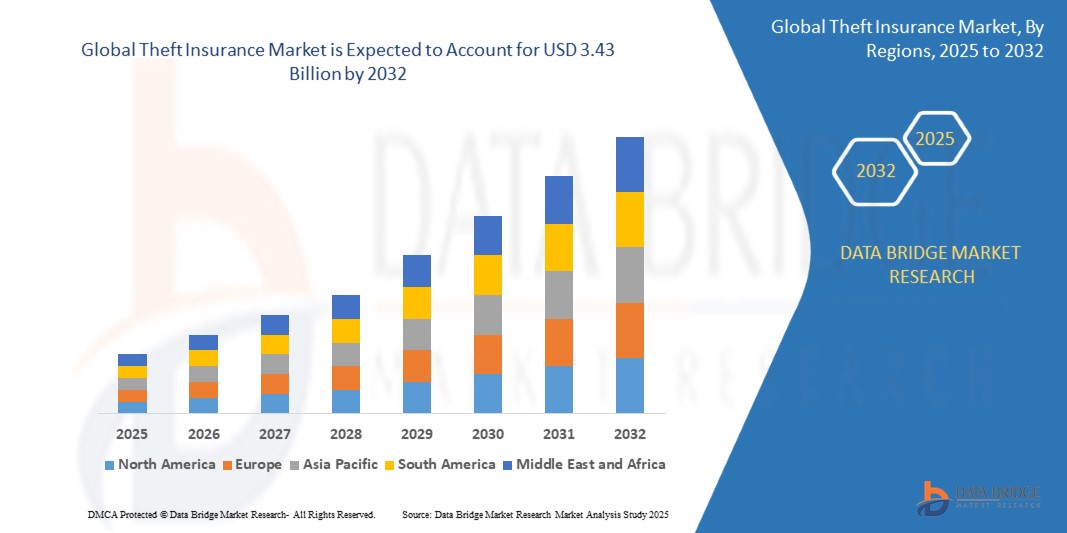
Theft Insurance Market Analysis
The theft insurance market is experiencing significant growth, driven by the increasing demand for identity theft protection and financial security solutions. With the rise in cybercrime and identity theft, consumers and businesses alike are seeking comprehensive protection against potential financial losses. The market has seen advancements in technology, with insurers offering digital tools such as real-time fraud alerts, data protection services, and identity monitoring, which have enhanced the effectiveness of theft insurance products. In addition, the expansion of online services and the growing use of smartphones have contributed to the surge in theft-related crimes, thus fueling the demand for these insurance products. Leading companies are increasingly integrating artificial intelligence and machine learning into their theft detection systems to improve the speed and accuracy of fraud detection. For instance, TransUnion, NortonLifeLock, and Equifax have developed cutting-edge solutions that track suspicious activity and provide immediate assistance to policyholders. As the market continues to evolve, there is a growing focus on providing tailored insurance plans that address specific customer needs, including coverage for online transactions, credit card fraud, and personal identity theft. This trend is likely to propel the theft insurance market in the coming years.
Theft Insurance Market Size
The global Theft Insurance market size was valued at USD 1.10 billion in 2024 and is projected to reach USD 3.43 billion by 2032, with a CAGR of 15.30% during the forecast period of 2025 to 2032. In addition to the market insights such as market value, growth rate, market segments, geographical coverage, market players, and market scenario, the market report curated by the Data Bridge Market Research team includes in-depth expert analysis, import/export analysis, pricing analysis, production consumption analysis, and pestle analysis.
Theft Insurance Market Trends
“Rising Adoption of Digital Platforms and Data Analytics”
The theft insurance market is seeing a notable trend toward the integration of advanced digital tools, such as AI-powered fraud detection and real-time alerts, to improve the effectiveness of theft protection services. With rising concerns over identity theft and cybercrime, consumers are increasingly turning to insurance products that offer proactive monitoring and swift intervention. For instance, NortonLifeLock and Equifax have pioneered the use of machine learning algorithms to track suspicious activity and provide immediate notifications to policyholders, allowing them to take action before significant damage occurs. In addition, companies are expanding their offerings to include comprehensive coverage for digital theft, covering identity breaches, credit card fraud, and even online account takeovers. This shift toward more comprehensive and personalized theft protection aligns with the growing demand for cybersecurity insurance solutions, driving market growth. As consumers become more aware of the need to safeguard their personal information, the adoption of such advanced insurance products is expected to increase, solidifying the trend toward digital-first security solutions.
Report Scope and Theft Insurance Market Segmentation
|
Attributes |
Theft Insurance Key Market Insights |
|
Segments Covered |
|
|
Countries Covered |
U.S., Canada and Mexico in North America, Germany, France, U.K., Netherlands, Switzerland, Belgium, Russia, Italy, Spain, Turkey, Rest of Europe in Europe, China, Japan, India, South Korea, Singapore, Malaysia, Australia, Thailand, Indonesia, Philippines, Rest of Asia-Pacific (APAC) in the Asia-Pacific (APAC), Saudi Arabia, U.A.E, South Africa, Egypt, Israel, Rest of Middle East and Africa (MEA) as a part of Middle East and Africa (MEA), Brazil, Argentina and Rest of South America as part of South America |
|
Key Market Players |
Equifax, Inc. (U.S.), NortonLifeLock Inc. (U.S.), TransUnion LLC. (U.S.), Experian Information Solutions, Inc. (U.S.), Malwarebytes Inc. (U.S.), LexisNexis Risk Solutions (U.S.), AllClearID (U.S.), Kroll (U.S.), Fair Isaac Corporation (U.S.), McAfee, LLC (U.S.), Allstate Insurance Company (U.S.), Aura (U.S.), Chubb (U.S.), GEICO (U.S.), IDShield (U.S.), Nationwide Mutual Insurance Company (U.S.), The Hanover Insurance Group (U.S.), Liberty Mutual Insurance (U.S.), and MetLife Services and Solutions, LLC (U.S.) |
|
Market Opportunities |
|
|
Value Added Data Infosets |
In addition to the market insights such as market value, growth rate, market segments, geographical coverage, market players, and market scenario, the market report curated by the Data Bridge Market Research team includes in-depth expert analysis, import/export analysis, pricing analysis, production consumption analysis, and pestle analysis. |
Theft Insurance Market Definition
Theft insurance is a type of insurance policy designed to provide financial protection against the loss or theft of personal property, valuables, or assets. This insurance typically covers losses resulting from burglary, theft, or vandalism, and can include protection for both physical items, such as electronics and jewelry, as well as intangible assets, such as identity and financial information.
Theft Insurance Market Dynamics
Drivers
- Rising Crime Rates
Rising crime rates are a significant driver of the theft insurance market, as they increase the demand for protective coverage against financial losses from theft, burglary, and cybercrimes. According to the FBI's Uniform Crime Reporting (UCR) Program, property crimes, which include theft, larceny, and burglary, accounted for nearly 60% of all crimes reported in the U.S. in 2020, highlighting the widespread risk individuals and businesses face. In addition, cybercrimes, such as identity theft and online fraud, have surged in recent years. The Federal Trade Commission (FTC) reported over 1.4 million cases of identity theft in 2020, underscoring the growing vulnerability to digital theft. As these crime rates increase, individuals and businesses are increasingly seeking theft insurance to protect against potential losses, contributing significantly to the growth of the theft insurance market. The heightened risk of theft in both physical and digital spaces is prompting more consumers to secure policies that offer financial protection against such crimes.
- Growing Awareness of Security Risks
The growing awareness of security risks has become a key driver of the theft insurance market, as consumers are increasingly recognizing the need to protect themselves from financial losses due to property theft, fraud, and cybercrimes. Public campaigns, media coverage, and high-profile incidents of data breaches have heightened awareness about the vulnerabilities individuals and businesses face. For instance, after the 2017 Equifax data breach, which affected over 147 million people, there was a notable surge in the demand for identity theft protection services and insurance policies. According to a report from the National Association of Insurance Commissioners (NAIC), the number of consumers purchasing cyber insurance policies, including those offering protection against identity theft, has increased by 22% in recent years. As a result, consumers are more inclined to invest in theft insurance to shield themselves from potential financial damage caused by both physical property loss and digital theft. This growing security awareness is propelling market growth as consumers actively seek solutions for safeguarding their assets.
Opportunities
- Increasing Technological advancements in Security
Technological advancements in security have opened up significant opportunities in the theft insurance market, as innovations such as surveillance cameras, biometric security, and smart home systems are helping to monitor and prevent theft and enhancing the value of insurance policies. The integration of these technologies provides policyholders with greater confidence in safeguarding their properties, which in turn drives demand for theft insurance. For instance, the use of smart home systems, such as Ring doorbell cameras and Nest security cameras, has proven to reduce break-ins and increase home security. As a result, insurance companies are offering customized policies that offer discounts or enhanced coverage to customers who utilize these technologies. In addition, biometric security features, such as facial recognition and fingerprint scanning, are becoming more prevalent in both residential and commercial settings, further boosting demand for theft protection. This growing trend of combining advanced security systems with theft insurance presents a promising market opportunity, as consumers seek policies that complement their high-tech security setups.
- Increasing Value of Personal Assets
The increasing value of personal assets is creating a significant market opportunity for theft insurance, as individuals look to protect their valuable property from theft or loss. With the growing ownership of high-ticket items such as electronics, jewelry, and luxury vehicles, the need for comprehensive theft coverage has become more critical. For instance, the rise in the use of expensive smartphones, laptops, and other gadgets means consumers are more likely to seek insurance to cover potential theft or damage. In addition, as the luxury car market expands, with brands such as Tesla and Porsche gaining popularity, car owners are more inclined to secure theft insurance for these high-value vehicles. This trend is further fueled by the growing awareness of theft risks and the desire to safeguard significant investments. Insurance providers are capitalizing on this opportunity by offering specialized coverage that caters to high-net-worth individuals and those with valuable personal assets, making it an attractive area of growth for the theft insurance market.
Restraints/Challenges
- Cybersecurity Challenges
As digital theft and cybercrime continue to rise, the theft insurance market faces a growing challenge in adapting to the evolving nature of theft risks. Traditional theft insurance policies often focus on physical theft of property, leaving a gap in coverage when it comes to losses from cybercrimes, such as hacking, data breaches, and identity theft. For instance, businesses that store sensitive customer data online are increasingly targeted by cybercriminals, and the loss of this data can lead to significant financial damage. However, many traditional theft insurance policies do not provide adequate protection against these types of digital threats. This increasing cybersecurity risk forces insurers to rethink their offerings and develop specialized policies or add-ons to cover cybercrimes. The complexity and cost of creating these comprehensive coverage options present a challenge for insurers, while also making it more difficult for consumers to navigate and understand their insurance options. As a result, the rise of cybersecurity threats creates a gap in the market, pushing the need for new solutions that address the full spectrum of theft risks in the digital age.
- High Premium Costs
High premium costs are a significant barrier in the theft insurance market, as they make coverage unaffordable for many individuals and businesses. The cost of premiums can vary based on factors such as the value of insured property, the risk profile of the policyholder, and the coverage limits. For instance, a small business located in an area with a high crime rate may face considerably higher premiums for theft insurance compared to a business in a low-risk area. These high costs often discourage potential customers from purchasing or renewing their policies, especially in price-sensitive markets. The burden of expensive premiums can also lead to underinsurance, as businesses and individuals may opt for minimal coverage to keep costs down, leaving them vulnerable to significant financial loss in the event of a theft. As a result, high premium costs present a significant challenge for insurers looking to attract a broader customer base and for customers seeking comprehensive theft protection without the financial strain.
This market report provides details of new recent developments, trade regulations, import-export analysis, production analysis, value chain optimization, market share, impact of domestic and localized market players, analyses opportunities in terms of emerging revenue pockets, changes in market regulations, strategic market growth analysis, market size, category market growths, application niches and dominance, product approvals, product launches, geographic expansions, technological innovations in the market. To gain more info on the market contact Data Bridge Market Research for an Analyst Brief, our team will help you take an informed market decision to achieve market growth.
Theft Insurance Market Scope
The market is segmented on the basis of theft type, distribution channel, and end-user. The growth amongst these segments will help you analyse meagre growth segments in the industries, and provide the users. The growth amongst these segments will help you analyze meagre growth segments in the industries and provide the users with a valuable market overview and market insights to help them make strategic decisions for identifying core market applications.
Theft Type
- Bank Fraud
- Credit Card Fraud
- Phone/Utilities Fraud
- Employment/Tax-Related Fraud
- Other Theft Types
Distribution Channel
- Direct Sales
- Online Sales
- Agents and Brokers
- Bancassurance
End-User
- Business
- Individuals
Theft Insurance Market Regional Analysis
The market is analyzed and market size insights and trends are provided by country, theft type, distribution channel, and end-user. The growth amongst these segments will help you analyse meagre growth segments in the industries, and provide the users as referenced above.
The countries covered in the market report are U.S., Canada, Mexico in North America, Germany, Sweden, Poland, Denmark, Italy, U.K., France, Spain, Netherland, Belgium, Switzerland, Turkey, Russia, Rest of Europe in Europe, Japan, China, India, South Korea, New Zealand, Vietnam, Australia, Singapore, Malaysia, Thailand, Indonesia, Philippines, Rest of Asia-Pacific (APAC) in Asia-Pacific (APAC), Brazil, Argentina, Rest of South America as a part of South America, U.A.E, Saudi Arabia, Oman, Qatar, Kuwait, South Africa, Rest of Middle East and Africa (MEA) as a part of Middle East and Africa (MEA).
North America dominates the global theft insurance market, driven by the region's high awareness of personal and asset security among consumers and businesses. The widespread adoption of advanced security measures, coupled with the increasing value of insured assets, fuels the demand for comprehensive theft insurance policies. In addition, the presence of major insurance providers and innovative coverage options contributes to the region's market leadership. Growing concerns over rising crime rates and cyber theft further boost the adoption of theft insurance across residential, commercial, and digital domains in North America.
The Asia-Pacific region is anticipated to exhibit the highest compound annual growth rate (CAGR) during the forecast period, driven by rapid economic development and increasing urbanization across key markets. The rising awareness of asset protection and growing penetration of insurance services in emerging economies are major contributors to this growth. In addition, the expanding middle-class population, coupled with increasing disposable incomes, is encouraging individuals and businesses to invest in theft insurance solutions. The region's dynamic growth is further supported by advancements in digital technology and the growing adoption of cybersecurity measures to combat evolving threats.
The country section of the report also provides individual market impacting factors and changes in market regulation that impact the current and future trends of the market. Data points such as down-stream and upstream value chain analysis, technical trends and porter's five forces analysis, case studies are some of the pointers used to forecast the market scenario for individual countries. Also, the presence and availability of global brands and their challenges faced due to large or scarce competition from local and domestic brands, impact of domestic tariffs and trade routes are considered while providing forecast analysis of the country data.
Theft Insurance Market Share
The market competitive landscape provides details by competitor. Details included are company overview, company financials, revenue generated, market potential, investment in research and development, new market initiatives, global presence, production sites and facilities, production capacities, company strengths and weaknesses, product launch, product width and breadth, application dominance. The above data points provided are only related to the companies' focus related to market.
Theft Insurance Market Leaders Operating in the Market Are:
- Equifax, Inc. (U.S.)
- NortonLifeLock Inc. (U.S.)
- TransUnion LLC (U.S.)
- Experian Information Solutions, Inc. (U.S.)
- Malwarebytes Inc. (U.S.)
- LexisNexis Risk Solutions (U.S.)
- AllClearID (U.S.)
- Kroll (U.S.)
- Fair Isaac Corporation (U.S.)
- McAfee, LLC (U.S.)
- Allstate Insurance Company (U.S.)
- Aura (U.S.)
- Chubb (U.S.)
- GEICO (U.S.)
- IDShield (U.S.)
- Nationwide Mutual Insurance Company (U.S.)
- The Hanover Insurance Group (U.S.)
- Liberty Mutual Insurance (U.S.)
- MetLife Services and Solutions, LLC (U.S.)
Latest Developments in Theft Insurance Market
- In December 2024, Zetrix, a layer-1 public blockchain, announced an exclusive partnership with Astron-Xinghuo BIF, the international chain of China's national public permissioned blockchain under the Ministry of Industry and IT (MIIT). This collaboration aims to offer and promote Digital ID applications for Chinese nationals and business entities, enabling real-time, fraud-proof identity verification
- In November 2024, Veridas, a global leader in identity verification and biometric solutions, announced the launch of its Identity Verification (IDV) platform on Google Cloud Marketplace. This move empowers organizations within the Google Cloud ecosystem with advanced fraud protection capabilities
- In November 2024, NordVPN unveiled NordProtect, a new ID theft protection tool, marking a significant expansion in its cybersecurity offerings. This service is currently available for Prime users in the US, with plans for wider support in the future
- In October 2024, ExpressVPN introduced Identity Defender, a suite of services designed to protect personal information. The package includes ID Alerts, ID Theft Insurance, and Data Removal, helping users safeguard their identities effectively
- In March 2024, Vero partnered with Privacy4Cars to launch Identi-FI, a solution providing privacy tools and identity protection for connected car owners. This service includes data deletion from connected cars and recovery assistance in case of identity theft
SKU-
세계 최초의 시장 정보 클라우드 보고서에 온라인으로 접속하세요

- 대화형 데이터 분석 대시보드
- 높은 성장 잠재력 기회를 위한 회사 분석 대시보드
- 사용자 정의 및 질의를 위한 리서치 분석가 액세스
- 대화형 대시보드를 통한 경쟁자 분석
- 최신 뉴스, 업데이트 및 추세 분석
- 포괄적인 경쟁자 추적을 위한 벤치마크 분석의 힘 활용
연구 방법론
데이터 수집 및 기준 연도 분석은 대규모 샘플 크기의 데이터 수집 모듈을 사용하여 수행됩니다. 이 단계에는 다양한 소스와 전략을 통해 시장 정보 또는 관련 데이터를 얻는 것이 포함됩니다. 여기에는 과거에 수집한 모든 데이터를 미리 검토하고 계획하는 것이 포함됩니다. 또한 다양한 정보 소스에서 발견되는 정보 불일치를 검토하는 것도 포함됩니다. 시장 데이터는 시장 통계 및 일관된 모델을 사용하여 분석하고 추정합니다. 또한 시장 점유율 분석 및 주요 추세 분석은 시장 보고서의 주요 성공 요인입니다. 자세한 내용은 분석가에게 전화를 요청하거나 문의 사항을 드롭하세요.
DBMR 연구팀에서 사용하는 주요 연구 방법론은 데이터 마이닝, 시장에 대한 데이터 변수의 영향 분석 및 주요(산업 전문가) 검증을 포함하는 데이터 삼각 측량입니다. 데이터 모델에는 공급업체 포지셔닝 그리드, 시장 타임라인 분석, 시장 개요 및 가이드, 회사 포지셔닝 그리드, 특허 분석, 가격 분석, 회사 시장 점유율 분석, 측정 기준, 글로벌 대 지역 및 공급업체 점유율 분석이 포함됩니다. 연구 방법론에 대해 자세히 알아보려면 문의를 통해 업계 전문가에게 문의하세요.
사용자 정의 가능
Data Bridge Market Research는 고급 형성 연구 분야의 선두 주자입니다. 저희는 기존 및 신규 고객에게 목표에 맞는 데이터와 분석을 제공하는 데 자부심을 느낍니다. 보고서는 추가 국가에 대한 시장 이해(국가 목록 요청), 임상 시험 결과 데이터, 문헌 검토, 재생 시장 및 제품 기반 분석을 포함하도록 사용자 정의할 수 있습니다. 기술 기반 분석에서 시장 포트폴리오 전략에 이르기까지 타겟 경쟁업체의 시장 분석을 분석할 수 있습니다. 귀하가 원하는 형식과 데이터 스타일로 필요한 만큼 많은 경쟁자를 추가할 수 있습니다. 저희 분석가 팀은 또한 원시 엑셀 파일 피벗 테이블(팩트북)로 데이터를 제공하거나 보고서에서 사용 가능한 데이터 세트에서 프레젠테이션을 만드는 데 도움을 줄 수 있습니다.











