



Global Wireless Access Point Market Segmentation, By Product (Wi-Fi 7 Access Points, Wi-Fi 6E Access Points, Wi-Fi 6 (802.11ax) Access Points, Wi-Fi 5 (802.11ac) Access Points, 802.11ac Wave 2 Access Points, 802.11ac Wave 1 Access Points, and Other Access Points), Deployment (Standalone, Controller-Based, and Cloud-based), Services (Managed Services and Professional Services), End Use Industry (BFSI, Healthcare, Manufacturing, Commercial, Telecom, and Others) – Industry Trends and Forecast to 2032
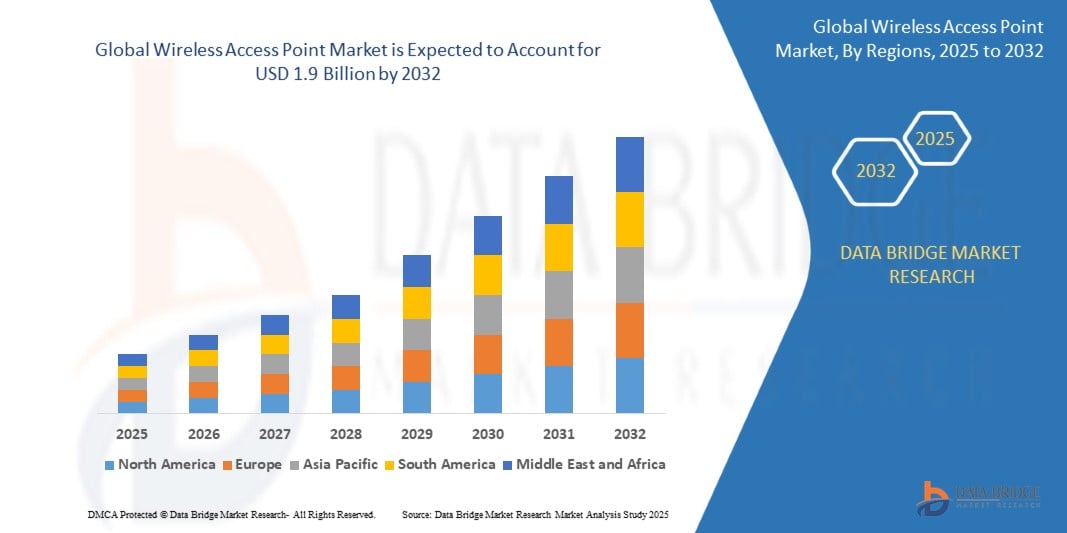
Global Wireless Access Point Market Analysis
The global wireless access point market is experiencing significant growth, driven by the increasing demand for high-speed internet connectivity and the expansion of wireless networks across various industries. Wireless access points (WAPs) are essential components in providing seamless and high-performance Wi-Fi connectivity in homes, offices, and public spaces. The market is benefiting from the rise in cloud-based technologies, the growing trend of remote work, and the increasing adoption of the Internet of Things (IoT) devices. Key recent developments include the launch of advanced WAPs supporting Wi-Fi 6 and Wi-Fi 6E technologies, which offer faster speeds, better efficiency, and improved network capacity. In addition, the ongoing deployment of 5G networks is expected to further drive market growth. As enterprises and consumers seek better wireless solutions, the demand for advanced, high-capacity wireless access points is set to continue growing, with major players focusing on innovation and product diversification to meet the evolving needs of the market.
Global Wireless Access Point Market Size
The global wireless access point market size was valued at USD 17.20 billion in 2024 and is projected to reach USD 32.31 billion by 2032, with a CAGR of 8.20% during the forecast period of 208.20 to 2032. In addition to the market insights such as market value, growth rate, market segments, geographical coverage, market players, and market scenario, the market report curated by the Data Bridge Market Research team includes in-depth expert analysis, import/export analysis, pricing analysis, production consumption analysis, and pestle analysis.
Global Wireless Access Point Market Trends
“Increasing Demand for Seamless Connectivity”
The global wireless access point market is evolving rapidly, driven by technological advancements and increasing demand for seamless connectivity. One key trend is the shift toward Wi-Fi 6 and Wi-Fi 6E technologies, which offer enhanced performance, faster speeds, and improved capacity for handling multiple devices. Innovations in wireless access points, such as integration with cloud management systems and support for 5G networks, are transforming the market. These advancements cater to the growing need for high-speed internet in both consumer and enterprise environments. With the rise of remote work, IoT devices, and the need for robust network infrastructures, the wireless access point market is poised for continued growth, providing solutions for a more connected world.
Report Scope and Global Wireless Access Point Market Segmentation
|
Attributes |
Global Wireless Access Point Key Market Insights |
|
Segments Covered |
|
|
Countries Covered |
U.S., Canada and Mexico in North America, Germany, France, U.K., Netherlands, Switzerland, Belgium, Russia, Italy, Spain, Turkey, Rest of Europe in Europe, China, Japan, India, South Korea, Singapore, Malaysia, Australia, Thailand, Indonesia, Philippines, Rest of Asia-Pacific (APAC) in the Asia-Pacific (APAC), Saudi Arabia, U.A.E, South Africa, Egypt, Israel, Rest of Middle East and Africa (MEA) as a part of Middle East and Africa (MEA), Brazil, Argentina and Rest of South America as part of South America |
|
Key Market Players |
Sophos Ltd. (U.K.), Huawei Technologies Co., Ltd. (China), Cisco Systems Inc. (U.S.), Avaya LLC (U.S.), NETGEAR (U.S.), Zyxel (Taiwan), Oberon Technologies, Inc. (U.S.), Kontron (Germany), Hewlett Packard Enterprise Development LP (U.S.), CommScope, Inc. (U.S.), Ubiquiti, Inc (U.S.), ALE International (France), Belkin (U.S.), D-Link (Taiwan), and Samsung (South Korea) |
|
Market Opportunities |
|
|
Value Added Data Infosets |
In addition to the market insights such as market value, growth rate, market segments, geographical coverage, market players, and market scenario, the market report curated by the Data Bridge Market Research team includes in-depth expert analysis, import/export analysis, pricing analysis, production consumption analysis, and pestle analysis. |
Global Wireless Access Point Market Definition
A global wireless access point (WAP) is a device that allows wireless devices, such as smartphones, laptops, and tablets, to connect to a wired network using Wi-Fi or other wireless standards. It acts as a bridge between the wired network infrastructure and the wireless devices, enabling seamless internet access and communication within a designated range. WAPs are commonly used in homes, offices, public spaces, and enterprise environments to provide high-speed wireless connectivity. They are an essential part of wireless networks, supporting various technologies such as Wi-Fi 5, Wi-Fi 6, and Wi-Fi 6E to enhance data transfer speeds, network capacity, and overall performance.
Global Wireless Access Point Market Dynamics
Drivers
- Rising Demand for High-Speed Internet
As internet usage continues to rise globally, there is an increasing demand for faster and more reliable connectivity, which is driving the growth of the wireless access point market. With the expansion of online activities such as streaming, gaming, remote work, and virtual learning, consumers and businesses require high-speed internet access to meet their needs. This growing demand for bandwidth-intensive applications places pressure on existing network infrastructures, creating a need for advanced wireless access points that can support higher speeds, improved efficiency, and greater capacity. As a result, the market for wireless access points is seeing significant growth, driven by the need for enhanced connectivity solutions.
- Adoption of Wi-Fi 6 and Wi-Fi 6E
The shift towards Wi-Fi 6 and Wi-Fi 6E technologies is a significant driver of growth in the wireless access point market. These advanced technologies offer higher speeds, lower latency, and improved network efficiency, making them ideal for supporting the growing number of connected devices and bandwidth-intensive applications. Wi-Fi 6 and Wi-Fi 6E are designed to handle crowded networks with greater capacity, ensuring seamless connectivity in environments such as offices, public spaces, and smart homes. As the demand for faster, more reliable internet continues to rise, the adoption of these next-generation wireless technologies is accelerating market growth, driving the need for compatible access points.
Opportunities
- Integration with 5G Technology
As 5G networks continue to expand globally, the demand for wireless access points (WAPs) capable of supporting ultra-fast speeds and handling high device density is growing. The integration of WAPs with 5G technology presents significant market opportunities, enabling enhanced connectivity and enabling new applications such as smart cities, autonomous vehicles, and advanced IoT ecosystems. 5G networks require robust infrastructure to handle the increased data traffic and provide low-latency connectivity, creating a rising demand for next-generation WAPs. This opportunity allows businesses to cater to the increasing demand for seamless, high-performance wireless networks across various industries, driving substantial market growth.
- Remote Work and Hybrid Work Models
The shift toward remote and hybrid work models has significantly increased the demand for stable, high-speed wireless networks. As businesses and employees adapt to flexible work environments, the need for reliable connectivity at home and in offices has never been greater. This change presents a key opportunity for wireless access points (WAPs) to provide seamless, high-performance connections that support video conferencing, collaboration tools, and other bandwidth-intensive applications. WAPs that offer robust performance, coverage, and speed are crucial for enabling smooth, uninterrupted work experiences. As the remote work trend continues, the market for WAPs is expected to expand, driven by these evolving demands.
Restraints/Challenges
- Interference and Network Congestion
The increasing number of connected devices is leading to network congestion and interference, which can significantly reduce the performance of wireless access points (WAPs). In densely populated areas, the demand for bandwidth-intensive applications, such as streaming, video conferencing, and gaming, exacerbates the issue. Managing network capacity and minimizing interference becomes a significant challenge, as multiple devices compete for bandwidth within the same frequency spectrum. This results in slower speeds, higher latency, and poor user experiences. As a result, wireless access point providers must develop solutions that effectively manage network traffic, optimize bandwidth allocation, and minimize interference to ensure consistent performance, creating a challenge in the market.
- High Deployment Costs
The installation of advanced wireless access points (WAPs), particularly in large-scale or enterprise environments, often involves significant upfront costs. Businesses must invest in the access points themselves and the necessary infrastructure to support them, including network cabling, routers, and switches. Furthermore, ongoing maintenance, software updates, and potential troubleshooting add to the overall expense. These costs can pose a financial barrier for small businesses and individuals, limiting their ability to adopt cutting-edge wireless technology. As a result, high deployment and maintenance costs act as a restraint on the broader adoption of advanced wireless access points, especially in cost-sensitive markets.
Global Wireless Access Point Market Scope
The market is segmented on the basis of product, deployment, services, and end use industry. The growth amongst these segments will help you analyze meagre growth segments in the industries and provide the users with a valuable market overview and market insights to help them make strategic decisions for identifying core market applications.
Product
- Wi-Fi 7 Access Points
- Wi-Fi 6E Access Points
- Wi-Fi 6 (802.11ax) Access Points
- Wi-Fi 5 (802.11ac) Access Points
- 802.11ac Wave 2 Access Points
- 802.11ac Wave 1 Access Points
- Other Access Points
Deployment
- Standalone
- Controller-based
- Cloud-based
Services
- Managed Services
- Professional Services
End Use Industry
- BFSI
- Healthcare
- Manufacturing
- Commercial
- Telecom
- Others
Global Wireless Access Point Market Regional Analysis
The market is analyzed and market size insights and trends are provided by country, product, deployment, services, and end use industry as referenced above.
The countries covered in the market report are U.S., Canada, Mexico in North America, Germany, Sweden, Poland, Denmark, Italy, U.K., France, Spain, Netherland, Belgium, Switzerland, Turkey, Russia, rest of Europe in Europe, Japan, China, India, South Korea, New Zealand, Vietnam, Australia, Singapore, Malaysia, Thailand, Indonesia, Philippines, rest of Asia-Pacific (APAC) in Asia-Pacific (APAC), Brazil, Argentina, rest of South America as a part of South America, U.A.E, Saudi Arabia, Oman, Qatar, Kuwait, South Africa, rest of Middle East and Africa (MEA) as a part of Middle East and Africa (MEA).
North America is expected to dominate market, accounting for 35%, driven by its advanced IT infrastructure and early adoption of next-generation wireless technologies. The United States leads this trend, with widespread deployment of Wi-Fi 6 and Wi-Fi 6E access points across diverse sectors such as business, education, and public spaces. Canada follows with growing adoption in smart city projects and expanding 5G networks, while the region benefits from major manufacturers and a focus on innovation, fueling the development of advanced Wi-Fi technologies.
Europe is expected to be the fastest growing region in the market due to presence of key countries such as Germany, U.K., and France in wireless access point adoption. The region's growth is driven by strict data protection regulations, encouraging organizations to invest in secure, efficient wireless networks. Notably, Western Europe has seen rapid growth in speed-based offerings and is the second-largest adopter of fixed wireless access (FWA) services globally, while industrial IoT and smart manufacturing applications further fuel the demand for wireless access points.
The country section of the report also provides individual market impacting factors and changes in market regulation that impact the current and future trends of the market. Data points such as down-stream and upstream value chain analysis, technical trends and porter's five forces analysis, case studies are some of the pointers used to forecast the market scenario for individual countries. Also, the presence and availability of global brands and their challenges faced due to large or scarce competition from local and domestic brands, impact of domestic tariffs and trade routes are considered while providing forecast analysis of the country data.
Global Wireless Access Point Market Share
The market competitive landscape provides details by competitor. Details included are company overview, company financials, revenue generated, market potential, investment in research and development, new market initiatives, global presence, production sites and facilities, production capacities, company strengths and weaknesses, product launch, product width and breadth, application dominance. The above data points provided are only related to the companies' focus related to market.
Global Wireless Access Point Market Leaders Operating in the Market Are:
- Sophos Ltd. (U.K.)
- Huawei Technologies Co., Ltd. (China)
- Cisco Systems Inc. (U.S.)
- Avaya LLC (U.S.)
- NETGEAR (U.S.)
- Zyxel (Taiwan)
- Oberon Technologies, Inc. (U.S.)
- Kontron (Germany)
- Hewlett Packard Enterprise Development LP (U.S.)
- CommScope, Inc. (U.S.)
- Ubiquiti, Inc (U.S.)
- ALE International (France)
- Belkin (U.S.)
- D-Link (India) Limited (Taiwan)
- Samsung (South Korea)
Latest Developments in Global Wireless Access Point Market
- In March 2023, Aruba partnered with Microsoft and reelyActive to streamline IoT workload migration to Microsoft Azure without custom engineering. This collaboration led to an open-source data converter enabling secure IoT data streaming from Aruba Wi-Fi access points to Azure applications such as Power BI, improving IoT integration and functionality
- In January 2022, Zyxel Communications joined the Open Networking Foundation to contribute to broadband transformation projects. This strategic move highlights Zyxel's commitment to advancing open networking standards and enhancing broadband infrastructure worldwide
- In August 2022, ASUS Republic of Gamers (ROG) launched the ROG Rapture GT-AX Pro, a gaming-focused access point designed to enhance gaming performance. Equipped with ultra-fast Wi-Fi 6 and 10 Gbps Ethernet, it caters to various types of gamers. The device offers two 5 GHz bands and one 2.4 GHz band, ensuring compatibility with older devices while utilizing advanced technology to boost connection speeds and improve overall connectivity for newer devices
- In January 2022, TP-Link introduced Aginet, a comprehensive solution designed for Internet Service Providers (ISPs). As part of the Aginet portfolio, TP-Link launched a range of products, including wireless access points, VDSL modem routers, Whole Home Mesh Wi-Fi, GPON Wi-Fi routers, GPON OLT, and 4G/5G routers. This diverse product lineup allows TP-Link to address the evolving needs of connectivity providers, ensuring a reliable and seamless internet experience for end-users
- In February 2022, Oberon introduced Version 2.0 of its web-based authoring and review tools, designed to streamline collaboration for small and medium-sized enterprises (SMEs). This updated version enhances ease of use and accessibility, allowing teams to work together more efficiently. By improving the workflow and collaboration capabilities, Oberon aims to better support the unique needs of SMEs in various industries
SKU-
세계 최초의 시장 정보 클라우드 보고서에 온라인으로 접속하세요

- 대화형 데이터 분석 대시보드
- 높은 성장 잠재력 기회를 위한 회사 분석 대시보드
- 사용자 정의 및 질의를 위한 리서치 분석가 액세스
- 대화형 대시보드를 통한 경쟁자 분석
- 최신 뉴스, 업데이트 및 추세 분석
- 포괄적인 경쟁자 추적을 위한 벤치마크 분석의 힘 활용
연구 방법론
데이터 수집 및 기준 연도 분석은 대규모 샘플 크기의 데이터 수집 모듈을 사용하여 수행됩니다. 이 단계에는 다양한 소스와 전략을 통해 시장 정보 또는 관련 데이터를 얻는 것이 포함됩니다. 여기에는 과거에 수집한 모든 데이터를 미리 검토하고 계획하는 것이 포함됩니다. 또한 다양한 정보 소스에서 발견되는 정보 불일치를 검토하는 것도 포함됩니다. 시장 데이터는 시장 통계 및 일관된 모델을 사용하여 분석하고 추정합니다. 또한 시장 점유율 분석 및 주요 추세 분석은 시장 보고서의 주요 성공 요인입니다. 자세한 내용은 분석가에게 전화를 요청하거나 문의 사항을 드롭하세요.
DBMR 연구팀에서 사용하는 주요 연구 방법론은 데이터 마이닝, 시장에 대한 데이터 변수의 영향 분석 및 주요(산업 전문가) 검증을 포함하는 데이터 삼각 측량입니다. 데이터 모델에는 공급업체 포지셔닝 그리드, 시장 타임라인 분석, 시장 개요 및 가이드, 회사 포지셔닝 그리드, 특허 분석, 가격 분석, 회사 시장 점유율 분석, 측정 기준, 글로벌 대 지역 및 공급업체 점유율 분석이 포함됩니다. 연구 방법론에 대해 자세히 알아보려면 문의를 통해 업계 전문가에게 문의하세요.
사용자 정의 가능
Data Bridge Market Research는 고급 형성 연구 분야의 선두 주자입니다. 저희는 기존 및 신규 고객에게 목표에 맞는 데이터와 분석을 제공하는 데 자부심을 느낍니다. 보고서는 추가 국가에 대한 시장 이해(국가 목록 요청), 임상 시험 결과 데이터, 문헌 검토, 재생 시장 및 제품 기반 분석을 포함하도록 사용자 정의할 수 있습니다. 기술 기반 분석에서 시장 포트폴리오 전략에 이르기까지 타겟 경쟁업체의 시장 분석을 분석할 수 있습니다. 귀하가 원하는 형식과 데이터 스타일로 필요한 만큼 많은 경쟁자를 추가할 수 있습니다. 저희 분석가 팀은 또한 원시 엑셀 파일 피벗 테이블(팩트북)로 데이터를 제공하거나 보고서에서 사용 가능한 데이터 세트에서 프레젠테이션을 만드는 데 도움을 줄 수 있습니다.











