


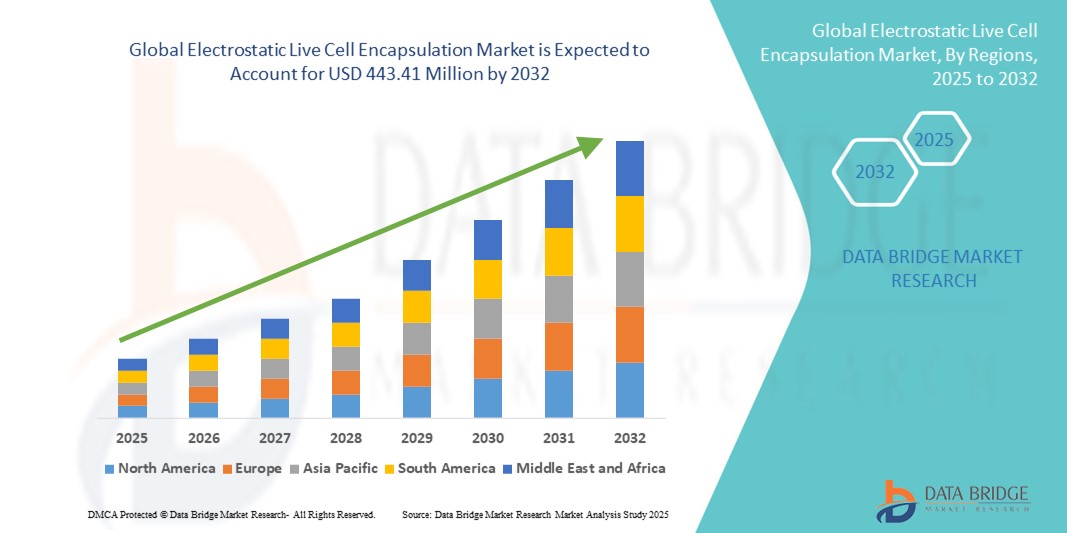
Electrostatic Live Cell Encapsulation Market Size
- The global electrostatic live cell encapsulation market size was valued at USD 321.51 million in 2024 and is expected to reach USD 443.41 million by 2032, at a CAGR of 4.10% during the forecast period
- The market growth is primarily driven by the rising demand for advanced drug delivery systems, regenerative medicine, and cell-based therapies, supported by the increasing prevalence of chronic and genetic diseases
- Furthermore, advancements in biomaterials and encapsulation polymers, combined with the growing focus on minimally invasive treatments and research in cell transplantation, are establishing electrostatic live cell encapsulation as a critical enabler in biomedical applications. These factors are fueling strong adoption across research and healthcare sectors, thereby significantly boosting the industry’s growth
Electrostatic Live Cell Encapsulation Market Analysis
- Electrostatic live cell encapsulation, enabling immobilization of living cells within biocompatible polymers, is becoming an essential technology in regenerative medicine, drug delivery, and biotechnology research due to its ability to enhance cell viability, provide immune protection, and enable controlled release of therapeutic agent
- The rising demand for this technology is primarily driven by the increasing prevalence of chronic and genetic diseases, rapid advancements in cell-based therapies, and growing research activities in probiotics, regenerative medicine, and cell transplantation
- North America dominated the electrostatic live cell encapsulation market with the largest revenue share of 40.5% in 2024, supported by robust investments in biotechnology, advanced healthcare infrastructure, and a strong presence of research institutions and biotech companies, particularly in the U.S. where regenerative medicine and cell therapy trials are expanding rapidly
- Asia-Pacific is expected to be the fastest growing region in the electrostatic live cell encapsulation market during the forecast period due to accelerating investments in healthcare research, rising government support for biotechnology innovation, and increasing patient demand for advanced therapies
- The alginate polymer segment dominated the electrostatic live cell encapsulation market with a market share of 45.8% in 2024, driven by its superior biocompatibility, cost-effectiveness, and extensive application across drug delivery, probiotics, and encapsulated cell transplantation
Report Scope and Electrostatic Live Cell Encapsulation Market Segmentation
|
Attributes |
Electrostatic Live Cell Encapsulation Key Market Insights |
|
Segments Covered |
|
|
Countries Covered |
North America
Europe
Asia-Pacific
Middle East and Africa
South America
|
|
Key Market Players |
|
|
Market Opportunities |
|
|
Value Added Data Infosets |
In addition to the insights on market scenarios such as market value, growth rate, segmentation, geographical coverage, and major players, the market reports curated by the Data Bridge Market Research also include in-depth expert analysis, pricing analysis, brand share analysis, consumer survey, demography analysis, supply chain analysis, value chain analysis, raw material/consumables overview, vendor selection criteria, PESTLE Analysis, Porter Analysis, and regulatory framework. |
Electrostatic Live Cell Encapsulation Market Trends
Advancements in Biomaterials and Polymer Engineering
- A significant and accelerating trend in the global electrostatic live cell encapsulation market is the continuous development of advanced biomaterials and encapsulation polymers, such as alginate blends, chitosan, cellulose sulfate, and synthetic hydrogels. These innovations are enhancing cell viability, improving permeability control, and reducing immune rejection
- For instance, researchers are developing modified alginate hydrogels with tailored porosity that enable precise nutrient exchange while protecting encapsulated therapeutic cells from host immune responses. Similarly, nanostructured chitosan derivatives are being investigated for enhanced biocompatibility in probiotic encapsulation
- These advanced polymers allow encapsulated cells to survive longer and function more effectively, enabling reliable drug delivery and cell transplantation applications. In addition, they open new avenues for controlled release mechanisms, enhancing therapeutic outcomes in chronic disease management
- The growing adoption of biomaterial innovations across regenerative medicine, immunotherapy, and biotechnology R&D is accelerating the shift towards more sophisticated encapsulation solutions. Universities and biotech firms are actively collaborating to refine polymer formulations that can be tailored for specific medical applications
- This trend towards more intelligent, functionalized, and biocompatible encapsulation materials is fundamentally reshaping expectations in cell therapy and biomedical research. Consequently, companies and research institutions are prioritizing next-generation encapsulation systems that can meet clinical demands and scale for commercial applications
- The demand for encapsulation solutions with enhanced material science integration is rapidly growing across healthcare, biotechnology, and nutraceutical sectors as stakeholders increasingly prioritize efficacy, safety, and reproducibility
Electrostatic Live Cell Encapsulation Market Dynamics
Driver
Rising Adoption of Cell-Based Therapies and Regenerative Medicine
- The increasing prevalence of chronic and genetic diseases, coupled with advancements in regenerative medicine, is a major driver fueling the adoption of electrostatic live cell encapsulation technologies. These systems offer controlled release, cell protection, and high viability for therapeutic applications
- For instance, clinical trials in diabetes research are exploring alginate-based encapsulated islet cells as a promising treatment to restore insulin production, reducing dependency on lifelong insulin injections. Such developments highlight the transformative potential of encapsulation in addressing unmet medical needs
- Growing awareness of cell therapies, along with funding initiatives from governments and private investors, is accelerating research and commercialization efforts. Encapsulation provides a scalable platform to deliver living therapeutic cells safely and effectively
- Furthermore, the versatility of electrostatic encapsulation enables applications across regenerative tissue engineering, probiotics, and advanced drug delivery systems, making it a preferred technology across multiple verticals
- The rising collaborations between biotech firms, research institutes, and pharmaceutical companies are expected to drive continuous innovation and market expansion during the forecast period
Restraint/Challenge
High Cost of Encapsulation Systems and Regulatory Compliance Barriers
- Despite strong potential, the market faces challenges related to the high costs of advanced encapsulation systems and complex regulatory requirements for clinical approval. This creates barriers for widespread adoption, particularly in emerging economies with limited healthcare budgets
- For example, large-scale encapsulation equipment and purified biomaterials are expensive, and long approval timelines for cell therapy-based products often delay commercialization. This limits smaller biotech firms from scaling operations quickly
- Concerns over reproducibility, immune responses in transplantation, and compliance with stringent FDA and EMA standards further add to the hurdles in clinical adoption. Addressing these issues is essential to accelerate technology translation from lab to market
- Moreover, the lack of standardized protocols in encapsulation research often leads to variability in outcomes, raising challenges for regulatory acceptance
- Overcoming these barriers through cost-optimized encapsulation technologies, streamlined regulatory pathways, and collaborative efforts between academia, industry, and regulators will be critical for sustained market growth
Electrostatic Live Cell Encapsulation Market Scope
The market is segmented on the basis of polymer type and application.
- By Polymer Type
On the basis of polymer type, the global electrostatic live cell encapsulation market is segmented into alginate, HEMA-MMA (Hydroxyethyl Methacrylate-Methyl Methacrylate), chitosan, siliceous encapsulates, cellulose sulfate, PAN-PVC (Poly Acrylonitrile Vinyl Chloride), and others. The alginate segment dominated the market with the largest revenue share of 45.8% in 2024, driven by its excellent biocompatibility, cost-effectiveness, and established role in biomedical research. Alginate hydrogels are widely preferred due to their mild gelation process, which preserves cell viability, and their porous nature that facilitates nutrient and oxygen exchange. They are extensively used in drug delivery systems, probiotics, and cell transplantation, making them the most versatile polymer in the market. Furthermore, alginate’s availability from natural sources and scalability in production have further strengthened its dominance across research and clinical applications.
The chitosan segment is anticipated to witness the fastest growth rate from 2025 to 2032, fueled by its unique antimicrobial properties, biodegradability, and ability to enhance cell adhesion. Chitosan-based encapsulates are increasingly being studied for probiotics, targeted drug delivery, and regenerative medicine applications, where controlled release and improved stability are critical. Its cationic nature allows it to be chemically modified or combined with other polymers, expanding its functional potential in biomedical innovation. Growing government and private investments in bio-based polymers, coupled with rising demand for sustainable and advanced therapeutic materials, are further accelerating chitosan’s adoption. As research transitions into commercialization, chitosan is expected to be a key growth driver in the encapsulation market.
- By Application
On the basis of application, the global electrostatic live cell encapsulation market is segmented into drug delivery, regenerative medicine, cell transplantation, probiotics, and research. The drug delivery segment dominated the market with the largest revenue share in 2024, supported by the rising need for controlled, localized, and sustained release therapies. Encapsulation enables higher efficacy by improving drug bioavailability and minimizing systemic side effects. It also provides protection for sensitive therapeutic molecules, including peptides and proteins, which are otherwise unstable in traditional delivery systems. With chronic diseases such as cancer, diabetes, and cardiovascular disorders on the rise globally, demand for encapsulation-based drug delivery solutions is growing. Pharmaceutical and biotech companies are increasingly integrating encapsulation technologies into their pipelines, ensuring this segment maintains its leading position.
The regenerative medicine segment is projected to register the fastest growth during the forecast period, driven by increasing clinical adoption of stem cell and tissue-engineered therapies. Encapsulation provides a protective and supportive microenvironment for therapeutic cells, improving their survival and functionality post-implantation. Importantly, it also helps shield transplanted cells from immune rejection, addressing one of the most significant barriers in regenerative treatment success. Rising global investments in stem cell research, coupled with growing incidences of degenerative diseases such as Parkinson’s and Type 1 diabetes, are creating strong demand for encapsulation solutions. As regenerative medicine therapies move from experimental to commercial stages, encapsulation will serve as a critical enabler, fueling rapid market expansion in this segment.
Electrostatic Live Cell Encapsulation Market Regional Analysis
- North America dominated the electrostatic live cell encapsulation market with the largest revenue share of 40.5% in 2024, supported by robust investments in biotechnology, advanced healthcare infrastructure, and a strong presence of research institutions and biotech companies, particularly in the U.S. where regenerative medicine and cell therapy trials are expanding rapidly
- Researchers and companies in the U.S. are increasingly utilizing encapsulation technologies in clinical trials for diabetes, cancer, and neurodegenerative disorders, where controlled release and immune protection of therapeutic cells are critical for success
- This widespread adoption is further supported by substantial government funding for biomedical research, a highly developed academic ecosystem, and growing collaborations between universities, startups, and pharmaceutical companies, positioning North America as the global hub for electrostatic live cell encapsulation innovation
U.S. Electrostatic Live Cell Encapsulation Market Insight
The U.S electrostatic live cell encapsulation market captured the largest revenue share of 82% in 2024 within North America, fueled by strong investments in biotechnology and regenerative medicine. The rapid uptake of encapsulation technologies in clinical trials for diabetes, cancer, and neurodegenerative diseases is propelling market expansion. The growing focus on cell-based therapies, coupled with the presence of leading biotech firms and research universities, strengthens the U.S. position. Moreover, supportive government funding and FDA initiatives to accelerate advanced therapy development are further boosting adoption.
Europe Electrostatic Live Cell Encapsulation Market Insight
The Europe electrostatic live cell encapsulation market is projected to expand at a substantial CAGR throughout the forecast period, primarily driven by stringent regulatory emphasis on innovative but safe biomedical applications. Growing demand for advanced cell therapies and probiotics is supporting adoption across the region. European consumers and institutions are particularly focused on sustainable and biocompatible materials such as alginate and chitosan. Research collaborations between academic institutions and biotech firms are further stimulating advancements, while government-backed healthcare modernization projects enhance commercialization prospects.
U.K. Electrostatic Live Cell Encapsulation Market Insight
The U.K. electrostatic live cell encapsulation market is anticipated to grow at a noteworthy CAGR during the forecast period, supported by rising investments in cell therapy and regenerative medicine research. Increasing demand for innovative drug delivery solutions and heightened focus on precision medicine are propelling adoption. The U.K.’s strong academic research ecosystem, combined with funding from both government and private institutions, is accelerating innovation. Moreover, concerns over the rising incidence of chronic diseases are encouraging faster clinical translation of encapsulation technologies.
Germany Electrostatic Live Cell Encapsulation Market Insight
The Germany electrostatic live cell encapsulation market is expected to expand at a considerable CAGR during the forecast period, driven by its leadership in biotechnology and life sciences innovation. Germany’s focus on biocompatible, sustainable, and eco-conscious solutions aligns with growing interest in encapsulation technologies. Rising investments in regenerative medicine, along with strong collaborations between universities, research institutes, and biotech companies, support adoption. Furthermore, Germany’s advanced healthcare infrastructure and emphasis on translational research create favorable conditions for market growth.
Asia-Pacific Electrostatic Live Cell Encapsulation Market Insight
The Asia-Pacific electrostatic live cell encapsulation market is poised to grow at the fastest CAGR of 25% during 2025 to 2032, driven by increasing healthcare investments, urbanization, and expanding biotech industries in China, Japan, and India. Government-backed initiatives to promote digitalization and innovation in healthcare are accelerating adoption. In addition, APAC is emerging as a key hub for biopolymer production, improving affordability and accessibility of encapsulation systems. The region’s rising focus on probiotics, regenerative therapies, and clinical research is further fueling demand.
Japan Electrostatic Live Cell Encapsulation Market Insight
The Japan electrostatic live cell encapsulation market is gaining momentum due to the country’s advanced research culture, rapid adoption of biotechnology, and growing demand for innovative therapies. Japan’s strong focus on regenerative medicine and stem cell research is a major driver, particularly with government-backed R&D programs. The integration of encapsulation in probiotic delivery and therapeutic applications is also rising. Moreover, Japan’s aging population is such asly to spur demand for advanced treatment solutions, strengthening market expansion across healthcare and research sectors.
India Electrostatic Live Cell Encapsulation Market Insight
The India electrostatic live cell encapsulation market accounted for the largest market revenue share in Asia-Pacific in 2024, supported by rapid urbanization, growing middle-class population, and expanding biotech research capacity. India is increasingly emerging as a key market for regenerative medicine and probiotics, with encapsulation technologies gaining traction in both academic and commercial settings. Government-led healthcare initiatives, along with cost-effective manufacturing capabilities, are boosting accessibility. The presence of strong domestic players and rising clinical research activity is expected to accelerate India’s role in the global encapsulation market.
Electrostatic Live Cell Encapsulation Market Share
The electrostatic live cell encapsulation industry is primarily led by well-established companies, including:
- Sigilon Therapeutics, Inc. (U.S.)
- Blacktrace Holdings Ltd. (U.K.)
- Evonik Industries AG (Germany)
- Kadimastem Ltd. (Israel)
- PanCryos ApS (Denmark)
- PharmaCyte Biotech, Inc. (U.S.)
- Beta-O2 Technologies Ltd. (Israel)
- CellGenix GmbH (Germany)
- Sernova Corp. (Canada)
- Neurotech Pharmaceuticals, Inc. (U.S.)
- Innovatis Inc. (U.S.)
- Austrianova Singapore Pte Ltd. (Singapore)
- Lonza Group AG (Switzerland)
- Algatech Ltd. (Israel)
- Novamatrix (Norway)
- StemCell Systems GmbH (Germany)
- Sphere Fluidics Ltd. (U.K.)
- Biodesign Cell Factory (Italy)
What are the Recent Developments in Global Electrostatic Live Cell Encapsulation Market?
- In April 2025, researchers introduced a continuously oxygenated macroencapsulation system that delivers oxygen via electrolysis of tissue moisture. This innovation supports high-density encapsulation (60,000 islet equivalent cells per mL), maintaining cell viability under low-oxygen (1%) conditions. In a rat model, implants reversed diabetes for up to three months without requiring immunosuppression demonstrating a major leap in encapsulated cell therapy sustainability and efficacy
- In March 2025, the U.S. Food and Drug Administration (FDA) approved Encelto (revakinagene taroretcel-lwey), an encapsulated cell therapy developed by Neurotech Pharmaceuticals, Inc. for the treatment of macular telangiectasia type 2 (MacTel). This is the first and only approved treatment for this degenerative retinal disease
- In November 2022, BIO INX and Nanoscribe launched Hydrobio INX N400, the first commercially available bioresin designed for live-cell encapsulation in two-photon polymerization (2PP) 3D printing. This enables high-resolution 3D biofabrication using living cells as building blocks for biomimetic tissue constructs
- In October 2022, TreeFrog Therapeutics and Invetech announced a significant partnership, resulting in the delivery of a new GMP (Good Manufacturing Practice) encapsulation device. This collaboration, which transitioned a cell encapsulation technology to clinical-grade standards, is a critical milestone. It allows for the scaled-up production of clinical-grade cell therapies for a variety of conditions, including Parkinson's disease
- In May 2022, PanCryos announced it had executed an exclusive global license agreement with Brigham and Women’s Hospital for a convection-enhanced macroencapsulation device (ceMED). Developed in collaboration with the Harvard Stem Cell Institute, ceMED is intended as a delivery platform for PanCryos’ stem cell-derived insulin therapy (PanINSULA™) aimed at treating Type 1 diabetes, enhancing cell survival, glucose responsiveness, and insulin secretion in preclinical models

- Interactive Data Analysis Dashboard
- Company Analysis Dashboard for high growth potential opportunities
- Research Analyst Access for customization & queries
- Competitor Analysis with Interactive dashboard
- Latest News, Updates & Trend analysis
- Harness the Power of Benchmark Analysis for Comprehensive Competitor Tracking
Data collection and base year analysis are done using data collection modules with large sample sizes. The stage includes obtaining market information or related data through various sources and strategies. It includes examining and planning all the data acquired from the past in advance. It likewise envelops the examination of information inconsistencies seen across different information sources. The market data is analysed and estimated using market statistical and coherent models. Also, market share analysis and key trend analysis are the major success factors in the market report. To know more, please request an analyst call or drop down your inquiry.
The key research methodology used by DBMR research team is data triangulation which involves data mining, analysis of the impact of data variables on the market and primary (industry expert) validation. Data models include Vendor Positioning Grid, Market Time Line Analysis, Market Overview and Guide, Company Positioning Grid, Patent Analysis, Pricing Analysis, Company Market Share Analysis, Standards of Measurement, Global versus Regional and Vendor Share Analysis. To know more about the research methodology, drop in an inquiry to speak to our industry experts.
Data Bridge Market Research is a leader in advanced formative research. We take pride in servicing our existing and new customers with data and analysis that match and suits their goal. The report can be customized to include price trend analysis of target brands understanding the market for additional countries (ask for the list of countries), clinical trial results data, literature review, refurbished market and product base analysis. Market analysis of target competitors can be analyzed from technology-based analysis to market portfolio strategies. We can add as many competitors that you require data about in the format and data style you are looking for. Our team of analysts can also provide you data in crude raw excel files pivot tables (Fact book) or can assist you in creating presentations from the data sets available in the report.













