Federal and provincial net-zero emission mandates are significantly accelerating fleet electrification across Canada, driving strong growth in the Fleet Electrification as a Service (FEaaS) market. National climate commitments and regulations, along with zero-emission vehicle targets set by provinces such as British Columbia and Quebec, are compelling commercial fleet operators to transition from internal combustion engine vehicles to electric alternatives. Government policies including carbon pricing, zero-emission vehicle mandates, purchase incentives, and infrastructure funding programs are reducing financial barriers while increasing compliance pressure on businesses to decarbonize transportation operations. As fleets face high upfront costs, charging infrastructure complexities, grid integration challenges, and evolving technology standards, many organizations are turning to Fleet Electrification as a Service providers for turnkey solutions covering vehicle procurement, charging deployment, energy management, maintenance, and performance optimization. These service-based models enable companies to meet regulatory requirements, achieve sustainability targets, and manage total cost of ownership more effectively while accelerating the nationwide shift toward low-emission transportation.
Access Full Report @ https://www.databridgemarketresearch.com/reports/canada-fleet-electrification-as-a-service-feaas-market
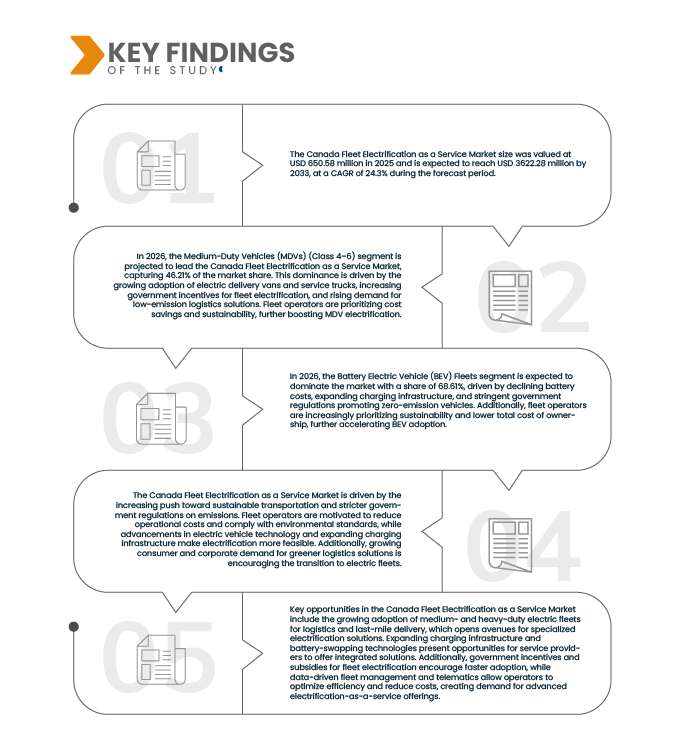
Data Bridge Market Research analyses that the Canada Fleet Electrification as a Service Market is expected to reach USD 3,622.28 million by 2033 from USD 650.58 million in 2025, growing with a CAGR of 24.3% in the forecast period of 2026 to 2033.
Key Findings of the Study
Expansion of Zero-Emission Vehicle Incentive Programs for Commercial Fleets
Expansion of zero-emission vehicle incentive programs for commercial fleets is accelerating adoption of electric trucks, vans, and buses across Canada, as federal and provincial subsidies, tax credits, and rebate schemes reduce upfront acquisition costs and improve total cost of ownership. Enhanced funding initiatives in provinces such as Ontario and Quebec are encouraging fleet operators to transition from diesel-powered vehicles to battery-electric alternatives, thereby stimulating demand for integrated Fleet Electrification as a Service solutions that bundle vehicle financing, charging infrastructure deployment, energy management, and ongoing operational support.
Report Scope and Market Segmentation
|
Report Metric
|
Details
|
|
Forecast Period
|
2026 to 2033
|
|
Base Year
|
2025
|
|
Historic Years
|
2018-2024 (Customizable from 2013-2017)
|
|
Quantitative Units
|
Revenue in USD Thousand
|
|
Segments Covered
|
By Fleet Configuration (Medium-Duty Vehicles (MDVs) (Class 4–6), Heavy-Duty Vehicles (HDVs) (Class 7–8), and Specialty & Off-Road Fleets), By Low-Carbon Technology Type (Battery Electric Vehicle (BEV) Fleets, Fuel Cell Electric Vehicles (FCEVs), Hybrid & Transitional Technologies, and Future & Emerging Technologies), By Digital Platforms (Fleet Energy Management Systems (FEMS), Smart Charging & Load Balancing, and AI-Based Route & Charging Optimization), By Offering (Vehicle Electrification Services, Charging Infrastructure as a Service, Energy & Power Management Services, Fleet Operations & Logistics Management, Financing, and Risk & Compliance Services), By Business Model Type (Full Fleet Electrification as a Service (End-to-End), Modular / Hybrid FEaaS, and Site-Based Energy + Fleet as a Service), By end use industry (Public Sector & Government Fleets, Logistics & Transportation, Utilities & Energy Companies, Industrial & Commercial Fleets, and Institutional & Campus Fleets), By Contract Structure (Subscription-Based Models, Long-Term Managed Service Contracts, and Financing & Risk Allocation Models), By Provider Type (OEM-Led Service Providers, Energy & Utility-Led Providers, Technology & Platform Providers, and Infrastructure & EPC Providers), By province (Québec, British Columbia, Ontario, and Alberta)
|
|
Countries Covered
|
Canada
|
|
Market Players Covered
|
|
|
Data Points Covered in the Report
|
In addition to the market insights such as market value, growth rate, market segments, geographical coverage, market players, and market scenario, the market report curated by the Data Bridge Market Research team includes in-depth expert analysis, import/export analysis, pricing analysis, production consumption analysis, and pestle analysis.
|
Segment Analysis
The Canada fleet electrification as a service market is segmented into nine notable segments, which are based on Fleet configuration, Low-Carbon Technology Type, Digital Platforms, Offering, Business Model Type, End-Use Industry, Contract Structure, Provider Type, Province.
- On the basis of Fleet Configuration, Canada Fleet Electrification as a Service (FEaaS) market is segmented into Medium-Duty Vehicles (MDVs) (Class 4–6), Heavy-Duty Vehicles (HDVs) (Class 7–8), Specialty & Off-Road Fleets.
In 2026, the Medium-Duty Vehicles (MDVs) (Class 4–6) segment is expected to dominate the Canada fleet electrification as a service market
In 2026, the Medium-Duty Vehicles (MDVs) (Class 4–6) segment is expected to dominate with a 46.21% market share.
- On the basis of Low-Carbon Technology Type, the Canada Fleet Electrification as a Service (FEaaS) market is segmented into Battery Electric Vehicle (BEV) Fleets, Fuel Cell Electric Vehicles (FCEVs), Hybrid & Transitional Technologies, Future & Emerging Technologies.
In 2026, the Battery Electric Vehicle (BEV) Fleets segment is expected to dominate the Canada fleet electrification as a service market
In 2026, the Battery Electric Vehicle (BEV) Fleets segment is expected to dominate with a 68.61% market share.
- On the basis of Digital Platforms, the Canada Fleet Electrification as a Service (FEaaS) market is segmented into Fleet Energy Management Systems (FEMS), Smart Charging & Load Balancing, AI-Based Route & Charging Optimization. In 2026, the Fleet Energy Management Systems (FEMS) segment is expected to dominate with a 42.82% market share.
- On the basis of Offering, the Canada Fleet Electrification as a Service (FEaaS) market is segmented into Vehicle Electrification Services, Charging Infrastructure as a Service, Energy & Power Management Services, Fleet Operations & Logistics Management, Financing, Risk & Compliance Services. In 2026, the Vehicle Electrification Services segment is expected to dominate with a 31.44% market share.
- On the basis of Business Model Type, the Canada Fleet Electrification as a Service (FEaaS) market is segmented into Full Fleet Electrification as a Service (End-to-End), Modular / Hybrid FEaaS, Site-Based Energy + Fleet as a Service. In 2026, the Full Fleet Electrification as a Service (End-to-End) segment is expected to dominate with a 48.60% market share.
- On the basis of End-Use Industry, Canada Fleet Electrification as a Service (FEaaS) market is segmented into Public Sector & Government Fleets, Logistics & Transportation, Utilities & Energy Companies, Industrial & Commercial Fleets, and Institutional & Campus Fleets. In 2026, the Logistics & Transportation segment is expected to dominate with a 31.99% market share.
- On the basis of Contract Structure, the Canada Fleet Electrification as a Service (FEaaS) market is segmented into Subscription-Based Models, Long-Term Managed Service Contracts, Financing & Risk Allocation Models. In 2026, the Subscription-Based Models segment is expected to dominate with a 39.87% market share.
- On the basis of Provider Type, the Canada Fleet Electrification as a Service (FEaaS) market is segmented into OEM-Led Service Providers, Energy & Utility-Led Providers, Technology & Platform Providers, Infrastructure & EPC Providers. In 2026, the OEM-Led Service Providers segment is expected to dominate with a 36.18% market share.
- On the basis of Province, the Canada Fleet Electrification as a Service (FEaaS) market is segmented into Québec, British Columbia, Ontario, Alberta. In 2026, the Québec province is expected to dominate with a 40.21% market share.
Major Players
Data Bridge Market Research analyzes some of the major market players operating in the market, such as 7Gen (Canada), Jim Pattison Lease (Canada), ENGIE (France), Comco Canada Ltd. (Canada), Ziing (Canada), Shell plc (U.K.), LION ELECTRIC (FLEET SOLUTIONS) (Canada), Zeemac (Canada), ELECTRAMECCANICA (COMMERCIAL EV SOLUTIONS) (Canada), Hitachi Energy Ltd (Switzerland), Schneider Electric (France), ABB (Switzerland), Siemens (Germany), BC Hydro (Canada), ChargePoint, Inc. (U.S.), eCAMION Inc. (Canada), Teal Electrification Systems (Canada), Geotab Inc. (Canada), Hydro One Networks Inc. (Canada), InCharge Energy (U.S.), PowerON Energy Solutions (Canada), Merchants Fleet (U.S.), Ryder System, Inc. (U.S.) among others.
Market Developments
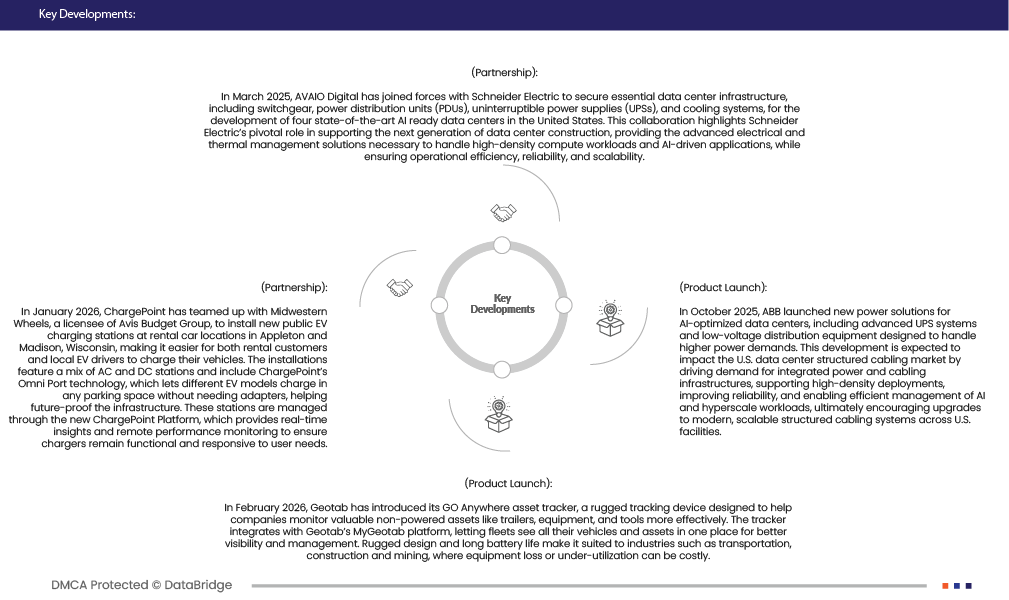
- In January 2025, ChargePoint has teamed up with Midwestern Wheels, a licensee of Avis Budget Group, to install new public EV charging stations at rental car locations in Appleton and Madison, Wisconsin, making it easier for both rental customers and local EV drivers to charge their vehicles. The installations feature a mix of AC and DC stations and include ChargePoint’s Omni Port technology, which lets different EV models charge in any parking space without needing adapters, helping future-proof the infrastructure. These stations are managed through the new ChargePoint Platform, which provides real-time insights and remote performance monitoring to ensure chargers remain functional and responsive to user needs.
- In March 2025, AVAIO Digital has joined forces with Schneider Electric to secure essential data center infrastructure, including switchgear, power distribution units (PDUs), uninterruptible power supplies (UPSs), and cooling systems, for the development of four state-of-the-art AI ready data centers in the United States. This collaboration highlights Schneider Electric’s pivotal role in supporting the next generation of data center construction, providing the advanced electrical and thermal management solutions necessary to handle high-density compute workloads and AI-driven applications, while ensuring operational efficiency, reliability, and scalability.
- In January 2025 siemens introduced advanced industrial AI and digital twin technologies designed to enhance operational efficiency with real-time decision-making. They launched the Siemens Industrial Co-pilot for Operations, bringing AI directly to the shop floor. Siemens also announced a partnership with Jet Zero to develop a fuel-efficient, zero-emission blended-wing aircraft. These innovations highlight Siemens’ focus on driving sustainability and digital transformation across industries.
Regional Analysis
Geographically, the country covered in the Canada fleet electrification as a service market report is Canada.
For more detailed information about the Canada fleet electrification as a service market, click here – https://www.databridgemarketresearch.com/reports/canada-fleet-electrification-as-a-service-feaas-market