The increasing adoption of cloud-based workforce management solutions is a key growth driver for the Europe Workforce Management Market. Organizations across the region are replacing traditional workforce management systems with cloud-based platforms to improve employee scheduling, attendance tracking, payroll management, workforce planning, and regulatory compliance. These solutions provide real-time access to workforce data, improve operational efficiency, reduce infrastructure costs, and support remote and hybrid work environments. The growing focus on digital transformation among European businesses is further accelerating the adoption of cloud technologies. In addition, initiatives by the European Union to strengthen digital infrastructure and promote secure cloud services are encouraging organizations to modernize their workforce operations. This trend is creating significant revenue opportunities for workforce management software providers, cloud service vendors, HR technology companies, and AI solution developers. Businesses are increasingly investing in cloud-based workforce analytics, mobile workforce applications, employee self-service platforms, and AI-driven workforce planning tools to improve productivity and decision-making.
Access Full Report @ https://www.databridgemarketresearch.com/reports/europe-workforce-management-market
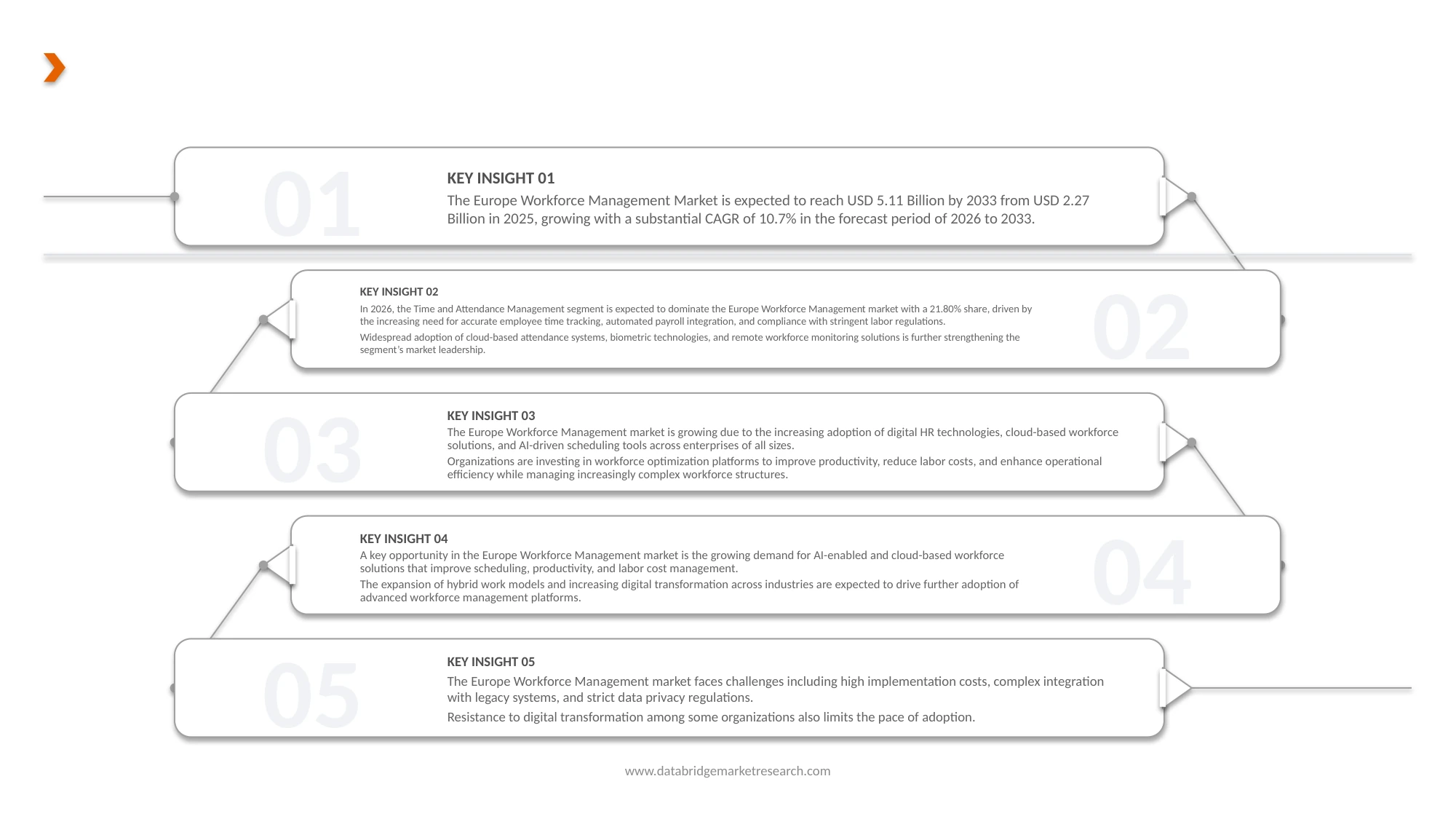
Data Bridge Market Research analyses that the Europe Workforce Management Market is expected to reach USD 5.11 billion by 2033 from USD 2.27 billion in 2024, growing with a CAGR of 10.7% in the forecast period of 2025 to 2032.
Key Findings of the Study
Rising Need for Labor Law Compliance and Workforce Optimization
The rising need for labor law compliance and workforce optimization is becoming a major driver of the Europe Workforce Management Market. European employers operate under complex labor regulations covering working hours, overtime, employee rights, leave management, health and safety, and wage compliance. As regulations continue to evolve, organizations are increasingly adopting workforce management solutions to automate compliance monitoring, maintain accurate employee records, and reduce the risk of penalties. At the same time, businesses are under pressure to improve productivity, manage labor costs, and optimize workforce utilization in a competitive economic environment. Digital workforce management platforms help organizations streamline scheduling, track employee attendance in real time, improve workforce planning, and ensure compliance with changing labor laws. Recent initiatives by the European Union, including the implementation of employment-related regulations and digital workplace requirements, have further encouraged organizations to modernize workforce management processes. This trend is creating revenue opportunities for workforce management software providers, HR technology companies, payroll solution vendors, and workforce analytics providers. Looking ahead, increasing regulatory scrutiny, labor shortages, and the growing use of automation and artificial intelligence in workforce planning are expected to drive continued demand for advanced workforce management solutions across Europe.
Report Scope and Market Segmentation
|
Report Metric
|
Details
|
|
Forecast Period
|
2026 to 2033
|
|
Base Year
|
2025
|
|
Historic Years
|
2018-2024 (Customizable from 2013-2017)
|
|
Quantitative Units
|
Revenue in USD Billion
|
|
Segments Covered
|
Solution Type (Time and Attendance Management, Leave and Absence Management, Planning and Scheduling, Workforce Scheduling, Workforce Analytics, Budgeting and Forecasting, Task Management, Fatigue Management, Employee Engagement and Self-Service, and Others), Service Type (Consulting Services, Implementation Services, Training Services, Support and Maintenance Services, Customization Services), Deployment Type (Cloud-Based, On-Premises, and Hosted Deployment), Operating System, (Windows, Linux, Macos, Android, IOS, and Cross-platform), Enterprise Size (Large Enterprises, Medium Enterprises, Small Enterprises), Enduse-Industry (Retail and E-Commerce, Healthcare, Manufacturing, Banking, Financial Services and Insurance, Information Technology and Telecommunications, Government and Public Sector, Transportation and Logistics, Hospitality, Energy and Utilities, and Others), Workforce Type (Field Workforce, Desk-Based Workforce, Remote Workforce, Frontline Workforce, Contract Workforce), Functionality (Workforce Administration, Labor Management, Workforce Optimization, Workforce Intelligence, and Workforce Mobility), Integration Type (Human Capital Management Integration, Payroll Integration, Enterprise Resource Planning Integration, Customer Relationship Management Integration, and Business Intelligence Integration), Technology (Artificial Intelligence Enabled Workforce Management, Machine Learning Enabled Workforce Management, Cloud-Native Workforce Management, Mobile Workforce Management, Internet Of Things Enabled Workforce Management, and Advanced Analytics Enabled Workforce Management)
|
|
Countries Covered
|
Germany, France, Netherlands, Switzerland, Austria, Belgium, Hungary, Italy, Spain, U.K., Russia, Turkey, Luxembourg, and Rest of Europe
|
|
Market Players Covered
|
SD Worx NV (Belgium), ATOSS Software SE (Germany), Zucchetti S.p.A. (Italy), The Access Group (UK), Personio (Germany), Asseco Business Solutions (Poland), Sage Group PLC (UK), Unit4 (Netherlands), Factorial (Spain), Skello (France), Cegedim SA (France), Quinyx (Sweden), Puzzel (Norway), SISQUAL Workforce Management (Portugal), Primion Technology GmbH (Germany), Plano Solutions GmbH (Plano WFM) (Germany), Tamigo ApS (Denmark), SameSystem A/S (Denmark), Mitrefinch (UK), Softworks (Ireland), Manus Software Europe (Netherlands), Bizimply (Ireland), Holy-Dis (France), Interflex (Germany), Kenjo (Germany), Rotageek (UK), Worklinq (Denmark), Shiftbase (Netherlands), Timegrip (Denmark), InVision AG (Part of PeopleWare Group) (Germany), Papershift (Germany), and PARiM Software (Estonia)
|
|
Data Points Covered in the Report
|
In addition to the market insights such as market value, growth rate, market segments, geographical coverage, market players, and market scenario, the market report curated by the Data Bridge Market Research team includes in-depth expert analysis, import/export analysis, pricing analysis, production consumption analysis, and pestle analysis.
|
Segment Analysis
The Europe workforce management market is segmented into ten notable segments based on the solution type, service type, deployment type, operating system, enterprise size, enduse-industry, workforce type, functionality, integration type, and technology.
- On the basis of solution type, the Europe workforce management market is segmented into time and attendance management, leave and absence management, planning and scheduling, workforce scheduling, budgeting and forecasting, task management, fatigue management, employee engagement and self-service, and others.
In 2026, the time and attendance management segment is expected to dominate the Europe workforce management market
In 2026, the time and attendance management segment is expected to dominate the market with a 21.80% market share and is expected to reach USD 1,106,328.72 thousand by 2033, growing with the CAGR of 10.6% during the forecast period 2026 to 2033.
- On the basis of service type, the Europe workforce management market is segmented into consulting services, implementation services, training services, support and maintenance services, and customization services.
In 2026, the implementation services segment is expected to dominate the Europe workforce management market
In 2026, the implementation services segment is expected to dominate the market with a 38.73% market share and is expected to reach USD 1,985,933.08 thousand by 2033, growing with the CAGR of 10.8% during the forecast period 2026 to 2033.
- On the basis of deployment type, the Europe workforce management market is segmented into cloud-based, on-premises, and hosted deployment. In 2026, the cloud-based segment is expected to dominate the market with a 58.54% market share and is expected to reach USD 3,045,134.14 thousand by 2033, growing with the highest CAGR of 11.0% during the forecast period 2026 to 2033.
- On the basis of operating system, the Europe workforce management market is segmented into Windows, Linux, macOS, Android, iOS, and cross-platform. In 2026, the windows segment is expected to dominate the market with a 43.07% market share and is expected to reach USD 2,115,934.68 thousand by 2033, growing with the highest CAGR of 10.1% during the forecast period 2026 to 2033.
- On the basis of enterprise size, the Europe workforce management market is segmented into large enterprises, medium enterprises, and small enterprises. In 2026, the large enterprises segment is expected to dominate the market with a 56.67% market share and is expected to reach USD 2,852,736.41 thousand by 2033, growing with the highest CAGR of 10.4% during the forecast period 2026 to 2033.
- On the basis of enduse-industry, the Europe workforce management market is segmented into retail and e-commerce, healthcare, manufacturing, banking, financial services and insurance (BFSI), information technology and telecommunications, government and public sector, transportation and logistics, hospitality, energy and utilities, and others. In 2026, the information technology and telecommunications segment is expected to dominate the market with a 22.91% market share and is expected to reach USD 1,194,008.25 thousand by 2033, growing with the highest CAGR of 11.0% during the forecast period 2026 to 2033.
- On the basis of workforce type, the Europe workforce management market is segmented into field workforce, desk-based workforce, remote workforce, frontline workforce, and contract workforce. In 2026, desk-based workforce segment is expected to dominate the market with a 36.57% market share and is expected to reach USD 1,761,750.56 thousand by 2033, growing with the highest CAGR of 9.8% during the forecast period 2026 to 2033.
- On the basis of functionality, the Europe workforce management market is segmented into workforce administration, labor management, workforce optimization, workforce intelligence, and workforce mobility. In 2026, the workforce administration segment is expected to dominate the market with a 29.65% market share and is expected to reach USD 1,426,482.15 thousand by 2033, growing with the highest CAGR of 9.9% during the forecast period 2026 to 2033.
- On the basis of integration type, the Europe workforce management market is segmented into human capital management integration, payroll integration, enterprise resource planning integration, customer relationship management integration, and business intelligence integration. In 2026, the into human capital management integration segment is expected to dominate the market with a 31.01% market share and is expected to reach USD 1,621,779.50 thousand by 2033, growing with the highest CAGR of 11.3% during the forecast period 2026 to 2033.
- On the basis of technology, the Europe workforce management market is segmented into artificial intelligence enabled workforce management, machine learning enabled workforce management, cloud-native workforce management, mobile workforce management, internet of things enabled workforce management, and advanced analytics enabled workforce management. In 2026, the cloud-native workforce management segment is expected to dominate the market with a 27.89% market share and is expected to reach USD 1,452,385.34 thousand by 2033, growing with the highest CAGR of 10.8% during the forecast period 2026 to 2033
Major Players
Data Bridge Market Research analyzes some of the major market players operating in the market including Asseco Business Solutions (Poland), The Access Group (UK), Sage Group PLC (UK), ATOSS Software SE (Germany), and Zucchetti S.p.A. (Italy).
Market Developments
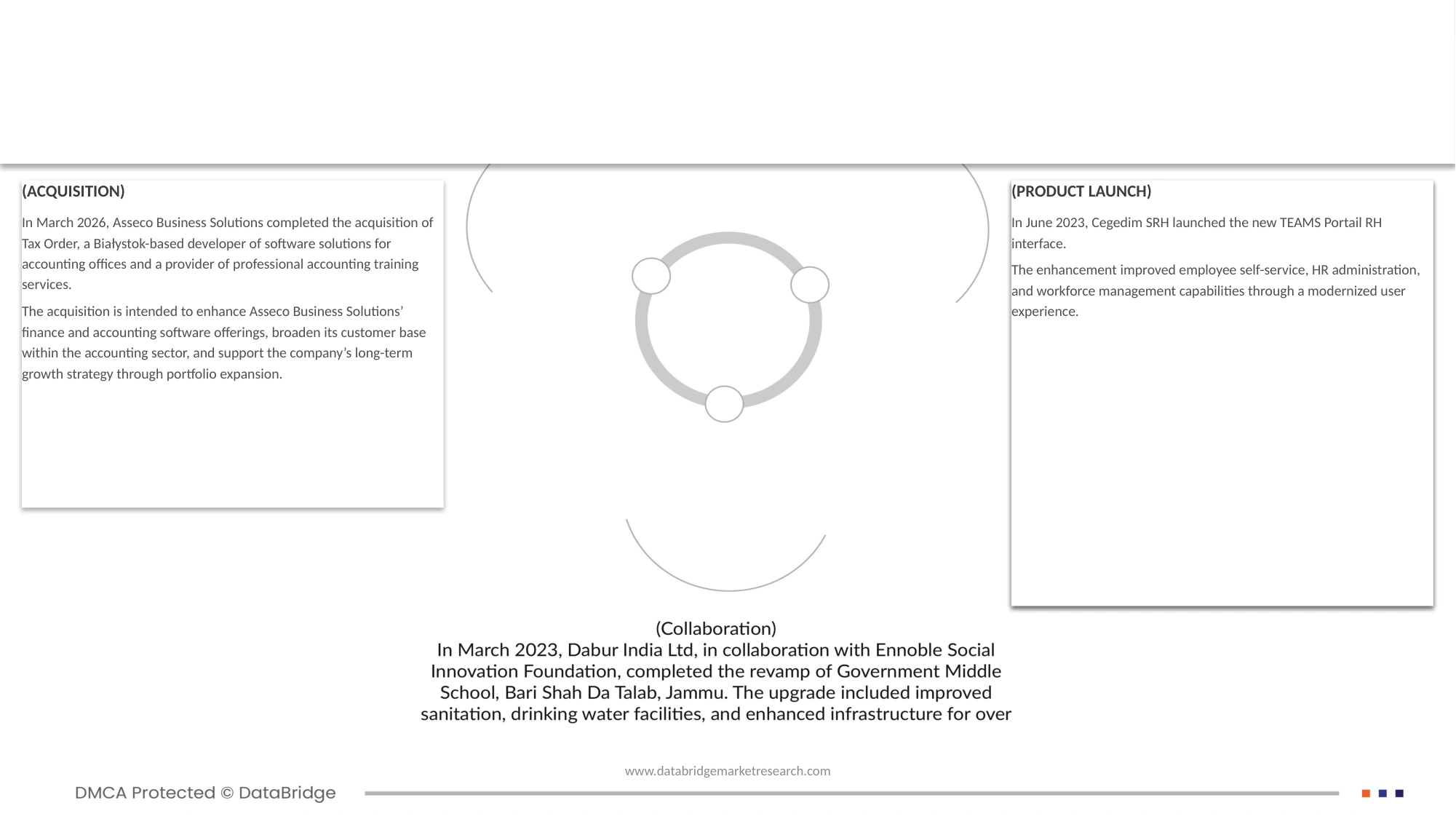
- In July 2025, Tamigo strengthened its European presence by acquiring its reseller operations in Benelux, Norway, and Spain, bringing these businesses directly into the company. This merger was aimed at improving knowledge sharing, customer service, and operational alignment across Europe while retaining local market expertise. The integration also restructured the leadership team to support Tamigo’s growth as a pan-European workforce management provider for retail and hospitality businesses.
- In December 2025, SISQUAL WFM launched SISQUAL E-Sign, a digital signature and document management solution integrated with its workforce management platform. The solution enables paperless document distribution, remote signing, centralized document control, legal compliance, auditability, and secure management of HR-related documents such as contracts, overtime approvals, and absence justifications, helping organizations streamline administrative processes and improve operational efficiency.
- In January 2025, Peopleware has launched its new unified workforce management (WFM) brand initiative, bringing together all InVision Group products and services under a single “Peopleware” identity. The launch highlights a refreshed positioning focused on AI-driven, employee-centric WFM solutions designed to improve planning, scheduling, and operational efficiency across global organizations. This will strengthen the company’s market presence by creating a unified brand ecosystem.
- In September 2025, Worklinq (formerly ProMark) has officially rebranded as part of a strategic transformation to strengthen its position as a leading European Workforce Management (WFM) provider. The change reflects its shift toward a more unified brand identity, expanded international ambitions, and a stronger focus on delivering cloud-based, employee-centric WFM solutions. This rebranding helps the company modernize its market positioning, improve brand clarity across regions, and support its growth strategy.
- In 2026, Worklinq has entered into a strategic partnership agreement with Azets, where Azets will act as an implementation partner for selected Worklinq customers in Denmark. The collaboration is designed to strengthen joint sales and deployment capabilities, particularly for small and medium-sized enterprises, while building on the existing integration between Worklinq’s platform and Azets’ payroll system EPOS. This partnership enhances Worklinq’s ability to scale customer implementations more efficiently by combining consulting expertise with its workforce management platform.
Regional Analysis
Geographically, the country covered in the Europe workforce management market report Germany, France, Netherlands, Switzerland, Austria, Belgium, Hungary, Italy, Spain, U.K., Russia, Turkey, Luxembourgh, and Rest Of Europe.
As per Data Bridge Market Research analysis:
Germany is the dominant region in the Europe workforce management market
Germany leads the Europe workforce management market due to its strong industrial base, high enterprise digitalization, widespread adoption of Industry 4.0 technologies, and the presence of major workforce management software providers such as ATOSS Software SE and SAP. The country has a large manufacturing, automotive, logistics, and retail sector that increasingly relies on workforce optimization, employee scheduling, time tracking, and labor compliance solutions to improve operational efficiency. Additionally, stringent labor regulations and collective bargaining frameworks in Germany encourage organizations to adopt advanced workforce management platforms to ensure compliance, automate workforce planning, and enhance productivity across enterprises.
Spain is estimated to be the fastest-growing region in the Europe workforce management market
Spain is expected to be the fastest-growing region in the Europe workforce management market from 2026 to 2033, driven by the rapid digital transformation of businesses, increasing adoption of cloud-based HR and workforce solutions among SMEs, and the expansion of the retail, hospitality, healthcare, and service sectors. The country is also witnessing rising investments in employee productivity tools, flexible workforce scheduling, and labor compliance technologies as organizations adapt to hybrid work environments and evolving labor regulations. In addition, the growing presence of technology-driven HR startups and workforce software providers such as Factorial is further accelerating market growth across Spain.
For more detailed information about Europe workforce management market click here – https://www.databridgemarketresearch.com/reports/europe-workforce-management-market