The rising adoption of autonomous and remotely operated underwater systems has become a pivotal driver in the Global AUV (Autonomous Underwater Vehicle) and ROV (Remotely Operated Vehicle) Market. As offshore industrial sectors expand into increasingly challenging marine environments—characterized by extreme depths, low visibility, and hazardous conditions—these unmanned platforms are increasingly entrusted with critical subsea tasks previously undertaken by human divers. Autonomous systems mitigate human risk by performing complex inspection and intervention missions while reducing the operational downtime associated with manual methods and ensuring continuity of vital subsea activities. Governmental and official sources, technical reports, and industry disclosures throughout 2022 to 2025 substantiate a growing trend toward integrating advanced AUVs and ROVs to enhance safety, operational efficiency, and resilience in harsh underwater environments.
Access Full Report @ https://www.databridgemarketresearch.com/reports/global-auv-and-rov-market
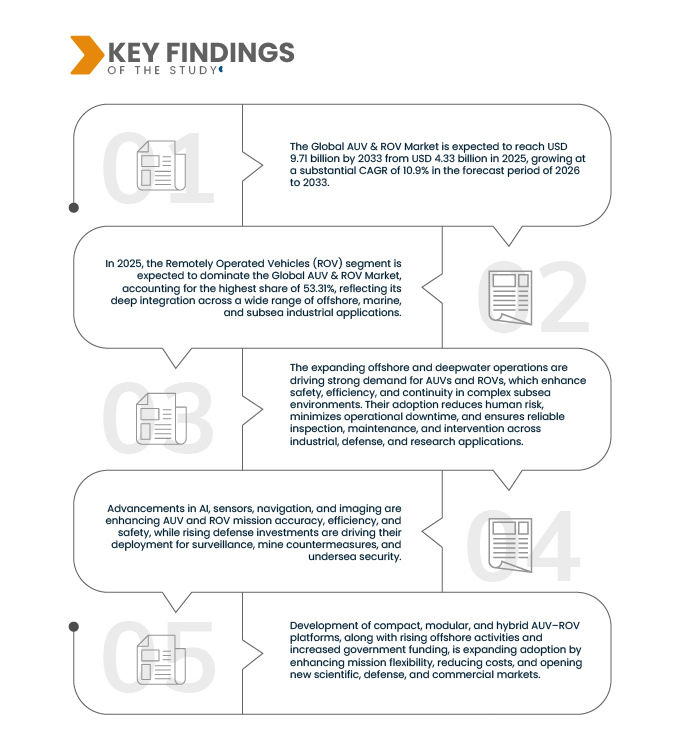
Data Bridge market research analyzes that the Global AUV and ROV Market is expected to reach USD 9.71 billion by 2033 from USD 4.33 billion in 2025, growing at a substantial CAGR of 10.9% in the forecast period of 2026 to 2033.
Key Findings of the Study
Growing offshore oil & gas exploration and Deepwater field development increase demand for AUVs and ROVs for inspection, repair, and maintenance activities.
The expansion of offshore oil and gas exploration, particularly in deepwater and ultra-deepwater environments, has fundamentally elevated the operational complexity of subsea assets. As hydrocarbon provinces extend farther from shore and into increasingly hostile marine conditions, unmanned underwater systems such as Autonomous Underwater Vehicles (AUVs) and Remotely Operated Vehicles (ROVs) have emerged as indispensable technologies for ensuring structural integrity and operational continuity. These platforms enable remote and high-resolution inspection, facilitate critical maintenance tasks, and reduce reliance on diver-based interventions, thereby improving safety, reducing downtime, and enhancing asset reliability. The proliferation of subsea infrastructure combined with heightened regulatory emphasis on safety compliance underscores the strategic role of AUVs and ROVs in supporting inspection, repair, and maintenance (IRM) activities across the offshore energy lifecycle. Evidence from industry disclosures and official documentation indicates ongoing investments, technology deployments, and policy planning that link upstream deepwater developments directly to increased utilization of unmanned underwater vehicles.
Report Scope and Market Segmentation
|
Report Metric
|
Details
|
|
Forecast Period
|
2026 to 2033
|
|
Base Year
|
2025
|
|
Historic Years
|
2024 (Customizable to 2018-2023)
|
|
Quantitative Units
|
Revenue in USD Billion
|
|
Segments Covered
|
By Product Type (Autonomous Underwater Vehicles (AUV), Remotely Operated Vehicles (ROV), Hybrid Vehicles, Gliders and Others), By System Component (Sensors & Payloads, Structure & Frames, Launch and Recovery Systems), By Depth (Up to 300 m, 301–1,000 m, 1,001–3,000 m and Above 3,000 m) By Application (Oil & Gas, Defense & Security, Scientific Research, Environmental Monitoring, Search & Salvage, Commercial and Others) By Propulsion Type (Electric, Hydraulic, Mechanical and Hybrid), By Operating Modality (Fully Autonomous, Semi-Autonomous, Remote-Controlled and Hybrid Control), By Distribution Channel (Direct (OEM) and Indirect (Third-Party Distributed))
|
|
Countries Covered
|
North America
Europe
Asia-Pacific
Middle East and Africa
South America
|
|
Market Players Covered
|
Kongsberg Maritime (Norway), Oceaneering International (U.S.), Saab AB (Saab Seaeye) (Sweden), Teledyne Marine (U.S.), Forum Energy Technologies (U.S.), TechnipFMC (U.K.), ECA Group (France), DOF Subsea (Norway), Atlas Elektronik GmbH (Germany), Boston Engineering Corporation (U.S.), IKM Subsea (Norway), VideoRay (U.S.), Soil Machine Dynamics (SMD) (U.K.), Hydroid (HII) (U.S.), Aquabotix Technology Corporation (U.S.), Strategic Robotic Systems (U.S.), ROVOP (U.K.), Seamor Marine Ltd (Canada), SeaRobotics Corporation (U.S.), Mariscope Meerestechnik (Germany), International Submarine Engineering Ltd. (Canada), Deep Ocean Engineering, Inc. (U.S.), Boxfish Robotics Ltd. (New Zealand), Planys Technologies (India), Cellula Robotics Ltd. (Canada), L3Harris Technologies, Inc. (U.S.), Subsea Tech (France), Eelume (Norway), Blueye Robotics AS (Norway)
|
|
Data Points Covered in the Report
|
In addition to the insights on market scenarios such as market value, growth rate, segmentation, geographical coverage, and major players, the market reports curated by the Data Bridge Market Research also include import export analysis, production capacity overview, production consumption analysis and price trend analysis.
|
Segment Analysis
The global AUV & ROV market is segmented into seven notable segments which are based on product type, system component, depth, application, propulsion type, operating modality, and distribution channel.
- On the basis of product type, the global AUV & ROV market is segmented into autonomous underwater vehicles (AUV), remotely operated vehicles (ROV), hybrid vehicles, gliders, and others.
In 2026, the remotely operated vehicles (ROV) segment is expected to dominate the market
On the basis of Material Type, global AUV & ROV Market is segmented into autonomous underwater vehicles (AUV), remotely operated vehicles (ROV), hybrid vehicles, gliders, Others. In 2026, the remotely operated vehicles (ROV) segment is expected to dominate with 53.23% market share and is expected to reach USD 5.11 billion by 2033, growing with the highest CAGR of 10.7% in the forecast period of 2026 to 2033.
In 2026, the Sensors & Payloads segment is expected to dominate the market
- On the basis of system component, the Global AUV & ROV market is segmented into Sensors & Payloads, Structure & Frames, and Launch and Recovery Systems. In 2026, the Sensors & Payloads segment is expected to dominate the market with 73.27% market share and is expected to reach USD 7.19 billion by 2033, growing with a CAGR of 11.0% during the forecast period of 2026 to 2033.
In 2026, the Up to 300 m segment is expected to dominate the market
- On the basis of depth, the Global AUV & ROV market is segmented into Up to 300 m, 301 m–1,000 m, 1,001 m–3,000 m, and Above 3,000 m. In 2026, the Up to 300 m segment is expected to dominate the market with 58.70% market share and is expected to reach USD 5.68 billion by 2033, growing with a CAGR of 10.8% during the forecast period of 2026 to 2033.
In 2026, the Oil & Gas segment is expected to dominate the market
- On the basis of application, the Global AUV & ROV market is segmented into Oil & Gas, Defense & Security, Scientific Research, Environmental Monitoring, Commercial, Search & Salvage, and Others. In 2026, the Oil & Gas segment is expected to dominate the market with 54.47% market share and is expected to reach USD 5.23 billion by 2033, growing with a CAGR of 10.7% during the forecast period of 2026 to 2033.
In 2026, the Electric propulsion segment is expected to dominate the market
- On the basis of propulsion type, the Global AUV & ROV market is segmented into Electric, Hydraulic, Hybrid, and Mechanical. In 2026, the Electric propulsion segment is expected to dominate the market with 46.59% market share and is expected to reach USD 4.61 billion by 2033, growing with a CAGR of 11.2% during the forecast period of 2026 to 2033.
In 2026, the Remote-Controlled segment is expected to dominate the market
- On the basis of operating modality, the Global AUV & ROV market is segmented into Remote-Controlled, Fully Autonomous, Semi-Autonomous, and Hybrid Control. In 2026, the Remote-Controlled segment is expected to dominate the market with 52.54% market share and is expected to reach USD 5.00 billion by 2033, growing with a CAGR of 10.5% during the forecast period of 2026 to 2033.
In 2026, the Direct segment is expected to dominate the market
- On the basis of distribution channel, the Global AUV & ROV market is segmented into Direct and Indirect channels. In 2026, the Direct distribution channel is expected to dominate the market with 64.88% market share and is expected to reach USD 6.37 billion by 2033, growing with a CAGR of 11.1% during the forecast period of 2026 to 2033.
Major Players
Kongsberg Maritime (Norway), Oceaneering International (U.S.), Saab AB (Saab Seaeye) (Sweden), Teledyne Marine (U.S.), Forum Energy Technologies (U.S.), TechnipFMC (U.K.), ECA Group (France), DOF Subsea (Norway), Atlas Elektronik GmbH (Germany), Boston Engineering Corporation (U.S.), IKM Subsea (Norway), VideoRay (U.S.), Soil Machine Dynamics (SMD) (U.K.), Hydroid (HII) (U.S.), Aquabotix Technology Corporation (U.S.), Strategic Robotic Systems (U.S.), ROVOP (U.K.), Seamor Marine Ltd (Canada), SeaRobotics Corporation (U.S.), Mariscope Meerestechnik (Germany), International Submarine Engineering Ltd. (Canada), Deep Ocean Engineering, Inc. (U.S.), Boxfish Robotics Ltd. (New Zealand), Planys Technologies (India), Cellula Robotics Ltd. (Canada), L3Harris Technologies, Inc. (U.S.), Subsea Tech (France), Eelume (Norway), Blueye Robotics AS (Norway).
Market Developments
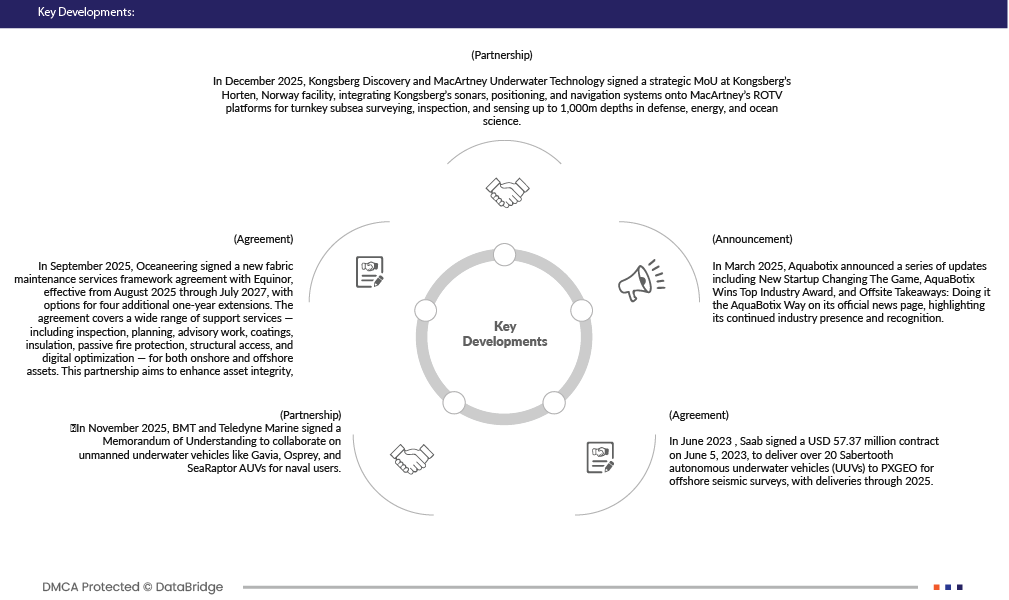
- In 2025 December, Kongsberg Discovery and MacArtney Underwater Technology signed a strategic MoU at Kongsberg’s Horten, Norway facility, integrating Kongsberg’s sonars, positioning, and navigation systems onto MacArtney’s ROTV platforms for turnkey subsea surveying, inspection, and sensing up to 1,000m depths in defense, energy, and ocean science.
- In 2025 October, Oceaneering successfully completed a North Sea field trial of its Ocean Perception marine wildlife-mitigation solution, conducted aboard an offshore wind installation vessel in partnership with Van Oord. The system uses 360° thermal imaging, radar, and real-time monitoring to accurately detect and track bird activity, even in low-light and nighttime conditions. The trial demonstrated its ability to reduce false positives and improve environmental compliance, ultimately helping operators expand safe operational windows and enhance offshore project efficiency.
- In 2018 September, TechnipFMC signed a Strategic Collaboration Agreement with Equinor to deepen and formalize their long‑standing partnership across offshore energy projects worldwide. Under the agreement, the two companies committed to working together from early concept and pre‑FEED phases through project execution and subsea operations, with the aim of driving continuous improvements, integrating next‑generation technologies, and achieving sustainable cost reductions across Equinor’s offshore developments. This collaboration builds on earlier successes in integrated EPCI delivery and is intended to enhance competitiveness, streamline project delivery, and strengthen both firms’ ability to support complex subsea and offshore infrastructure programs.
- In 2025 November, BMT and Teledyne Marine signed a Memorandum of Understanding to collaborate on unmanned underwater vehicles like Gavia, Osprey, and SeaRaptor AUVs for naval users.
- In 2025 August, Saab secured a USD 6.31 million deal with Swedish FMV to develop a Large Uncrewed Undersea Vehicle (LUUV) using Autonomous Ocean Core for seabed surveillance, targeting sea trials in summer 2026.
As per Data Bridge Market Research analysis:
Geographically, the countries covered in the global AUV & ROV Market report are North America, Europe, Asia-Pacific, Middle East and Africa, South America. The North America is further segmented into U.S., Canada, and Mexico. Europe is further segmented into Germany, U.K., France, Italy, Spain, Russia, Turkey, Netherlands, Norway, Finland, Denmark, Sweden, Switzerland, Belgium, and rest of Europe. The Asia-Pacific is further segmented into China, Japan, India, South Korea, Australia, Indonesia, Thailand, Malaysia, Singapore, Taiwan, Philippines, New Zealand, and rest of Asia-Pacific. The South America is further segmented into Brazil, Argentina, Colombia, Chile, Peru and rest of South America. The Middle East and Africa is further segmented into Saudi Arabia, U.A.E., South Africa, Turkey, Qatar, Egypt, Israel, Oman, Kuwait, Bahrain and Rest of Middle East and Africa.
U.S. is the dominating country in global AUV & ROV Market
U.S. is the dominant country in the global Autonomous Underwater Vehicle (AUV) and Remotely Operated Vehicle (ROV) market, supported by its advanced marine technology ecosystem, strong defense and naval spending, and leadership in offshore energy and subsea research. The country benefits from the presence of major AUV and ROV manufacturers, extensive deployment by the U.S. Navy, and high adoption across offshore oil & gas exploration, seabed mapping, underwater inspection, and oceanographic research. Additionally, continuous investments in deep-sea exploration, underwater surveillance, and next-generation autonomous systems further strengthen the U.S.’s leading position in the global market.
India is expected to be the fastest growing country in global AUV & ROV Market
India is expected to be the fastest-growing country in the global AUV & ROV market, driven by rising investments in naval modernization, underwater surveillance, and indigenous defense manufacturing. Increasing focus on maritime security, port and coastal monitoring, offshore renewable energy, and deep-sea mining initiatives is accelerating demand for AUVs and ROVs. Government-led programs promoting domestic development of autonomous marine systems, coupled with growing collaboration between research institutions, defense agencies, and private technology firms, are further supporting rapid market expansion in India.
For more detailed information about the global AUV & ROV Market report, click here – https://www.databridgemarketresearch.com/reports/global-auv-and-rov-market