The Global Contraceptive Market, supported by increasing demand for reproductive healthcare, pregnancy prevention, and family planning solutions. Healthcare providers, including hospitals, gynecology and obstetric clinics, and family planning centers, contribute significantly by offering contraceptive counselling, prescriptions, and access to a wide range of contraceptive drugs and devices. Government healthcare programs and community health centers are also expanding access through awareness campaigns and reproductive health initiatives, particularly in developing economies. In addition, retail pharmacies, online pharmacies, and drug stores are improving product availability and convenience for consumers.
Pharmaceutical companies and medical device manufacturers are strengthening market development through product innovation, improved formulations, and the introduction of long-acting reversible contraceptives. Growing awareness among adolescents and adults, increasing acceptance of modern contraceptive methods, and expanding healthcare infrastructure are further supporting market demand across diverse regions and consumer groups.
Access Full Report @ https://www.databridgemarketresearch.com/reports/global-contraceptives-market
Data Bridge market research analyzes that the Global Contraceptive Market is expected to reach USD 10.49 billion by 2033 from USD 8.67 billion in 2025, growing at a substantial CAGR of 2.40% in the forecast period of 2026 to 2033.
Key Findings of the Study
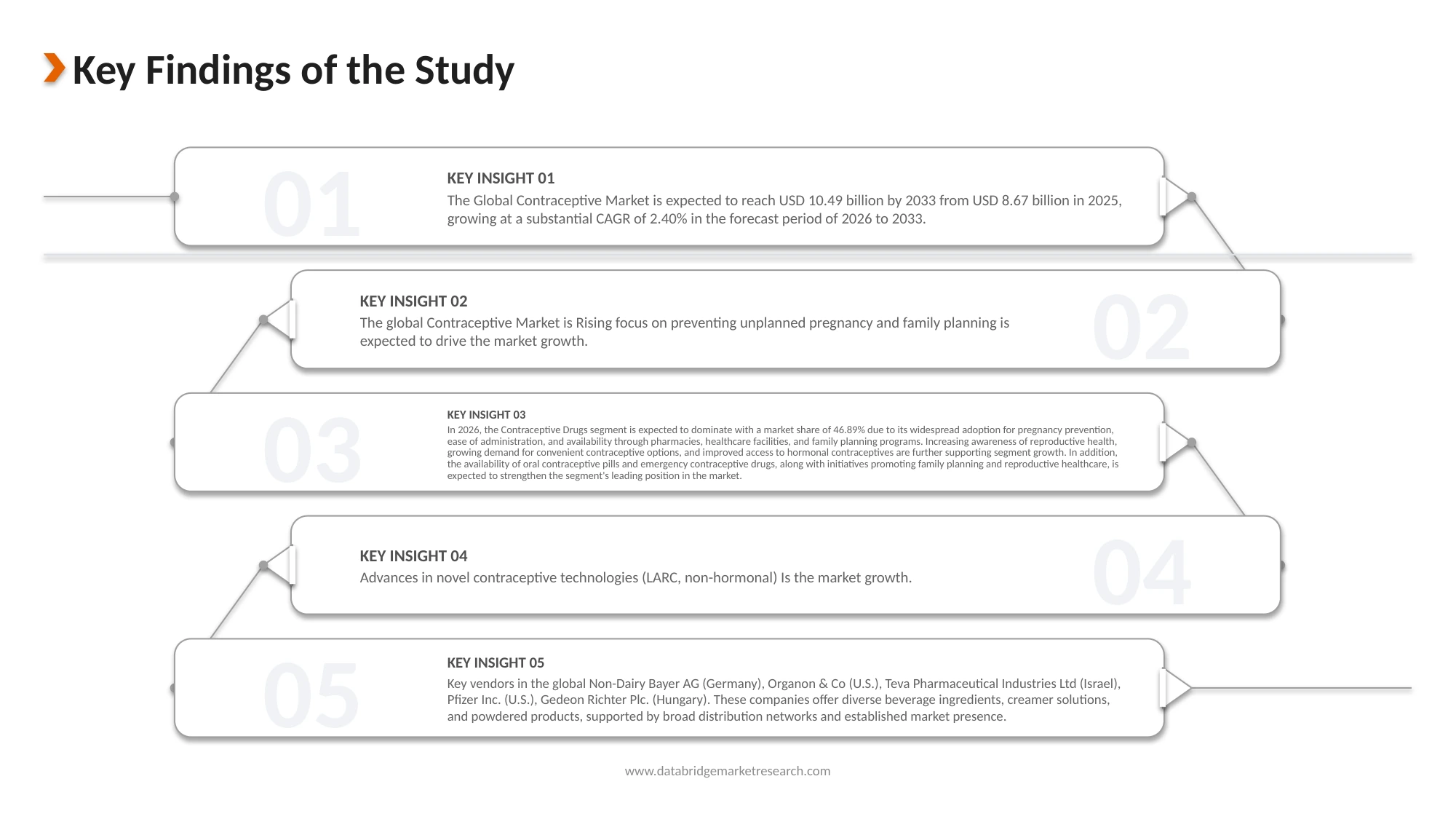
Rising Focus on Preventing Unplanned Pregnancy and Family Planning
The increasing installation of wind turbines is driving demand in the global slewing bearings market, as these systems require specialized bearings to support rotational movement and withstand heavy operational loads. A typical wind turbine commonly uses multiple large slewing bearings, with four rings or bearing units potentially required depending on the turbine design and configuration. These components are used in critical systems, including blade pitch adjustment and nacelle yaw positioning, enabling turbines to optimize blade angles and align with changing wind directions.
The expansion of onshore and offshore wind energy projects is increasing demand for durable, high-load-capacity bearings that can operate reliably under variable weather conditions. Furthermore, growing investments in renewable energy infrastructure and the development of larger-capacity turbines are creating opportunities for manufacturers to supply advanced slewing bearings with improved fatigue resistance, sealing performance, and service life.
Report Scope and Market Segmentation
|
Report Metric
|
Details
|
|
Forecast Period
|
2026 to 2033
|
|
Base Year
|
2025
|
|
Historic Years
|
2018-2024 (Customizable to 2013-2017)
|
|
Quantitative Units
|
Revenue in USD millions
|
|
Segments Covered
|
By Product Type (Contraceptive Drugs, Contraceptive Devices, Contraceptive Spermicides & Adjunct Products), By Hormonal Composition (Estrogen + Progestin Combination Contraceptives, Progestin-Only Contraceptives, Non-Hormonal Contraceptives, Other Hormonal Contraceptives), By Duration of Action (Short-Acting Reversible Contraceptives, Intermediate-Acting Contraceptives, Long-Acting Reversible Contraceptives (LARC), Permanent Contraception), By Route of Administration (Oral, Injectable, Transdermal, Vaginal, Intrauterine, Subdermal, External Application, Other Routes), By Gender (Female Contraceptives, Male Contraceptives), By Prescription Status (Prescription Contraceptives, Over-the-Counter (OTC) Contraceptives), By Age Group (Adolescents (10-19 Years), Young Adults (20-29 Years), Adults (30-44 Years), Older Reproductive-Age Population (45-49 Years)), By End User (Hospitals, Gynecology & Obstetric Clinics, Family Planning Centers, Community Health Centers, Individual / Home Users), By Distribution Channel (Hospital Pharmacies, Retail Pharmacies & Drug Stores, Online Pharmacies, Direct / Institutional Sales)
|
|
Countries Covered
|
U.S., Canada, Mexico, China, Japan, India, South Korea, Thailand, Malaysia, Indonesia, Vietnam, Taiwan, Philippines, Singapore, New Zealand, Australia, Rest of Asia-Pacific, Germany, France, Spain, U.K., Italy, Turkey, Poland, Belgium, Netherlands, Sweden, Russia, Switzerland, Denmark, Finland, Norway, Rest of Europe, U.S., Mexico, Canada, Brazil, Argentina, Colombia, Chile, Peru, Ecuador, Uruguay, Paraguay, Bolivia, Venezuela, Rest of South America, South Africa, Egypt, Saudi Arabia, U.A.E, Israel, Kuwait, Oman, Qatar, Bahrain, Rest of Middle East & Africa
|
|
Market Players Covered
|
|
|
Data Points Covered in the Report
|
In addition to the insights on market scenarios such as market value, growth rate, segmentation, geographical coverage, and major players, the market reports curated by the Data Bridge Market Research also include in-depth expert analysis, patient epidemiology, pipeline analysis, pricing analysis, and regulatory framework.
|
Segment Analysis
The global contraceptive market is segmented into nine notable segments based on product type, hormonal composition, duration of action, route of administration, gender, prescription status, age group, end user, and distribution channel.
- On the basis of product type, the global contraceptive market is segmented into contraceptive drugs, contraceptive devices, and contraceptive spermicides & adjunct products.
In 2026, the contraceptive drugs segment is expected to dominate the market.
In 2026, the contraceptive drugs segment is expected to dominate due to the widespread use of oral contraceptive pills, injectable contraceptives, and emergency contraceptives for pregnancy prevention. Their availability through pharmacies and healthcare facilities, ease of administration, and suitability for different reproductive health needs are supporting segment growth.
- On the basis of hormonal composition, the global contraceptive market is segmented into estrogen + progestin combination contraceptives, progestin-only contraceptives, non-hormonal contraceptives, and other hormonal contraceptives.
In 2026, the estrogen + progestin combination contraceptives segment is expected to dominate the market.
In 2026, the estrogen + progestin combination contraceptives segment is expected to dominate due to the widespread use of combined oral contraceptive pills and other hormonal formulations for effective pregnancy prevention. Their established clinical use, availability in different formulations, and ability to provide predictable menstrual cycle regulation are supporting segment demand.
- On the basis of duration of action, the Global Contraceptive Market is segmented into short-acting reversible contraceptives, intermediate-acting contraceptives, long-acting reversible contraceptives (LARC), and permanent contraception.
In 2026, the short-acting reversible contraceptives segment is expected to dominate the market.
In 2026, the short-acting reversible contraceptives segment is expected to dominate due to the widespread adoption of oral contraceptive pills, condoms, and other methods that allow users to manage contraception according to their preferences. Their broad availability, familiarity among consumers, and flexibility in discontinuation are supporting demand across diverse age groups.
- On the basis of route of administration, the Global Contraceptive Market is segmented into oral, injectable, transdermal, vaginal, intrauterine, subdermal, external application, and other routes.
In 2026, the oral segment is expected to dominate the market.
In 2026, the oral segment is expected to dominate due to the widespread use of contraceptive pills, ease of administration, and broad availability through retail pharmacies and healthcare providers. The availability of combined and progestin-only formulations, along with the convenience of self-administration, is supporting adoption among women seeking reversible pregnancy prevention methods.
- On the basis of gender, the Global Contraceptive Market is segmented into female contraceptives and male contraceptives.
In 2026, the female contraceptives segment is expected to dominate the market.
In 2026, the female contraceptives segment is expected to dominate due to the availability of a broad range of established contraceptive options, including oral pills, injectables, implants, intrauterine devices, patches, and vaginal rings. Increasing awareness of reproductive health and family planning, combined with access to healthcare counselling, is supporting the adoption of female contraceptive methods.
- On the basis of prescription status, the Global Contraceptive Market is segmented into prescription contraceptives and over-the-counter (OTC) contraceptives.
In 2026, the prescription contraceptives segment is expected to dominate the market.
In 2026, the prescription contraceptives segment is expected to dominate due to the demand for medically supervised contraceptive methods, including hormonal pills, injectables, implants, and intrauterine devices. Healthcare professional guidance supports appropriate product selection, safety monitoring, and individualized contraceptive care, contributing to demand through hospitals, clinics, and prescription-based pharmacy channels.
- On the basis of age group, the Global Contraceptive Market is segmented into adolescents (10–19 years), young adults (20–29 years), adults (30–44 years), and the older reproductive-age population (45–49 years).
In 2026, the young adults (20–29 years) segment is expected to dominate the market.
In 2026, the young adults (20–29 years) segment is expected to dominate due to increasing demand for reliable pregnancy prevention, birth spacing, and reproductive health management. Greater awareness of family planning, access to contraceptive counselling, and the availability of multiple contraceptive options are supporting adoption among individuals in this age group.
- On the basis of end user, the Global Contraceptive Market is segmented into hospitals, gynecology & obstetric clinics, family planning centers, community health centers, and individual / home users.
In 2026, the individual / home users segment is expected to dominate the market.
In 2026, the individual / home users segment is expected to dominate due to the growing preference for convenient and accessible contraceptive methods that can be used outside healthcare facilities. The widespread availability of oral contraceptive pills, condoms, and other self-administered products through retail and online pharmacies is supporting consumer adoption and increasing access to pregnancy prevention options.
- On the basis of distribution channel, the Global Contraceptive Market is segmented into hospital pharmacies, retail pharmacies & drug stores, online pharmacies, and direct / institutional sales.
In 2026, the retail pharmacies & drug stores segment is expected to dominate the market.
In 2026, the retail pharmacies & drug stores segment is expected to dominate due to their broad geographic presence, convenient access, and established role in distributing contraceptive products. The availability of oral contraceptives, condoms, emergency contraceptives, and other birth control options through pharmacy networks supports consumer access. In addition, pharmacist guidance and repeat purchasing convenience are contributing to the segment's leading position.
Major Players
Bayer AG (Germany), Organon & Co (U.S.), Teva Pharmaceutical Industries Ltd (Israel), Pfizer Inc. (U.S.), Gedeon Richter Plc. (Hungary), among others are the major players dealing in the market.
Regional Analysis
Geographically, the country covered in the global slewing bearings market report is China, Japan, India, South Korea, Thailand, Malaysia, Indonesia, Vietnam, Taiwan, Philippines, Singapore, New Zealand, Australia, Rest of Asia-Pacific, Germany, France, Spain, U.K., Italy, Turkey, Poland, Belgium, Netherlands, Sweden, Russia, Switzerland, Denmark, Finland, Norway, Rest of Europe, U.S., Mexico, Canada, Brazil, Argentina, Colombia, Chile, Peru, Ecuador, Uruguay, Paraguay, Bolivia, Venezuela, Rest of South America, South Africa, Egypt, Saudi Arabia, U.A.E, Israel, Kuwait, Oman, Qatar, Bahrain, Rest of Middle East & Africa.
As per Data Bridge Market Research analysis:
North America is the dominant region in the global slewing bearings market
North America is a dominant region in the global slewing bearings market, supported by strong industrial manufacturing, infrastructure development, and increasing investments in construction and mining equipment. The presence of established machinery manufacturers and advanced engineering capabilities across the U.S. and Canada is contributing to demand for high-performance slewing bearings. Growing adoption of industrial automation, material-handling systems, and heavy-duty equipment is further supporting regional market expansion. In addition, increasing investments in renewable energy projects, particularly wind power, are creating opportunities for specialized bearing solutions. Ongoing infrastructure modernization and rising demand for durable, precision-engineered components are expected to strengthen North America's position in the global market.
Middle East and Africa is estimated to be the fastest-growing region in the global slewing bearings market
The Middle East and Africa is expected to be the fastest-growing region in the Global Slewing Bearings Market, driven by increasing investments in infrastructure development, construction, mining, and renewable energy projects. Rapid urbanization, expanding transportation networks, and large-scale commercial and industrial developments across the GCC countries are increasing demand for cranes, excavators, and heavy machinery that utilize slewing bearings. In addition, growing mining activities in South Africa and other African countries are supporting demand for durable, high-load-capacity bearing solutions. Investments in wind and solar energy installations, industrial modernization, and port infrastructure are further creating growth opportunities. These developments are expected to accelerate regional market expansion during the forecast period.
Market Developments
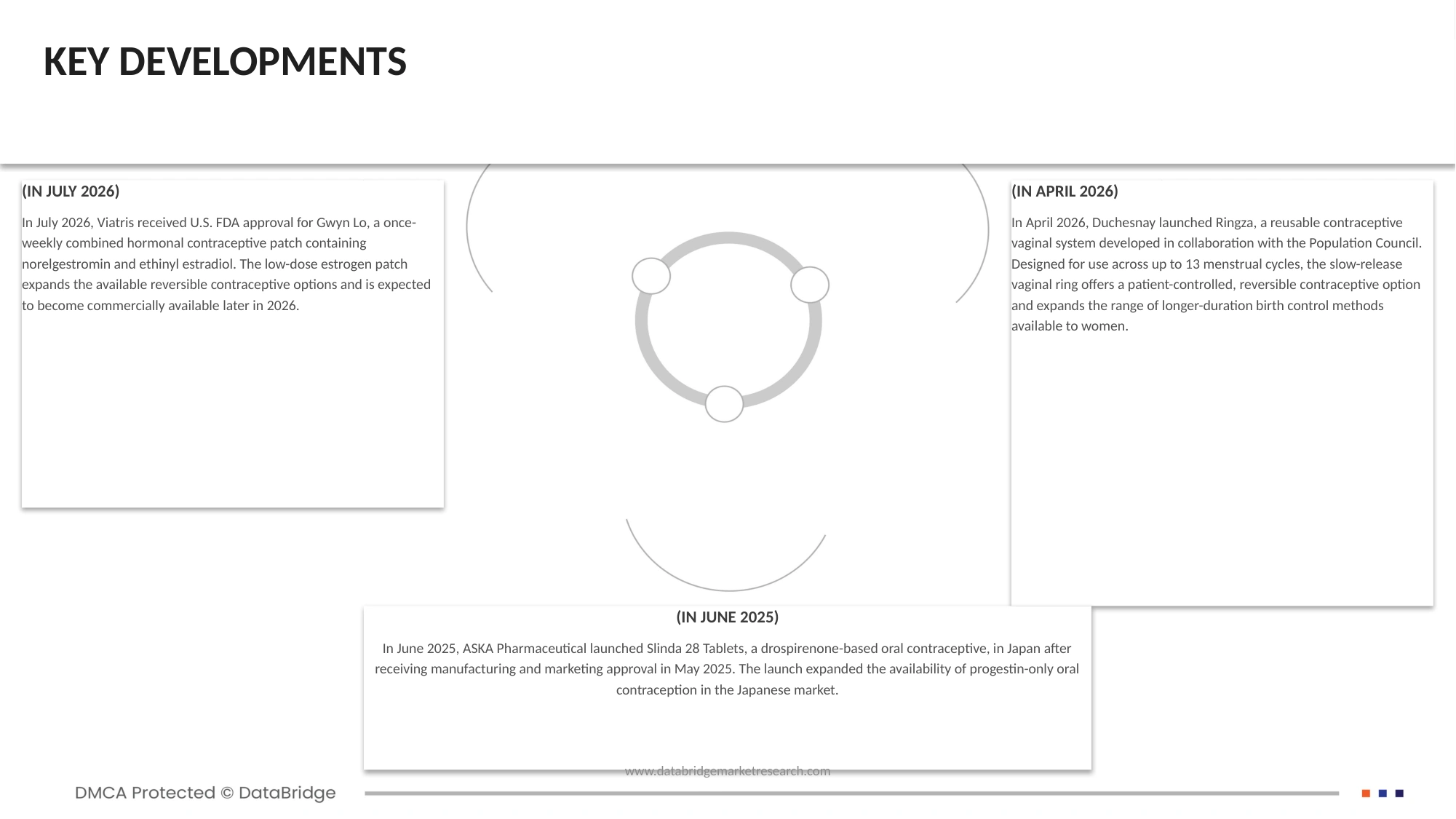
- In July 2026, Viatris received U.S. FDA approval for Gwyn Lo, a once-weekly combined hormonal contraceptive patch containing norelgestromin and ethinyl estradiol. The low-dose estrogen patch expands the available reversible contraceptive options and is expected to become commercially available later in 2026.
- In April 2026, Duchesnay launched Ringza, a reusable contraceptive vaginal system developed in collaboration with the Population Council. Designed for use across up to 13 menstrual cycles, the slow-release vaginal ring offers a patient-controlled, reversible contraceptive option and expands the range of longer-duration birth control methods available to women.
- In June 2025, ASKA Pharmaceutical launched Slinda 28 Tablets, a drospirenone-based oral contraceptive, in Japan after receiving manufacturing and marketing approval in May 2025. The launch expanded the availability of progestin-only oral contraception in the Japanese market.
- In February 2026, Contraline and the Population Council entered into a global exclusive licensing agreement for the Nestorone/testosterone (NES/T) male contraceptive gel. Under the agreement, Contraline will lead late-stage development and regulatory engagement, with the goal of advancing this reversible, investigational male contraceptive toward regulatory approval.
- In June 2026, Organon completed a global licensing agreement with Sebela Pharmaceuticals for exclusive rights to MIUDELLA, a hormone-free copper intrauterine device approved by the U.S. FDA in February 2025. The agreement strengthens Organon's contraceptive portfolio by adding a long-acting, reversible, non-hormonal pregnancy-prevention option. Commercial availability was anticipated in late 2026.
As per Data Bridge Market Research analysis:
For more detailed information about the Global Contraceptive Market report, click here – https://www.databridgemarketresearch.com/reports/global-contraceptives-market