Increasing government support and orphan drug incentives are playing a major role in driving the global Type 1 SBS-IF treatment market. Since Short Bowel Syndrome with Intestinal Failure is considered a rare and life-threatening condition, many governments and healthcare regulators are encouraging pharmaceutical companies to invest in treatment development through orphan drug programs, faster approvals, tax credits, research grants, and extended market exclusivity benefits. The U.S. Food and Drug Administration has granted orphan drug designation to several SBS therapies, including GLP-2 analog treatments such as teduglutide, because these therapies address serious unmet medical needs in a small patient population. Under the U.S. Orphan Drug Act, companies developing rare disease therapies can receive up to seven years of market exclusivity after approval, along with clinical trial support and fee reductions. These incentives have encouraged major pharmaceutical companies to increase investments in advanced biologic therapies and pediatric SBS treatment programs. In Europe, the European Medicines Agency has also expanded orphan medicine support through accelerated assessment pathways and long-term regulatory incentives for rare gastrointestinal disorders.
Another important growth factor is the increasing involvement of public healthcare systems and rare disease organizations in improving access to SBS-IF treatment and nutritional support programs. Governments in North America and Europe are funding specialized intestinal rehabilitation centers, home parenteral nutrition services, and pediatric rare disease programs to improve long-term patient survival.
Access Full Report @ https://www.databridgemarketresearch.com/reports/global-type-1-sbs-if-short-bowel-syndrome-with-intestinal-failure-treatment-market
Data Bridge Market Research analyzes that the Global Type 1 SBS-IF Treatment Market is expected to reach USD 1.71 billion by 2033 from USD 1.02 billion in 2025, growing at a substantial CAGR of 7.3% in the forecast period of 2026 to 2033.
Key Findings of the Study
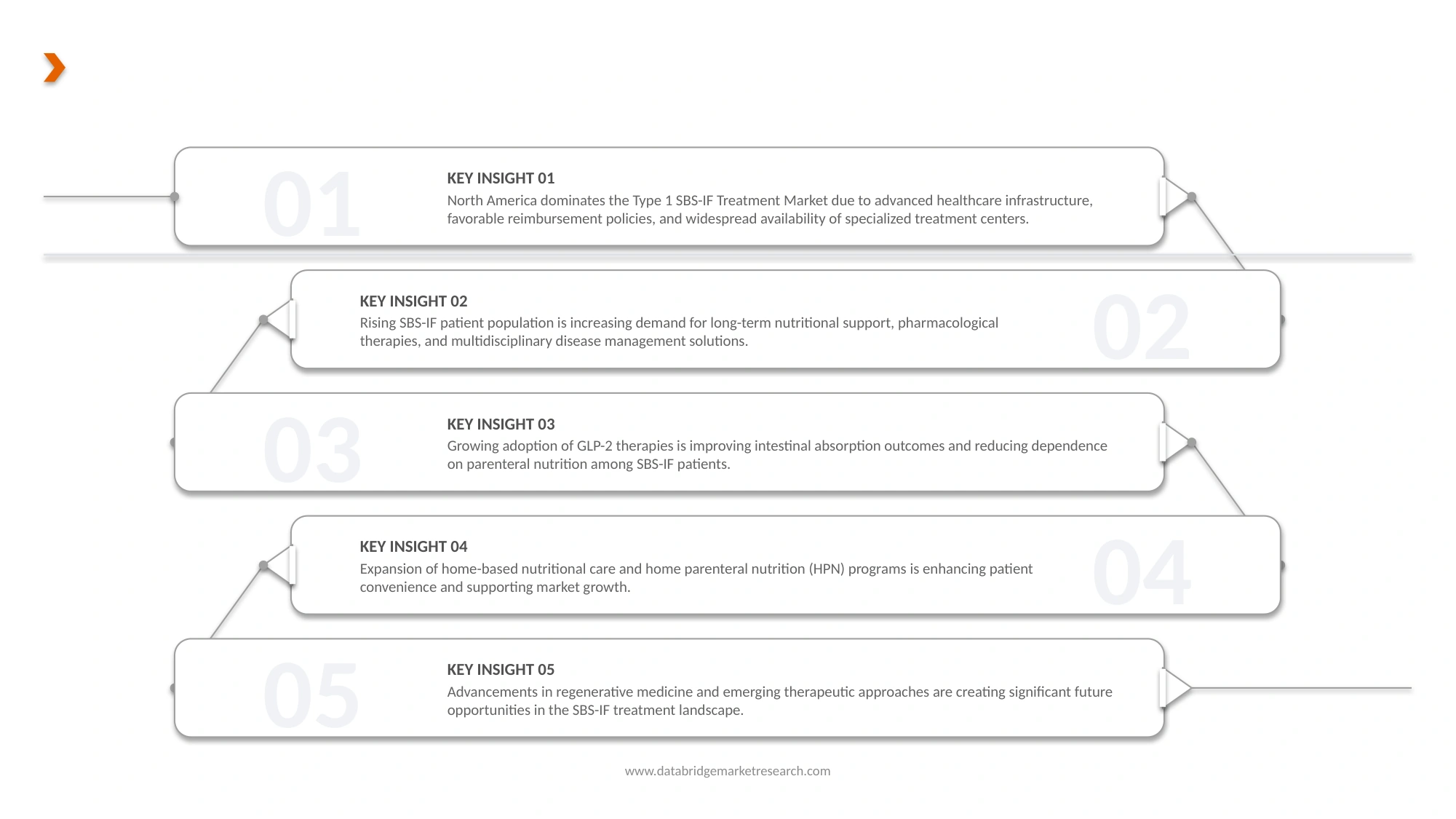
Growing Adoption of GLP-2 Therapies
The growing adoption of GLP-2 therapies is becoming a major driver for the global Type 1 SBS-IF treatment market. Therapies such as teduglutide help SBS-IF patients absorb nutrients more effectively, reducing dependence on long-term parenteral nutrition and lowering risks of infections, liver complications, dehydration, and repeated hospitalizations. The U.S. Food and Drug Administration has approved these therapies for both adults and children, supporting wider treatment adoption globally.
At the same time, increasing investments by pharmaceutical companies and healthcare systems in rare disease treatments are further boosting market growth. Specialized intestinal rehabilitation programs across North America and Europe are increasingly using GLP-2 therapies as part of standard care. Clinical studies supported by the National Institutes of Health and ASPEN have shown that some patients achieve partial independence from parenteral nutrition, improving quality of life and long-term disease management.
Report Scope and Market Segmentation
|
Report Metric
|
Details
|
|
Forecast Period
|
2026 to 2033
|
|
Base Year
|
2025
|
|
Historic Year
|
2024 (Customizable 2018-2023)
|
|
Quantitative Units
|
Revenue in USD Billion
|
|
Segments Covered
|
By Treatment Modality (Nutritional Support Therapy, Pharmacological Therapy, Surgical & Interventional Treatment, and Emerging & Advanced Therapies), by Market Attribution (Core SBS-IF Market, SBS-IF Attributable Market, and Adjacent / Non-Specific Market), by Disease Management Phase (Acute Phase (Type 1 SBS-IF), Adaptation Phase, and Recovery Phase), by Patient Type (Adult and Pediatric), by Route of Administration (Intravenous, Subcutaneous, Oral, and Enteral), by Intravenous Type (PN and Injectables), by End User (Hospitals (Acute Care), Home Care (HPN Programs), ICU Settings, Specialty GI Centers, and Pediatric Specialty Hospitals), by End User (Hospitals (Acute Care), Home Care (HPN Programs), ICU Settings, Specialty GI Centers, and Pediatric Specialty Hospitals), by Distribution Channel (Hospital Pharmacy, Specialty Pharmacy, Retail Pharmacy, and Online Pharmacy)
|
|
Countries Covered
|
.S., Canada, Mexico, Germany, U.K., Italy, France, Spain, Switzerland, Russia, Turkey, Belgium, Netherlands, Denmark, Norway, Finland, Sweden, Rest of Europe, Japan, China, South Korea, India, Singapore, Thailand, Indonesia, Malaysia, Philippines, Australia, New Zealand, Hong Kong, Taiwan, Rest of Asia-Pacific, Argentina, Bolivia, Brazil, Chile, Colombia, Ecuador, Paraguay, Peru, Uruguay, Venezuela, Rest of South America, South Africa, Egypt, Saudi Arabia, United Arab Emirates, Israel, Bahrain, Kuwait, Oman, Qatar, and Rest of Middle East and Africa
|
|
Market Players Covered
|
· Takeda Pharmaceutical Company Limited (Japan)
· Fresenius Kabi AG (Germany)
· Baxter International Inc. (U.S.)
· Nestlé Health Science (Switzerland)
· Abbott Laboratories (U.S.)
· Zealand Pharma A/S (Denmark)
· Hanmi Pharm. Co., Ltd. (South Korea)
· OxThera (Sweden)
· AmeriPharma Specialty Care (U.S.)
· ContinuumRx (U.S.)
· Napo Therapeutics (Brazil)
· Eclipse Regenesis (U.S.)
· AcuLife Healthcare Private Limited (India)
· Ferring Pharmaceuticals (Switzerland)
· Shandong Qidu Pharmaceutical Co., Ltd. (China)
· Choice Parenteral Nutrition LLC (U.S.)
· Integrated Care Systems (U.S.)
· Beverly Hills Digestive Care (U.S.)
· Stanford Health Care (U.S.)
· Vision Parenteral (U.S.)
· Amsino International, Inc. (U.S.)
· Aculife Healthcare (India)
· Nutrego (Netherlands)
· Camvitaa (India)
· Laboratoire Dielen (France)
Infusion Solutions (U.S.)
Aurora Health Care (U.S.)
|
|
Data Points Covered in the Report
|
In addition to the insights on market scenarios such as market value, growth rate, segmentation, geographical coverage, and major players, the market reports curated by the Data Bridge Market Research also include depth expert analysis, patient epidemiology, pipeline analysis, pricing analysis, and regulatory framework.
|
Segment Analysis
The Global Type 1 SBS-IF (Short Bowel Syndrome with Intestinal Failure) Treatment Market is segmented into seven notable segments based on treatment modality, market attribution, disease management phase, patient type, route of administration, end user, and distribution channel.
- On the basis of treatment modality, the Global Type 1 SBS-IF (Short Bowel Syndrome with Intestinal Failure) Treatment Market is segmented into nutritional support therapy, pharmacological therapy, surgical & interventional treatment, and emerging & advanced therapies
In 2026, the nutritional support therapy segment is expected to dominate the global Type 1 SBS-IF treatment market
In 2026, the nutritional support therapy segment is expected to dominate the market with a market share of 42.00% due to the critical dependence of Type 1 SBS-IF patients on nutritional rehabilitation and long-term intestinal support therapies for maintaining hydration, nutrient absorption, and overall metabolic stability.
- On the basis of market attribution, the Global Type 1 SBS-IF (Short Bowel Syndrome with Intestinal Failure) Treatment Market is segmented into core SBS-IF market, SBS-IF attributable market, and adjacent/non-specific market.
In 2026, the core SBS-IF market segment is expected to dominate the global Type 1 SBS-IF treatment market
In 2026, the core SBS-IF market segment is expected to dominate the market with a market share of 56.72% due to the high clinical dependence on specialized nutritional therapies and targeted intestinal adaptation treatments directly associated with SBS-IF management.
- On the basis of disease management phase, the Global Type 1 SBS-IF (Short Bowel Syndrome with Intestinal Failure) Treatment Market is segmented into acute phase (Type 1 SBS-IF), adaptation phase, and recovery phase. In 2026, the acute phase (Type 1 SBS-IF) segment is expected to dominate the market with a market share of 46%
- On the basis of patient type, the Global Type 1 SBS-IF (Short Bowel Syndrome with Intestinal Failure) Treatment Market is segmented into adult and pediatric. In 2026, the adult segment is expected to dominate the market with a market share of 37%
- On the basis of route of administration, the Global Type 1 SBS-IF (Short Bowel Syndrome with Intestinal Failure) Treatment Market is segmented into intravenous, subcutaneous, oral, and enteral. The intravenous segment is further segmented into PN and injectables. In 2026, the intravenous segment is expected to dominate the market with a market share of45%
- On the basis of end user, the Global Type 1 SBS-IF (Short Bowel Syndrome with Intestinal Failure) Treatment Market is segmented into hospitals (acute care), home care (HPN programs), ICU settings, specialty GI centers, and pediatric specialty hospitals. In 2026, the hospitals (acute care) segment is expected to dominate the market with a market share of 67%
- On the basis of distribution channel, the Global Type 1 SBS-IF (Short Bowel Syndrome with Intestinal Failure) Treatment Market is segmented into hospital pharmacy, specialty pharmacy, retail pharmacy, and online pharmacy. In 2026, the hospital pharmacy segment is expected to dominate the market with a market share of 37%
Major Players
Data Bridge Market Research analyzes Takeda Pharmaceutical Company Limited (Japan), Fresenius Kabi AG (Germany), Baxter International Inc. (U.S.), Nestlé Health Science (Switzerland), Abbott Laboratories (U.S.)as the major market players of the global Type 1 SBS-IF treatment market.
Market Developments
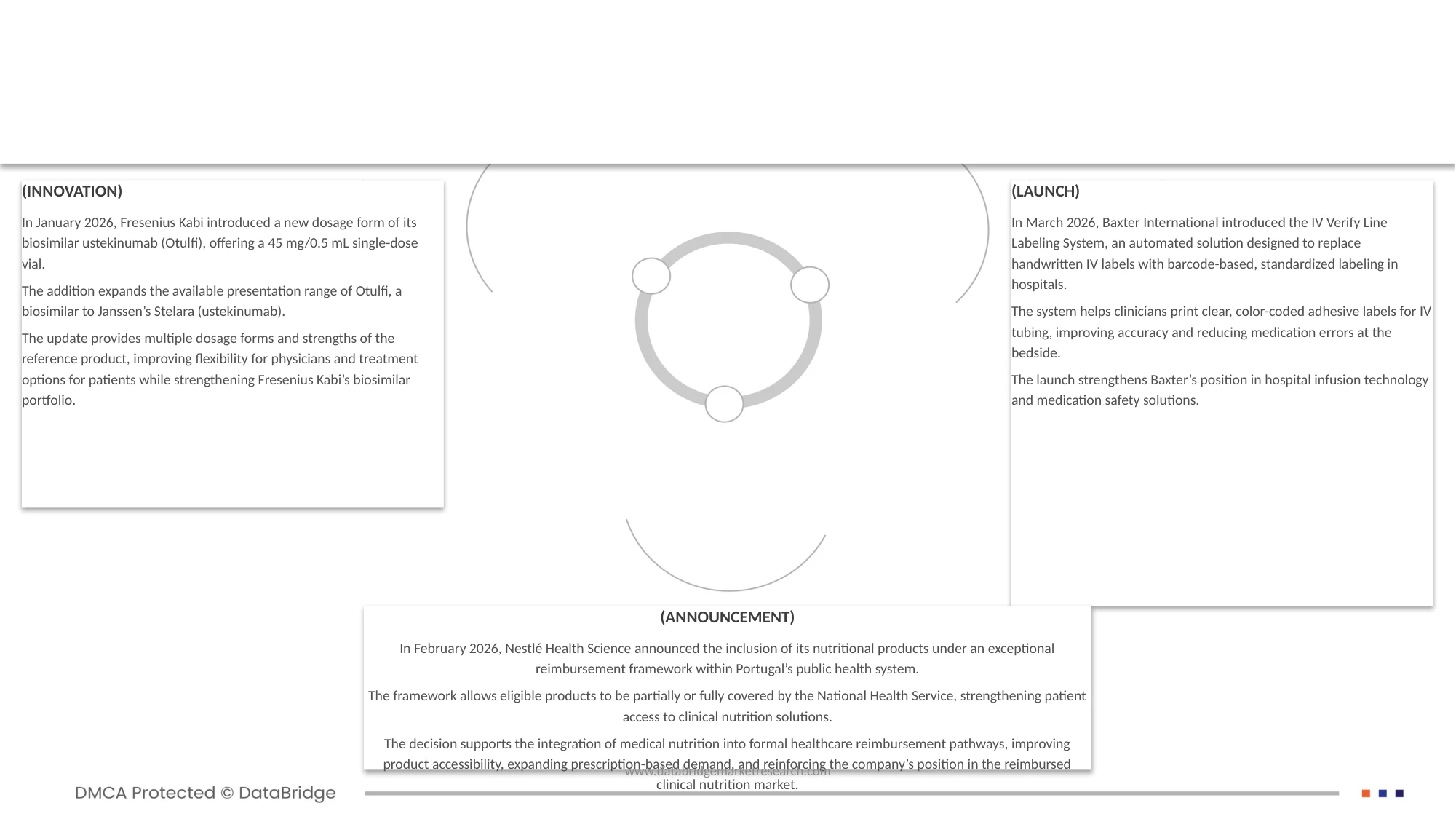
- In January 2026, Fresenius Kabi has introduced a new dosage form of its biosimilar ustekinumab (Otulfi), offering a 45 mg/0.5 mL single-dose vial. This addition expands the available presentation range of Otulfi, which is a biosimilar to Janssen’s Stelara (ustekinumab). With this update, Fresenius Kabi now provides multiple dosage forms and strengths of the reference product, improving flexibility for physicians and treatment options for patients. This strengthens Fresenius Kabi’s biosimilar portfolio by improving product flexibility.
- In March 2026, Baxter International has introduced the IV Verify Line Labeling System, an automated solution designed to replace handwritten IV labels with barcode-based, standardized labeling at hospitals. The system helps clinicians print clear, color-coded adhesive labels for IV tubing, improving accuracy and reducing medication errors at the bedside. It strengthens Baxter’s position in hospital infusion technology.
- In February 2026, Nestlé Health Science announced the inclusion of its nutritional products under an exceptional reimbursement framework within Portugal’s public health system, allowing eligible products to be partially or fully covered by the National Health Service. This regulatory decision strengthens patient access to clinical nutrition solutions and supports integration of medical nutrition into formal healthcare reimbursement pathways. This will benefit the company by improving product accessibility, expanding prescription-based demand, and reinforcing its position within the reimbursed clinical nutrition market.
- In May 2024, Moog Inc. received FDA 510(k) clearance for its CURLIN 8000 Ambulatory Infusion System, a next-generation platform designed for advanced home infusion therapy. The system is engineered to deliver multiple therapies with improved precision, safety, and flexibility in ambulatory and home care settings. It enhances the accurate administration of drugs and nutrients, making it highly suitable for patients requiring long-term parenteral nutrition support. In the context of Short Bowel Syndrome with Intestinal Failure (SBS-IF), where patients often depend on home parenteral nutrition (HPN), the CURLIN 8000 plays an important supportive role.
- In February 2026, Amsino International announced a new three-year partnership with Partners Cooperative, a U.S. healthcare group purchasing organization. Under this agreement, Amsino will supply its pre-filled saline flush syringe products, ensuring long-term availability and supply continuity for hospital networks and healthcare providers. This strengthens Amsino’s position in the single-use injectable and fluid delivery device segment of the medical devices market
Regional Analysis
Geographically, the countries covered in the global Type 1 SBS-IF treatment market report are the .S., Canada, Mexico, Germany, U.K., Italy, France, Spain, Switzerland, Russia, Turkey, Belgium, Netherlands, Denmark, Norway, Finland, Sweden, Rest of Europe, Japan, China, South Korea, India, Singapore, Thailand, Indonesia, Malaysia, Philippines, Australia, New Zealand, Hong Kong, Taiwan, Rest of Asia-Pacific, Argentina, Bolivia, Brazil, Chile, Colombia, Ecuador, Paraguay, Peru, Uruguay, Venezuela, Rest of South America, South Africa, Egypt, Saudi Arabia, United Arab Emirates, Israel, Bahrain, Kuwait, Oman, Qatar, and Rest of Middle East and Africa.
As per Data Bridge Market Research analysis:
North America is expected to be the dominant and the fastest-growing region in the global Type 1 SBS-IF treatment market
North America is expected to be the dominant and the fastest-growing region in the Global Cosmeceutical Market due to advanced healthcare infrastructure, strong reimbursement support, increasing adoption of home parenteral nutrition programs, and growing utilization of innovative SBS-IF therapies across the U.S. and Canada.
For more detailed information about the global Type 1 SBS-IF treatment market report, click here – https://www.databridgemarketresearch.com/reports/global-type-1-sbs-if-short-bowel-syndrome-with-intestinal-failure-treatment-market