
Rapid urbanization and the relentless proliferation of high-rise building construction stand as the preeminent drivers of the global elevator market. This symbiotic relationship stems from the fundamental shift in how cities accommodate growing populations: by building upwards. As urban land becomes increasingly scarce and expensive, vertical expansion becomes the most viable and efficient strategy for residential, commercial, and mixed-use development. Every new multi-story structure, from apartment complexes to towering corporate headquarters, inherently creates a demand for sophisticated vertical transportation systems.
This high-rise boom directly translates into a surging need for new elevator installations worldwide, especially in rapidly developing regions like Asia-Pacific, where smart city initiatives and massive infrastructure projects are underway. Beyond sheer volume, the height and density of these new buildings compel innovation. Manufacturers are driven to develop faster, higher-capacity elevators, such as those employing advanced traction technology and destination dispatch systems, to manage the efficient flow of thousands of occupants. Furthermore, the premium on space in modern high-rises promotes the adoption of Machine Room-Less (MRL) elevators, which save valuable floor area, while increasing focus on sustainability pushes for energy-efficient models with regenerative drives. Consequently, this continuous cycle of urban growth and vertical construction not only expands the new installation market but also perpetually fuels the demand for advanced, safe, and efficient elevator technologies, making it the most critical force shaping the global elevator industry.
Access Full Report @ https://www.databridgemarketresearch.com/reports/global-elevator-market
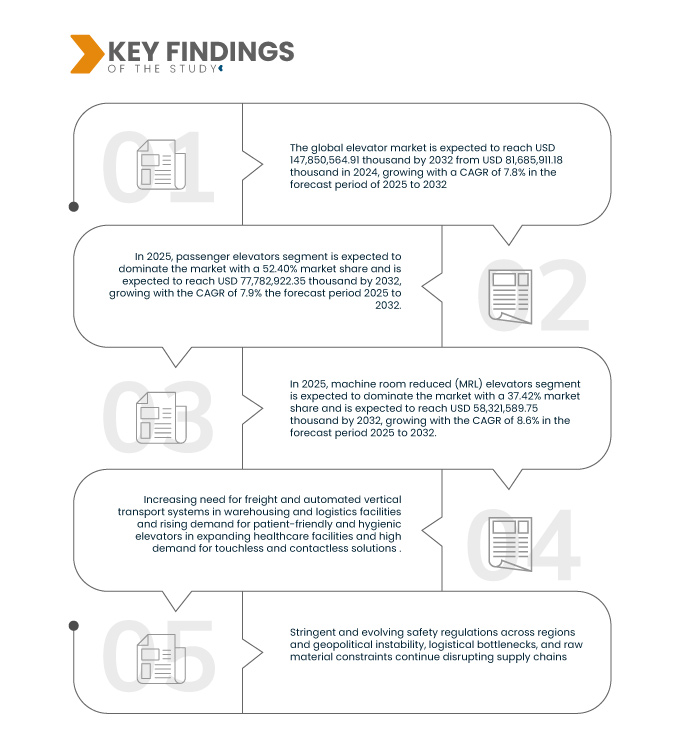
Data Bridge market research analyzes that the Global Elevator Market is expected to reach USD 147,850,564.91 thousand by 2032 from USD 81,685,911.18 thousand in 2024, growing with a CAGR of 7.8% in the forecast period of 2025 to 2032.
Key Findings of the Study
Increasing Government investments in smart cities and public infrastructure
Government-led investments in smart cities and large-scale public infrastructure projects are emerging as a significant driver of the global elevator market. As countries aim to improve urban livability, economic productivity, and sustainability, smart city initiatives have become a strategic focus—especially in developing regions such as Asia-Pacific, the Middle East, and Africa.
Smart cities rely on efficient, accessible, and integrated mobility systems, including vertical transportation. Government-backed projects such as metro stations, airports, hospitals, government complexes, and affordable housing require advanced elevator solutions to support increasing population density and infrastructure scale. Additionally, these projects often incorporate building automation, energy efficiency, and accessibility mandates, creating opportunities for smart elevators equipped with IoT-based destination dispatch systems, predictive maintenance, and regenerative drives.
Report Scope and Market Segmentation
|
Report Metric
|
Details
|
|
Forecast Period
|
2025 to 2032
|
|
Base Year
|
2024
|
|
Historic Years
|
2023 (Customizable to 2018-2022)
|
|
Quantitative Units
|
Revenue in USD
|
|
Segments Covered
|
By Type (Passenger Elevator, Freight/ Cargo Elevator, Service Elevator, Home Elevators and Others), By Mechanism (Machine Room Reduced (MRL) Elevators, Traction / Cable Driven Elevators, Hydraulic Elevators, A.C. Elevators, D.C. Elevators and Others), By Speed (~1.0 MPS (or less)1.5 - 2.0 MPS, 2.5 - 3.0 MPS, 3.5 - 4.0 MPS and 5.0 MPS (or more)), By Component (Hardware and Services), By Deck (Single Deck and Double Deck), By Capacity (630kg (or less), 630–1050kg, 1050–1600kg, 1600–2000kg, 2000–2500kg, Over 2500kg), By Elevation (Low Rise Elevators, Mid Rise Elevators and High Rise Elevators), By Destination Control (Conventional and Smart), By Door Type (Automatic Door, Sliding Door, Manual Door, Swinging Door and Others), By End Use (Commercial, Residential and Industrial)
|
|
Countries Covered
|
U.S., Canada, Mexico, Germany, U.K., Italy, France, Spain, Switzerland, Netherlands, Belgium, Russia, Denmark, Sweden, Poland, Turkey, Luxembourg, Finland, Norway, Rest Of Europe, China, India, Japan, South Korea, Australia, Indonesia, Vietnam, Malaysia, Thailand, Taiwan, Singapore, Philippines, New Zealand and Rest of Asia-Pacific, Brazil, Argentina, rest of South America, Saudi Arabia, U.A.E., Egypt, South Africa, Qatar, Israel, Kuwait, Oman, Bahrain and Rest of Middle East and Africa
|
|
Market Players Covered
|
TK Elevator (Germany), Hitachi, Ltd. (Japan), Schindler Holding Ltd. (Switzerland), Otis Worldwide Corporation (U.S.), TOSHIBA CORPORATION (Japan), KONE Corporation (Finland), HYUNDAI ELEVATOR Co., Ltd. (South Korea), CANNY Elevator Co., Ltd. (China), KLEEMANN (Greece), Fujitec Co., Ltd. (Japan), Cibes Lift (Sweden), Stannah (U.K.), Gulf Elevators (Saudi Arabia), Sodimas (France), American Crescent Elevator (U.S.), Mitsubishi Elevator India Pvt Ltd (India), Zhejiang Meilun Elevator Co., Ltd. (China), GEDA Original (Germany), Garaventa Lift (Canada), Schmitt + Sohn (Germany), Bunse-Aufzüge GmbH (Germany), Nationwide Lifts (U.S.), Stag Home Elevators LLP. (India), EKA (India), Johnson Lifts (India), Custom Elevator (U.S.), SUZHOU LG ELEVATOR CO., LTD. (China), Vintec Elevators (India), AVT Beckett (U.K.)
|
|
Data Points Covered in the Report
|
In addition to the insights on market scenarios such as market value, growth rate, segmentation, geographical coverage, and major players, the market reports curated by the Data Bridge Market Research also include in-depth expert analysis, geographically represented company-wise production and capacity, network layouts of distributors and partners, detailed and updated price trend analysis and deficit analysis of supply chain and demand.
|
Segment Analysis
The global elevator market is segmented into ten notable segments based on type, mechanism, speed, component, deck, capacity, elevation, destination control, door type, and end-use.
- On the basis of type, the global elevator market is segmented into passenger elevators, freight elevators, hospital elevators, observation elevators, residential elevators, and others
In 2025, the passenger elevators segment is expected to dominate the market
In 2025, passenger elevators segment is expected to dominate the market with a 52.40% share due to its widespread installation in high-rise residential and commercial buildings driven by rapid urbanization and infrastructure growth across developing regions
- On the basis of mechanism, the global elevator market is segmented into machine room reduced (MRL) ELEVATORS, TRACTION / cable driven elevators, hydraulic elevators, A.C. elevators, D.C. elevators and others
In 2025, the machine room reduced (MRL) elevators segment is expected to dominate the market
. In 2025, machine room reduced (MRL) elevators segment is expected to dominate the market with a 37.42% share due to its energy efficiency, superior speed range, and increasing installation in high-rise buildings, particularly in commercial and office complexes
- On the basis of speed, the global elevator market is segmented into ~1.0 mps (or less), 1.5 - 2.0 mps, 2.5 - 3.0 mps, 3.5 - 4.0 mps and 5.0 mps (or more).
In 2025, the ~1.0 mps (or less) segment is expected to dominate the market
In 2025, ~1.0 mps (or less) segment is expected to dominate the market with a 46.23% share due to their suitability in mid-rise residential and commercial buildings which represent the majority of global urban development
- On the basis of component, the global elevator market is segmented into hardware and services
In 2025, the hardware segment is expected to dominate the market
In 2025, hardware segment is expected to dominate the market with a 65.86% market share due to the increasing adoption of advanced digital control systems, IoT-based monitoring, and predictive maintenance technologies
- On the basis of deck, the market is segmented into Single Deck and Double Deck.
In 2025, the Single Deck segment is expected to dominate the market
In 2025, Single Deck segment is expected to dominate the market with a 72.29% share due to their simplicity, lower installation cost, and prevalence in most residential and mid-rise commercial buildings
- On the basis of capacity, the global elevator market is segmented into up to 630kg (or less), 630–1050kg, 1050–1600kg, 1600–2000kg, 2000–2500kg and Over 2500kg.
In 2025, the 630kg (or less) segment is expected to dominate the market
In 2025, 630kg (or less) segment is expected to dominate the market with a 32.34% market share due to the wide installation of standard passenger elevators in mid-sized buildings. However, demand for elevators with higher capacities is rising in hospitals, malls, and airports
- On the basis of elevation, the market is segmented into low rise elevators, mid-rise elevators and high-rise elevators.
In 2025, the low rise elevators segment is expected to dominate the market
In 2025, low rise elevators segment is expected to dominate the market with a 49.44% market share due to its ability to optimize elevator allocation and reduce waiting times, particularly in buildings with multiple elevators and high passenger volumes
- On the basis of destination control, the global elevator market is segmented into conventional control and smart control.
In 2025, the conventional control) elevators segment is expected to dominate the market
In 2025, conventional control segment is expected to dominate the market with a 56.61% market share due to rapid urban development and the rising trend of multi-storey residential apartments and commercial offices globally
- On the basis of door type, the market is segmented into automatic door, sliding door, manual door, swinging door and others.
In 2025, the automatic door segment is expected to dominate the market
In 2025, automatic door segment is expected to dominate the market with a 42.42% market share due to safety, ease of access, and growing installation in both residential and commercial sectors. Manual doors remain prominent in low-budget or rural infrastructure projects
- On the basis of end-use, the global elevator market is segmented into commercial, residential and industrial.
In 2025, the commercial segment is expected to dominate the market
In 2025, commercial segment is expected to dominate the market with a 51.06% market share due to the increase in high-rise residential complexes, especially in densely populated urban regions across Asia-Pacific and the Middle East
Major Players
TK Elevator (Germany), Hitachi, Ltd. (Japan), Schindler Holding Ltd. (Switzerland), Otis Worldwide Corporation (U.S.), TOSHIBA CORPORATION (Japan)
Market Developments
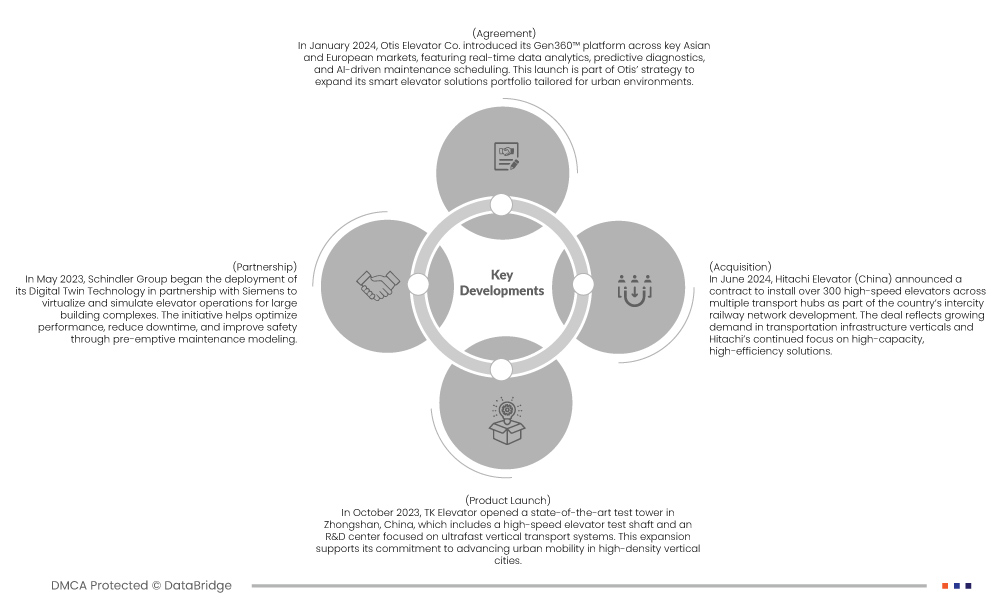
- In January 2024, Otis Elevator Co. introduced its Gen360™ platform across key Asian and European markets, featuring real-time data analytics, predictive diagnostics, and AI-driven maintenance scheduling. This launch is part of Otis’ strategy to expand its smart elevator solutions portfolio tailored for urban environments.
- In May 2023, Schindler Group began the deployment of its Digital Twin Technology in partnership with Siemens to virtualize and simulate elevator operations for large building complexes. The initiative helps optimize performance, reduce downtime, and improve safety through pre-emptive maintenance modeling.
- In October 2023, TK Elevator opened a state-of-the-art test tower in Zhongshan, China, which includes a high-speed elevator test shaft and an R&D center focused on ultrafast vertical transport systems. This expansion supports its commitment to advancing urban mobility in high-density vertical cities.
- In June 2024, Hitachi Elevator (China) announced a contract to install over 300 high-speed elevators across multiple transport hubs as part of the country’s intercity railway network development. The deal reflects growing demand in transportation infrastructure verticals and Hitachi’s continued focus on high-capacity, high-efficiency solutions.
As per Data Bridge Market Research analysis:
For more detailed information about the global elevator market report, click here – https://www.databridgemarketresearch.com/reports/global-elevator-market










