
The push for electric vehicle (EV) adoption and stricter global emissions standards has fundamentally changed the automotive manufacturing landscape. Manufacturers are under immense pressure to reduce vehicle weight to extend battery range and improve overall efficiency. This has led to a significant shift from traditional metal components to advanced, lightweight polymers. Glass fibre reinforced polyphenylene ether (polypropylene) compounds are emerging as a key material in this transition. These compounds offer a superior balance of high strength, rigidity, and low density, making them ideal for structural and under-the-hood applications where they can replace heavier metal parts. Their excellent heat resistance and dimensional stability ensure they can withstand the demanding thermal and mechanical stress of an EV's engine bay and chassis. This trend is particularly pronounced globally as there is rapid growth in EV production and adoption.
Access Full Report @ https://www.databridgemarketresearch.com/reports/middle-east-polypropylene-compounds-market
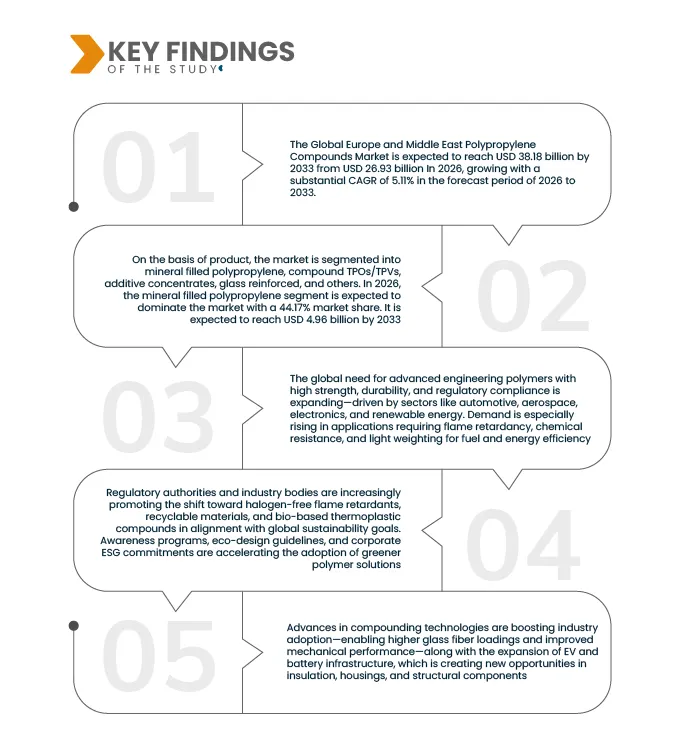
Data Bridge market research analyzes that the Global Europe and Middle East Polypropylene Compounds Market is expected to reach USD 38.18 billion by 2033 from USD 26.93 billion In 2026, growing with a substantial CAGR of 5.11% in the forecast period of 2026 to 2033.
Key Findings of the Study
Rising Demand for Flame-Retardant Polypropylene Grades in EV Battery Modules, Connectors, and High-Voltage Housings
The high-energy density of EV battery systems presents a significant fire risk, making flame retardancy a critical safety requirement. This has led to a surge in demand for specialized flame-retardant polymers, with polypropylene compounds being a top choice. The excellent electrical insulation, thermal stability, and inherent flame resistance of polypropylene make it an ideal material for protecting sensitive battery components, high-voltage connectors, and other electrical housings. The development of advanced, halogen-free flame-retardant polypropylene grades is especially important as the industry moves away from traditional, halogenated flame retardants due to environmental and health concerns. This trend is accelerating as they ramp up EV production and implement more stringent safety standards.
Report Scope and Market Segmentation
|
Report Metric
|
Details
|
|
Forecast Period
|
2026 to 2033
|
|
Base Year
|
2025
|
|
Historic Years
|
2024 (Customizable to 2018-2023)
|
|
Quantitative Units
|
Revenue in USD Billion
|
|
Segments Covered
|
By Product (Mineral Filled Polypropylene, Compound TPOs/TPVs, Additive Concentrates, Glass Reinforced, and Others), Polymer Type (Homopolymers and Copolymers), Application (Fiber, Film & Sheet, Raffia, and Others), End Use (Automotive, Packaging, Building and Construction, Electrical and Electronics, Consumer Goods, Medical, Textile, and Others)
|
|
Countries Covered
|
Europe
Middle East
|
|
Market Players Covered
|
|
|
Data Points Covered in the Report
|
In addition to the insights on market scenarios such as market value, growth rate, segmentation, geographical coverage, and major players, the market reports curated by the Data Bridge Market Research also include import export analysis, production capacity overview, production consumption analysis, price trend analysis, climate change scenario, supply chain analysis, value chain analysis, raw material/consumables overview, vendor selection criteria, PESTLE Analysis, Porter Analysis, and regulatory framework.
|
Segment Analysis
The Global Europe and Middle East polypropylene compounds market is segmented into four notable segments based on product, polymer type, application, and end use.
- On the basis of product, the market is segmented into mineral filled polypropylene, compound TPOs/TPVs, additive concentrates, glass reinforced, and others.
In 2026, the mineral filled polypropylene segment is expected to dominate the market
In 2026, the mineral filled polypropylene segment is expected to dominate the market with a 44.17% market share due to its high mechanical stiffness, thermal stability, low-temperature properties, and good dimensional stability over a wide temperature range. Available as a natural coloured, colorable, UV-stabilized compound.
- On the basis of polymer type, the market is segmented into homopolymers and copolymers.
In 2026, the homopolymers segment is expected to dominate the market
In 2026, the homopolymers segment is expected to dominate the market with a 74.50% market share. due to its high strength-to-weight ratio, excellent chemical resistance, high performance in thermoforming and corrosive environments, no moisture absorption, resist most acids, alkalis, degreasing agents, and organic solvents, good weldability, lightweight, and non-toxic and non-staining.
On the basis of application, the market is segmented into fiber, film & sheet, raffia, and others. In 2026, the fiber segment is expected to dominate the market with a 42.93% market share due to its more cost effectiveness, fast, and easy-to-use alternative to mesh as a reinforcement method. It poses lower thermal conductivity than other fibers. Increased impact resistance while preventing erosion. Reduces the formation of retraction and contraction cracks.
On the basis of end use, the market is segmented into automotive, packaging, building and construction, electrical and electronics, consumer goods, medical, textile, and others. In 2026, the automotive segment is expected to dominate the market with a 29.93% market share due to its low cost but has outstanding mechanical properties and moldability, it accounts for more than half of all the plastic materials used in automobiles. PP compounds are used for a variety of parts, including bumper facias, instrumental panels and door trims.
Major Players
LyondellBasell Industries Holdings B.V. (Netherlands), PetroChina Company Limited (China), Exxon Mobil Corporation (United States), TotalEnergies (France), China Petrochemical Corporation – SINOPEC (China)
Latest Developments in Polypropylene compounds market
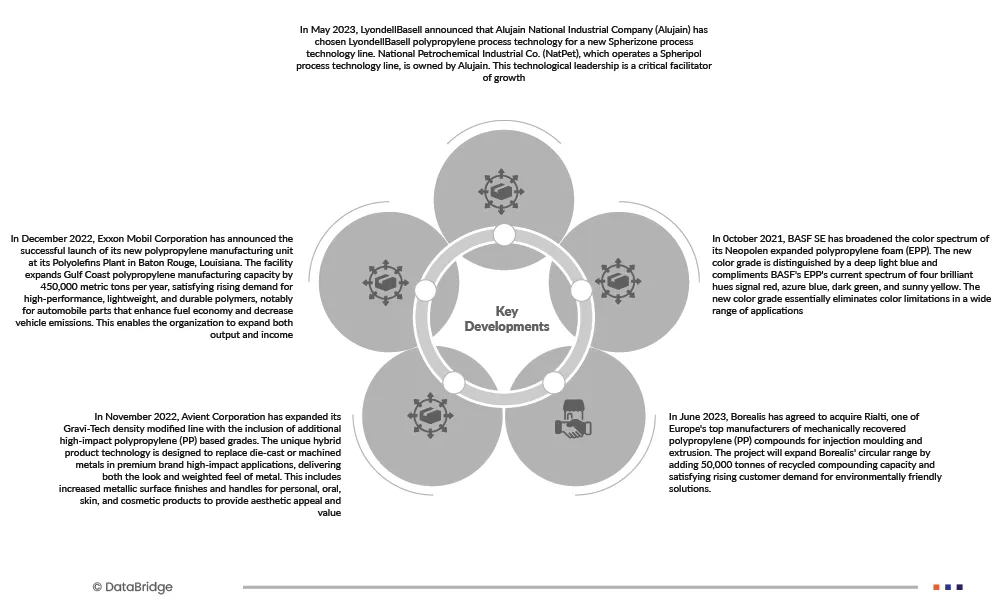
- In May 2023, LyondellBasell announced that Alujain National Industrial Company (Alujain) has chosen LyondellBasell polypropylene process technology for a new Spherizone process technology line. National Petrochemical Industrial Co. (NatPet), which operates a Spheripol process technology line, is owned by Alujain. This technological leadership is a critical facilitator of growth.
- In December 2022, Exxon Mobil Corporation has announced the successful launch of its new polypropylene manufacturing unit at its Polyolefins Plant in Baton Rouge, Louisiana. The facility expands Gulf Coast polypropylene manufacturing capacity by 450,000 metric tons per year, satisfying rising demand for high-performance, lightweight, and durable polymers, notably for automobile parts that enhance fuel economy and decrease vehicle emissions. This enables the organization to expand both output and income.
- In November 2022, Avient Corporation has expanded its Gravi-Tech density modified line with the inclusion of additional high-impact polypropylene (PP) based grades. The unique hybrid product technology is designed to replace die-cast or machined metals in premium brand high-impact applications, delivering both the look and weighted feel of metal. This includes increased metallic surface finishes and handles for personal, oral, skin, and cosmetic products to provide aesthetic appeal and value.
- In 0ctober 2021, BASF SE has broadened the color spectrum of its Neopolen expanded polypropylene foam (EPP). The new color grade is distinguished by a deep light blue and compliments BASF's EPP's current spectrum of four brilliant hues signal red, azure blue, dark green, and sunny yellow. The new color grade essentially eliminates color limitations in a wide range of applications
As per Data Bridge Market Research analysis:
Geographically, the countries covered in the market are Saudi Arabia, United Arab Emirates, Egypt, Israel, Kuwait, Oman, Qatar, Bahrain, and rest of Middle East, Germany, Italy, France, U.K., Spain, Russia, Turkey, Belgium, Netherlands, Sweden, Switzerland, Denmark, Norway, Finland, rest of Europe .
Polypropylene compounds market Regional Analysis
The Europe polypropylene compounds market is experiencing steady and strong growth, driven by the rising adoption of lightweight and high-performance materials across automotive, electrical & electronics, industrial equipment, and packaging sectors. The region’s stringent environmental regulations, including EU directives promoting recyclability, carbon reduction, and circular economy practices, are accelerating the shift toward advanced PP compounds—particularly recycled, bio-based, and mineral-filled grades. Countries such as Germany, France, the UK, and Italy are witnessing robust demand due to expanding automotive production, growing electric vehicle manufacturing, and increasing investment in sustainable packaging solutions. Additionally, advancements in compounding technologies, reinforcement techniques, and polymer modification are enabling manufacturers to achieve superior mechanical strength, thermal stability, and design flexibility, further strengthening the regional market outlook.
Germany polypropylene compounds market Insights
Germany represents one of the most influential and high-growth markets within Europe’s polypropylene compounds industry, supported by a strong manufacturing base and rapid technological advancements. The market is expanding at a robust CAGR of 5.51% from 2026 to 2033. Growth is primarily driven by the country’s dominant automotive sector, where polypropylene compounds are widely used for lightweighting applications in bumpers, interior trims, dashboards, battery housings, and under-the-hood components. Germany’s accelerating shift toward electric vehicles (EVs), combined with stringent CO₂ emission norms, is further boosting demand for high-performance PP compounds that offer improved structural rigidity, heat resistance, and recyclability.
For more detailed information about the Global Europe and Middle East polypropylene compounds market report, click here – https://www.databridgemarketresearch.com/reports/middle-east-polypropylene-compounds-market










