Resistance to UV radiation is a crucial attribute of non-metallic enclosures, particularly those constructed from UV-stabilized plastics. In outdoor applications, prolonged exposure to sunlight can lead to material degradation in traditional enclosures. Non-metallic enclosures with UV-resistant properties ensure longevity and sustained functionality in harsh environmental conditions. This feature is especially vital in sectors such as renewable energy, telecommunications, and outdoor infrastructure installations, where protection against UV-induced wear and tear is paramount.
Access Full Report @ https://www.databridgemarketresearch.com/reports/us-non-metallic-enclosure-market
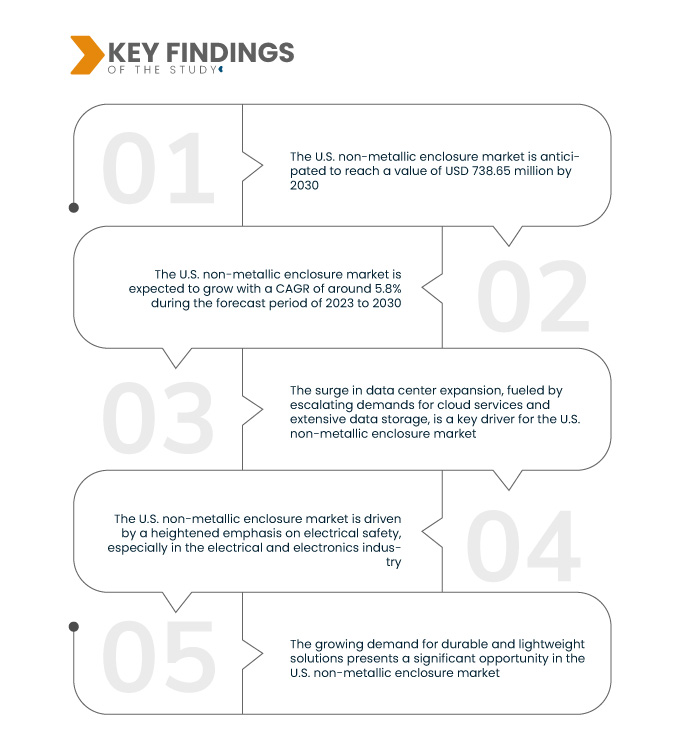
Data Bridge Market Research analyses the U.S. Non-Metallic Enclosure Market, which was USD 486.82 million in 2022, is expected to reach up to USD 738.65 million by 2030 and is expected to undergo a CAGR of 5.8% during the forecast period of 2023 to 2030. The market is driven by the rise in smart infrastructure projects, including smart cities and intelligent transportation systems. The need for advanced enclosures to safeguard electronic components and sensors in these projects favors non-metallic enclosures due to their lightweight and durable attributes, positioning them as optimal solutions for the evolving demands of modern, technology-driven infrastructure.
Key Findings of the Study
Growing industrial automation and control systems are expected to drive the market's growth rate
The growing adoption of automation and control systems in diverse U.S. industries is a key driver for the non-metallic enclosure market. As industries embrace advanced technologies, there is an escalating demand for enclosures that safeguard sensitive electronic components. Non-metallic enclosures, crafted from polycarbonate or fiberglass, fulfill this need by offering insulation and robust protection against electromagnetic interference (EMI). These enclosures ensure electronic systems' integrity and contribute to automated processes' efficiency and reliability.
Report Scope and Market Segmentation
Report Metric
|
Details
|
Forecast Period
|
2023 to 2030
|
Base Year
|
2022
|
Historic Years
|
2021 (Customizable to 2015-2020)
|
Quantitative Units
|
Revenue in USD Million, Volumes in Units, Pricing in USD
|
Segments Covered
|
Material Type (Fiberglass, Polycarbonate, PVC, Polyester), Type (Junction Enclosures, Disconnect Enclosures, Operator Interface Enclosures, Environment and Climate Control Enclosures and Push Button Enclosures), Design (Standard Type and Custom Type), Mounted Type (Wall Mounted Enclosure, Floor-Mounted/Free Standing Enclosure and Underground), Form Factor (Small Enclosure, Compact Enclosure and Free-Size Enclosure), Capacity Range (Less than 400 cu.in and More than 400 cu.in), Place (Indoor and Outdoor), Weight (Less than 10 lbs and More than 10 lbs), Vertical (Power Generation and Distribution, Oil and Gas, Metal and Mining, Medical, Pulp and Paper, Food and Beverages, Transportation and Others)
|
Market Players Covered
|
Allied Moulded Products, Inc. (U.S.), OMEGA Engineering (a subsidiary of Spectris) (U.S.), Arlington Industries, Inc. (U.S.), Robroy Industries (U.S.), Hubbell (U.S.), Schneider Electric (France), ABB (Switzerland), Legrand SA (France), Eaton (Ireland), Emerson Electric Co. (U.S.), Polycase (U.S.), nVent (U.K.), FIBOX Enclosures (Finland)
|
Data Points Covered in the Report
|
In addition to the insights on market scenarios such as market value, growth rate, segmentation, geographical coverage, and major players, the market reports curated by the Data Bridge Market Research also include in-depth expert analysis, geographically represented company-wise production and capacity, network layouts of distributors and partners, detailed and updated price trend analysis and deficit analysis of supply chain and demand.
|
Segment Analysis:
The U.S. non-metallic enclosure market is segmented on the basis of product type, wound type, wound class, end user, and distribution channel.
- On the basis of material type, the U.S. non-metallic enclosure market is segmented into fiberglass, polycarbonate, PVC, and polyester
- On the basis of type, the U.S. non-metallic enclosure market is segmented into junction enclosures, disconnect enclosures, operator interface enclosures, environment and climate control enclosures, and push button enclosures
- On the basis of design, the U.S. non-metallic enclosure market is segmented into standard type and custom type
- On the basis of mounted type, the U.S. non-metallic enclosure market is segmented into wall mounted enclosure, floor-mounted/free standing enclosure, and underground
- On the basis of form factor, the U.S. non-metallic enclosure market is segmented into small enclosure, compact enclosure, and free-size enclosure
- On the basis of capacity range, the U.S. non-metallic enclosure market is segmented into less than 400 cu.in and more than 400 cu.in
- On the basis of place, the U.S. non-metallic enclosure market is segmented into indoor and outdoor
- On the basis of range, the U.S. non-metallic enclosure market is segmented into less than 10 lbs and more than 10 lbs
- Com base na vertical, o mercado de invólucros não metálicos dos EUA está segmentado em geração e distribuição de energia, petróleo e gás, metal e mineração, médico, celulose e papel, alimentos e bebidas, transportes e outros.
Principais jogadores
A Data Bridge Market Research reconhece as seguintes empresas como os principais participantes do mercado de armários não metálicos dos EUA: Allied Moulded Products, Inc. (EUA), OMEGA Engineering (uma subsidiária da Spectris) (EUA), Arlington Industries, Inc. (EUA), Robroy Industries (EUA), Hubbell (EUA), Schneider Electric (França)
Desenvolvimentos de mercado
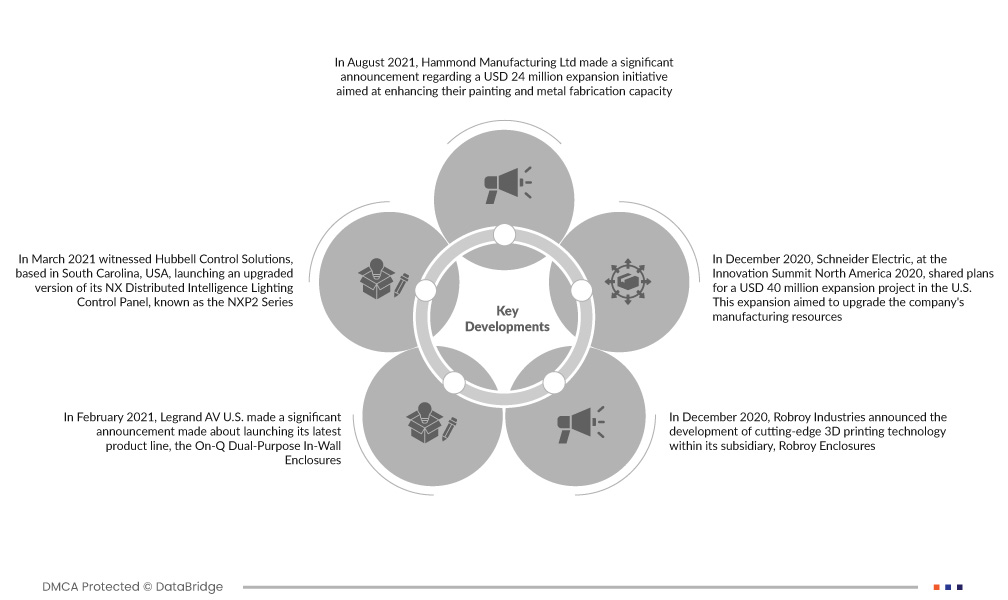
- Em agosto de 2021, a Hammond Manufacturing Ltd anunciou uma iniciativa de expansão de 24 milhões de dólares para aumentar a sua capacidade de pintura e fabrico de metal. A empresa revelou planos para uma nova instalação de 96.000 pés quadrados, com entrada em funcionamento prevista para o final de 2022. A Hammond Manufacturing Ltd é especializada na produção de produtos eletrónicos e elétricos, abrangendo armários metálicos e não metálicos, bastidores, armários pequenos, réguas de tomadas, supressores de picos e transformadores eletrónicos.
- Em março de 2021, a Hubbell Control Solutions, com sede na Carolina do Sul, EUA, lançou um painel de controlo de iluminação de inteligência distribuída NX atualizado, a Série NXP2. Este produto inovador centraliza os pontos de ligação dentro de um armário, oferecendo uma solução que agiliza a implementação de sistemas de controlo de iluminação em conformidade com o código. A série NXP2 está disponível com opções de caixa de montagem em superfície e embutida, proporcionando flexibilidade aos utilizadores
- Em fevereiro de 2021, a Legrand AV US fez um anúncio significativo sobre o lançamento da sua mais recente linha de produtos, os armários de parede de dupla finalidade On-Q. Estas soluções apresentam-se em dois formatos: 9 polegadas (ENP0900-NA) e 17 polegadas (ENP1700-NA). Concebidos para aplicações versáteis, estes armários embutidos na parede podem ser utilizados para armazenamento AV atrás de uma TV ou como armários para cablagem estruturada. Os produtos satisfazem as necessidades de alojamento de descodificadores de cabo, leitores de streaming e outros dispositivos, aumentando a comodidade para os utilizadores
- Em dezembro de 2020, a Robroy Industries anunciou o desenvolvimento de tecnologia de impressão 3D de ponta na sua subsidiária, Robroy Enclosures. Esta tecnologia foi fundamental na criação de soluções exclusivas para acessórios de armários e aplicações exigentes. A introdução da impressão 3D permitiu à empresa criar protótipos rapidamente, facilitando análises e testes de funcionalidade mais rápidos antes do fabrico em larga escala. Este avanço tecnológico reforçou a presença de mercado da Robroy Industries
- Em dezembro de 2020, a Schneider Electric, no Innovation Summit North America 2020, partilhou os planos para um projeto de expansão de 40 milhões de dólares nos EUA. Esta expansão teve como objetivo atualizar os recursos de fabrico da empresa. Além disso, a Schneider Electric lançou uma nova linha de armários robustos para data centers, visando a Internet Industrial das Coisas (IIoT). Conhecidos como EcoStruxure Micro Data Center R-Series, estes armários são concebidos para ambientes industriais interiores, oferecendo uma solução rápida e eficiente para a implementação e gestão de infraestruturas de computação de ponta, especialmente em fábricas.
Para obter informações mais detalhadas sobre o relatório do mercado de armários não metálicos dos EUA, clique aqui – https://www.databridgemarketresearch.com/reports/us-non-metallic-enclosure-market