



Global Allergic Rhinitis Market, By Type (Seasonal, Perennial, and Occupational Rhinitis), Treatment (Immunotherapy, Antihistamines, Decongestants, Vertebral Fusion, Corticosteroids, and Others), Route of Administration (Oral, Parenteral, and Intranasal), Form (Solid and Liquid), Test (Skin Test, IgE RAST Test, and Complete Blood Count), Distribution Channel (Hospital Pharmacies, Retail Pharmacies, and Online Stores) – Industry Trends and Forecast to 2030.
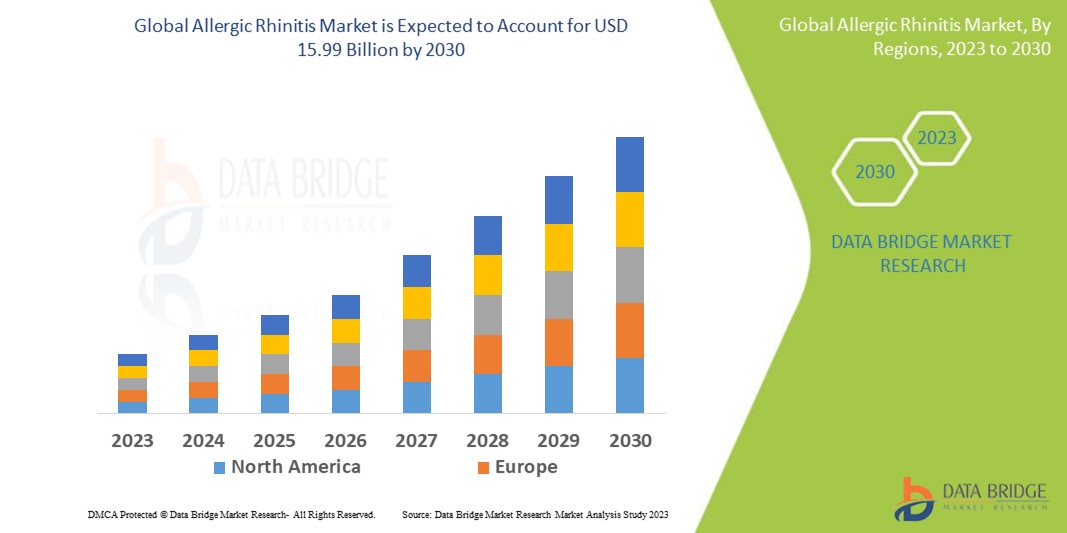
Allergic Rhinitis Market Analysis and Size
Allergic rhinitis, also called hay fever, refers to an allergic reaction caused by increased sensitivity to allergens in the surrounding environment of the patients. The individual suffers from a runny or stuffy nose, constant sneezing, swelling & redness around the eyes, and watery eyes. The increased amount of pollen in the environment has been seen as one of the most common causes of this allergic reaction. The surge in demand for effective and potent drugs among consumers across the globe is one of the major factors driving the market growth. The increase in the prevalence of various allergic rhinitis, including seasonal allergic rhinitis, perennial allergic rhinitis, and occupational allergic rhinitis among the population, and the rise in government initiatives to promote awareness regarding allergic rhinitis accelerate the market growth.
Data Bridge Market Research analyses that the market, which was USD 12.00 billion in 2022, would rocket up to USD 15.99 billion by 2030 and is expected to undergo a CAGR of 3.65% during the forecast period. “Antihistamines” dominates the treatment segment of the allergic rhinitis market owing to their therapeutic efficacy and minimal side effects. In addition to the insights on market scenarios such as market value, growth rate, segmentation, geographical coverage, and major players, the market reports curated by the Data Bridge Market Research also include depth expert analysis, patient epidemiology, pipeline analysis, pricing analysis, and regulatory framework.
Allergic Rhinitis Market Scope and egmentation
|
Report Metric |
Details |
|
Forecast Period |
2023 to 2030 |
|
Base Year |
2022 |
|
Historic Years |
2021 (Customizable to 2015-2020) |
|
Quantitative Units |
Revenue in USD Million, Volumes in Units, Pricing in USD |
|
Segments Covered |
By Type (Seasonal, Perennial, and Occupational Rhinitis), Treatment (Immunotherapy, Antihistamines, Decongestants, Vertebral Fusion, Corticosteroids, and Others), Route of Administration (Oral, Parenteral, and Intranasal), Form (Solid and Liquid), Test (Skin Test, IgE RAST Test, and Complete Blood Count), Distribution Channel (Hospital Pharmacies, Retail Pharmacies, and Online Stores) |
|
Countries Covered |
U.S., Canada, Mexico, Germany, Italy, U.K., France, Spain, Netherland, Belgium, Switzerland, Turkey, Russia, rest of Europe, Japan, China, India, South Korea, Australia, Singapore, Malaysia, Thailand, Indonesia, Philippines, rest of Asia-Pacific, Brazil, Argentina, rest of South America, South Africa, Saudi Arabia, UAE, Egypt, Israel, rest of Middle East and Africa) |
|
Market Players Covered |
Merck KGaA (Germany), GSK group of companies (U.K.), Sanofi (France), Cigna (U.S.), Himalaya Wellness (India), Janssen Pharmaceuticals, Inc. (U.S.), FAES Farma SA (Spain), Hisamitsu Pharmaceutical Co., Inc. (Japan), Glenmark Pharmaceuticals (India), Olainfarm (Latvia), Boehringer Ingelheim International GmbH (Germany), Covis Pharma (Switzerland), Teva Pharmaceutical Industries Ltd. (Israel), Sandoz International GmbH (Germany), ALK-Abello A/S (Denmark) Meda AB (Sweden), and Bayer AG (Germany) |
|
Market Opportunities |
|
Market Definition
Allergic rhinitis, commonly known as hay fever, is an allergic reaction triggered by heightened sensitivity to allergens in the surrounding environment. Individuals experiencing allergic rhinitis typically exhibit symptoms such as a congested or runny nose, frequent sneezing, inflammation, and redness around the eyes, as well as excessive tearing. The presence of elevated pollen levels in the environment is widely recognized as one of the primary causes of this allergic response.
Allergic Rhinitis Market Dynamics
Drivers
- Increasing prevalence of allergic rhinitis
Allergic rhinitis has become one of the most prevalent conditions affecting a significant portion of the global population. The rising prevalence of allergic rhinitis, mainly due to environmental factors, drives the demand for effective treatment options.
- Advancements in Treatment Options
The development of innovative and effective treatment options for allergic rhinitis, including pharmacological and non-pharmacological approaches, is driving the market growth. This includes nasal corticosteroids, antihistamines, immunotherapy, and emerging therapies such as biologics.
- Rising Awareness and Diagnosis
Growing awareness among individuals regarding allergic rhinitis and its impact on quality of life has led to more people seeking medical help and getting diagnosed. Early diagnosis and intervention are important for effective management, contributing to market growth.
Opportunities
- Technological Advancements
Advancements in medical technology, including the development of innovative drug delivery systems, such as nasal sprays and inhalers, provide opportunities to improve treatment outcomes and patient convenience. Technological advancements can lead to more targeted and efficient therapies for allergic rhinitis.
- Increasing Personalised Medicine
The concept of personalized medicine, tailoring treatment plans to individual patients based on their genetic makeup and specific allergens, holds potential for the future of allergic rhinitis management. Advancements in molecular diagnostics and genetic testing may open new avenues for personalized treatment approaches.
Restraints/Challenges
Various obstacles may restrain the expansion of the market. These challenges include side effects associated with allergic rhinitis therapies and underdiagnosis. These factors can impede market growth and pose barriers for market players in the forecast period of 2023-2030
This Allergic rhinitis Market report provides details of new recent developments, trade regulations, import-export analysis, production analysis, value chain optimization, market share, impact of domestic and localized market players, analyses opportunities in terms of emerging revenue pockets, changes in market regulations, strategic market growth analysis, market size, category market growths, application niches and dominance, product approvals, product launches, geographic expansions, technological innovations in the market. To gain more info on the Allergic rhinitis Market contact Data Bridge Market Research for an Analyst Brief, our team will help you take an informed market decision to achieve market growth.
Recent Development
-
In June 2021, Bayer AG announced that it received FDA approval for Astepro® Allergy (Azelastine HCI .15%) as an over-the-counter (OTC) product for the temporary relief of nasal congestion, runny nose, sneezing, and itchy nose due to hay fever or other upper respiratory allergies. This has helped the company to expand its product portfolio
-
In July 2021, GlaxoSmithKline plc (GSK) announced that it received FDA approval for Nucala (mepolizumab), a monoclonal antibody that targets interleukin-5 (IL-5), as a treatment for patients with chronic rhinosinusitis. This has helped the company to expand its product portfolio.
Global Allergic Rhinitis Market Scope
The Allergic rhinitis Market is segmented on the basis of type, treatment, route of administration, form, test, and distribution channel. The growth amongst these segments will help you analyze meagre growth segments in the industries and provide the users with a valuable market overview and market insights to help them make strategic decisions for identifying core market applications.
Type
- Seasonal
- Perennial
- Occupational Rhinitis
Treatment
- Immunotherapy
- Antihistamines
- Decongestants
- Vertebral Fusion
- Corticosteroids
- Others
Route of Administration
- Oral
- Parenteral
- Intranasal
Form
- Solid
- Liquid
Test
- Skin Test
- IgE RAST Test
- Complete Blood Count
Distribution Channel
- Hospital Pharmacies
- Retail Pharmacies
- Online Stores
Allergic rhinitis Market Regional Analysis/Insights
The Allergic rhinitis Market is analysed and market size insights and trends are provided by country, product, application and end user as referenced above.
The countries covered in the allergic rhinitis market report are U.S., Canada, Mexico, Germany, Italy, U.K., France, Spain, Netherland, Belgium, Switzerland, Turkey, Russia, rest of Europe, Japan, China, India, South Korea, Australia, Singapore, Malaysia, Thailand, Indonesia, Philippines, rest of Asia-Pacific, Brazil, Argentina, rest of South America, South Africa, Saudi Arabia, UAE, Egypt, Israel, rest of Middle East and Africa.
North America dominates the allergic rhinitis market because of the major market players and the availability of advanced medications for treatment within the region.
Asia-Pacific is expected to witness the fastest growth during the forecast period of 2022-2030 because of the continuous healthcare developments in developing countries such as India and China.
The country section of the report also provides individual market impacting factors and changes in regulation in the market domestically that impacts the current and future trends of the market. Data points like down-stream and upstream value chain analysis, technical trends and porter's five forces analysis, case studies are some of the pointers used to forecast the market scenario for individual countries. Also, the presence and availability of global brands and their challenges faced due to large or scarce competition from local and domestic brands, impact of domestic tariffs and trade routes are considered while providing forecast analysis of the country data.
Healthcare Infrastructure growth Installed base and New Technology Penetration
The Allergic rhinitis Market also provides you with detailed market analysis for every country growth in healthcare expenditure for capital equipment, installed base of different kind of products for Allergic rhinitis Market, impact of technology using life line curves and changes in healthcare regulatory scenarios and their impact on the Allergic rhinitis Market. The data is available for historic period 2010-2020.
Competitive Landscape and Allergic rhinitis Market Share Analysis
The Allergic rhinitis Market competitive landscape provides details by competitor. Details included are company overview, company financials, revenue generated, market potential, investment in research and development, new market initiatives, global presence, production sites and facilities, production capacities, company strengths and weaknesses, product launch, product width and breadth, application dominance. The above data points provided are only related to the companies' focus related to Allergic rhinitis Market.
Some of the major players operating in the market are:
- Merck KGaA (Germany)
- GSK group of companies (U.K.)
- Sanofi (France)
- Cigna (U.S.)
- Himalaya Wellness (India)
- Janssen Pharmaceuticals, Inc. (U.S.)
- FAES Farma SA (Spain)
- Hisamitsu Pharmaceutical Co., Inc. (Japan)
- Glenmark Pharmaceuticals (India)
- Olainfarm (Latvia)
- Boehringer Ingelheim International GmbH (Germany)
- Covis Pharma (Switzerland)
- Teva Pharmaceutical Industries Ltd. (Israel)
- Sandoz International GmbH (Germany)
- ALK-Abello A/S (Denmark)
- Meda AB (Sweden)
- Bayer AG (Germany)
SKU-
Obtenha acesso online ao relatório sobre a primeira nuvem de inteligência de mercado do mundo

- Painel interativo de análise de dados
- Painel de análise da empresa para oportunidades de elevado potencial de crescimento
- Acesso de analista de pesquisa para personalização e customização. consultas
- Análise da concorrência com painel interativo
- Últimas notícias, atualizações e atualizações Análise de tendências
- Aproveite o poder da análise de benchmark para um rastreio abrangente da concorrência
Metodologia de Investigação
A recolha de dados e a análise do ano base são feitas através de módulos de recolha de dados com amostras grandes. A etapa inclui a obtenção de informações de mercado ou dados relacionados através de diversas fontes e estratégias. Inclui examinar e planear antecipadamente todos os dados adquiridos no passado. Da mesma forma, envolve o exame de inconsistências de informação observadas em diferentes fontes de informação. Os dados de mercado são analisados e estimados utilizando modelos estatísticos e coerentes de mercado. Além disso, a análise da quota de mercado e a análise das principais tendências são os principais fatores de sucesso no relatório de mercado. Para saber mais, solicite uma chamada de analista ou abra a sua consulta.
A principal metodologia de investigação utilizada pela equipa de investigação do DBMR é a triangulação de dados que envolve a mineração de dados, a análise do impacto das variáveis de dados no mercado e a validação primária (especialista do setor). Os modelos de dados incluem grelha de posicionamento de fornecedores, análise da linha de tempo do mercado, visão geral e guia de mercado, grelha de posicionamento da empresa, análise de patentes, análise de preços, análise da quota de mercado da empresa, normas de medição, análise global versus regional e de participação dos fornecedores. Para saber mais sobre a metodologia de investigação, faça uma consulta para falar com os nossos especialistas do setor.
Personalização disponível
A Data Bridge Market Research é líder em investigação formativa avançada. Orgulhamo-nos de servir os nossos clientes novos e existentes com dados e análises que correspondem e atendem aos seus objetivos. O relatório pode ser personalizado para incluir análise de tendências de preços de marcas-alvo, compreensão do mercado para países adicionais (solicite a lista de países), dados de resultados de ensaios clínicos, revisão de literatura, mercado remodelado e análise de base de produtos . A análise de mercado dos concorrentes-alvo pode ser analisada desde análises baseadas em tecnologia até estratégias de carteira de mercado. Podemos adicionar quantos concorrentes necessitar de dados no formato e estilo de dados que procura. A nossa equipa de analistas também pode fornecer dados em tabelas dinâmicas de ficheiros Excel em bruto (livro de factos) ou pode ajudá-lo a criar apresentações a partir dos conjuntos de dados disponíveis no relatório.











