Segmentação Global Anti-Ansiedade do Mercado de Medicamentos, Por Tipo de Distúrbio (Transtorno Pânico, Agorafobia, Ansiedade Generalizada, Ansiedade Social, Fóbia Específica e Outros), Classe de Medicamentos (Inibidores Seletivos de Recaptação de Serotonina (ISRS),Benzodiazepinas, Inibidores de Recaptação de Serotonina-Norepinefrina (SNRIs) e Beta-Bloqueadores), Canal de Distribuição ( Farmácias Hospitais, Farmácias de Varejo/Lojas de Drogas e Farmácias Online) – Tendências e Previsão da Indústria para 2032
Análise do Mercado de Medicamentos Anti-Ansiedade
O mercado de medicamentos anti-ansiedade tem observado um crescimento notável, impulsionado em grande parte pela sensibilização em torno das questões de saúde mental e pela crescente prevalência de transtornos de ansiedade em todo o mundo. Fatores como o aumento dos níveis de estresse por pressões no trabalho, desafios pessoais e incertezas globais têm aumentado notavelmente a demanda por medicamentos antiansiedade. As empresas farmacêuticas estão fazendo progressos na criação de medicamentos que não só fornecem alívio eficaz, mas também vêm com menos efeitos colaterais, estimulando uma emocionante onda de inovação na indústria.
O aumento da procura no mercado é amplamente alimentado pelo advento de novas classes de medicamentos, tais como inibidores seletivos da recaptação de serotonina (ISRSs) e inibidores da recaptação de serotonina-norepinefrina (ISRNs), que estão gradualmente substituindo medicamentos mais velhos, como benzodiazepinas. Esta mudança é vista como altamente benéfica, uma vez que estas novas drogas representam um risco muito menor de dependência e efeitos adversos.
Além disso, a crescente disponibilidade de serviços de saúde e a crescente tendência de pessoas que buscam ajuda profissional para as lutas em saúde mental estão contribuindo para a expansão do mercado. A ascensão de soluções digitais de saúde e telemedicina tem tornado mais conveniente que os indivíduos consultem os profissionais de saúde, impulsionando ainda mais a demanda por tratamentos antiansiedade.
No entanto, o mercado enfrenta obstáculos como desafios regulatórios, preocupações de dependência e o custo premium de novos medicamentos. Apesar desses desafios, a ênfase contínua no cuidado em saúde mental sugere um futuro promissor para o mercado de medicamentos antiansiedade.
Tamanho do mercado de drogas anti-ansiedade
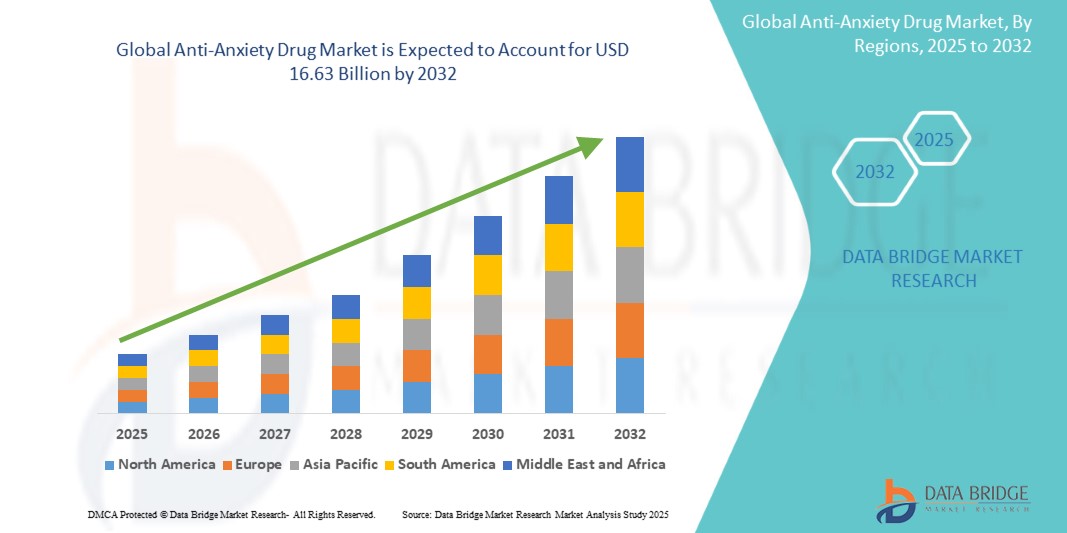
O tamanho global do mercado de medicamentos anti-ansiedade foi avaliado em 11,25 bilhões de dólares em 2024 e prevê-se atingir 16,63 bilhões de dólares em 2032, com um CAGR de 5,01% durante o período previsto de 2025 a 2032. Além dos insights sobre cenários de mercado, como valor de mercado, taxa de crescimento, segmentação, cobertura geográfica e principais atores, os relatórios de mercado curados pela Data Bridge Market Research também incluem análise de especialistas de profundidade, epidemiologia de pacientes, análise de pipelines, análise de preços e marco regulatório.
Anti-AnsiedadeTendências do mercado
“Incrementar a mudança para medicamentos não benzodiazepínicos”
Uma tendência notável no mercado de medicamentos anti-ansiedade é a mudança crescente para medicamentos não-benzodiazepínicos, particularmente inibidores seletivos da recaptação de serotonina (ISRSs) e inibidores da recaptação de serotonina-norepinefrina (ISRNs). Estas novas classes de medicamentos estão a ganhar força devido à sua eficácia no tratamentoperturbações da ansiedadeapesar de apresentar um menor risco de dependência e efeitos colaterais em relação às benzodiazepinas tradicionais. Pacientes e profissionais de saúde estão cada vez mais optando por essas alternativas, pois oferecem soluções de longo prazo sem o risco de dependência comumente associado com benzodiazepínicos. Esta tendência é também apoiada pelas crescentes preocupações quanto ao potencial de utilização abusiva e aos efeitos adversos da utilização a longo prazo de benzodiazepinas, incentivando as empresas farmacêuticas a concentrarem-se no desenvolvimento de tratamentos mais seguros e sustentáveis. À medida que a consciência da saúde mental melhora e a demanda por tratamentos mais confiáveis e seguros aumenta, o mercado de medicamentos anti-ansiedade está vendo uma mudança para essas opções mais novas e menos viciantes.
Relatar escopo e anti-ansiedade drogaSegmentação do mercado
| Atributos | Anti-AnsiedadeChavePerspectivas de mercado |
| Segmentos Cobertos |
|
| Países abrangidos | EUA, Canadá e México, Alemanha, França, Reino Unido, Itália, Rússia, Espanha, Dinamarca, Suécia, Noruega, Resto da Europa, China, Japão, Índia, Coreia do Sul, Austrália, Tailândia, Resto da Ásia-Pacífico (APAC), Arábia Saudita, U.A.E, África do Sul, Nigéria, Egito, Kuwait, Resto do Oriente Médio e África, Brasil, Argentina e Resto da América do Sul |
| Jogadores do mercado chave | Aurobindo Pharma (Índia), AbbVie Inc. (EUA), AstraZeneca (U.K.), Bristol-Myers Squibb Company (EUA), F. Hoffmann-La Roche Ltd (Suíça), Gedeon Richter Plc. (Hungary), Johnson & Johnson Services, Inc. (EUA), Lilly (EUA), Lundbeck (Dinamarca), Mind Medicine (MindMed) Inc. (Canadá), Merck KGaA (Alemanha), Merck & Co., Inc. (EUA), Neuphoria Therapeutics, Inc. (EUA), Otsuka Holdings Co., Ltd. (Japão), Pfizer Inc. (EUA), Pharmanovia (EUA), Sanofi (França), Sun Pharmaceutical Industries Ltd. (Índia), Takeda Pharmaceutical Company (Japão) e Teva Pharmaceutical Industries Ltd. (Israil) |
| Oportunidades de Mercado |
|
| Informações sobre o Valor Adicionado | Além dos insights sobre cenários de mercado, como valor de mercado, taxa de crescimento, segmentação, cobertura geográfica e principais atores, os relatórios de mercado curados pela Data Bridge Market Research também incluem análise de especialistas de profundidade, epidemiologia de pacientes, análise de pipelines, análise de preços e marco regulatório. |
Anti-AnsiedadeMercadoDefinição
Uma droga antiansiedade é um tipo de medicação usada para aliviar sintomas de ansiedade, uma condição caracterizada por preocupação excessiva, nervosismo e medo. Essas drogas funcionam visando os neurotransmissores ou receptores do cérebro para ajudar a regular o humor e reduzir os efeitos fisiológicos da ansiedade. Os tipos comuns de medicamentos antiansiedade incluem benzodiazepinas, inibidores seletivos da recaptação de serotonina (ISRSs), inibidores da recaptação de serotonina-norepinefrina (ISRNs), ebetabloqueadores, cada um com diferentes mecanismos de ação e perfis de efeitos colaterais. Estes medicamentos são tipicamente prescritos para transtornos de ansiedade, tais como transtorno de ansiedade generalizada (GAD),perturbação do pânico, e transtorno de ansiedade social.
Dinâmicas do mercado anti-ansiedade
Controladores
- Avanços no desenvolvimento e inovação de drogas
Os recentes avanços no desenvolvimento de drogas estão impulsionando significativamente o mercado de drogas anti-ansiedade. As empresas farmacêuticas estão focadas em criar tratamentos mais eficazes, mais seguros e menos viciantes para transtornos de ansiedade. Medicamentos mais recentes, como inibidores da recaptação de serotonina-norepinefrina (ISRNs) e novas formulações, como esquetamina (SPRAVATO), estão emergindo como alternativas aos benzodiazepínicos tradicionais, que apresentam maiores riscos de dependência. Por exemplo, o desenvolvimento de MM120 ODT, um fármaco baseado em lisergida sendo investigado para transtorno de ansiedade generalizada (DGA), representa uma nova fronteira no tratamento da ansiedade. Esses medicamentos inovadores visam proporcionar alívio com menos efeitos colaterais e menor potencial de dependência, atraindo maior interesse dos profissionais de saúde e dos pacientes. À medida que a pesquisa continua evoluindo, o mercado de medicamentos antiansiedade está experimentando crescimento impulsionado pela promessa de opções de tratamento mais especializadas e eficazes, oferecendo aos pacientes alternativas mais seguras e ampliando significativamente as oportunidades de mercado.
- Conscientização e aceitação crescentes do tratamento em saúde mental
O aumento da consciência e a destigmatização da saúde mental têm impulsionado um aumento nos indivíduos que buscam ajuda profissional para a ansiedade. À medida que a sociedade se torna mais aberta sobre os desafios da saúde mental, as pessoas são mais propensas a consultar os profissionais de saúde e explorar opções de tratamento, incluindo medicamentos. Essa mudança é apoiada por campanhas, movimentos das mídias sociais e políticas voltadas para quebrar estigmas de saúde mental. Por exemplo, medicamentos como a esquetamina (SPRAVATO) para depressão resistente ao tratamento e transtornos de ansiedade ganharam popularidade devido à sua eficácia e aceitação crescente. Além disso, a incorporação de telemedicina e serviços de saúde mental on-line tem tornado o tratamento mais acessível, permitindo aos pacientes o acesso fácil a medicamentos prescritos. Essa crescente demanda por tratamentos antiansiedade e crescente engajamento dos pacientes está impulsionando significativamente o crescimento do mercado, com as empresas farmacêuticas focadas na inovação para atender a essa necessidade crescente de cuidados de saúde mental eficazes e acessíveis.
Oportunidades
- Expansão dos Serviços Digitais e Telessaúde
O surgimento de soluções digitais de saúde e telemedicina apresenta uma oportunidade significativa para o mercado de medicamentos antiansiedade. Com o crescente acesso a plataformas de saúde virtuais, os pacientes podem facilmente consultar remotamente os profissionais de saúde, facilitando a busca de tratamento para transtornos de ansiedade. Por exemplo, plataformas de telemedicina como BetterHelp e Talkspace fornecem aconselhamento acessível em saúde mental, e esses serviços muitas vezes trabalham em conjunto com tratamentos farmacêuticos, criando uma experiência perfeita para os pacientes. Além disso, a terapia digital – como aplicativos projetados para ajudar a gerenciar a ansiedade – está ganhando tração. Esses serviços permitem o monitoramento e o manejo contínuo dos sintomas de ansiedade, oferecendo uma abordagem holística que complementa a medicação. À medida que a telessaúde continua a se expandir, aumenta o acesso aos cuidados de saúde mental, impulsionando assim a demanda por medicamentos antiansiedade. Espera-se que essa mudança digital na área da saúde alimente o crescimento do mercado, tornando os tratamentos mais acessíveis e aumentando o número de pacientes que buscam prescrições.
- Crescente Mercado de Medicina Personalizada
O crescente foco na medicina personalizada proporciona uma oportunidade única para o crescimento no mercado de medicamentos anti-ansiedade. Adaptar os tratamentos a perfis genéticos individuais e condições de saúde únicas pode melhorar a eficácia e reduzir os efeitos colaterais, oferecendo soluções mais direcionadas para transtornos de ansiedade. Por exemplo, testes farmacogenéticos estão sendo usados para identificar quais antidepressivos ou medicamentos anti-ansiedade podem funcionar melhor para um paciente com base em sua composição genética. O desenvolvimento de medicamentos como a esquetamina (SPRAVATO), que é utilizada para depressão e ansiedade resistentes ao tratamento, destaca essa tendência para atendimento personalizado. Além disso, as empresas estão explorando o uso de biomarcadores e insights genéticos para criar medicamentos que atendam às necessidades específicas de pacientes com ansiedade. À medida que a medicina personalizada se torna mais comum, ela abre novas oportunidades para os desenvolvedores de medicamentos fornecerem soluções mais eficazes e personalizadas, potencialmente impulsionando o crescimento do mercado, melhorando os resultados dos pacientes e ampliando a aplicação da droga.
Restrições/Desafios
- Atrasos regulamentares e de aprovação
Uma restrição significativa no mercado de medicamentos antiansiedade é o complexo e longo processo de aprovação regulatória. O desenvolvimento de novos medicamentos antiansiedade muitas vezes enfrenta rigorosos ensaios de segurança e eficácia, o que pode atrasar a entrada no mercado. Por exemplo, medicamentos como MM120 ODT, sendo desenvolvido para transtorno de ansiedade generalizada (GAD), enfrentam testes rigorosos antes que possam obter aprovação de órgãos reguladores como o FDA. Esses longos prazos de aprovação podem retardar a comercialização de tratamentos inovadores, limitando a velocidade com que novos medicamentos chegam ao mercado. Além disso, o alto custo e complexidade da realização de ensaios clínicos, incluindo o recrutamento de pacientes e a conformidade regulatória, podem desencorajar as empresas menores de entrar no mercado. Esta restrição pode dificultar o ritmo da inovação e retardar o crescimento global do mercado, uma vez que as empresas podem atrasar o lançamento de novas terapias ou concentrar-se em alternativas mais facilmente aprovadas.
- Risco de abuso e dependência de drogas
Um desafio fundamental no mercado de medicamentos antiansiedade é o risco de abuso e dependência, particularmente com medicamentos como benzodiazepínicos, comumente prescritos para alívio da ansiedade. O potencial viciante de medicamentos como o alprazolam e o diazepam tem suscitado preocupações quanto ao seu uso a longo prazo, levando a restrições à sua prescrição. Em alguns casos, os pacientes desenvolvem tolerância ou dependência física, o que pode resultar em mau uso e outros desfechos negativos de saúde. Por exemplo, os benzodiazepínicos têm sido associados a distúrbios de abuso de substâncias e mortes por overdose, levando os órgãos reguladores a reforçar as diretrizes de prescrição. Como resultado, há crescente pressão sobre as empresas farmacêuticas para desenvolver alternativas mais seguras com menores riscos de dependência. Esse desafio impacta o crescimento do mercado, limitando o uso generalizado de certos medicamentos antiansiedade e incentivando a indústria a se concentrar na criação de tratamentos com menos propriedades viciantes, impulsionando a necessidade de novas inovações.
Este relatório de mercado fornece detalhes de novos desenvolvimentos recentes, regulamentação comercial, análise importação-exportação, análise de produção, otimização da cadeia de valor, market share, impacto de atores de mercado nacionais e localizados, análises de oportunidades em termos de emergentes bolsas de receita, mudanças na regulamentação de mercado, análise estratégica do crescimento do mercado, tamanho do mercado, crescimentos de mercado categoria, nichos de aplicação e dominância, aprovação de produtos, lançamentos de produtos, expansões geográficas, inovações tecnológicas no mercado. Para obter mais informações sobre o contato de mercado Data Bridge Market Research for an Analyst Brief, nossa equipe irá ajudá-lo a tomar uma decisão de mercado informada para alcançar o crescimento do mercado.
Âmbito do mercado anti-ansiedade
O mercado é segmentado com base no tipo de transtorno, classe de drogas e canal de distribuição. O crescimento entre esses segmentos irá ajudá-lo a analisar segmentos de crescimento escassos nas indústrias e fornecer aos usuários uma visão geral de mercado valiosa e insights de mercado para ajudá-los a tomar decisões estratégicas para identificar aplicações de mercado principais.
Perturbações do foroe
- Perturbações do foro psiquiátrico
- Agorafobia
- Ansiedade Generalizada
- Ansiedade social
- Fóbia Específica
- Outros
Classe de drogas
- Inibidores Seletivos de Recaptação de Serotonina (SSRIs)
- Benzodiazepinas
- Inibidores da Recaptação da Serotonina-Norepinefrina (ISRN)
- Bloqueadores Beta
Canal de Distribuição
- Farmácias Hospitalares
- Farmácias de Varejo/Lojas de Drogas
- Farmácias Online
Análise regional do mercado de drogas contra a ansiedade
O mercado é analisado e insights e tendências da dimensão do mercado são fornecidos pelo país, tipo de desordem, classe de drogas e canal de distribuição como referido acima.
Os países abrangidos pelo relatório de mercado são EUA, Canadá e México, Alemanha, França, Reino Unido, Itália, Rússia, Espanha, Dinamarca, Suécia, Noruega, Resto da Europa, China, Japão, Índia, Coreia do Sul, Austrália, Tailândia, Resto da Ásia-Pacífico (APAC), Arábia Saudita, U.A.E, África do Sul, Nigéria, Egito, Kuwait, Resto do Oriente Médio e África, Brasil, Argentina e Resto da América do Sul.
Espera-se que a América do Norte domine o mercado de drogas anti-ansiedade. A região beneficia de uma combinação de fatores, incluindo altos níveis de conscientização e reconhecimento de problemas de saúde mental, acesso generalizado aos cuidados de saúde e pesquisa e desenvolvimento farmacêutico avançado. Além disso, campanhas de conscientização em saúde mental e iniciativas de combate ao estigma em torno da saúde mental contribuem para a crescente demanda por medicamentos antiansiedade.
Espera-se que a Ásia-Pacífico apresente a maior taxa de crescimento no mercado de medicamentos anti-ansiedade. Vários fatores contribuem para este rápido crescimento, incluindo o aumento da prevalência de transtornos de ansiedade devido ao aumento dos níveis de estresse, urbanização e mudança de estilos de vida em países como China, Índia e Japão. À medida que a conscientização das questões de saúde mental melhora em toda a região, mais indivíduos buscam tratamento para ansiedade, levando a uma maior demanda por medicamentos antiansiedade.
A secção «país» do relatório também fornece factores de impacto individuais no mercado e alterações na regulamentação no mercado nacional que afectam as tendências actuais e futuras do mercado. Pontos de dados como análise de corrente descendente e corrente ascendente da cadeia de valor, tendências técnicas e análise de cinco forças de porter, estudos de caso são alguns dos indicadores usados para prever o cenário de mercado para cada país. Além disso, a presença e disponibilidade de marcas globais e seus desafios enfrentados devido à grande ou escassa concorrência de marcas locais e nacionais, o impacto das tarifas nacionais e rotas comerciais são considerados ao fornecer análise de previsão dos dados do país.
Luta contra a ansiedade no mercado de drogas
O cenário competitivo do mercado fornece detalhes por concorrente. Detalhes incluídos são visão geral da empresa, finanças da empresa, receita gerada, potencial de mercado, investimento em pesquisa e desenvolvimento, novas iniciativas de mercado, presença global, locais de produção e instalações, capacidades de produção, pontos fortes e fracos da empresa, lançamento do produto, largura e amplitude do produto, dominância da aplicação. Os pontos de dados acima fornecidos estão relacionados apenas com o foco das empresas relacionados com o mercado.
Anti-AnsiedadeOs líderes de mercado que operam no mercado são:
- Aurobindo Pharma (Índia)
- AbbVie Inc. (EUA)
- AstraZeneca (U.K.)
- Bristol- Myers Squibb Company (EUA)
- F. Hoffmann-La Roche Ltd (Suíça)
- Gedeon Richter Plc. (Hungria)
- Johnson & Johnson Services, Inc. (EUA)
- Lilly (EUA)
- Lundbeck (Dinamarca)
- Medicina Mental (MindMed) Inc. (Canadá)
- Merck KGaA (Alemanha)
- Merck & Co., Inc. (EUA)
- Neuphoria Therapeutics, Inc. (EUA)
- Otsuka Holdings Co., Ltd. (Japão)
- Pfizer Inc. (EUA)
- Pharmanovia (U.K.)
- Sanofi (França)
- Sun Pharmaceutical Industries Ltd. (Índia)
- Takeda Pharmaceutical Company Limited (Japão)
- Teva Pharmaceutical Industries Ltd (Israel)
Mais recentes desenvolvimentos no mercado de drogas anti-ansiedade
- Em janeiro de 2025, Johnson e Johnson anunciaram que a Food and Drug Administration (FDA) dos EUA havia aprovado uma aplicação suplementar de novas drogas (sNDA) para SPRAVATO (esketamina) CIII spray nasal. Esta aprovação faz do SPRAVATO a primeira e única monoterapia para adultos com perturbação depressiva major (MDD) que não responderam adequadamente a pelo menos dois antidepressivos orais
- Em dezembro de 2024, Mind Medicine (MindMed) Inc. anunciou que o primeiro paciente tinha sido doado em seu estudo de Fase 3 de viagem de MM120 ODT, uma versão farmacêutica otimizada de lysergide D-tartarato (LSD) para o tratamento de transtorno de ansiedade generalizada (GAD). O estudo Voyage é o primeiro de dois ensaios de Fase 3 que avaliam a eficácia e segurança do MM120 ODT em comparação com um placebo, com uma inscrição esperada de cerca de 200 participantes nos Estados Unidos. O segundo ensaio de Fase 3, o estudo Panorama, será conduzido tanto nos EUA como na Europa e está previsto para começar na primeira metade de 2025.
- Em outubro de 2024, AbbVie e Gedeon Richter Plc. anunciaram um novo acordo para a descoberta, co-desenvolvimento e licenciamento de novas metas destinadas a tratar as condições neuropsiquiátricas. Essa colaboração baseia-se em sua parceria de quase duas décadas em projetos do sistema nervoso central (SNC), que levou ao lançamento global de produtos como a cariprazina (VRAYLAR/REAGILA) e a descoberta do candidato à investigação de drogas ABBV-932, projetado para tratar depressão bipolar e transtorno de ansiedade generalizada
- Em setembro de 2023, a Pharmanovia anunciou a expansão de seu portfólio de neurologia através da aquisição de 11 marcas do sistema nervoso central (SNC) da Sanofi, uma empresa global de saúde. Estas marcas abrangem quatro áreas terapêuticas-chave com necessidades contínuas não satisfeitas em doenças do SNC: psicoléptico, ansiolítico, antiepilético e antipsicótico
- Em março de 2023, a Pharmanovia anunciou a expansão de seu contrato exclusivo de licença e fornecimento com a Aquestive Therapeutics, Inc. para sua formulação patenteada de filme bucal diazepam. O acordo expandido agora abrange o resto do mundo, excluindo os EUA, Canadá e China. Diazepam, um membro da classe de medicamentos benzodiazepínicos, é utilizado para tratar situações como ansiedade, espasmos musculares e convulsões
SKU-
Obtenha acesso online ao relatório sobre a primeira nuvem de inteligência de mercado do mundo
- Painel interativo de análise de dados
- Painel de análise da empresa para oportunidades de elevado potencial de crescimento
- Acesso de analista de pesquisa para personalização e customização. consultas
- Análise da concorrência com painel interativo
- Últimas notícias, atualizações e atualizações Análise de tendências
- Aproveite o poder da análise de benchmark para um rastreio abrangente da concorrência
Metodologia de Investigação
A recolha de dados e a análise do ano base são feitas através de módulos de recolha de dados com amostras grandes. A etapa inclui a obtenção de informações de mercado ou dados relacionados através de diversas fontes e estratégias. Inclui examinar e planear antecipadamente todos os dados adquiridos no passado. Da mesma forma, envolve o exame de inconsistências de informação observadas em diferentes fontes de informação. Os dados de mercado são analisados e estimados utilizando modelos estatísticos e coerentes de mercado. Além disso, a análise da quota de mercado e a análise das principais tendências são os principais fatores de sucesso no relatório de mercado. Para saber mais, solicite uma chamada de analista ou abra a sua consulta.
A principal metodologia de investigação utilizada pela equipa de investigação do DBMR é a triangulação de dados que envolve a mineração de dados, a análise do impacto das variáveis de dados no mercado e a validação primária (especialista do setor). Os modelos de dados incluem grelha de posicionamento de fornecedores, análise da linha de tempo do mercado, visão geral e guia de mercado, grelha de posicionamento da empresa, análise de patentes, análise de preços, análise da quota de mercado da empresa, normas de medição, análise global versus regional e de participação dos fornecedores. Para saber mais sobre a metodologia de investigação, faça uma consulta para falar com os nossos especialistas do setor.
Personalização disponível
A Data Bridge Market Research é líder em investigação formativa avançada. Orgulhamo-nos de servir os nossos clientes novos e existentes com dados e análises que correspondem e atendem aos seus objetivos. O relatório pode ser personalizado para incluir análise de tendências de preços de marcas-alvo, compreensão do mercado para países adicionais (solicite a lista de países), dados de resultados de ensaios clínicos, revisão de literatura, mercado remodelado e análise de base de produtos . A análise de mercado dos concorrentes-alvo pode ser analisada desde análises baseadas em tecnologia até estratégias de carteira de mercado. Podemos adicionar quantos concorrentes necessitar de dados no formato e estilo de dados que procura. A nossa equipa de analistas também pode fornecer dados em tabelas dinâmicas de ficheiros Excel em bruto (livro de factos) ou pode ajudá-lo a criar apresentações a partir dos conjuntos de dados disponíveis no relatório.