


Global Engine Oil Packaging Market, By Packaging (Stand-Up Pouches, Bottles, Drums, Pails, Cans And Tubes), Lubricant (Engine Oil, Transmission And Hydraulic Fluid, Process Oil And Metal-Working Fluid), End-use (Automotive, Metal Working, Oil And Gas And Powder Generation), Material (Metal and Plastic) , Country (U.S., Canada, Mexico, Germany, Italy, U.K., France, Spain, Netherlands, Belgium, Switzerland, Turkey, Russia, Rest of Europe, Japan, China, India, South Korea, Australia, Singapore, Malaysia, Thailand, Indonesia, Philippines, Rest of Asia- Pacific, Brazil, Argentina, Rest of South America, South Africa, Saudi Arabia, U.A.E, Egypt, Israel, Rest of Middle East and Africa) Industry Trends and Forecast to 2029.
Análise de Mercado e Perspectivas deMercado de embalagem de óleo de motor
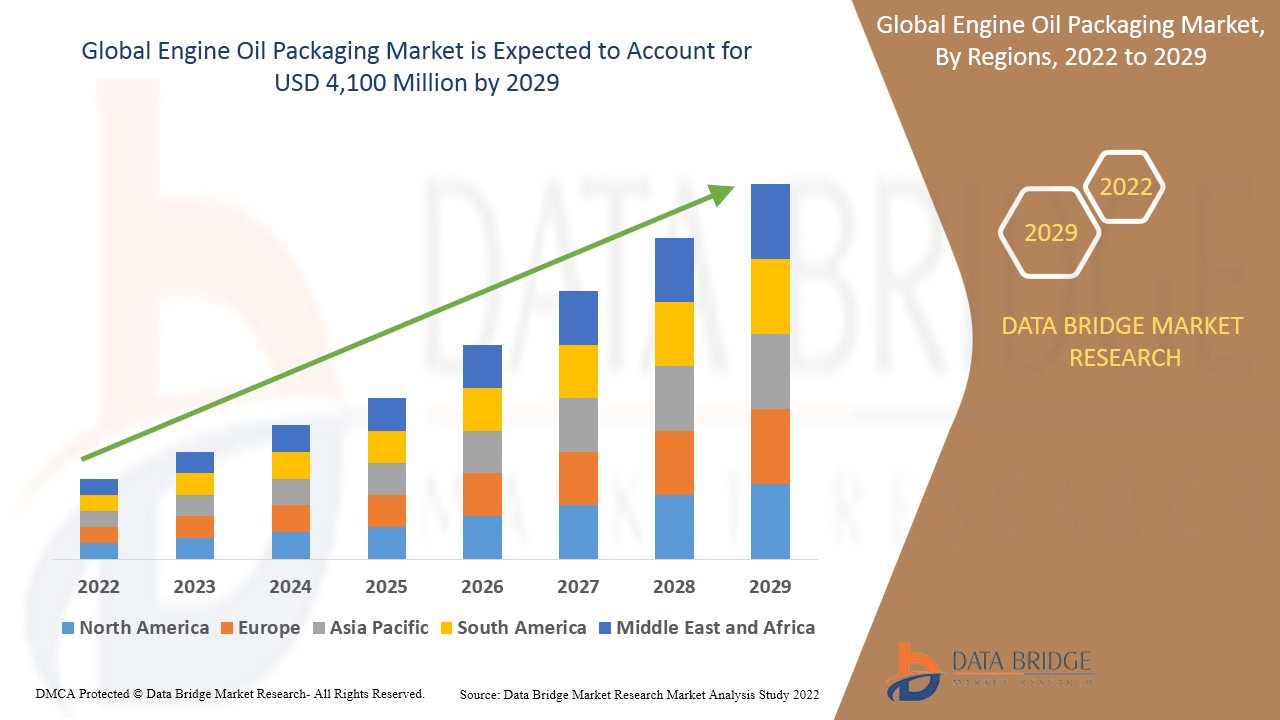
Data Bridge Market Research analisa que o mercado de embalagens de óleo de motor irá projetar um CAGR de 3,5% para o período de previsão de 2022-2029 e atingiria um valor estimado de USD 4,100 milhões até o final do período de previsão.
A embalagem lubrificante é constituída por garrafas de plástico rígido levemente ponderadas. A embalagem pode ser um fator importante na prevenção do medicamento. A embalagem flexível inclui bolsas stand-up, sacos e caixas de entrada, e é comumente encontrado em indústrias como fabricação, automotivo e eletrônica. A embalagem lubrificante é usada em uma variedade de indústrias porque é necessário para uma variedade de aplicações, tais como energia, automóveis, energia, e assim por diante.
A crescente demanda por lubrificantes, e assim por soluções de embalagem de lubrificantes convenientes, está impulsionando o mercado global de embalagens de óleo de motor para frente. A demanda global por veículos com motores IC aumentou significativamente na última década, criando uma enorme demanda por lubrificantes. Além disso, um aumento das vendas de duas rodas está alimentando a demanda do mercado. Além disso, a expansão significativa de indústrias como mineração, petróleo e gás, geração de energia, etc., está contribuindo para o crescimento do mercado global de embalagens de óleo de motor. A indústria de embalagens de óleo de motor beneficia da investigação e desenvolvimento de tecnologia de embalagem em curso. O mercado beneficiou muito de novos materiais de fabrico, como o HDPE e o polipropileno.
A crescente demanda por óleo de motor de alta quilometragem de países desenvolvidos para carros esportivos e de luxo, bem como a crescente demanda por óleo de mistura sintética de passageiros e veículos comerciais, e as crescentes normas e regulamentos governamentais para reduzir o fumo e usar óleo de motor de boa qualidade para proteção ambiental, estão entre os principais fatores que impulsionam o mercado de embalagens de óleo de motor automotivo.
O crescente uso de energia renovável em equipamentos industriais, como a eletricidade, está impedindo o crescimento do mercado global de embalagens lubrificantes. Com o aumento das vendas de veículos híbridos e eletrónicos, a procura da indústria automóvel, o principal utilizador final, está a diminuir significativamente. A presença de substitutos de óleo de motor de baixo custo, bem como a crescente preferência da sociedade por veículos elétricos sem motores, estão entre os principais fatores que irão limitar o crescimento do mercado e desafiar ainda mais o mercado de óleo de motor automotivo durante o período de previsão.
Este relatório de mercado de embalagem de óleo de motor fornece detalhes de novos desenvolvimentos recentes, regulamentos comerciais, análise de exportação de importação, análise de produção, otimização da cadeia de valor, market share, impacto de jogadores de mercado nacionais e localizados, análises de oportunidades em termos de bolsas de receita emergentes, mudanças em regulamentos de mercado, análise estratégica do crescimento do mercado, tamanho do mercado, crescimentos de mercado categoria, nichos de aplicação e dominância, aprovação de produtos, lançamentos de produtos, expansões geográficas, inovações tecnológicas no mercado. Para obter mais informações sobre o mercado de embalagens de óleo de motor contato Data Bridge Market Research for aResumo Analista, nossa equipe irá ajudá-lo a tomar uma decisão de mercado informada para alcançar o crescimento do mercado.
Global Engine Oil Packaging Market Scope e Tamanho do Mercado
O mercado global de embalagens de óleo de motor é segmentado com base em embalagens, lubrificantes, uso final e material. O crescimento entre estes segmentos irá ajudá-lo a analisar segmentos de crescimento escassos nas indústrias, e fornecer aos usuários uma visão de mercado valiosa e insights de mercado para ajudá-los a tomar decisões estratégicas para a identificação de aplicações de mercado principais.
- Com base na embalagem, o mercado de embalagens de óleo do motor é segmentado em bolsas stand-up, garrafas, tambores, baldes, latas e tubos.
- Com base no lubrificante, o mercado global de embalagens de óleo de motor é segmentado em óleo de motor, transmissão e fluido hidráulico, óleo de processo e fluido de trabalho de metal
- Com base no uso final, o mercado global de embalagens de óleo de motor é segmentado em automóveis, metalurgia, petróleo e gás e geração de energia
- Com base no material, o mercado global de embalagens de óleo de motor é segmentado em metal e plástico.
Embalagem de óleo do motorAnálise do nível do país de mercado
O mercado global de embalagens de óleo de motor é analisado e as informações e tendências do tamanho do mercado são fornecidas pelo país, embalagem, lubrificante, uso final e material referenciado acima.
Os países abrangidos pelo relatório do mercado de embalagens de óleo de motor são EUA, Canadá e México na América do Norte, Alemanha, França, Reino Unido, Holanda, Suíça, Bélgica, Rússia, Itália, Espanha, Turquia, Resto da Europa na Europa, China, Japão, Índia, Coreia do Sul, Singapura, Malásia, Austrália, Tailândia, Indonésia, Filipinas, Resto da Ásia-Pacífico (APAC) na Ásia-Pacífico (APAC), Arábia Saudita, EUA, África do Sul, Egito, Israel, Resto do Oriente Médio e África (MEA) como parte do Oriente Médio e África (MEA), Brasil, Argentina e Resto da América do Sul como parte da América do Sul.
A região Ásia-Pacífico representa a maioria do mercado global de embalagens de lubrificantes. Avanços rápidos nas indústrias automobilística e de geração de energia são importantes contribuintes para o crescimento do mercado nesta região. O rendimento disponível das pessoas aumentou, o que levou a um aumento da propriedade dos veículos, aumentando a procura de lubrificantes. O crescente uso de óleo transformador e óleo de turbina na crescente indústria de geração de energia também está alimentando o crescimento do mercado na China, Índia, Indonésia, Coréia e outros países.
A secção de país do relatório do mercado da embalagem de óleo de motor também fornece fatores de impacto individuais no mercado e mudanças na regulação no mercado nacional que afetam as tendências atuais e futuras do mercado. Os pontos de dados, como os volumes de consumo, os locais de produção e os volumes, a análise das exportações de importação, a análise da tendência dos preços, o custo das matérias-primas, a análise a jusante e a montante da cadeia de valor são alguns dos principais indicadores utilizados para prever o cenário de mercado para cada país. Além disso, a presença e disponibilidade de marcas globais e seus desafios enfrentados devido à grande ou escassa concorrência de marcas locais e nacionais, o impacto das tarifas nacionais e rotas comerciais são considerados ao fornecer análise de previsão dos dados do país.
Paisagem competitiva e Análise do mercado da embalagem do óleo do motor
O mercado competitivo de embalagens de óleo de motor fornece detalhes pelo concorrente. Detalhes incluídos são visão geral da empresa, finanças da empresa, receita gerada, potencial de mercado, investimento em pesquisa e desenvolvimento, novas iniciativas de mercado, presença global, locais de produção e instalações, capacidades de produção, pontos fortes e fracos da empresa, lançamento do produto, largura e amplitude do produto, dominância da aplicação. Os pontos de dados acima fornecidos estão relacionados apenas com o foco das empresas relacionados com o mercado da embalagem de óleo de motor.
Alguns dos principais intervenientes que operam no relatório do mercado de embalagens de óleo de motor são Motul, Petroliam Nasional Berhad (PETRONAS) (20076-K), ExxonMobil, Royal Dutch Shell, Total S.A., Fuchs Group, Petronas Lubricant International Sdn Bhd, Amsoil Inc, CASTROL LIMITED, Chevron Corporation, Oryx Energies SA, KenolKobil Ltd., Sinopec, Pennzoil, Equilon Enterprises, Lukoil e Idemitsu Kosan Co., Ltd, Kiva Container, Protective Packaging Corporation, Transcendia, International Plastics Inc., Auer Packaging, Dou Yee Enterprises Singapore e Botron Company Inc., entre outros intervenientes globais. Os dados de market share estão disponíveis para a Global, América do Norte, Europa, Ásia-Pacífico (APAC), Oriente Médio e África (MEA) e América do Sul separadamente. Os analistas da DBRM entendem os pontos fortes competitivos e fornecem análises competitivas para cada concorrente separadamente.
SKU-
Obtenha acesso online ao relatório sobre a primeira nuvem de inteligência de mercado do mundo

- Painel interativo de análise de dados
- Painel de análise da empresa para oportunidades de elevado potencial de crescimento
- Acesso de analista de pesquisa para personalização e customização. consultas
- Análise da concorrência com painel interativo
- Últimas notícias, atualizações e atualizações Análise de tendências
- Aproveite o poder da análise de benchmark para um rastreio abrangente da concorrência
Metodologia de Investigação
A recolha de dados e a análise do ano base são feitas através de módulos de recolha de dados com amostras grandes. A etapa inclui a obtenção de informações de mercado ou dados relacionados através de diversas fontes e estratégias. Inclui examinar e planear antecipadamente todos os dados adquiridos no passado. Da mesma forma, envolve o exame de inconsistências de informação observadas em diferentes fontes de informação. Os dados de mercado são analisados e estimados utilizando modelos estatísticos e coerentes de mercado. Além disso, a análise da quota de mercado e a análise das principais tendências são os principais fatores de sucesso no relatório de mercado. Para saber mais, solicite uma chamada de analista ou abra a sua consulta.
A principal metodologia de investigação utilizada pela equipa de investigação do DBMR é a triangulação de dados que envolve a mineração de dados, a análise do impacto das variáveis de dados no mercado e a validação primária (especialista do setor). Os modelos de dados incluem grelha de posicionamento de fornecedores, análise da linha de tempo do mercado, visão geral e guia de mercado, grelha de posicionamento da empresa, análise de patentes, análise de preços, análise da quota de mercado da empresa, normas de medição, análise global versus regional e de participação dos fornecedores. Para saber mais sobre a metodologia de investigação, faça uma consulta para falar com os nossos especialistas do setor.
Personalização disponível
A Data Bridge Market Research é líder em investigação formativa avançada. Orgulhamo-nos de servir os nossos clientes novos e existentes com dados e análises que correspondem e atendem aos seus objetivos. O relatório pode ser personalizado para incluir análise de tendências de preços de marcas-alvo, compreensão do mercado para países adicionais (solicite a lista de países), dados de resultados de ensaios clínicos, revisão de literatura, mercado remodelado e análise de base de produtos . A análise de mercado dos concorrentes-alvo pode ser analisada desde análises baseadas em tecnologia até estratégias de carteira de mercado. Podemos adicionar quantos concorrentes necessitar de dados no formato e estilo de dados que procura. A nossa equipa de analistas também pode fornecer dados em tabelas dinâmicas de ficheiros Excel em bruto (livro de factos) ou pode ajudá-lo a criar apresentações a partir dos conjuntos de dados disponíveis no relatório.











