


Segmentação do mercado global de intralogística por componente (hardware, software e serviços), uso final (alimentos e bebidas, logística, varejo e comércio eletrônico, automotivo, manufatura industrial, aeroportos, produtos químicos e outros usos finais) - Tendências e previsões do setor até 2033
O que é o Tamanho do Mercado Intralogistics e taxa de crescimento
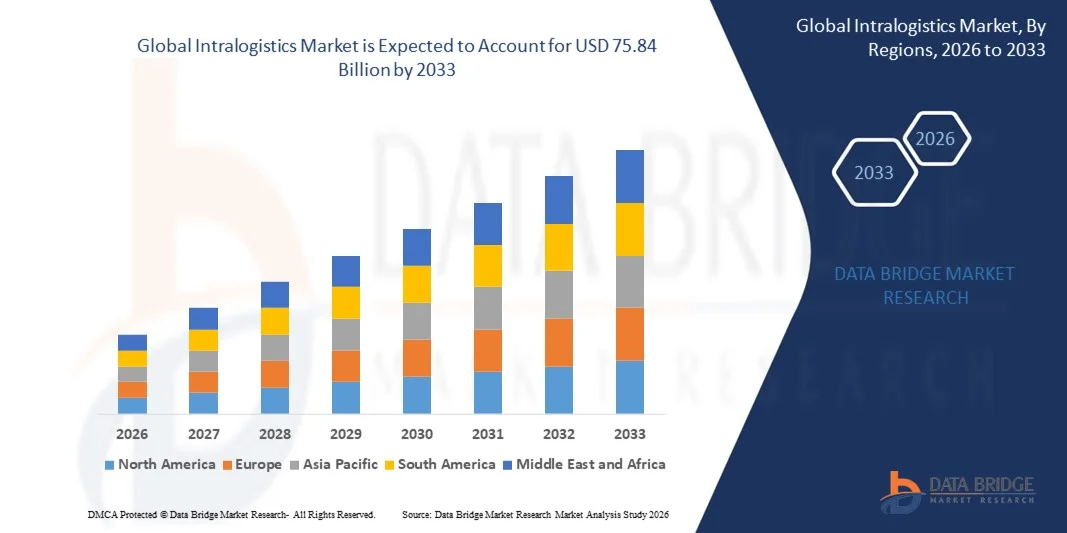
- Conforme a Data Bridge Market Research Analysis, o tamanho global do mercado Intralogistics foi avaliado em29,14 mil milhões de USD em 2025e espera-se alcançar75,84 mil milhões de USD até 2033, crescendo emCAGR de 12,70%durante o período de previsão.
- O crescimento do mercado é impulsionado principalmente pela crescente adoção de soluções de automação, robótica e IA em armazéns e centros de distribuição, aumentando a eficiência operacional e reduzindo os custos de trabalho.
- Além disso, a crescente demanda por gerenciamento de estoques em tempo real, cumprimento de pedidos mais rápido e integração da cadeia de suprimentos contínua está impulsionando a implantação de sistemas intralogísticos avançados. Estes factores conduzem colectivamente a adopção acelerada demanuseamento automatizado de materiaissoluções, aumentando significativamente a expansão do mercado.
Tamanho e previsão do mercado
- Valor de mercado global (2025):29,14 mil milhões de USD
- Valor de mercado previsto (2033):75,84 mil milhões de USD
- Previsões CAGR (2026-2033):12.70%
Quais são os principais takeaways do mercado intralogistics
- Soluções de intralogística, incluindo manipulação automatizada de material, robótica eSistemas de gestão de armazéns, são cada vez mais essenciais para operações modernas de cadeia de suprimentos em ambientes industriais e comerciais devido à sua eficiência, escalabilidade e capacidade de integração com plataformas logísticas digitais.
- A crescente demanda por soluções intralogísticas é impulsionada principalmente pelo rápido aumento do comércio eletrônico, aumentando a pressão para o cumprimento mais rápido da ordem, e pela necessidade de operações de armazém automatizadas e econômicas.
- A América do Norte dominou o Global Intralogistics Market com a maior parcela de receita de 33,1% em 2025, atribuída à adoção precoce de automação de armazéns, alto investimento em infraestrutura logística e uma forte presença de fornecedores líderes de soluções intralogística, com os EUA testemunhando a implantação significativa de sistemas automatizados de armazenamento e recuperação e robótica em centros de distribuição, impulsionados por inovações tanto de empresas de automação industrial estabelecidas quanto de startups tecnológicas emergentes.
- Espera-se que a Ásia-Pacífico seja a região de crescimento mais rápido no mercado Intralogistics Global durante o período de previsão devido à rápida industrialização, expansão do comércio eletrônico e aumento de investimentos em tecnologias de armazenamento inteligente.
- O segmento de hardware dominou o mercado com a maior parcela de receita de 52,6% em 2025, impulsionada pela implantação generalizada de sistemas automatizados de armazenamento e recuperação (AS/RS), transportadores, braços robóticos e robôs móveis autônomos (AMRs) em armazéns e centros de distribuição.
Escopo de Relatório e Segmentação de Mercado Intralogística Global
|
Atributos |
Intralogistics Principais Perspectivas do Mercado |
|
Segmentos Cobertos |
|
|
Países abrangidos |
América do Norte
Europa
Ásia- Pacífico
Médio Oriente e África
América do Sul
|
|
Jogadores do mercado chave |
• Dematic (EUA) |
|
Oportunidades de Mercado |
|
|
Informações sobre o Valor Adicionado |
Além dos insights de mercado, como valor de mercado, taxa de crescimento, segmentos de mercado, cobertura geográfica, atores de mercado e cenário de mercado, o relatório de mercado curado pela equipe de Pesquisa do Mercado da Ponte de Dados inclui análise de especialistas em profundidade, análise de importação/exportação, análise de preços, análise de consumo de produção e análise de pilão. |
Qual é a tendência chave no mercado intralogístico
Melhoria da eficiência através da integração de IA e robótica
- Uma tendência significativa e acelerada no Mercado Intralogístico Global é o aprofundamento da integração da inteligência artificial (IA) e da robótica avançada em operações de armazém e distribuição. Essa fusão de tecnologias está aumentando significativamente a eficiência operacional, precisão e escalabilidade em cadeias de suprimentos.
- Por exemplo, robôs móveis autônomos (AMRs) equipados com sistemas de navegação baseados em IA podem otimizar dinamicamente rotas em armazéns, reduzindo o tempo de viagem e aumentando a produtividade. Da mesma forma, sistemas robóticos de captação alimentados por visão computacional e aprendizado de máquina podem identificar e lidar com uma ampla gama de produtos com intervenção humana mínima.
- A integração de IA na intralogística permite manutenção preditiva, otimização de inventário e gerenciamento inteligente de fluxo de trabalho. Por exemplo, alguns sistemas utilizam IA para prever demanda, priorizar ordens e ajustar processos de manipulação de materiais em tempo real. A integração da robótica suporta ainda a classificação, embalagem e transporte automatizados, reduzindo custos e erros trabalhistas.
- A integração perfeita de IA e robótica com sistemas de gerenciamento de armazéns (WMS) e plataformas de planejamento de recursos corporativos (ERP) facilita o monitoramento e controle centralizados de operações de toda a cadeia de suprimentos. Através de uma única interface, os operadores podem gerenciar estoque, rastrear remessas e coordenar sistemas automatizados, criando um ambiente logístico totalmente conectado e inteligente.
- Essa tendência para soluções intralogísticas mais inteligentes, adaptativas e interconectadas está transformando fundamentalmente padrões operacionais e expectativas na gestão da cadeia de suprimentos. Consequentemente, empresas como a Dematic, GreyOrange e Swisslog estão desenvolvendo soluções de robótica e automação habilitadas para IA que aumentam a velocidade, precisão e flexibilidade em armazéns e centros de distribuição.
- A demanda por sistemas intralogísticos com integração perfeita de IA e robótica está crescendo rapidamente nos setores de manufatura, comércio eletrônico e varejo, pois as empresas priorizam cada vez mais a eficiência, escalabilidade e tomada de decisões orientadas por dados.
Dinâmica do Mercado Intralogístico Global
Controlador
Necessidade crescente devido ao comércio eletrônico Expansão e demanda por eficiência operacional
- O rápido crescimento do comércio eletrônico, o aumento das expectativas dos consumidores para uma entrega mais rápida e a necessidade de operações de armazém altamente eficientes são importantes motores para a demanda aumentada de soluções intralogísticas avançadas.
- Por exemplo, em 2025, a GreyOrange introduziu um sistema de automação de armazéns movidos por IA capaz de otimizar o cumprimento da ordem em tempo real, demonstrando como as empresas-chave estão impulsionando a inovação e adoção no mercado intralogístico. Espera-se que tais avanços acelerem o crescimento do mercado ao longo do período previsto.
- À medida que as empresas enfrentam uma pressão crescente para reduzir os custos de mão-de-obra, melhorar a precisão e acelerar o processamento de pedidos, soluções intralogísticas como sistemas automatizados de armazenamento e recuperação (AS/RS), robôs móveis autônomos (AMRs) e sistemas transportadores oferecem vantagens convincentes sobre as operações manuais tradicionais.
- Além disso, a adoção crescente de armazéns inteligentes e plataformas de cadeia de suprimentos digitais está fazendo dos sistemas intralogísticos uma parte integrante dos ecossistemas logísticos modernos, oferecendo integração perfeita com sistemas de gerenciamento de armazéns (WMS) e software de planejamento de recursos empresariais (ERP).
- A demanda por gerenciamento de inventário em tempo real, análise preditiva e manuseio automatizado de materiais está impulsionando a implantação generalizada de soluções intralogísticas nos setores de comércio eletrônico, fabricação e varejo. Os investimentos em sistemas de automação escaláveis, modulares e fáceis de usar contribuem ainda mais para a expansão do mercado.
Restrição/Desafio
Altos Custos de Implementação e Complexidade de Integração
- O investimento inicial relativamente elevado necessário para sistemas intralogísticos avançados, incluindo robótica, software orientado por IA e soluções de armazenamento automatizado, representa um desafio significativo para a adoção de mercado, particularmente para pequenas e médias empresas (PMEs).
- Por exemplo, algumas implementações AS/RS de alta capacidade podem custar milhões de dólares, dissuadindo as empresas menores de adotar automação em grande escala, apesar de seus benefícios operacionais.
- Além disso, integrar soluções intralogísticas com layouts de armazém existentes, sistemas legados e processos de cadeia de suprimentos pode ser complexo, exigindo pessoal qualificado, tempo e investimento adicional. Empresas como Dematic e Vanderlande enfatizam soluções modulares e escaláveis para mitigar esses desafios.
- Embora as economias operacionais a longo prazo e os ganhos de eficiência justifiquem frequentemente os custos iniciais, as barreiras financeiras e técnicas percebidas podem retardar a adoção, especialmente em regiões em desenvolvimento ou para empresas com experiência limitada em automação.
- Superar esses desafios através de soluções econômicas, opções modulares de implantação, treinamento abrangente e integração perfeita do sistema será vital para o crescimento sustentado do mercado.
Como é segmentado o Mercado Intralogistics
O mercado é segmentado com base no Componente e na utilização final.
- Por Componente
Com base no componente, o Global Intralogistics Market é segmentado em hardware, software e serviços. O segmento de hardware dominou o mercado com a maior parcela de receita de 52,6% em 2025, impulsionada pela implantação generalizada de sistemas automatizados de armazenamento e recuperação (AS/RS), transportadores, braços robóticos e robôs móveis autônomos (AMRs) em armazéns e centros de distribuição. Os investimentos em hardware formam a espinha dorsal das operações intralogísticas, fornecendo a infraestrutura tangível necessária para automação, manuseio de materiais e eficiência operacional.
Espera-se que o segmento de software testemunhe o CAGR mais rápido de 22,3% de 2026 a 2033, alimentado pela crescente adoção de sistemas de gerenciamento de armazéns (WMS), análises preditivas orientadas por IA e plataformas baseadas em nuvem. Soluções de software otimizam o gerenciamento de estoque, agendamento de fluxo de trabalho e manutenção preditiva, permitindo que as empresas ganhem visibilidade e eficiência em tempo real sem necessariamente aumentar a infraestrutura física. O segmento de serviços, incluindo instalação, manutenção e consultoria, também suporta a adoção geral, mas contribui com uma menor participação em relação ao hardware e software.
- Por Uso Final
Com base no uso final, o Global Intralogistics Market é segmentado em alimentos e bebidas, logística, varejo e e-commerce, manufatura automotiva, industrial, aeroportos, produtos químicos e outros usos finais. O segmento logístico representou a maior parcela de receita de mercado de 36,8% em 2025, impulsionada pelo rápido crescimento do e-commerce, pela necessidade de cumprimento rápido e preciso da ordem e pela crescente complexidade das cadeias de suprimentos que requerem soluções automatizadas de armazenamento, triagem e distribuição. As empresas do setor logístico estão cada vez mais implementando tecnologias intralogísticas para otimizar as operações de armazéns, reduzir a dependência laboral e minimizar os tempos de processamento de pedidos.
Espera-se que o segmento de varejo e e-commerce testemunhe o CAGR mais rápido de 24,1% de 2026 a 2033, alimentado pelo aumento das compras on-line, os requisitos de distribuição omnicanal e a necessidade de soluções de armazém escaláveis e automatizadas para gerenciar os picos de estoque e demanda flutuantes. Outros sectores, como a indústria automóvel e industrial, também contribuem para o crescimento devido à automatização do transporte de materiais e à integração das linhas de montagem, mas as suas taxas de adopção são comparativamente moderadas.
Qual é a região que detém a maior parte do mercado intralogístico
- A América do Norte dominou o Global Intralogistics Market com a maior parcela de receita de 33,1% em 2025, impulsionada pela adoção precoce de soluções de automação de armazéns, robótica avançada e manipulação de materiais movidos por IA.
- As empresas da região priorizam a eficiência operacional, o cumprimento mais rápido da ordem e a otimização de custos, tornando os sistemas automatizados de intralogística um investimento crítico nos setores de fabricação, e-commerce e distribuição.
- Essa adoção generalizada é ainda apoiada pela alta prontidão tecnológica, forte infraestrutura e pela presença de grandes fornecedores de soluções intralogísticas. A crescente integração de IA, robótica e software de gerenciamento de armazéns permite o rastreamento em tempo real de inventário, manutenção preditiva e coordenação contínua da cadeia de suprimentos, estabelecendo a América do Norte como o principal mercado de soluções intralogísticas em aplicações industriais e comerciais.
U.S. Intralogistics Market Insight
O mercado intralogistics dos EUA capturou a maior parte de receita de 81% em 2025 na América do Norte, alimentada pela rápida adoção de automação de armazém, robótica orientada por IA e sistemas avançados de manuseio de materiais. As empresas estão priorizando cada vez mais a eficiência operacional, o cumprimento de pedidos mais rápido e a otimização de custos em setores de comércio eletrônico, fabricação e distribuição. A crescente preferência por soluções de automação modulares e escaláveis, combinada com a integração de sistemas de gerenciamento de armazéns (WMS) e análises preditivas, está impulsionando o crescimento do mercado. Além disso, a presença de fornecedores de soluções intralogística líderes e infraestrutura robusta suporta a implantação de sistemas automatizados sofisticados em aplicações industriais e comerciais.
Europa Intralogistics Market Insight
O mercado europeu de intralogística é projetado para expandir-se em um CAGR substancial durante o período de previsão, impulsionado principalmente por regulamentos rigorosos sobre eficiência da cadeia de suprimentos, otimização do trabalho e padrões de segurança. A crescente demanda por automação em armazéns, aliada à necessidade de gerenciamento de estoque em tempo real e manuseio eficiente de materiais, está promovendo a adoção de soluções intralogísticas. Países como Alemanha, Países Baixos e França estão assistindo a um crescimento significativo nos sistemas de armazenamento automatizado, soluções de coleta robótica e software de armazém orientado por IA, especialmente nos setores de fabricação, varejo e e-commerce.
Intralogistics Market Insight
O mercado intralogístico do Reino Unido está previsto para crescer em um CAGR notável durante o período de previsão, impulsionado pela tendência crescente de automação de armazéns e pela necessidade de processamento de pedidos mais rápido nos setores de comércio eletrônico e varejo. Além disso, as pressões sobre os custos de mão-de-obra e a demanda de monitoramento centralizado de armazéns estão incentivando as empresas a adotar sistemas automatizados de armazenamento, recuperação e triagem. Espera-se que a robusta infra-estrutura de comércio electrónico do país e o crescente investimento em tecnologias inteligentes de armazéns continuem a estimular o crescimento do mercado.
Alemanha Intralogistics Market Insight
Espera-se que o mercado intralogístico da Alemanha se expanda em um considerável CAGR durante o período de previsão, impulsionado pelo aumento da conscientização das práticas de automação, digitalização e Indústria 4.0. A infraestrutura industrial avançada da Alemanha e o foco em soluções sustentáveis e eficientes em termos energéticos promovem a adoção de robótica orientada por IA, veículos guiados automatizados (AGVs) e software de gerenciamento de armazéns. A integração de sistemas intralogísticos com operações de fábrica inteligentes está se tornando cada vez mais prevalente, particularmente em instalações de fabricação e logística que buscam aumentar a produtividade e precisão operacional.
Visão Intralogística Ásia-Pacífico Mercado
O mercado intralogístico Ásia-Pacífico está preparado para crescer ao mais rápido possível no CAGR de 24% durante o período de previsão de 2026 a 2033, impulsionado pela rápida industrialização, expansão do comércio eletrônico e crescente demanda por soluções automatizadas de cadeia de suprimentos em países como China, Japão e Índia. Iniciativas governamentais que apoiam a fabricação inteligente e a digitalização estão acelerando a adoção, enquanto o surgimento da região como um centro de fabricação de sistemas de robótica e automação está melhorando a acessibilidade e acessibilidade de soluções intralogísticas.
Japão Intralogistics Market Insight
O mercado intralogístico do Japão está ganhando força devido ao ecossistema tecnológico avançado do país, aos elevados custos trabalhistas e à crescente necessidade de eficiência operacional. As empresas japonesas estão adotando rapidamente veículos guiados automatizados, sistemas de coleta robótica e soluções de gerenciamento de armazéns movidos por IA para otimizar o gerenciamento de estoques e reduzir a dependência em trabalho manual. A integração de sistemas intralogísticos com fábricas inteligentes mais amplas e plataformas habilitadas para IoT está alimentando o crescimento, especialmente em instalações de fabricação e distribuição.
China Intralogistics Market Insight
O mercado intralogístico da China representou a maior participação de receita de mercado na Ásia-Pacífico em 2025, atribuída à urbanização rápida, expansão do comércio eletrônico e adoção crescente de automação industrial. A China é um dos maiores mercados para sistemas de armazéns automatizados, AGVs e soluções robóticas, impulsionados pela alta demanda dos setores de varejo, logística e fabricação. O impulso do governo para uma logística inteligente, o aumento do investimento na automação habilitada para IA e a disponibilidade de soluções intralogísticas domésticas econômicas são fatores fundamentais que impulsionam o crescimento do mercado na China.
Quais são as Principais Empresas do Mercado Intralogístico
A indústria Intralogística é liderada principalmente por empresas bem estabelecidas, incluindo:
• Dematic (EUA)
•Grupo KION / Dematic(Alemanha)
• Swisslog (Suíça)
• Vanderlande (Países Baixos)
• Hikrobot (China)
•Soluções Bastian(EUA)
•Toyota Material Manuseamento(Japão)
•Grupo Fives(França)
•Cisco- Eagle(EUA)
• SSI Schäfer (Alemanha)
• Muratec / Murata Machinery (Japão)
• Knapp AG (Áustria)
• Daifuku (Japão)
• Geek+ (China)
• Raymond Handling Concepts (EUA)
• Jungheinrich AG (Alemanha)
• Magazino (Alemanha)
• Motores OTTO (Canadá)
• Elettric80 (Itália)
• GrayOrange (EUA)
Quais são as últimas evoluções no mercado intralogístico
- Em abril de 2024, a Dematic, líder global em soluções intralogísticas e de automação, lançou uma iniciativa estratégica na África do Sul para modernizar as operações de armazéns através de seus avançados sistemas automatizados de armazenamento e recuperação (AS/RS) e soluções robóticas. Esta iniciativa enfatiza o compromisso da empresa em oferecer soluções eficientes, escaláveis e orientadas para a cadeia de suprimentos adaptadas aos desafios logísticos regionais, reforçando sua posição no rápido crescimento do Mercado Intralogístico Global.
- Em março de 2024, a GreyOrange, provedora de robótica e intralogística baseada em IA, implantou seu sistema de classificação e coleta de próxima geração em grandes centros de atendimento de comércio eletrônico nos EUA Projetado para otimizar a precisão de pedidos e a velocidade de processamento, este sistema destaca a dedicação da GreyOrange em aumentar a eficiência operacional e permitir que as empresas atendam a crescente demanda do consumidor com precisão e confiabilidade.
- Em março de 2024, a Honeywell International Inc. implementou com sucesso um projeto de automação de armazéns movidos por IA em Bengaluru, Índia, visando melhorar a logística urbana e a eficiência da cadeia de suprimentos industrial. O projeto aproveita a robótica avançada, algoritmos de IA e software de gerenciamento de armazéns para melhorar o rendimento e minimizar o tempo de inatividade operacional, demonstrando o papel crescente das tecnologias inteligentes intralogísticas na criação de redes logísticas mais eficientes e resilientes.
- Em fevereiro de 2024, a SSI Schäfer anunciou uma parceria estratégica com uma empresa europeia líder em comércio eletrônico para implantar sistemas de armazém totalmente automatizados, incluindo soluções transportadoras e estações robóticas. Esta colaboração é projetada para simplificar o cumprimento da ordem, reduzir a dependência laboral e melhorar a responsividade da cadeia de suprimentos, enfatizando o foco da SSI Schäfer em impulsionar a inovação e excelência operacional no setor intralogístico.
- Em janeiro de 2024, Vanderlande, um fornecedor proeminente de sistemas automatizados de manuseio de materiais, revelou seu sistema de classificação de alta velocidade de última geração na LogiMAT 2024. Equipado com análises preditivas orientadas por IA e design modular, o sistema permite que armazéns e centros de distribuição lidem com volumes de ordem de pico com maior eficiência e precisão, refletindo o compromisso da Vanderlande em integrar tecnologia avançada em operações intralogísticas para atender às demandas do mercado em evolução.
SKU-
Obtenha acesso online ao relatório sobre a primeira nuvem de inteligência de mercado do mundo

- Painel interativo de análise de dados
- Painel de análise da empresa para oportunidades de elevado potencial de crescimento
- Acesso de analista de pesquisa para personalização e customização. consultas
- Análise da concorrência com painel interativo
- Últimas notícias, atualizações e atualizações Análise de tendências
- Aproveite o poder da análise de benchmark para um rastreio abrangente da concorrência
Metodologia de Investigação
A recolha de dados e a análise do ano base são feitas através de módulos de recolha de dados com amostras grandes. A etapa inclui a obtenção de informações de mercado ou dados relacionados através de diversas fontes e estratégias. Inclui examinar e planear antecipadamente todos os dados adquiridos no passado. Da mesma forma, envolve o exame de inconsistências de informação observadas em diferentes fontes de informação. Os dados de mercado são analisados e estimados utilizando modelos estatísticos e coerentes de mercado. Além disso, a análise da quota de mercado e a análise das principais tendências são os principais fatores de sucesso no relatório de mercado. Para saber mais, solicite uma chamada de analista ou abra a sua consulta.
A principal metodologia de investigação utilizada pela equipa de investigação do DBMR é a triangulação de dados que envolve a mineração de dados, a análise do impacto das variáveis de dados no mercado e a validação primária (especialista do setor). Os modelos de dados incluem grelha de posicionamento de fornecedores, análise da linha de tempo do mercado, visão geral e guia de mercado, grelha de posicionamento da empresa, análise de patentes, análise de preços, análise da quota de mercado da empresa, normas de medição, análise global versus regional e de participação dos fornecedores. Para saber mais sobre a metodologia de investigação, faça uma consulta para falar com os nossos especialistas do setor.
Personalização disponível
A Data Bridge Market Research é líder em investigação formativa avançada. Orgulhamo-nos de servir os nossos clientes novos e existentes com dados e análises que correspondem e atendem aos seus objetivos. O relatório pode ser personalizado para incluir análise de tendências de preços de marcas-alvo, compreensão do mercado para países adicionais (solicite a lista de países), dados de resultados de ensaios clínicos, revisão de literatura, mercado remodelado e análise de base de produtos . A análise de mercado dos concorrentes-alvo pode ser analisada desde análises baseadas em tecnologia até estratégias de carteira de mercado. Podemos adicionar quantos concorrentes necessitar de dados no formato e estilo de dados que procura. A nossa equipa de analistas também pode fornecer dados em tabelas dinâmicas de ficheiros Excel em bruto (livro de factos) ou pode ajudá-lo a criar apresentações a partir dos conjuntos de dados disponíveis no relatório.











