



Global Smart Kitchen Appliances Market Segmentation, By Product Type (Ovens, Dishwashers, Refrigerators, Cookware and Cooktops, Smart Coffee Maker, Kettle, Freezer, Range Hoods, Scale and Thermometers, and Others), Connectivity Technology (Wi-Fi, Near Field Communication, and Bluetooth), End User (Residential and Commercial), Distribution Channel (Multi-brand Stores, Exclusive Stores, Online, and Others) – Industry Trends and Forecast to 2032
Smart Kitchen Appliances Market Analysis
The smart kitchen appliances is experiencing significant growth, driven by advancements in technology and innovative design methods. Recent trends include the integration of smart technologies, such as IoT-enabled appliances, which enhance convenience and energy efficiency. These appliances can be controlled remotely, allowing homeowners to monitor usage and automate tasks, thereby optimizing kitchen operations.
Moreover, 3D visualization software is revolutionizing kitchen design, enabling consumers to visualize their space before installation. This technology not only improves customer satisfaction but also reduces design errors, leading to cost savings and efficient project completion.
Sustainable materials, such as eco-friendly laminates and recycled wood, are increasingly popular, catering to the rising demand for environmentally conscious products. The use of modular components allows for customizable configurations, appealing to diverse consumer preferences and maximizing space efficiency in urban environments.
The growth in online retailing and e-commerce platforms has also expanded market reach, providing consumers with access to a broader range of smart kitchen appliance solutions. As urbanization and disposable incomes rise, the smart kitchen appliances is poised for continued expansion, driven by innovative technologies and evolving consumer lifestyles.
Smart Kitchen Appliances Market Size
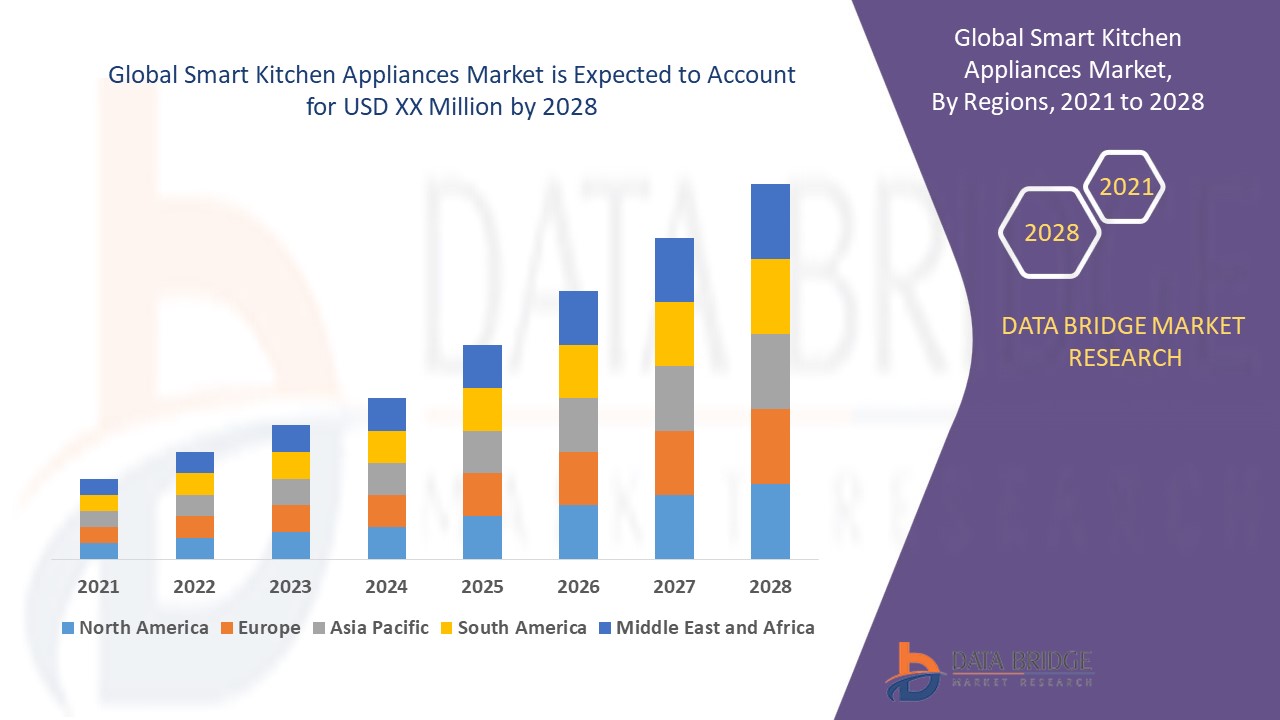
The global smart kitchen appliances market size was valued at USD 21.66 billion in 2024 and is projected to reach USD 68.64 billion by 2032, with a CAGR of 12.51% during the forecast period of 2025 to 2032. In addition to the insights on market scenarios such as market value, growth rate, segmentation, geographical coverage, and major players, the market reports curated by the Data Bridge Market Research also include in-depth expert analysis, pricing analysis, brand share analysis, consumer survey, demography analysis, supply chain analysis, value chain analysis, raw material/consumables overview, vendor selection criteria, PESTLE Analysis, Porter Analysis, and regulatory framework.
Smart Kitchen Appliances Market Trends
“Rise of Smart Kitchen Technology”
One specific trend driving the growth of the smart kitchen appliances market is the integration of smart kitchen technology. Consumers increasingly seek innovative solutions that enhance convenience and efficiency in cooking and meal preparation. Smart kitchen appliances, such as smart refrigerators and ovens, allow users to control settings remotely and receive notifications, promoting energy efficiency. For instance, brands such as Samsung and LG have introduced connected appliances that sync with smartphones apps, enabling users to monitor their kitchen from anywhere. This technological advancement not only appeals to tech-savvy consumers but also enhances the overall cooking experience, significantly contributing to the demand for smart kitchen appliances equipped with these smart features.
Report Scope and Smart Kitchen Appliances Market Segmentation
|
Attributes |
Smart Kitchen Appliances Key Market Insights |
|
Segments Covered |
|
|
Countries Covered |
U.S., Canada and Mexico in North America, Germany, France, U.K., Netherlands, Switzerland, Belgium, Russia, Italy, Spain, Turkey, Rest of Europe in Europe, China, Japan, India, South Korea, Singapore, Malaysia, Australia, Thailand, Indonesia, Philippines, Rest of Asia-Pacific (APAC) in the Asia-Pacific (APAC), Saudi Arabia, U.A.E, South Africa, Egypt, Israel, Rest of Middle East and Africa (MEA) as a part of Middle East and Africa (MEA), Brazil, Argentina and Rest of South America as part of South America |
|
Key Market Players |
LG Electronics (South Korea), Whirlpool Corporation (U.S.), Panasonic Corporation (Japan), Morphy Richards India (India), Samsung (South Korea), Koninklijke Philips N.V. (Netherlands), Robert Bosch GmbH (Germany), Electrolux AB (Sweden), GE Appliances (U.S.), Toshiba Lifestyle Products and Services Corporation (Japan), Havells India Ltd. (India), BSH Home Appliances Group (Germany), Hitachi Appliances, Inc. (Japan), Mabe International (Mexico), Midea Group (China), Miele India Pvt. Ltd. (India), Daewoo Electricals (South Korea), Behmor, Inc. (U.S.), Rallison Appliances (China), and Hangzhou Robam Electric Co. (China) |
|
Market Opportunities |
|
|
Value Added Data Infosets |
In addition to the insights on market scenarios such as market value, growth rate, segmentation, geographical coverage, and major players, the market reports curated by the Data Bridge Market Research also include in-depth expert analysis, pricing analysis, brand share analysis, consumer survey, demography analysis, supply chain analysis, value chain analysis, raw material/consumables overview, vendor selection criteria, PESTLE Analysis, Porter Analysis, and regulatory framework. |
Smart Kitchen Appliances Market Definition
A smart kitchen appliances is a modern and customizable kitchen design that utilizes pre-fabricated units or modules, allowing for efficient space management and aesthetic appeal. These modules can include cabinets, drawers, shelves, and appliances, which can be arranged in various configurations to suit individual preferences and kitchen layouts. Typically made from materials such as plywood, MDF, or particle board, smart kitchen appliance offer flexibility in design, enabling homeowners to choose colors, finishes, and accessories that match their style. They are also easy to install and replace, making them a popular choice for contemporary homes seeking functionality and elegance.
Smart Kitchen Appliances Market Dynamics
Drivers
- Growing Residential Construction and Renovation Activities
The surge in residential construction and renovation activities is significantly driving the smart kitchen appliance market. As homeowners seek to maximize space and enhance efficiency, smart kitchen appliance are becoming increasingly popular. These kitchens are designed to fit into various layouts, offering customizable options that appeal to modern consumers. For instance, in April 2022, Nobia launched its group-wide design concept, Nordic Nature, inspired by the serene beauty of Nordic forests. Initially introduced in 2021 by Marbodal (Sweden), Sigdal (Norway), and A’la Carte (Finland), it expanded in 2022 with HTH and Invita (Denmark) and Magnet (UK). This innovative design approach not only enhances the aesthetic appeal of kitchens but also aims to boost sales by attracting consumers seeking a fresh, nature-inspired ambiance.
- Increasing Demand for Space-Saving and Efficient Storage among Consumers
The rising demand for space-saving and efficient storage solutions is significantly driving growth in the global smart kitchen appliance market. With the trend toward nuclear families, consumers increasingly seek kitchens that maximize functionality while occupying minimal space. Companies such as Häfele and IKEA have responded by offering smart kitchen appliance solutions that incorporate glossy and laminated finishes, enhancing aesthetics while optimizing storage. These designs often feature customizable elements, such as drawers, cabinets, and micro-compartments, allowing homeowners to tailor their kitchens to their specific needs. This adaptability not only aligns with contemporary design trends but also meets the needs of modern, open living spaces, reinforcing the demand for smart kitchen appliance.
Opportunities
- Increasing Adoption due to Changing Lifestyle Pattern of Consumers
The growing adoption of smart kitchen appliance reflects changing lifestyle patterns, particularly following the post-lockdown era when people spend more time at home. As disposable incomes rise, consumers seek spacious, aesthetically pleasing kitchen designs that enhance functionality and style. For instance, in 2022, Snaidero introduced its new brand, MandiCasa, expanding its portfolio to include a variety of premium offerings such as smart kitchen appliance cabinets, bath vanities, bathrooms, and closets sourced from top Italian suppliers. This launch reflects Snaidero's dedication to providing high-quality, stylish home solutions that cater to evolving consumer preferences, enhancing its market competitiveness while promoting Italian craftsmanship and design excellence in modern living spaces.
- Advancement in Technology
The smart kitchen appliance industry is experiencing significant growth due to technological advancements and innovative product launches. With the entry of new players, consumers can choose from a diverse range of customizable designs, layouts, and accessories that cater to their specific needs. For instance, brands such as IKEA have integrated augmented reality apps to help customers visualize kitchen setups in their homes. In addition, the rise of e-commerce and social media marketing has transformed how consumers shop, leading to increased online sales. As disposable incomes rise and consumer awareness of smart home solutions grows, opportunities for advanced products—such as smart appliances and eco-friendly materials—continue to expand, fueling market growth.
Restraints/Challenges
- High Cost of Installation
The installation of smart kitchen appliance often incurs high costs, particularly due to the necessity for proper ventilation systems. Effective ventilation is crucial to vent out cooking fumes and ensure fresh air circulation. This requirement typically involves installing a chimney or exhaust fan, which adds to the overall expense. In addition, for optimal ventilation, the kitchen must have doors or windows that open into a balcony or open area, further complicating installation and design. These added expenses can deter potential buyers, particularly those on a budget, ultimately hindering market growth as consumers seek more affordable alternatives that require less investment in ventilation solutions.
- Competition from Traditional Kitchens
The smart kitchen appliance market faces significant challenges due to strong competition from traditional kitchen designs, which maintain a considerable market share. In regions where custom cabinetry and local craftsmanship are highly valued, consumers often prefer the uniqueness and personalization of traditional kitchens. This preference can stem from cultural influences, a desire for bespoke solutions, or a perception of higher quality associated with handcrafted elements. As a result, the established presence of traditional kitchens can limit the growth potential of smart kitchen appliance, as some demographics remain resistant to adopting prefabricated options, impacting overall market expansion.
Smart Kitchen Appliances Market Scope
The market is segmented on the basis of type, application, end-user and material. The growth amongst these segments will help you analyze meagre growth segments in the industries and provide the users with a valuable market overview and market insights to help them make strategic decisions for identifying core market applications.
Product Type
- Ovens, Dishwashers
- Refrigerators
- Cookware and Cooktops
- Smart Coffee Maker
- Kettle
- Freezer
- Range Hoods
- Scale and Thermometers
- Others
Connectivity Technology
- Wi-Fi
- Near Field Communication
- Bluetooth
End User
- Residential
- Commercial
Distribution Channel
- Multi-brand Stores
- Exclusive Stores
- Online
- Others
Smart Kitchen Appliances Market Regional Analysis
The market is analyzed and market size insights and trends are provided by type, application, end-user and material as referenced above.
The countries covered in the market report are U.S., Canada, Mexico in North America, Germany, Sweden, Poland, Denmark, Italy, U.K., France, Spain, Netherland, Belgium, Switzerland, Turkey, Russia, Rest of Europe in Europe, Japan, China, India, South Korea, New Zealand, Vietnam, Australia, Singapore, Malaysia, Thailand, Indonesia, Philippines, Rest of Asia-Pacific (APAC) in Asia-Pacific (APAC), Brazil, Argentina, Rest of South America as a part of South America, U.A.E, Saudi Arabia, Oman, Qatar, Kuwait, South Africa, Rest of Middle East and Africa (MEA) as a part of Middle East and Africa (MEA).
North America leads the smart kitchen appliances market because of the rise in the trend of technology driven appliances, rise in the disposable income as well as the high investments on renovations and modern designs.
Asia-Pacific is expected to expand at a significant growth rate over the forecast period because of the high adoption of smart refrigerators, smart ovens, mainly in China.
The country section of the report also provides individual market impacting factors and changes in market regulation that impact the current and future trends of the market. Data points such as down-stream and upstream value chain analysis, technical trends and porter's five forces analysis, case studies are some of the pointers used to forecast the market scenario for individual countries. Also, the presence and availability of global brands and their challenges faced due to large or scarce competition from local and domestic brands, impact of domestic tariffs and trade routes are considered while providing forecast analysis of the country data.
Smart Kitchen Appliances Market Share
The market competitive landscape provides details by competitor. Details included are company overview, company financials, revenue generated, market potential, investment in research and development, new market initiatives, global presence, production sites and facilities, production capacities, company strengths and weaknesses, product launch, product width and breadth, application dominance. The above data points provided are only related to the companies' focus related to market.
Smart Kitchen Appliances Market Leaders Operating in the Market Are:
- LG Electronics (South Korea)
- Whirlpool Corporation (U.S.)
- Panasonic Corporation (Japan)
- Morphy Richards India (India)
- Samsung (South Korea)
- Koninklijke Philips N.V. (Netherlands)
- Robert Bosch GmbH (Germany)
- Electrolux AB (Sweden)
- GE Appliances (U.S.)
- Toshiba Lifestyle Products and Services Corporation (Japan)
- Havells India Ltd. (India)
- BSH Home Appliances Group (Germany)
- Hitachi Appliances, Inc. (Japan)
- Mabe International (Mexico)
- Midea Group (China)
- Miele India Pvt. Ltd. (India)
- Daewoo Electricals (South Korea)
- Behmor, Inc. (U.S.)
- Rallison Appliances (China)
- Hangzhou Robam Electric Co. (China)
Latest Developments in Smart Kitchen Appliances Market
- In January 2023, VersaWare launched its next generation of smart kitchen appliances at CES. This innovative product line features a connected mixing bowl and cutting board, along with a smartphone app that personalizes meal preparation to meet nutritional goals. Users can scan ingredients and receive real-time nutritional data, eliminating the need for traditional measuring tools
- In May 2023, LG Electronics introduced the InstaView fridge in Australia. This refrigerator features MoodUP technology, allowing users to customize the fridge's door colors from a palette of 190,000 options using LED panels. Additionally, it includes built-in Bluetooth speakers and an InstaView Door-in-Door feature that lets users view the contents without opening the door
- In January 2021, Samsung Electronics released its Bespoke Flex refrigerators, which come in three models: Stainless Steel, Bespoke, and Family Hub. These refrigerators are equipped with a Beverage Center and a Dual Auto Ice Maker, enhancing user convenience and functionality in kitchen design
- In October 2020, Xiaomi partnered with Huami to enhance its smart appliance technology. This collaboration focuses on developing advanced chips and algorithms to improve the functionality of Xiaomi's smart home products, aiming to create more efficient and connected devices for consumers
- In May 2020, Panasonic and Blue Yonder expanded their strategic partnership to advance autonomous supply chain development. This collaboration aims to leverage technology for optimizing supply chain operations, enhancing efficiency and responsiveness in manufacturing and distribution processes
SKU-
Obtenha acesso online ao relatório sobre a primeira nuvem de inteligência de mercado do mundo

- Painel interativo de análise de dados
- Painel de análise da empresa para oportunidades de elevado potencial de crescimento
- Acesso de analista de pesquisa para personalização e customização. consultas
- Análise da concorrência com painel interativo
- Últimas notícias, atualizações e atualizações Análise de tendências
- Aproveite o poder da análise de benchmark para um rastreio abrangente da concorrência
Metodologia de Investigação
A recolha de dados e a análise do ano base são feitas através de módulos de recolha de dados com amostras grandes. A etapa inclui a obtenção de informações de mercado ou dados relacionados através de diversas fontes e estratégias. Inclui examinar e planear antecipadamente todos os dados adquiridos no passado. Da mesma forma, envolve o exame de inconsistências de informação observadas em diferentes fontes de informação. Os dados de mercado são analisados e estimados utilizando modelos estatísticos e coerentes de mercado. Além disso, a análise da quota de mercado e a análise das principais tendências são os principais fatores de sucesso no relatório de mercado. Para saber mais, solicite uma chamada de analista ou abra a sua consulta.
A principal metodologia de investigação utilizada pela equipa de investigação do DBMR é a triangulação de dados que envolve a mineração de dados, a análise do impacto das variáveis de dados no mercado e a validação primária (especialista do setor). Os modelos de dados incluem grelha de posicionamento de fornecedores, análise da linha de tempo do mercado, visão geral e guia de mercado, grelha de posicionamento da empresa, análise de patentes, análise de preços, análise da quota de mercado da empresa, normas de medição, análise global versus regional e de participação dos fornecedores. Para saber mais sobre a metodologia de investigação, faça uma consulta para falar com os nossos especialistas do setor.
Personalização disponível
A Data Bridge Market Research é líder em investigação formativa avançada. Orgulhamo-nos de servir os nossos clientes novos e existentes com dados e análises que correspondem e atendem aos seus objetivos. O relatório pode ser personalizado para incluir análise de tendências de preços de marcas-alvo, compreensão do mercado para países adicionais (solicite a lista de países), dados de resultados de ensaios clínicos, revisão de literatura, mercado remodelado e análise de base de produtos . A análise de mercado dos concorrentes-alvo pode ser analisada desde análises baseadas em tecnologia até estratégias de carteira de mercado. Podemos adicionar quantos concorrentes necessitar de dados no formato e estilo de dados que procura. A nossa equipa de analistas também pode fornecer dados em tabelas dinâmicas de ficheiros Excel em bruto (livro de factos) ou pode ajudá-lo a criar apresentações a partir dos conjuntos de dados disponíveis no relatório.











