


Global Smart Television (T.V.) Market Segmentation, By Resolution (4K UHD TV, HDTV, Full HD T.V., 8K T.V.), Screen Size (Below 32 inches, 32 to 45 inches, 46 to 55 inches, 56 to 65 inches, Above 65 inches), Type (Flat, Curved), Technology (OLED, QLED, LED, Plasma, Others), Platform (Android, Roku, WebOS, Tizen O.S., iOS, MyHomeScreen, Others), Distribution Channel (Direct, Indirect) – Industry Trends and Forecast to 2032.
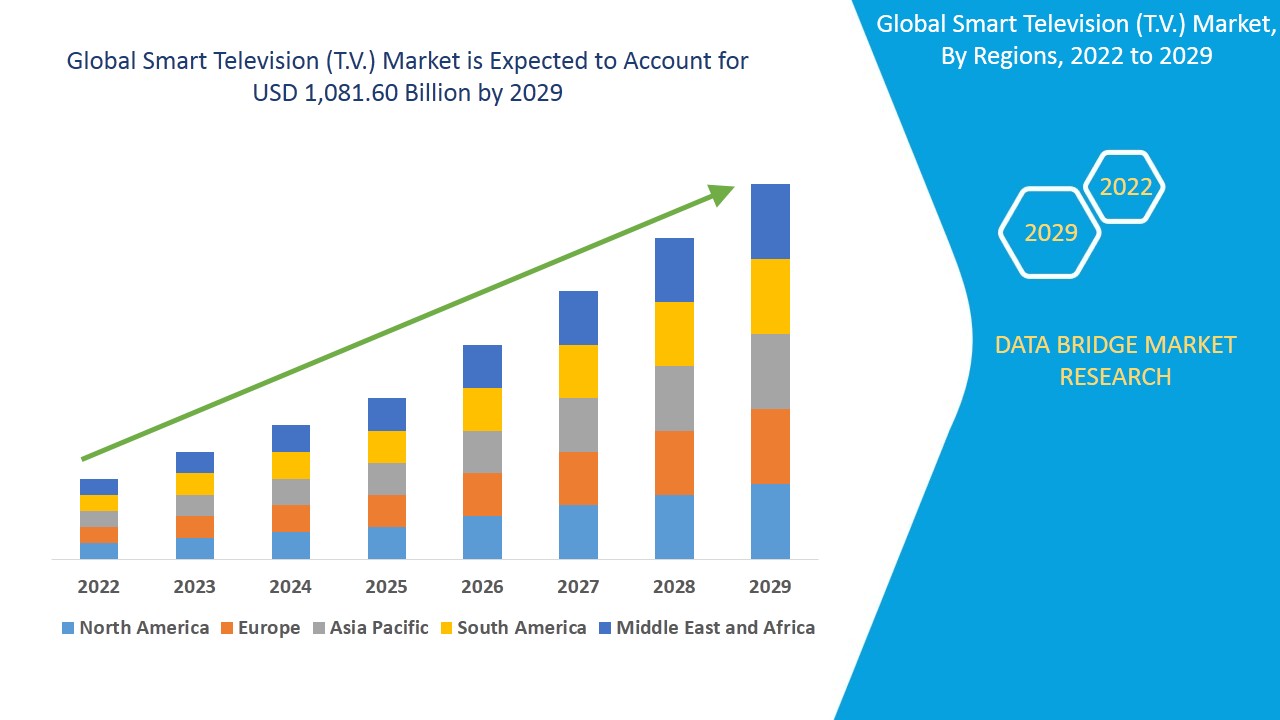
Smart Television (T.V.) Market Analysis
The smart T.V. market is expected to develop significantly during the forecast period of 2025-2032, owing to increased consumption of online content as a result of increased internet usage globally. A smart T.V. is a television that can be connected to the Internet and utilized as a stand-alone device. Although smart television (T.V.) are now sold as a separate product, any conventional television (T.V.) with a set-top box can be transformed into a smart television (T.V.) By connecting to the internet, over-the-top video provided by online streaming services can be streamed easily on smart television (T.V.). Customers prefer this service because it offers on-demand streaming material that can be seen on a widescreen instead of being limited to our computers or mobile phones. As a result of China's active theft of the smart television (T.V.) market's manufacturing share, the Asia Pacific region now leads the worldwide smart television (T.V.) market.
Smart Television (T.V.) Market Size
Global Smart Television (T.V.) Market size was valued at USD 420.99 billion in 2024 and is projected to reach USD 1905.23 billion by 2032, with a CAGR of 20.77% during the forecast period of 2025 to 2032.
Report Scope and Market Segmentation
|
Attributes |
Smart Television (T.V.) Key Market Insights |
|
Segmentation |
|
|
Countries Covered |
U.S., Canada, and Mexico in North America, Brazil, Argentina, and the rest of South America as part of South America, Germany, Italy, U.K., France, Spain, Netherlands, Belgium, Switzerland, Turkey, Russia, Rest of Europe in Europe, Japan, China, India, South Korea, Australia, Singapore, Malaysia, Thailand, Indonesia, Philippines, rest of Asia-Pacific (APAC) in the Asia-Pacific (APAC), Saudi Arabia, U.A.E, South Africa, Egypt, Israel, rest of the Middle East and Africa (MEA) as a part of the Middle East and Africa (MEA). |
|
Key Market Players |
SAMSUNG (South Korea), SONY INDIA (Japan), L.G. Electronics (South Korea), Google LLC (U.S.), Panasonic Corporation (Japan), SHARP CORPORATION (U.S.), Koninklijke Philips N.V. (Netherlands), Hitachi Ltd. (Japan), TCL (China), Skyworth Group Limited (China), Haier Group (Hong Kong), TOSHIBA CORPORATION (Japan), Videocon Industries Limited (Mumbai), Grande Holdings Company Limited (Hong Kong), Xiaomi (China), Hisense International (China), VIZIO, Inc. (U.S.), INSIGNIA SYSTEMS (U.S.), Apple Inc (U.S.) |
Smart Television (T.V.) Market Definition
Smart televisions (T.V.s), also known as linked T.V.s, have internet connectivity built in, allowing them to offer a variety of capabilities such as on-demand content from various apps, access to streaming services, and the ability to connect with other wireless devices. They can also passively receive cable, satellite, or over-the-air (OTA) broadcasts. Aside from that, smart T.V.s have additional hardware and connections and a television operating system and graphical user interface (GUI). Viewers can use these adaptations to access and manage aspects of linked devices as well as stream material from internet video services.
Smart Television (T.V.) Market Dynamics
- Rise in online content consumption during COVID-19
However, during the pandemic, entertainment corporations are focusing on finding new methods to adapt to the changing digital reality. The industry is seeing a rapid surge in digital content consumption, with platforms like Netflix and Amazon Prime Video seeing worldwide viewership. Strong emphasis on online content distribution, combined with the increasing relaxation of COVID restrictions, is expected to boost the popularity of smart television (T.V.) brands around the world, accelerating the smart television (T.V.) market.
- Increasing demand for personalized entertainment
The rise in the demand for personalized entertainment will accelerate the smart television (T.V.) market's growth rate. Gone are the days when people gathered to movie theatres or flipped through satellite television channels. Smart T.V.s provide this service by connecting to the internet, allowing users to subscribe to their preferred online streaming services such as Netflix and Amazon Prime.
Furthermore, the smart television (T.V.) market is also being driven by significant factors such as the rise in the level of disposable income and rapid urbanization. Smart television (T.V.) market is estimated to rise rapidly over the forecast period because of surging adoption of advanced technologies. Other significant factors such as emergence of smartphone manufacturers such as Xiaomi, OnePlus and Micromax and adoption of 4K resolution T.V. will cushion the growth rate of smart television (T.V.) market.
- Rise in number of strategic collaborations will boost new market opportunities
The rise in the number of strategic collaborations will extend profitable opportunities to the market players in 2025 to 2032. Collaborations with streaming media player manufacturers, which assist them grow their portfolio and raise their profile will enhance the market's growth rate in coming years.
Moreover, increasing technological advancement and emerging new markets will create profitable opportunities for smart television (T.V.) market in the future.
Restraints/Challenges
- Taxation of smart T.V.s will act a market restrain.
However, the market for smart television (T.V.) is forecast to be constrained by the taxation of smart television.
Also, fear, uncertainty, and doubt of customer will further challenge the growth of the smart television (T.V.) market. The severe impact of the COVID-19 outbreak on supply chain and the high repairing cost of smart T.V.s will act as major restraints and further impede the growth rate smart television (T.V.) market.
This smart television (T.V.) market report provides details of new recent developments, trade regulations, import-export analysis, production analysis, value chain optimization, market share, the impact of domestic and localized market players, analyses opportunities in terms of emerging revenue pockets, changes in market regulations, strategic market growth analysis, market size, category market growths, application niches and dominance, product approvals, product launches, geographic expansions, technological innovations in the market. To gain more info on the smart television (T.V.) market contact Data Bridge Market Research for an Analyst Brief, Our team will help you take an informed market decision to achieve market growth.
Smart Television (T.V.) Market Scope
The smart television (T.V.) market is segmented on the basis of resolution, screen size, type, technology, platform and distribution channel. The growth amongst these segments will help you analyze meagre growth segments in the industries and provide the users with a valuable market overview and market insights to help them make strategic decisions for identifying core market applications.
Resolution
- 4K UHD TV
- HDTV
- Full HD T.V.
- 8K TV
Screen Size
- Below 32 inches
- 32 to 45 inches
- 46 to 55 inches
- 56 to 65 inches
- Above 65 inches
Type
- Flat
- Curved
Technology
- OLED
- QLED
- LED
- Plasma
- Others
Platform
- Android
- Roku
- WebOS
- Tizen O.S.
- iOS
- MyHomeScreen
- Others
Distribution Channel
- Direct
- Indirect
Smart Television (T.V.) Market Regional Analysis
The smart television (T.V.) market is analyzed and market size insights and trends are provided by country, resolution, screen size, type, technology, platform and distribution channel as referenced above.
The countries covered in the smart television (T.V.) market report are the U.S., Canada, and Mexico in North America, Brazil, Argentina, and the rest of South America as part of South America, Germany, Italy, U.K., France, Spain, Netherlands, Belgium, Switzerland, Turkey, Russia, Rest of Europe in Europe, Japan, China, India, South Korea, Australia, Singapore, Malaysia, Thailand, Indonesia, Philippines, rest of Asia-Pacific (APAC) in the Asia-Pacific (APAC), Saudi Arabia, U.A.E, South Africa, Egypt, Israel, rest of the Middle East and Africa (MEA) as a part of the Middle East and Africa (MEA).
Asia-Pacific dominates the smart television (T.V.) market in terms of market share and market revenue and will continue to flourish its dominance during the forecast period. This is due to the increasing adoption of smart televisions in rapidly developing economies such as India. Additionally, the rising demand for 4K display technology because of consumer inclination towards better quality and sleek design will further flourish the market's growth rate in this region.
Middle East and Africa are expected to witness significant growth during the forecast period of 2025 to 2032 due to the advancement across OTT space and a notable increase in engaging content in the region. Also, shifting consumer focus towards online content because of the rising availability of seamless, high-speed internet connections will further flourish the market's growth rate in this region.
The country section of the report also provides individual market impacting factors and changes in market regulation that impact the current and future trends of the market. Data points such as down-stream and upstream value chain analysis, technical trends and porter's five forces analysis, case studies are some of the pointers used to forecast the market scenario for individual countries. Also, the presence and availability of global brands and their challenges faced due to large or scarce competition from local and domestic brands, impact of domestic tariffs and trade routes are considered while providing forecast analysis of the country data.
Smart Television (T.V.) Market Share
The smart television (T.V.) market competitive landscape provides details by competitor. Details included are company overview, company financials, revenue generated, market potential, investment in research and development, new market initiatives, global presence, production sites and facilities, production capacities, company strengths and weaknesses, product launch, product width and breadth, application dominance. The above data points provided are only related to the companies' focus related to smart television (T.V.) market.
Smart Television (T.V.) Market Leaders Operating in the Market Are:
- SAMSUNG (South Korea)
- SONY INDIA (Japan)
- L.G. Electronics (South Korea)
- Google LLC (U.S.)
- Panasonic Corporation (Japan)
- SHARP CORPORATION (U.S.)
- Koninklijke Philips N.V., (Netherlands)
- Hitachi Ltd. (Japan)
- TCL (China)
- Skyworth Group Limited (China)
- Haier Group (Hong Kong)
- TOSHIBA CORPORATION (Japan)
- Videocon Industries Limited (Mumbai)
- Grande Holdings Company Limited (Hong Kong)
- Xiaomi (China)
- Hisense International (China)
- VIZIO, Inc., (U.S.)
- INSIGNIA SYSTEMS (U.S.)
- Apple Inc (U.S.),
Latest Developments in Smart Television (T.V.) Market
- In April 2021, Samsung launched its ultra-high-end Neo QLED TV line. For a cinematic watching experience, the new range has a nearly bezel-less Infinity One Design and true-to-life picture quality. There will be five sizes available: 85-inch (2m 16cm), 75-inch (1m 89cm), 65-inch (1m 63cm), 55-inch (1m 38cm), and 50-inch (1m 38cm) (1m 25cm). Furthermore, Samsung's unique Neo Quantum Processor with superior upscaling capabilities is included in Neo QLED TVs. The Neo Quantum Processor can maximize picture quality to 4K and 8K picture output regardless of input quality by using up to 16 separate neural network models, each trained in A.I. upscaling and deep learning technologies.
SKU-
Obtenha acesso online ao relatório sobre a primeira nuvem de inteligência de mercado do mundo

- Painel interativo de análise de dados
- Painel de análise da empresa para oportunidades de elevado potencial de crescimento
- Acesso de analista de pesquisa para personalização e customização. consultas
- Análise da concorrência com painel interativo
- Últimas notícias, atualizações e atualizações Análise de tendências
- Aproveite o poder da análise de benchmark para um rastreio abrangente da concorrência
Metodologia de Investigação
A recolha de dados e a análise do ano base são feitas através de módulos de recolha de dados com amostras grandes. A etapa inclui a obtenção de informações de mercado ou dados relacionados através de diversas fontes e estratégias. Inclui examinar e planear antecipadamente todos os dados adquiridos no passado. Da mesma forma, envolve o exame de inconsistências de informação observadas em diferentes fontes de informação. Os dados de mercado são analisados e estimados utilizando modelos estatísticos e coerentes de mercado. Além disso, a análise da quota de mercado e a análise das principais tendências são os principais fatores de sucesso no relatório de mercado. Para saber mais, solicite uma chamada de analista ou abra a sua consulta.
A principal metodologia de investigação utilizada pela equipa de investigação do DBMR é a triangulação de dados que envolve a mineração de dados, a análise do impacto das variáveis de dados no mercado e a validação primária (especialista do setor). Os modelos de dados incluem grelha de posicionamento de fornecedores, análise da linha de tempo do mercado, visão geral e guia de mercado, grelha de posicionamento da empresa, análise de patentes, análise de preços, análise da quota de mercado da empresa, normas de medição, análise global versus regional e de participação dos fornecedores. Para saber mais sobre a metodologia de investigação, faça uma consulta para falar com os nossos especialistas do setor.
Personalização disponível
A Data Bridge Market Research é líder em investigação formativa avançada. Orgulhamo-nos de servir os nossos clientes novos e existentes com dados e análises que correspondem e atendem aos seus objetivos. O relatório pode ser personalizado para incluir análise de tendências de preços de marcas-alvo, compreensão do mercado para países adicionais (solicite a lista de países), dados de resultados de ensaios clínicos, revisão de literatura, mercado remodelado e análise de base de produtos . A análise de mercado dos concorrentes-alvo pode ser analisada desde análises baseadas em tecnologia até estratégias de carteira de mercado. Podemos adicionar quantos concorrentes necessitar de dados no formato e estilo de dados que procura. A nossa equipa de analistas também pode fornecer dados em tabelas dinâmicas de ficheiros Excel em bruto (livro de factos) ou pode ajudá-lo a criar apresentações a partir dos conjuntos de dados disponíveis no relatório.











