



Segmentação do mercado global de ingredientes sustentáveis para bebidas, por aplicação (refrigerantes, bebidas alcoólicas, sucos de frutas, bebidas lácteas e bebidas energéticas), origem (natural, sintética e orgânica), funcionalidade (adoçante, aromatizante, acidulante e conservante) - Tendências e previsões do setor até 2033
Qual é o tamanho e a taxa de crescimento do mercado global de ingredientes sustentáveis para bebidas?
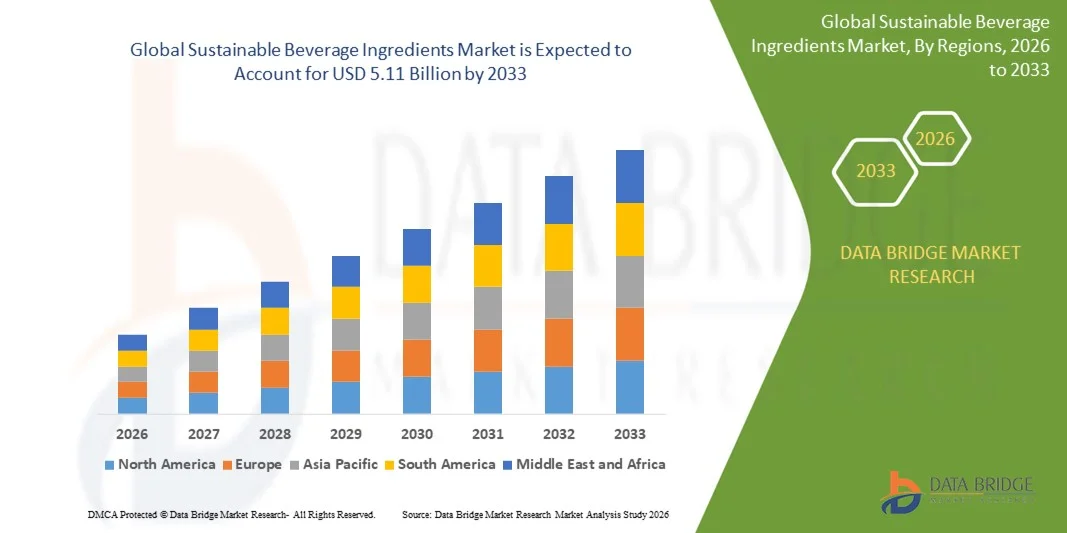
- O mercado global de ingredientes sustentáveis para bebidas foi avaliado em US$ 2,64 bilhões em 2025 e deverá atingir US$ 5,11 bilhões até 2033 , com uma taxa de crescimento anual composta (CAGR) de 7,60% durante o período de previsão.
- A crescente adoção de formulações de bebidas naturais, à base de plantas e ecologicamente corretas é um dos principais fatores que impulsionam o crescimento do mercado. A preferência cada vez maior do consumidor por ingredientes de baixa caloria, com rótulos limpos e de origem sustentável, juntamente com uma maior conscientização sobre o impacto ambiental, está acelerando a expansão do mercado em bebidas funcionais, sucos, bebidas prontas para consumo e água fortificada.
- A crescente popularidade de antioxidantes de origem sustentável, sabores naturais, extratos botânicos e adoçantes orgânicos, aliada às preocupações com aditivos artificiais e produtos químicos sintéticos, fortalece ainda mais a demanda. O foco crescente em fornecimento ético, produção neutra em carbono e sistemas circulares de ingredientes continua a sustentar a trajetória de crescimento geral do mercado.
Quais são os principais pontos a serem destacados no mercado de ingredientes sustentáveis para bebidas?
- A crescente conscientização sobre os benefícios para a saúde de ingredientes naturais e de origem responsável, a mudança nas preferências do consumidor em direção a bebidas voltadas para o bem-estar e o aumento da renda disponível globalmente estão influenciando positivamente o mercado de ingredientes sustentáveis para bebidas. Além disso, as inovações contínuas em produtos, novas formulações derivadas de plantas e soluções de rótulo limpo oferecem oportunidades lucrativas para os participantes do mercado.
- Os altos custos de produção associados a ingredientes sustentáveis e orgânicos para bebidas, juntamente com a disponibilidade de alternativas sintéticas mais baratas, são fatores-chave que restringem o crescimento do mercado. A limitada conscientização do consumidor em regiões emergentes e a complexidade para obter certificações de sustentabilidade verificadas também devem representar desafios para a expansão do mercado.
- A região Ásia-Pacífico dominou o mercado de ingredientes sustentáveis para bebidas, com uma participação de 43,6% na receita em 2025, impulsionada pela forte demanda por ingredientes naturais, à base de plantas e com rótulo limpo na China, Japão, Índia e Coreia do Sul.
- Prevê-se que a América do Norte registre a taxa de crescimento anual composta (CAGR) mais rápida, de 9,4%, entre 2026 e 2033, impulsionada pela crescente demanda por ingredientes para bebidas com rótulo limpo, de baixa caloria e à base de plantas nos EUA e no Canadá.
- O segmento de refrigerantes dominou o mercado com uma participação de 41,8% na receita em 2025, impulsionado pelo alto consumo de bebidas carbonatadas, águas aromatizadas, refrigerantes funcionais, chás prontos para beber e bebidas eletrolíticas naturais.
Escopo do relatório e segmentação do mercado de ingredientes sustentáveis para bebidas.
|
Atributos |
Principais informações de mercado sobre ingredientes sustentáveis para bebidas |
|
Segmentos abrangidos |
|
|
Países abrangidos |
América do Norte
Europa
Ásia-Pacífico
Oriente Médio e África
Ámérica do Sul
|
|
Principais participantes do mercado |
|
|
Oportunidades de mercado |
|
|
Conjuntos de informações de dados de valor agregado |
Além das informações sobre cenários de mercado, como valor de mercado, taxa de crescimento, segmentação, cobertura geográfica e principais participantes, os relatórios de mercado elaborados pela Data Bridge Market Research também incluem análises aprofundadas de especialistas, análises de preços, análises de participação de marcas, pesquisas com consumidores, análises demográficas, análises da cadeia de suprimentos, análises da cadeia de valor, visão geral de matérias-primas/insumos, critérios de seleção de fornecedores, análise PESTLE, análise de Porter e estrutura regulatória. |
Qual é a principal tendência no mercado de ingredientes sustentáveis para bebidas?
Crescente demanda por ingredientes de bebidas enriquecidos com nutrientes e multissustentáveis
- O mercado de ingredientes sustentáveis para bebidas está passando por uma forte transformação, com foco em formulações multifuncionais, ricas em nutrientes e com rótulos limpos, integrando prebióticos, fibras vegetais e extratos botânicos para agregar valor ao produto.
- Os fabricantes estão desenvolvendo sistemas de ingredientes multifuncionais que auxiliam na redução do açúcar, no controle de calorias, na saúde digestiva e em um uso funcional mais amplo em bebidas, laticínios e nutracêuticos.
- Os consumidores estão cada vez mais optando por ingredientes naturais, com baixo teor calórico e livres de produtos químicos como substitutos para aditivos artificiais, impulsionando a adoção em diversas categorias de alimentos e bem-estar.
- Por exemplo, empresas como ADM, Tate & Lyle, Layn Corp e NOW Foods expandiram suas linhas de misturas de ingredientes fortificados, desenvolvidas para bebidas funcionais, nutrição esportiva e lanches com baixo teor de açúcar.
- O crescente interesse na manutenção da saúde, no controle de peso e na nutrição com rótulos limpos continua a impulsionar a demanda global.
- À medida que os consumidores priorizam soluções naturais, multifuncionais e voltadas para a saúde, os ingredientes sustentáveis para bebidas continuarão sendo fundamentais para a inovação no ecossistema de bebidas saudáveis.
Quais são os principais fatores que impulsionam o mercado de ingredientes sustentáveis para bebidas?
- A crescente demanda por ingredientes com baixo teor calórico, naturais, à base de plantas e com funcionalidade aprimorada está acelerando a adoção global em diversas categorias de bebidas e nutrição.
- Por exemplo, em 2025, a ADM, a Tate & Lyle e a Layn Corp ampliaram seus portfólios de ingredientes para uso em bebidas funcionais, sucos fortificados e lanches adequados para diabéticos.
- A crescente conscientização sobre a redução do consumo de açúcar, o controle da obesidade e as dietas de baixo índice glicêmico está impulsionando o consumo nos EUA, na Europa e na região Ásia-Pacífico.
- Os avanços tecnológicos em extração, otimização de sabor e métodos de mistura melhoraram significativamente a qualidade, a estabilidade e a versatilidade de aplicação dos ingredientes.
- A crescente preferência por ingredientes orgânicos, veganos, não transgênicos e de origem sustentável está impulsionando ainda mais a expansão do mercado.
- Com investimentos contínuos em P&D, novas formulações, colaborações estratégicas e distribuição global, espera-se que o mercado de ingredientes sustentáveis para bebidas mantenha um crescimento robusto a longo prazo.
Que fator está desafiando o crescimento do mercado de ingredientes sustentáveis para bebidas?
- Os altos custos de produção, purificação e processamento associados aos extratos de ingredientes naturais de alta qualidade limitam a acessibilidade em diversas regiões sensíveis a preços.
- Por exemplo, durante o período de 2024–2025, as flutuações no fornecimento de frutas, na produção agrícola e nos custos dos materiais de extração impactaram a eficiência da produção de importantes fabricantes.
- Regulamentações rigorosas relativas à segurança alimentar, à precisão da rotulagem e à certificação de rótulo limpo aumentam a complexidade do desenvolvimento de produtos.
- O conhecimento limitado dos consumidores em regiões emergentes sobre os benefícios dos ingredientes naturais e suas vantagens glicêmicas restringe uma penetração mais ampla no mercado.
- A forte concorrência de alternativas de menor custo, como estévia, eritritol e alulose, cria desafios de precificação e afeta a diferenciação do produto.
- Para superar essas barreiras, as empresas estão se concentrando em fornecimento eficiente, tecnologias de extração escaláveis, padronização regulatória e educação do consumidor para expandir a aceitação global de ingredientes premium para bebidas sustentáveis.
Como é segmentado o mercado de ingredientes sustentáveis para bebidas?
O mercado está segmentado com base na aplicação, na fonte e na funcionalidade .
- Por meio de aplicação
Com base na aplicação, o mercado de ingredientes sustentáveis para bebidas é segmentado em refrigerantes, bebidas alcoólicas, sucos de frutas, bebidas lácteas e bebidas energéticas. O segmento de refrigerantes dominou o mercado com uma participação de 41,8% da receita em 2025, impulsionado pelo alto consumo de bebidas carbonatadas, águas aromatizadas, refrigerantes funcionais, chás prontos para beber e bebidas eletrolíticas naturais. A crescente demanda por formulações de refrigerantes com baixo teor de açúcar e rótulos limpos, utilizando adoçantes de origem vegetal, extratos botânicos e intensificadores naturais, continua a sustentar a adoção em larga escala. Os fabricantes estão reformulando cada vez mais as bebidas carbonatadas com componentes sustentáveis e de baixa caloria para atender às diretrizes regulatórias de redução de açúcar e às expectativas dos consumidores preocupados com a saúde.
Prevê-se que o segmento de bebidas energéticas apresente o crescimento anual composto mais rápido entre 2026 e 2033, impulsionado pelo crescente interesse em bebidas de desempenho, alternativas naturais à cafeína, estimulantes metabólicos e formulações com baixo teor de açúcar entre os consumidores preocupados com a saúde e o bem-estar. A expansão de bebidas funcionais premium e bebidas nutracêuticas fortalece ainda mais o crescimento do segmento.
- Por Fonte
Com base na origem, o mercado de ingredientes sustentáveis para bebidas é segmentado em Natural, Sintético e Orgânico. O segmento Natural dominou o mercado com uma participação de 57,6% da receita em 2025, impulsionado pela crescente preferência por adoçantes de origem vegetal, extratos botânicos, concentrados de frutas, aromas naturais e intensificadores funcionais utilizados em bebidas prontas para consumo e bebidas funcionais. Os consumidores estão ativamente abandonando os aditivos artificiais, aumentando a demanda por ingredientes naturais conhecidos por sua maior credibilidade nutricional e fornecimento sustentável. A forte adoção em refrigerantes, sucos, bebidas proteicas e águas aromatizadas reforça ainda mais a liderança de mercado.
Prevê-se que o segmento de produtos orgânicos apresente o crescimento anual composto mais rápido entre 2026 e 2033, impulsionado pelo crescente interesse global em bebidas com rótulos limpos, não transgênicas, livres de químicos e ecologicamente corretas. A crescente penetração de categorias de bebidas orgânicas — incluindo sucos prensados a frio, kombucha, alternativas vegetais aos laticínios e bebidas premium voltadas para o bem-estar — está contribuindo significativamente para a aceleração do segmento.
- Por funcionalidade
Com base na funcionalidade, o mercado de ingredientes sustentáveis para bebidas é segmentado em Adoçantes, Aromatizantes, Acidulantes e Conservantes. O segmento de Adoçantes dominou o mercado com uma participação de 46,3% da receita em 2025, devido à crescente demanda global por adoçantes naturais, de baixa caloria e à base de plantas, utilizados em refrigerantes, bebidas esportivas, bebidas energéticas, alternativas lácteas, águas aromatizadas e bebidas funcionais. A mudança em direção à redução do açúcar, alegações de rótulo limpo e gerenciamento da saúde metabólica está impulsionando a substituição generalizada do açúcar refinado por soluções de adoçantes sustentáveis, como fruta-do-monge, estévia e concentrados derivados de frutas.
Prevê-se que o segmento de aromatizantes apresente o crescimento anual composto mais rápido entre 2026 e 2033, impulsionado por inovações em aromas naturais, infusões botânicas, extratos cítricos e essências de frutas tropicais utilizadas em bebidas premium. O crescente interesse do consumidor por perfis de sabor refrescantes, únicos e que priorizam a saúde continua a abrir fortes oportunidades de crescimento na formulação de bebidas em nível global.
Qual região detém a maior participação no mercado de ingredientes sustentáveis para bebidas?
- A região Ásia-Pacífico dominou o mercado de ingredientes sustentáveis para bebidas, com uma participação de 43,6% na receita em 2025, impulsionada pela forte demanda por ingredientes naturais, à base de plantas e com rótulo limpo na China, Japão, Índia e Coreia do Sul. O crescente foco do consumidor na redução do consumo de açúcar, bem-estar digestivo, controle de peso e hábitos alimentares com baixas calorias está impulsionando a ampla adoção do produto. O cultivo em larga escala da fruta-do-monge, as tecnologias avançadas de extração e a forte capacidade de exportação conferem à região uma vantagem competitiva na fabricação.
- Os principais players do mercado estão expandindo as formulações à base de fruta-do-monge, estévia e extratos botânicos por meio de inovações em purificação, modulação de sabor e agricultura sustentável. O apoio regulatório para a conformidade com rótulos limpos, certificações orgânicas e ingredientes não transgênicos fortalece ainda mais a liderança da região Ásia-Pacífico.
- A rápida urbanização, o aumento da renda disponível e a crescente preferência por adoçantes naturais em detrimento das alternativas artificiais impulsionam um forte crescimento regional.
Análise do Mercado de Ingredientes Sustentáveis para Bebidas na China
A China é a maior contribuinte para a região Ásia-Pacífico, impulsionada por sua extensa base de cultivo de fruta-do-monge e infraestrutura de processamento avançada. A demanda por bebidas, produtos de panificação, nutrição esportiva e alimentos funcionais está em ascensão devido à crescente conscientização sobre os benefícios dos adoçantes naturais. Os fabricantes estão aumentando os investimentos em pesquisa e desenvolvimento, sistemas de agricultura orgânica e métodos de extração ecologicamente corretos, o que impulsiona o consumo interno e a capacidade de exportação. A alta disponibilidade de matérias-primas e as fortes redes de distribuição fortalecem ainda mais a posição da China.
Análise do Mercado Japonês de Ingredientes Sustentáveis para Bebidas
O Japão apresenta um crescimento consistente impulsionado pela alta preferência do consumidor por adoçantes naturais e de baixa caloria em bebidas funcionais, alimentos tradicionais e produtos premium voltados para a saúde. Inovações contínuas no aprimoramento do sabor, nos níveis de pureza e na mistura com estévia e eritritol estão incentivando uma adoção mais ampla. Forte apoio regulatório, infraestrutura de varejo organizada e a crescente demanda por bebidas com rótulos limpos reforçam o ritmo de crescimento em todo o país.
Análise do Mercado de Ingredientes Sustentáveis para Bebidas na Índia
A Índia está emergindo como um mercado de crescimento significativo, impulsionado pela crescente conscientização sobre o controle do diabetes, da obesidade e por ingredientes alimentares naturais. A demanda por fruta-do-monge e outros adoçantes de origem vegetal está aumentando em bebidas, alimentos industrializados e no preparo de alimentos em casa. A expansão das plataformas de comércio eletrônico, a crescente adoção de produtos com rótulos limpos e as iniciativas governamentais de saúde e bem-estar estão contribuindo para a rápida penetração de ingredientes sustentáveis em bebidas.
Análise do Mercado de Ingredientes Sustentáveis para Bebidas na Coreia do Sul
A Coreia do Sul contribui fortemente para o crescimento regional devido ao crescente interesse em adoçantes naturais em alimentos dietéticos, bebidas funcionais e produtos de panificação. Influências das exportações de alimentos coreanos, tendências de bem-estar e conteúdo de saúde nas redes sociais estão moldando as preferências do consumidor por ingredientes de origem vegetal e com zero calorias. Embalagens premium, inovação de produtos e a expansão dos canais de varejo estão impulsionando ainda mais a aceitação do mercado.
Análise do Mercado de Ingredientes Sustentáveis para Bebidas na América do Norte (Região de Crescimento Mais Rápido)
Prevê-se que a América do Norte registre a taxa de crescimento anual composta (CAGR) mais rápida, de 9,4%, entre 2026 e 2033, impulsionada pela crescente demanda por ingredientes para bebidas com rótulo limpo, baixo teor calórico e à base de plantas nos EUA e no Canadá. A crescente conscientização sobre a redução do consumo de açúcar, dietas adequadas para diabéticos e tendências de bebidas funcionais acelera a adoção de produtos como água aromatizada, bebidas proteicas, alternativas ao leite e bebidas prontas para consumo (RTD). Empresas líderes estão focando na inovação em formulações com fruta-do-monge, estévia e misturas botânicas, aprimorando o sabor, a estabilidade e os perfis de sabor natural. O forte apoio regulatório para alegações de ingredientes não transgênicos, orgânicos e naturais impulsiona ainda mais esse crescimento. O crescimento do comércio eletrônico, das bebidas funcionais por assinatura e do marketing digital aumenta significativamente a acessibilidade.
Quais são as principais empresas no mercado de ingredientes sustentáveis para bebidas?
O setor de ingredientes sustentáveis para bebidas é liderado principalmente por empresas consolidadas, incluindo:
- Cargill, Incorporated (EUA)
- Archer-Daniels Midland Company (EUA)
- Kerry Group plc (Irlanda)
- DuPont (EUA)
- Tate & Lyle (Reino Unido)
- Ingredion (EUA)
- Novozymes A/S (Dinamarca)
- Mevive Internacional (Índia)
- Ingredientes Novasol Unip. Ltd. (Índia)
- Ingredientes alimentares Symega (Índia)
Quais são os desenvolvimentos recentes no mercado global de ingredientes sustentáveis para bebidas?
- Em setembro de 2025, a Lifeway Foods, Inc., produtora americana de produtos lácteos fermentados, lançou sua nova bebida funcional Muscle Mates, com 20 gramas de proteína e culturas probióticas ativas, consolidando ainda mais sua posição no segmento de bebidas funcionais ricas em proteínas.
- Em junho de 2025, a Amul, marca de laticínios pertencente à Federação Cooperativa de Marketing de Leite de Gujarat, lançou sua água proteica Amul contendo 10 gramas de proteína isolada do soro do leite, ampliando sua presença entre os consumidores focados em fitness no mercado de bebidas indiano.
- Em abril de 2025, a Nestlé SA, multinacional suíça de alimentos e bebidas, lançou sua mais recente linha de bebidas à base de proteínas, desenvolvida especificamente para pessoas que buscam perder peso, reforçando seu compromisso com inovações em bebidas focadas na saúde.
- Em fevereiro de 2025, a Fermenthe, uma empresa tailandesa de bebidas saudáveis, lançou seu kombucha pronto para beber, feito com uma mistura de chá verde e preto, oferecendo aos consumidores tailandeses uma opção de bebida refrescante e rica em probióticos.
- Em setembro de 2024, a Nura, empresa com sede na Califórnia, lançou o Madblend, um mix de extrato de estévia com baixas calorias e sabor semelhante ao da sacarose, ampliando sua presença na categoria de adoçantes de rótulo limpo nos EUA.
SKU-
Obtenha acesso online ao relatório sobre a primeira nuvem de inteligência de mercado do mundo

- Painel interativo de análise de dados
- Painel de análise da empresa para oportunidades de elevado potencial de crescimento
- Acesso de analista de pesquisa para personalização e customização. consultas
- Análise da concorrência com painel interativo
- Últimas notícias, atualizações e atualizações Análise de tendências
- Aproveite o poder da análise de benchmark para um rastreio abrangente da concorrência
Metodologia de Investigação
A recolha de dados e a análise do ano base são feitas através de módulos de recolha de dados com amostras grandes. A etapa inclui a obtenção de informações de mercado ou dados relacionados através de diversas fontes e estratégias. Inclui examinar e planear antecipadamente todos os dados adquiridos no passado. Da mesma forma, envolve o exame de inconsistências de informação observadas em diferentes fontes de informação. Os dados de mercado são analisados e estimados utilizando modelos estatísticos e coerentes de mercado. Além disso, a análise da quota de mercado e a análise das principais tendências são os principais fatores de sucesso no relatório de mercado. Para saber mais, solicite uma chamada de analista ou abra a sua consulta.
A principal metodologia de investigação utilizada pela equipa de investigação do DBMR é a triangulação de dados que envolve a mineração de dados, a análise do impacto das variáveis de dados no mercado e a validação primária (especialista do setor). Os modelos de dados incluem grelha de posicionamento de fornecedores, análise da linha de tempo do mercado, visão geral e guia de mercado, grelha de posicionamento da empresa, análise de patentes, análise de preços, análise da quota de mercado da empresa, normas de medição, análise global versus regional e de participação dos fornecedores. Para saber mais sobre a metodologia de investigação, faça uma consulta para falar com os nossos especialistas do setor.
Personalização disponível
A Data Bridge Market Research é líder em investigação formativa avançada. Orgulhamo-nos de servir os nossos clientes novos e existentes com dados e análises que correspondem e atendem aos seus objetivos. O relatório pode ser personalizado para incluir análise de tendências de preços de marcas-alvo, compreensão do mercado para países adicionais (solicite a lista de países), dados de resultados de ensaios clínicos, revisão de literatura, mercado remodelado e análise de base de produtos . A análise de mercado dos concorrentes-alvo pode ser analisada desde análises baseadas em tecnologia até estratégias de carteira de mercado. Podemos adicionar quantos concorrentes necessitar de dados no formato e estilo de dados que procura. A nossa equipa de analistas também pode fornecer dados em tabelas dinâmicas de ficheiros Excel em bruto (livro de factos) ou pode ajudá-lo a criar apresentações a partir dos conjuntos de dados disponíveis no relatório.











