



Global Virtual Classroom Market Segmentation, By User Type (Academic Institutions, Corporates), Component (Solutions, Hardware, Services), Deployment Mode (Cloud, On-Premises) – Industry Trends and Forecast to 2032
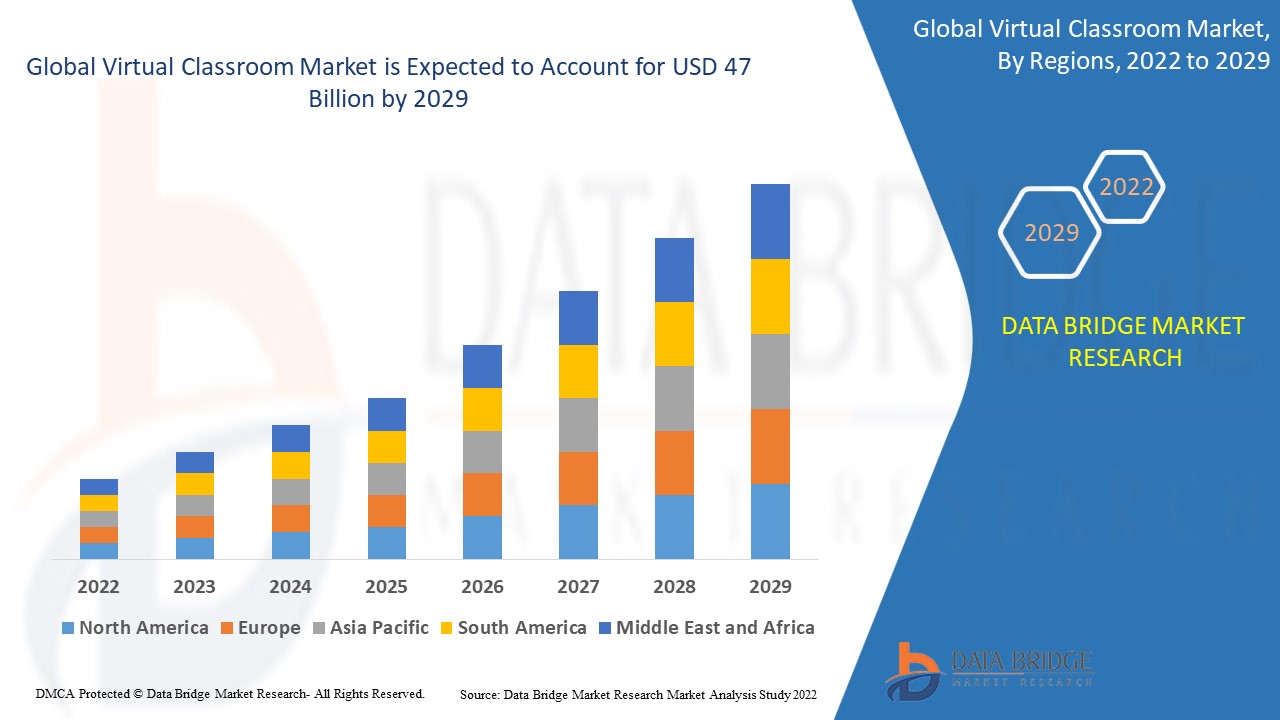
Virtual Classroom Market Analysis
Google recently stated that it would be enhancing its made-for-learning products and modernizing its virtual classroom capabilities in an effort to make it easier for students and teachers to transition to online learning. Additionally, as part of its "Digital Academy Initiative," Samsung collaborated with IIT Jodhpur to establish an AR-VR Innovation Lab on campus in December 2020. Students might receive training in the lab on cutting-edge technologies like virtual reality and augmented reality, which would help them master practical skills.
Virtual Classroom Market Size
Global virtual classroom market size was valued at USD 22.85 billion in 2024 and is projected to reach USD 72.46 billion by 2032, with a CAGR of 15.52% during the forecast period of 2025 to 2032.
Report Scope and Market Segmentation
|
Attributes |
Virtual Classroom Key Market Insights |
|
Segmentation |
|
|
Countries Covered |
U.S., Canada and Mexico in North America, Brazil, Argentina and Rest of South America as part of South America, Germany, Italy, U.K., France, Spain, Netherlands, Belgium, Switzerland, Turkey, Russia, Rest of Europe in Europe, Japan, China, India, South Korea, Australia, Singapore, Malaysia, Thailand, Indonesia, Philippines, Rest of Asia-Pacific (APAC) in the Asia-Pacific (APAC), Saudi Arabia, U.A.E, South Africa, Egypt, Israel, Rest of Middle East and Africa (MEA) as a part of Middle East and Africa (MEA) |
|
Key Market Players |
Robert Bosch GmbH (Germany), Hanwha Techwin Co., Ltd. (South Korea), Honeywell International Inc. (U.S.), IBM (U.S.), Axis Communications AB (Sweden), Johnson Controls (Ireland), Hangzhou Hikvision Digital Technology Co., Ltd. (China), NetApp (U.S.), Dahua Technology USA Inc. (China), KEDACOM (China), Verint Systems Inc. (U.S.), Mindtree Ltd. (India), AxxonSoft. (U.S.), Sony Coporation (Japan), Avigilon Corporation (Canada), Panasonic Corporation (Japan), Panopto (U.S.), Backstreet Surveillance (U.S.), SAMSUNG (U.S.), Arcules, Inc. (U.S.) |
|
Market Opportunities |
|
Virtual Classroom Market Definition
In a virtual classroom, teachers and students have access to an online learning environment where they can communicate. They can see and discuss any presentations here and do web-based Voice over IP, live streaming, and video conferencing. Multiple users can connect to each other simultaneously and remotely in this classroom.
Virtual Classroom Market Dynamics
This section deals with understanding the market drivers, advantages, opportunities, restraints and challenges. All of this is discussed in detail as below:
Drivers
- Adoption of advanced technologies
According to 2020 data from a national survey, 90% of instructors concur that using AR/VR technology to create tailored and differentiating experiences for students is a viable strategy. The market prognosis for virtual classrooms is also projected to change as a result of the increasing use of AR and VR technology in corporate learning and development. This will bolster the market growth rate.
- Opportunities presented by APAC region
The Asia-Pacific region is anticipated to hold a bigger market share for virtual classrooms. This is due to the fact that roughly half of all internet users worldwide, many of whom use smartphones exclusively, reside on the continent. The demand for e-learning has significantly increased ever since the number of COVID-19 cases increased in Asian economies. In fact, due to the growing demand for virtual classrooms throughout several states, including some rural areas, India is poised to experience tremendous growth in the virtual classroom business as a whole.
Furthermore, the factors such as rising urbanization, industrialization and mounting awareness regarding the importance of education in the backward regions are some other important market drivers. Additionally, growing support by the government on the promotion of the technology and solutions and increasing per capita income are anticipated to drive the growth rate of the market.
Opportunities
- Growth and expansion
Growth and expansion of education industry especially in the developing economies will present very many opportunities for the growth of the market. Additionally, the increasing trend of digitalization further offers numerous growth opportunities within the market. Rising number of end users on daily basis, both at large and small scale and complete digitization of operations will also work in favor of the market.
Restraints/Challenges
- Risk related concerns and issues
Due to the widespread adoption of virtual classrooms in educational institutions, there is an increasing risk of cyberattacks and Zoom bombers, which highlights the requirement for virtual classroom security measures. The year 2020 was designated as a "record-breaking" year for cyberattacks against public schools in the nation, according to an official report provided by a public data resource in the US, K-12 Cybersecurity Resource Center. This will impede the market growth rate.
- Lack of technical expertise
Dearth of expert knowledge and technical expertise and lack of awareness especially in the underdeveloped economies will create hurdles for the market in regards to the smooth growth in the market value. Additionally, dearth of technologically advanced infrastructure in the underdeveloped territories will further derail the market growth rate.
This virtual classroom market report provides details of new recent developments, trade regulations, import-export analysis, production analysis, value chain optimization, market share, impact of domestic and localized market players, analyses opportunities in terms of emerging revenue pockets, changes in market regulations, strategic market growth analysis, market size, category market growths, application niches and dominance, product approvals, product launches, geographic expansions, technological innovations in the market. To gain more info on the virtual classroom market contact Data Bridge Market Research for an Analyst Brief, our team will help you take an informed market decision to achieve market growth.
COVID-19 Impact on Virtual Classroom Market
The COVID-19 epidemic has resulted in lockdowns, physical separations, and isolations of individuals. Representatives of several organizations have begun telecommuting and working remotely as a result of these activities. This has increased interest in online education, web-based training, and electronic correspondence. Businesses that did not use e-learning prior to the epidemic are now launching a new online training program for their employees. Organizations who have successfully used eLearning and prepared are presently developing and testing new processes and techniques for the web.
Virtual Classroom Market Scope
The virtual classroom market is segmented on the basis of user type, component and deployment mode. The growth amongst these segments will help you analyze meagre growth segments in the industries and provide the users with a valuable market overview and market insights to help them make strategic decisions for identifying core market applications.
User Type
- Academic Institutions
- Corporates
Component
- Solutions
- Content Management
- Device Management
- Unified Communications and Collaboration
- Security
- Analytics and Data Visualization
- Hardware
- Interactive Whiteboards
- Mobile Computing Devices
- Virtual Reality Devices
- Interactive Displays and Projectors
- Security and Video Cameras
- Others
- Services
- Professional Services
- Training and Consulting
- Deployment and Integration
- Support and Maintenance
- Managed Services
Deployment
- Cloud
- On-premises
Virtual Classroom Market Regional Analysis
The virtual classroom market is analyzed and market size insights and trends are provided by country, user type, component and deployment mode as referenced above.
The countries covered in the virtual classroom market report are U.S., Canada and Mexico in North America, Brazil, Argentina and Rest of South America as part of South America, Germany, Italy, U.K., France, Spain, Netherlands, Belgium, Switzerland, Turkey, Russia, Rest of Europe in Europe, Japan, China, India, South Korea, Australia, Singapore, Malaysia, Thailand, Indonesia, Philippines, Rest of Asia-Pacific (APAC) in the Asia-Pacific (APAC), Saudi Arabia, U.A.E, South Africa, Egypt, Israel, Rest of Middle East and Africa (MEA) as a part of Middle East and Africa (MEA).
North America is flourishing its dominance in the global virtual classroom market due to factors the ageing infrastructure, and growing adoption and deployment of cutting-edge IP-based surveillance and monitoring systems. Additionally, presence of major players in this region is also bolstering the growth of the market.
Over the forecast period, Asia-Pacific is anticipated to have the greatest CAGR. The growth of the region is attributed to the increasing adoption of cloud-based VMS in APAC nations. In order to encourage economic growth, many nations, notably China, India, and others, are increasing their investments in infrastructure.
The country section of the report also provides individual market impacting factors and changes in regulation in the market domestically that impacts the current and future trends of the market. Data points like down-stream and upstream value chain analysis, technical trends and porter's five forces analysis, case studies are some of the pointers used to forecast the market scenario for individual countries. Also, the presence and availability of global brands and their challenges faced due to large or scarce competition from local and domestic brands, impact of domestic tariffs and trade routes are considered while providing forecast analysis of the country data.
Virtual Classroom Market Share
The virtual classroom market competitive landscape provides details by competitor. Details included are company overview, company financials, revenue generated, market potential, investment in research and development, new market initiatives, global presence, production sites and facilities, production capacities, company strengths and weaknesses, product launch, product width and breadth, application dominance. The above data points provided are only related to the companies' focus related to virtual classroom market.
Virtual Classroom Market Leaders Operating in the Market Are:
- Robert Bosch GmbH (Germany)
- Hanwha Techwin Co., Ltd. (South Korea)
- Honeywell International Inc. (U.S.)
- IBM (U.S.)
- Axis Communications AB (Sweden)
- Johnson Controls (Ireland)
- Hangzhou Hikvision Digital Technology Co., Ltd. (China)
- NetApp (U.S.)
- Dahua Technology USA Inc. (China)
- KEDACOM (China)
- Verint Systems Inc. (U.S.)
- Mindtree Ltd. (India)
- AxxonSoft. (U.S.)
- Sony Corporation (Japan)
- Avigilon Corporation (Canada)
- Panasonic Corporation (Japan)
- Panopto (U.S.)
- Backstreet Surveillance (U.S.)
- SAMSUNG (South Korea)
- Arcules, Inc. (U.S.)
SKU-
Obtenha acesso online ao relatório sobre a primeira nuvem de inteligência de mercado do mundo

- Painel interativo de análise de dados
- Painel de análise da empresa para oportunidades de elevado potencial de crescimento
- Acesso de analista de pesquisa para personalização e customização. consultas
- Análise da concorrência com painel interativo
- Últimas notícias, atualizações e atualizações Análise de tendências
- Aproveite o poder da análise de benchmark para um rastreio abrangente da concorrência
Metodologia de Investigação
A recolha de dados e a análise do ano base são feitas através de módulos de recolha de dados com amostras grandes. A etapa inclui a obtenção de informações de mercado ou dados relacionados através de diversas fontes e estratégias. Inclui examinar e planear antecipadamente todos os dados adquiridos no passado. Da mesma forma, envolve o exame de inconsistências de informação observadas em diferentes fontes de informação. Os dados de mercado são analisados e estimados utilizando modelos estatísticos e coerentes de mercado. Além disso, a análise da quota de mercado e a análise das principais tendências são os principais fatores de sucesso no relatório de mercado. Para saber mais, solicite uma chamada de analista ou abra a sua consulta.
A principal metodologia de investigação utilizada pela equipa de investigação do DBMR é a triangulação de dados que envolve a mineração de dados, a análise do impacto das variáveis de dados no mercado e a validação primária (especialista do setor). Os modelos de dados incluem grelha de posicionamento de fornecedores, análise da linha de tempo do mercado, visão geral e guia de mercado, grelha de posicionamento da empresa, análise de patentes, análise de preços, análise da quota de mercado da empresa, normas de medição, análise global versus regional e de participação dos fornecedores. Para saber mais sobre a metodologia de investigação, faça uma consulta para falar com os nossos especialistas do setor.
Personalização disponível
A Data Bridge Market Research é líder em investigação formativa avançada. Orgulhamo-nos de servir os nossos clientes novos e existentes com dados e análises que correspondem e atendem aos seus objetivos. O relatório pode ser personalizado para incluir análise de tendências de preços de marcas-alvo, compreensão do mercado para países adicionais (solicite a lista de países), dados de resultados de ensaios clínicos, revisão de literatura, mercado remodelado e análise de base de produtos . A análise de mercado dos concorrentes-alvo pode ser analisada desde análises baseadas em tecnologia até estratégias de carteira de mercado. Podemos adicionar quantos concorrentes necessitar de dados no formato e estilo de dados que procura. A nossa equipa de analistas também pode fornecer dados em tabelas dinâmicas de ficheiros Excel em bruto (livro de factos) ou pode ajudá-lo a criar apresentações a partir dos conjuntos de dados disponíveis no relatório.











