



Middle East and Africa Domestic Booster Pump Market Segmentation, By Product (Single Stage and Multiple Stage), Material (Cast Iron, Stainless Steel, Gunmetal, Aluminium, Copper, Titanium, and Others), Distribution Channel (B2B/Direct Sales, Third Party Distributors, Brand Websites, E-Commerce, and Others), End User (Residential Homes/Flats, Sea Farm Houses/Cottages/Guest Houses, and Others) - Industry Trends and Forecast to 2033
What is the Middle East and Africa Domestic Booster Pump Market Size and Growth Rate?
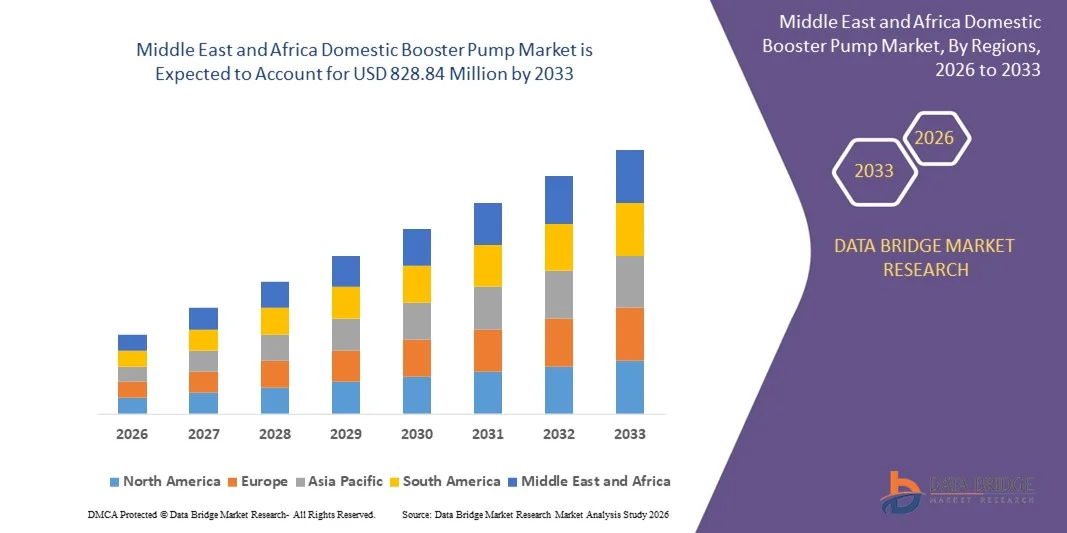
- The Middle East and Africa domestic booster pump market size was valued at USD 451.13 million in 2025 and is expected to reach USD 828.84 million by 2033, at a CAGR of 7.90% during the forecast period
- Increase in the world population is leading to the rise in requirement of water due to which the demand for domestic booster pump market is increasing with significant CAGR. High cost of installation of booster pumps is acting as major restraint for the domestic booster pump market growth
What are the Major Takeaways of Domestic Booster Pump Market?
- Increasing technological advancements in domestic booster pumps is acting as major window of opportunity for the domestic booster pump market
- Technical complexities involved with domestic booster pumps acts as a major challenge for the growth of domestic booster pump market
- Saudi Arabia dominated the Middle East and Africa domestic booster pump market with a revenue share of 44.87% in 2025, driven by strong residential construction, rapid urban infrastructure expansion, and the rising installation of domestic pressure-boosting systems across villas, apartment complexes, and multi-storey residential buildings
- South Africa is projected to register fastest growth of 11.36% from 2026 to 2033, supported by rising residential construction, modernization of aging water supply networks, and increasing installation of booster pumps across suburban homes and multi-unit housing complexes
- The Single Stage segment dominated the market with an estimated 58.4% share in 2025, supported by widespread residential usage, compact design, cost-effectiveness, and ease of installation
Report Scope and Domestic Booster Pump Market Segmentation
|
Attributes |
Domestic Booster Pump Key Market Insights |
|
Segments Covered |
|
|
Countries Covered |
Middle East and Africa
|
|
Key Market Players |
|
|
Market Opportunities |
|
|
Value Added Data Infosets |
In addition to the insights on market scenarios such as market value, growth rate, segmentation, geographical coverage, and major players, the market reports curated by the Data Bridge Market Research also include in-depth expert analysis, pricing analysis, brand share analysis, consumer survey, demography analysis, supply chain analysis, value chain analysis, raw material/consumables overview, vendor selection criteria, PESTLE Analysis, Porter Analysis, and regulatory framework. |
What is the Key Trend in the Domestic Booster Pump Market?
Growing Adoption of Energy-Efficient, Smart, and Sustainable Water Pumping Solutions
- The domestic booster pump market is experiencing a strong shift toward energy-efficient designs, low-noise performance, and intelligent water-pressure management technologies, driven by rising urbanization, smart-home adoption, and stricter energy-saving regulations
- Manufacturers are integrating variable frequency drives (VFDs), smart sensors, and IoT-enabled monitoring systems to optimize pressure control, reduce power consumption, and extend pump lifespan
- Digitalization is accelerating the use of remote diagnostics, predictive maintenance, and automated pressure optimization, improving operational efficiency in residential water supply systems
- For instance, leading brands such as Grundfos, WILO SE, Xylem, Pentair, and KSB are introducing AI-enabled booster pumps with real-time monitoring, cloud connectivity, and self-adjusting pressure capabilities
- Growing emphasis on water conservation, green-building standards, and eco-friendly home infrastructure is strengthening demand across the U.S., Europe, and Middle East and Africa
- As households increasingly prioritize efficient water pressure, reduced energy bills, and digital convenience, domestic booster pumps will remain essential to modern residential water management systems worldwide
What are the Key Drivers of Domestic Booster Pump Market?
- Rising demand for consistent household water pressure, especially in multi-storey buildings, gated communities, and urban housing, is accelerating adoption of domestic booster pumps across residential applications
- For instance, in 2025, companies such as Grundfos, Franklin Electric, and Pentair expanded production of energy-efficient VFD-based booster systems to meet increasing demand from high-density housing clusters
- Growing enforcement of energy-efficiency standards, water-usage regulations, and green-building norms across the U.S., Europe, and Middle East and Africa is fueling upgrades from conventional pumps to smart, efficient booster systems
- Advancements in brushless DC motors, automated pressure control, compact pump designs, and durable corrosion-resistant materials have enhanced performance, reliability, and operational efficiency
- Rising focus on water scarcity management, low-energy residential infrastructure, and improved home comfort is further strengthening market adoption
- Supported by rapid urban development, expansion of smart-home ecosystems, and increasing renovation of aging water supply systems, the domestic booster pump market is expected to witness strong and sustained growth
Which Factor is Challenging the Growth of the Domestic Booster Pump Market?
- High certification costs, extensive testing procedures, and complex compliance requirements often burden small manufacturers and emerging construction firms
- For instance, between 2024–2025, rising costs of raw materials, testing equipment, and specialized labor resulted in longer certification timelines for many companies
- Strict regulatory standards related to fire resistance, chemical emissions, structural integrity, and environmental performance add challenges for global market entrants
- Limited technical expertise and low awareness in developing economies restrict certification adoption among small and mid-sized construction material producers
- Competition from uncertified, low-cost, and counterfeit construction products creates pricing pressure and affects market differentiation
- To overcome these challenges, companies are focusing on digital certification tools, standardized global testing frameworks, cost-efficient processes, and awareness programs to expand certification accessibility worldwide
How is the Domestic Booster Pump Market Segmented?
The market is segmented on the basis of product, material, distribution channel, and end-user.
- By Product
The domestic booster pump market is segmented into Single Stage and Multiple Stage pumps. The Single Stage segment dominated the market with an estimated 58.4% share in 2025, supported by widespread residential usage, compact design, cost-effectiveness, and ease of installation. These pumps are highly preferred in apartments, villas, and small commercial buildings due to their simple operating mechanism and reliable performance in maintaining consistent household water pressure. Their lower maintenance needs and compatibility with standard plumbing systems further strengthen adoption across both developing and mature markets.
The Multiple Stage segment is projected to grow at the fastest CAGR from 2026 to 2033, driven by rising demand for high-pressure systems in multi-storey buildings, luxury homes, and water-intensive applications. Increasing adoption of smart multi-stage pumps featuring VFDs, energy-efficient motors, and IoT-based pressure monitoring enables precise pressure control and enhanced pumping efficiency. Growing urbanization and expansion of high-rise residential infrastructure will continue to accelerate segment growth.
- By Material
The domestic booster pump market is segmented into Cast Iron, Stainless Steel, Gunmetal, Aluminium, Copper, Titanium, and Others. The Cast Iron segment dominated the market with approximately 42.1% share in 2025, owing to its durability, corrosion resistance, high structural strength, and competitive pricing. Cast-iron booster pumps are widely used in residential buildings due to their long life, ability to handle moderate impurities, and suitability for medium-pressure applications. Their affordability makes them the preferred choice in price-sensitive markets across Middle East and Africa, the Middle East, and Latin America.
The Stainless Steel segment is projected to grow at the fastest CAGR from 2026 to 2033, driven by consumer preference for hygienic, corrosion-free, and premium-grade materials suitable for drinking-water applications. Increasing adoption of stainless-steel pumps in modern homes, villas, coastal regions, and smart water systems—combined with demand for lightweight and energy-efficient materials—continues to enhance market penetration.
- By Distribution Channel
The domestic booster pump market is segmented into B2B/Direct Sales, Third-Party Distributors, Brand Websites, E-Commerce, and Others. The B2B/Direct Sales segment dominated the market with an estimated 49.6% share in 2025, driven by strong partnerships with builders, plumbing contractors, commercial installers, and facility managers. Direct sales channels ensure faster product delivery, bulk purchasing advantages, customized solutions, and reliable after-sales support, making them the preferred route for large residential projects and institutional buyers.
The E-Commerce channel is expected to grow at the fastest CAGR from 2026 to 2033, supported by rising digital adoption, transparent pricing, doorstep delivery, easy comparison of pump specifications, and growing trust in online platforms. Increasing sales from marketplaces such as Amazon, Flipkart, and brand-owned online stores are driving rapid penetration among homeowners seeking convenient, self-service purchasing options. Improved online product information, reviews, and installation support videos further strengthen e-commerce growth.
- By End User
The domestic booster pump market is segmented into Residential Homes/Flats, Sea Farm Houses/Cottages/Guest Houses, and Others. The Residential Homes/Flats segment dominated the market with an estimated 67.8% share in 2025, supported by rising urbanization, growing multi-storey housing construction, and increasing consumer demand for consistent water pressure in bathrooms, kitchens, and household appliances. Booster pumps are widely used in apartments, gated societies, and standalone homes to ensure reliable water flow from overhead tanks, municipal supply lines, and storage units.
The Sea Farm Houses/Cottages/Guest Houses segment is projected to grow at the fastest CAGR from 2026 to 2033, driven by increasing development of vacation properties, farm stays, and premium hospitality units in coastal and semi-urban regions. Higher water-pressure requirements, use of multiple fixtures, and demand for efficient pumps resistant to corrosion and saline water exposure are supporting rapid adoption. Growth in tourism, holiday rentals, and remote living trends further accelerates segment expansion.
Which Region Holds the Largest Share of the Domestic Booster Pump Market?
- Saudi Arabia dominated the Middle East and Africa domestic booster pump market with a revenue share of 44.87% in 2025, driven by strong residential construction, rapid urban infrastructure expansion, and the rising installation of domestic pressure-boosting systems across villas, apartment complexes, and multi-storey residential buildings. Increasing demand for consistent water pressure—especially in densely populated urban centers—combined with growing adoption of energy-efficient and smart pump technologies, supports widespread deployment across the Kingdom. Large-scale housing development programs, renovation activities, and government-led water network upgrades continue to accelerate the installation of domestic booster pumps across major Saudi cities
- Domestic and regional pump manufacturers in Saudi Arabia are increasingly focusing on smart booster pumps, corrosion-resistant materials, variable-speed motors, and IoT-enabled pressure monitoring solutions to meet modern residential water supply requirements. Strong government emphasis on urban modernization, water efficiency, and advanced plumbing systems further reinforces Saudi Arabia’s leadership in the regional market
- Rising adoption of automated household water supply systems, rapid residential expansion, and continuous product innovation by local and global pump brands further strengthen Saudi Arabia’s dominance across the Middle East and Africa region
United Arab Emirates Domestic Booster Pump Market Insight
The U.A.E. demonstrates steady market growth driven by high-rise residential development, premium housing demand, and widespread integration of advanced water-pressure management systems across apartments, townhouses, and luxury villas. Strong preference for smart, energy-efficient, and low-noise pumps—particularly in modern residential communities—continues to fuel adoption. Increasing government focus on sustainable water systems and green building standards further strengthens market momentum across the Emirates.
South Africa Domestic Booster Pump Market Insight
South Africa is projected to register fastest growth of 11.36% from 2026 to 2033, supported by rising residential construction, modernization of aging water supply networks, and increasing installation of booster pumps across suburban homes and multi-unit housing complexes. Growing awareness of maintaining consistent water pressure—especially in areas with fluctuating municipal supply—continues to fuel household adoption. Expanding demand for energy-efficient pumps, durable motor systems, and automated pressure control solutions further accelerates market penetration across South African residential segments.
Which are the Top Companies in Domestic Booster Pump Market?
The domestic booster pump industry is primarily led by well-established companies, including:
- Grundfos Holding A/S (Denmark)
- Xylem Inc. (U.S.)
- KSB SE & Co. KGaA (Germany)
- Pentair plc (U.S.)
- ABB Ltd. (Sweden)
- DAB Pumps Spa (Italy)
- Franklin Electric (U.S.)
- Alfred Kärcher SE & Co. KG (Germany)
- WILO SE (Germany)
- Davey Water Products (Australia)
- EDDY Pump (U.S.)
- Eaton (U.S.)
- CNP India Private Limited (India)
- Torontech Inc. (Canada)
- Injung Tech Co., Ltd (South Korea)
What are the Recent Developments in Global Domestic Booster Pump Market?
- In January 2025, Grundfos introduced a new solar-enabled booster pump series that lowers energy consumption by 35% and is designed for off-grid households in emerging economies, aligning with the rising global focus on sustainability. This development is expected to strengthen the company’s position in renewable-compatible pumping solutions
- In October 2024, Xylem Inc. broadened its domestic pump portfolio with AI-powered pressure optimization features to improve reliability for multi-family residences after successful trials in the U.S., supporting the growing adoption of intelligent home water systems. This advancement is such asly to accelerate Xylem’s footprint in smart, automated pumping technologies
- In March 2024, Pentair Plc. acquired a strategic supplier to enhance its variable speed pump capabilities, aiming to secure an additional 10% market share in energy-efficient residential water applications, driven by rising consumer preference for sustainable technologies. This move is set to reinforce Pentair’s competitiveness in the high-efficiency pump segment
SKU-
Obtenha acesso online ao relatório sobre a primeira nuvem de inteligência de mercado do mundo

- Painel interativo de análise de dados
- Painel de análise da empresa para oportunidades de elevado potencial de crescimento
- Acesso de analista de pesquisa para personalização e customização. consultas
- Análise da concorrência com painel interativo
- Últimas notícias, atualizações e atualizações Análise de tendências
- Aproveite o poder da análise de benchmark para um rastreio abrangente da concorrência
Metodologia de Investigação
A recolha de dados e a análise do ano base são feitas através de módulos de recolha de dados com amostras grandes. A etapa inclui a obtenção de informações de mercado ou dados relacionados através de diversas fontes e estratégias. Inclui examinar e planear antecipadamente todos os dados adquiridos no passado. Da mesma forma, envolve o exame de inconsistências de informação observadas em diferentes fontes de informação. Os dados de mercado são analisados e estimados utilizando modelos estatísticos e coerentes de mercado. Além disso, a análise da quota de mercado e a análise das principais tendências são os principais fatores de sucesso no relatório de mercado. Para saber mais, solicite uma chamada de analista ou abra a sua consulta.
A principal metodologia de investigação utilizada pela equipa de investigação do DBMR é a triangulação de dados que envolve a mineração de dados, a análise do impacto das variáveis de dados no mercado e a validação primária (especialista do setor). Os modelos de dados incluem grelha de posicionamento de fornecedores, análise da linha de tempo do mercado, visão geral e guia de mercado, grelha de posicionamento da empresa, análise de patentes, análise de preços, análise da quota de mercado da empresa, normas de medição, análise global versus regional e de participação dos fornecedores. Para saber mais sobre a metodologia de investigação, faça uma consulta para falar com os nossos especialistas do setor.
Personalização disponível
A Data Bridge Market Research é líder em investigação formativa avançada. Orgulhamo-nos de servir os nossos clientes novos e existentes com dados e análises que correspondem e atendem aos seus objetivos. O relatório pode ser personalizado para incluir análise de tendências de preços de marcas-alvo, compreensão do mercado para países adicionais (solicite a lista de países), dados de resultados de ensaios clínicos, revisão de literatura, mercado remodelado e análise de base de produtos . A análise de mercado dos concorrentes-alvo pode ser analisada desde análises baseadas em tecnologia até estratégias de carteira de mercado. Podemos adicionar quantos concorrentes necessitar de dados no formato e estilo de dados que procura. A nossa equipa de analistas também pode fornecer dados em tabelas dinâmicas de ficheiros Excel em bruto (livro de factos) ou pode ajudá-lo a criar apresentações a partir dos conjuntos de dados disponíveis no relatório.











