



North America Predictive Maintenance Market, By Components (Solution, Services), Deployment Mode (Cloud, On-Premise), Organisation Size (Large Enterprises, Small and Medium-Sized Enterprises), Vertical (Manufacturing, Energy and Utilities, Transportation, Government, Healthcare, Aerospace, and Defense, Others), Stakeholder (MRO, OEM/ODM, Technology Integrators) – Industry Trends and Forecast to 2030.
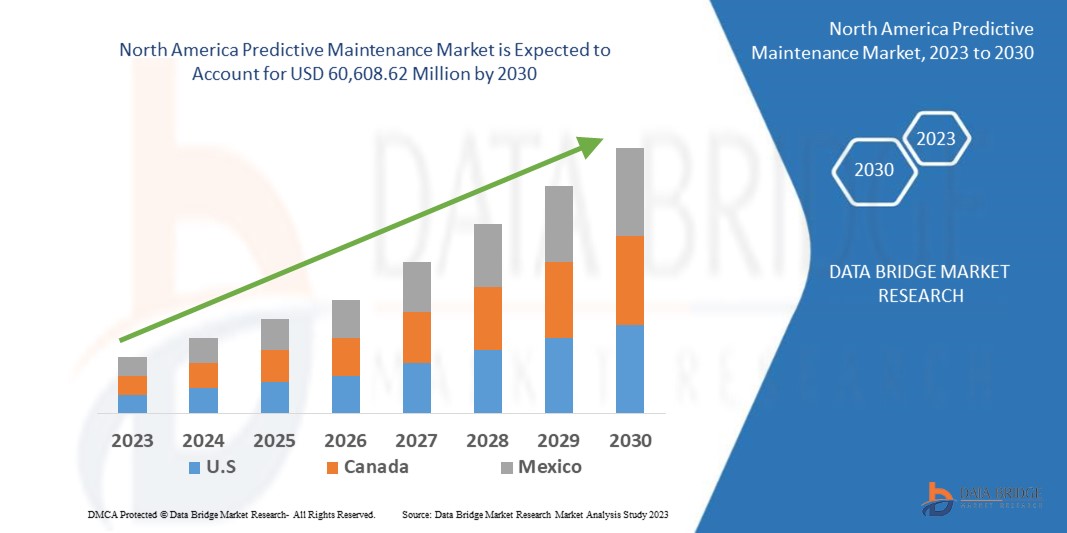
North America Predictive Maintenance Market Analysis and Size
Technology plays a vital role in product development; the advancement in predictive maintenance systems is opening massive opportunities for the market to analyze the performance and condition of any machine or instrumentation. Also, the increasing uptime, reduced maintenance cost, spare part inventory, and unexpected failures have led the market to flourish simultaneously. Furthermore, the decreasing repair and overhaul time is the major factor for the predictive maintenance market growth.
Data Bridge Market Research analyses that the predictive maintenance market is expected to reach USD 60,608.62 million by 2030, which was USD 3,923.85 million in 2022, at a CAGR of 40.80% during the forecast period. In addition to the market insights such as market value, growth rate, market segments, geographical coverage, market players, and market scenario, the market report curated by the Data Bridge Market Research team includes in-depth expert analysis, import/export analysis, pricing analysis, production consumption analysis, and pestle analysis.
North America Predictive Maintenance Market Scope and Segmentation
|
Report Metric |
Details |
|
Forecast Period |
2023 to 2030 |
|
Base Year |
2022 |
|
Historic Years |
2021 (Customizable to 2015 - 2020) |
|
Quantitative Units |
Revenue in USD Million, Volumes in Units, Pricing in USD |
|
Segments Covered |
Component (Hardware, Software, Services), Hypervisor Type (VMware, Kernel-based Virtual Machine (KVM), and Hyper-V), Organization Size (Medium and Small Sized Enterprises and Large Enterprises), Application (Virtualizing Critical Applications, Data Centre Consolidation, Data Protection, Cloud Computing, Virtual Desktop Infrastructure (VDI), Remote Office Branch Office (ROBO)), Deployment Mode (Private Cloud, Public Cloud, and Hybrid Cloud), End User (Banking, Financial Services, and Insurance (BFSI), IT and Telecom, Government, Healthcare and Life Science, Retail, Power and Energy, Manufacturing, Oil and Gas, Mining, Education, Transportation and Logistics and Media and Entertainment) |
|
Countries Covered |
U.S., Canada and Mexico in North America |
|
Market Players Covered |
Microsoft (U.S.), IBM (U.S.), SAP (Germany), SAS Institute Inc. (U.S.), Software AG (Germany), Cloud Software Group, Inc. (U.S.), Hewlett Packard Enterprise Development LP (U.S.), Altair Engineering Inc. (U.S.), Splunk Inc. (U.S.), Oracle (U.S.), Google (U.S.), Amazon Web Services, Inc. (U.S.), General Electric (U.S.), Schneider Electric (France), Hitachi, Ltd. (Japan), PTC (U.S.), RapidMiner (U.S), Operational Excellence (OPEX) Group Ltd, (U.K.), DINGO Software Pty. Ltd. (Australia), CHIRON Swiss SA (Russia) |
|
Market Opportunities |
|
Market Definition
A predictive maintenance software system is used to analyze the performance and condition of any machine or instrumentation whereas operational them. This software system observes the instrumentation victimization advanced procedures that allow the upkeep of the machinery to be even before any failure happens. The predictive maintenance software system has found its application in various fields, such as distinctive motor electrical phenomenon spikes, finding three-phase power imbalances from harmonic distortion, and heating from dangerous bearings.
North America Predictive Maintenance Market
Drivers
- Growing demand to reduce equipment failure, maintenance costs, and downtime
The increasing demand to decrease equipment failure, maintenance costs, and downtime considerably contributes to the predictive maintenance market growth. Equipment downtime is when specific equipment is not in operation because of unplanned equipment failure. Unplanned downtime and regular equipment failure of large equipment hinder business operations because of the temporary halt of production activities, financial penalties, idle staff time, and others. Hence, increasing demand to reduce equipment failure, maintenance costs, and downtime will likely increase demand for predictive maintenance in the forecast period.
- Increasing the number of industries globally to meet demand and supply
A growing number of medium and small-scale enterprises in the North American region globe is one of the major factors fostering the growth of the predictive maintenance market. In other words, the increased number of government and public sector, banking, financial services, and insurance (BFSI), healthcare and life sciences, retail and e-commerce, telecommunication, manufacturing, and IT industries directly influences the growth rate of the predictive maintenance market.
Opportunities
- Growing adoption of advanced technology
The adoption of advanced technology is a major trend that is gaining popularity in the market. Major companies operating in the predictive maintenance market are concentrated on offering technologically advanced predictive maintenance solutions to strengthen their market position. These companies employ next-generation technologies in their services, such as IoT, artificial intelligence, machine learning, cloud computing, thermography, and others, to match the market demand for better maintenance. The predictive maintenance solution uses artificial intelligence (AI) and machine learning algorithms to support the move towards zero-fault, zero-touch networks by proactively predicting and preventing incidents in the network.
- Increasing demand for predictive maintenance in the healthcare sector
The increasing demand for predictive maintenance in the healthcare sector during the forecast period will create lucrative opportunities for market growth. The predictive maintenance of biomedical devices such as x- ventilators, MR, tomography, and mammography is one of the major concerns in the rise of decision-making capabilities in hospitals. For instance, Accruent, a Texas-based services provider, provides predictive maintenance market solutions for healthcare machinery such as MRI machines and ventilators with their asset management solution. Furthermore, Accruent is responsible for offering healthcare asset management solutions to above 55 percent of hospitals in the U.S.
Restraints
- High requirement for regular maintenance and upgradation to keep the systems updated
Enterprises are adopting AI-based IoT results for the improved client experience. The merchandisers in the request must develop advanced conservation systems considering two important factors: updates and videlicet conservation. AI-based IoT systems must be maintained and streamlined according to changing business conditions to apply technological advancements. The software also needs to be improved as new factors are added. Hence, maintaining and upgrading AI-based IoT systems will be challenging for companies that provide results without interruption, which hampers the market growth.
- Inadequately skilled workforce
Trained workers are required to handle rearmost software systems to employ AI-based IoT skillsets. Hence, workers are required to be trained in operating upgraded systems. Moreover, diligence is dynamic toward adopting new technologies; they still face insufficient, largely professed workers.
This predictive maintenance market report provides details of new recent developments, trade regulations, import-export analysis, production analysis, value chain optimization, market share, impact of domestic and localized market players, analyses opportunities in terms of emerging revenue pockets, changes in market regulations, strategic market growth analysis, market size, category market growths, application niches and dominance, product approvals, product launches, geographic expansions, technological innovations in the market. To gain more info on the predictive maintenance market contact Data Bridge Market Research for an Analyst Brief, our team will help you take an informed market decision to achieve market growth.
Recent Developments
- In 2022, Siemens, a Germany-based technology company focused on transport, healthcare, industry, and infrastructure, acquired Senseye for an undisclosed amount. With this acquisition, Senseye became a subsidiary of Siemens and is expected to strengthen its position in the digital services portfolio.
North America Predictive Maintenance Market Scope
The predictive maintenance market is segmented on the basis of components, deployment mode, organisation size, vertical and stakeholder. The growth amongst these segments will help you analyze meagre growth segments in the industries and provide the users with a valuable market overview and market insights to help them make strategic decisions for identifying core market applications.
Component
- Solutions
- Integrated
- Standalone
- Service
- Managed Services
- Professional Services
- System Integration
- Support and Maintenance
- Consulting
System Integration
- Support and Maintenance
- Consulting
Deployment Mode
- On-premises
- Cloud
- Public Cloud
- Private Cloud
- Hybrid Cloud
Organization Size
- Large Enterprises
- Small and Medium-sized Enterprises (SMEs)
Vertical
- Government and Defense
- Manufacturing
- Energy and Utilities
- Transportation and Logistics
- Healthcare and Life Sciences
Stakeholder
- MRO
- OEM/ODM
- Technology Integrators
Predictive Maintenance Market Regional Analysis/Insights
The predictive maintenance market is analyzed and market size insights and trends are provided by country, components, deployment mode, organisation size, vertical and stakeholder as referenced above.
The countries covered in the predictive maintenance market report are U.S., Canada and Mexico in North America,
The U.S. dominates the predictive maintenance market because of growing investments in emerging technologies such as machine learning, IoT, and artificial intelligence, which enhances this region's solution and service segments. Furthermore, the rising adoption of predictive maintenance by the banking and IT & telecom industries will further grow this region's market.
The country section of the report also provides individual market impacting factors and changes in market regulation that impact the current and future trends of the market. Data points like down-stream and upstream value chain analysis, technical trends and porter's five forces analysis, case studies are some of the pointers used to forecast the market scenario for individual countries. Also, the presence and availability of Global brands and their challenges faced due to large or scarce competition from local and domestic brands, impact of domestic tariffs and trade routes are considered while providing forecast analysis of the country data.
Competitive Landscape and Predictive Maintenance Market Share Analysis
The predictive maintenance market competitive landscape provides details by competitor. Details included are company overview, company financials, revenue generated, market potential, investment in research and development, new market initiatives, Global presence, production sites and facilities, production capacities, company strengths and weaknesses, product launch, product width and breadth, application dominance. The above data points provided are only related to the companies' focus related to predictive maintenance market.
Some of the major players operating in the predictive maintenance market are:
- Microsoft (U.S.)
- IBM (U.S.)
- SAP (Germany)
- SAS Institute Inc. (U.S.)
- Software AG (Germany)
- Cloud Software Group, Inc. (U.S.)
- Hewlett Packard Enterprise Development LP (U.S.)
- Altair Engineering Inc. (U.S.)
- Splunk Inc. (U.S.)
- Oracle (U.S.)
- Google (U.S.)
- Amazon Web Services, Inc. (U.S.)
- General Electric (U.S.)
- Schneider Electric (France)
- Hitachi, Ltd. (Japan)
- PTC (U.S.)
- RapidMiner (U.S)
- Operational Excellence (OPEX) Group Ltd, (U.K.)
- DINGO Software Pty. Ltd. (Australia)
- CHIRON Swiss SA (Russia)
SKU-
Obtenha acesso online ao relatório sobre a primeira nuvem de inteligência de mercado do mundo

- Painel interativo de análise de dados
- Painel de análise da empresa para oportunidades de elevado potencial de crescimento
- Acesso de analista de pesquisa para personalização e customização. consultas
- Análise da concorrência com painel interativo
- Últimas notícias, atualizações e atualizações Análise de tendências
- Aproveite o poder da análise de benchmark para um rastreio abrangente da concorrência
Metodologia de Investigação
A recolha de dados e a análise do ano base são feitas através de módulos de recolha de dados com amostras grandes. A etapa inclui a obtenção de informações de mercado ou dados relacionados através de diversas fontes e estratégias. Inclui examinar e planear antecipadamente todos os dados adquiridos no passado. Da mesma forma, envolve o exame de inconsistências de informação observadas em diferentes fontes de informação. Os dados de mercado são analisados e estimados utilizando modelos estatísticos e coerentes de mercado. Além disso, a análise da quota de mercado e a análise das principais tendências são os principais fatores de sucesso no relatório de mercado. Para saber mais, solicite uma chamada de analista ou abra a sua consulta.
A principal metodologia de investigação utilizada pela equipa de investigação do DBMR é a triangulação de dados que envolve a mineração de dados, a análise do impacto das variáveis de dados no mercado e a validação primária (especialista do setor). Os modelos de dados incluem grelha de posicionamento de fornecedores, análise da linha de tempo do mercado, visão geral e guia de mercado, grelha de posicionamento da empresa, análise de patentes, análise de preços, análise da quota de mercado da empresa, normas de medição, análise global versus regional e de participação dos fornecedores. Para saber mais sobre a metodologia de investigação, faça uma consulta para falar com os nossos especialistas do setor.
Personalização disponível
A Data Bridge Market Research é líder em investigação formativa avançada. Orgulhamo-nos de servir os nossos clientes novos e existentes com dados e análises que correspondem e atendem aos seus objetivos. O relatório pode ser personalizado para incluir análise de tendências de preços de marcas-alvo, compreensão do mercado para países adicionais (solicite a lista de países), dados de resultados de ensaios clínicos, revisão de literatura, mercado remodelado e análise de base de produtos . A análise de mercado dos concorrentes-alvo pode ser analisada desde análises baseadas em tecnologia até estratégias de carteira de mercado. Podemos adicionar quantos concorrentes necessitar de dados no formato e estilo de dados que procura. A nossa equipa de analistas também pode fornecer dados em tabelas dinâmicas de ficheiros Excel em bruto (livro de factos) ou pode ajudá-lo a criar apresentações a partir dos conjuntos de dados disponíveis no relatório.











