


North America Underwater Unmanned Vehicle Market, By Type (Remotely Operated Vehicle (ROV), Autonomous Underwater Vehicle (AUV), Hybrid Underwater Vehicle (HUV)), Product Type(Heavy Work Class Vehicle, Work Class Vehicle, High-Capacity Electric Vehicle, Small Vehicles, Man Portable, Light Weight Vehicles, Heavy Weight Vehicles, Large Vehicles), Components (Inertial Navigation Systems, Cameras, Lighting Systems, Sensors, Video Screens, Synthetic Aperture Sonar, Others), Shape (Torpedo, Laminar Flow Body, Streamlined Rectangular Style, Multi hull), Propulsion System (Hybrid Systems, Electric Systems, Non-Electric Systems, Mechanical Systems, Others), Operating Depth (1000-3000m, 200-1000m, less than 200m, more than 3000m), Size Range (HWV (12.75-21), LWV (9-12.75), Man-Portable (3-9), Large (36)), Application (Army and Defense, ISR, Mine Countermeasures, Anti-Submarine Warfare, Detection, Inspection, Navigation, Accident Investigation, Petroleum and Gas, Environmental Security and tracking, Oceanography, Archaeology and Exploration, Search and Rescue Activities, Commercial Exploration, Scientific Research, Miscellaneous, Other), Technology (Collision Avoidance, Navigation, Communication, Imagery, Propulsion), Payload (Sensors, Synthetic Aperture Sonar, Cameras, Inertial Navigation Systems , Echo Sounders, Acoustic Doppler Current profilers, Others) – Industry Trends and Forecast to 2030.
North America Underwater Unmanned Vehicle Market Analysis and Size
Unmanned marine vehicles' superior surveillance, identification, and interception capabilities over conventional systems drive the market for defense-related ocean surveillance. They can be outfitted with stabilized armament systems, surveillance systems, and electro-optical tracking systems that can monitor infrared vision during the day and at night. Improved interfaces, platform interoperability, and sensors would significantly reduce costs. A greater focus on identifying the various steady states of earth's systems, learning what causes evolution from one steady state to another, and finding connections between the states of seemingly unrelated systems like climate and tectonic activity will drive the need for unmanned marine vehicles.
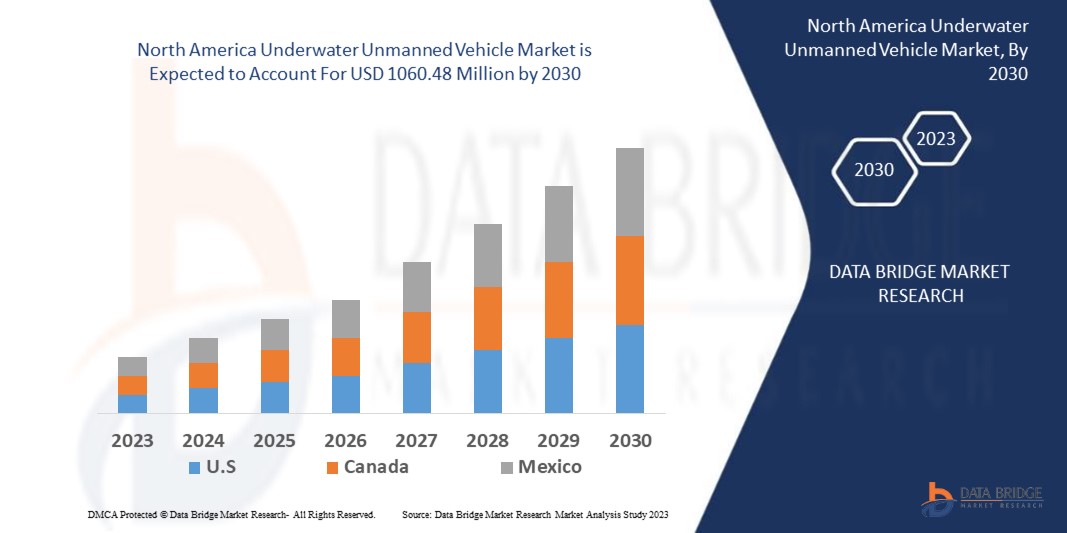
Data Bridge Market Research analyses that the underwater unmanned vehicle market, valued at USD 542.08 million in 2022, will reach USD 1060.48 million by 2030, growing at a CAGR of 8.75% during the forecast period of 2023 to 2030. In addition to the market insights such as market value, growth rate, market segments, geographical coverage, market players, and market scenario, the market report curated by the Data Bridge Market Research team includes in-depth expert analysis, import/export analysis, pricing analysis, production consumption analysis, and pestle analysis.
North America Underwater Unmanned Vehicle Market Scope and Segmentation
|
Report Metric |
Details |
|
Forecast Period |
2023 to 2030 |
|
Base Year |
2022 |
|
Historic Years |
2021 (Customizable to 2015 - 2020) |
|
Quantitative Units |
Revenue in USD Million, Volumes in Units, Pricing in USD |
|
Segments Covered |
Type (Remotely Operated Vehicle (ROV), Autonomous Underwater Vehicle (AUV), Hybrid Underwater Vehicle (HUV)), Product Type (Heavy Work Class Vehicle, Work Class Vehicle, High-Capacity Electric Vehicle, Small Vehicles, Man Portable, Light Weight Vehicles, Heavy Weight Vehicles, Large Vehicles), Components (Inertial Navigation Systems, Cameras, Lighting Systems, Sensors, Video Screens, Synthetic Aperture Sonar, Others), Shape (Torpedo, Laminar Flow Body, Streamlined Rectangular Style, Multi hull), Propulsion System (Hybrid Systems, Electric Systems, Non-Electric Systems, Mechanical Systems, Others), Operating Depth (1000-3000m, 200-1000m, less than 200m, more than 3000m), Size Range (HWV (12.75-21), LWV (9-12.75), Man-Portable (3-9), Large (>36)), Application (Army and Defense, ISR, Mine Countermeasures, Anti-Submarine Warfare, Detection, Inspection, Navigation, Accident Investigation, Petroleum and Gas, Environmental Security and tracking, Oceanography, Archaeology and Exploration, Search and Rescue Activities, Commercial Exploration, Scientific Research, Miscellaneous, Other) Technology (Collision Avoidance, Navigation, Communication, Imagery, Propulsion), Payload (Sensors, Synthetic Aperture Sonar, Cameras, Inertial Navigation Systems , Echo Sounders, Acoustic Doppler Current profilers, Others) |
|
Countries Covered |
U.S., Canada and Mexico in North America |
|
Market Players Covered |
ORPC, Inc. (U.S.), Lockheed Martin Corporation (U.S.), Saab AB (Sweden), Kongsberg Maritime (Norway), Boeing (U.S.), Northrop Grumman (U.S.), BAE Systems (U.K.), ATLAS ELEKTRONIK GmbH (Germany), International Submarine Engineering Limited (Canada), Teledyne Technologies Incorporated. (U.S.), Oceaneering International, Inc. (U.S.), SUBSEA7 (U.K.), Boston Engineering (U.S.), ECA GROUP (France), HII (U.S.), Modus Subsea Services (U.K.), L3Harris Technologies, Inc. (U.S.), EchoBlue Ltd (U.K.), Unique Group. (U.A.E), Thales (France) |
|
Market Opportunities |
|
Market Definition
An underwater vehicle that can operate remotely or autonomously without human input is an unmanned underwater vehicle (UVV). These are essential for underwater exploration activities because manual exploration presents numerous challenges. These vehicles are equipped with sensors for sonar, thrusters, cameras, and other equipment. Autonomous underwater vehicles, or AUVs, are self-propelled, unmanned, untethered underwater vehicles capable of carrying out simple tasks without the assistance of a human. In order to map the seafloor or describe the water's physical, chemical, or biological properties, AUVs are frequently used as survey platforms.
North America Underwater Unmanned Vehicle Market Dynamics
Drivers
- Expansion of the smart device market, which encourages the creation of operational and risk management
Changes in operational and risk management have resulted from introduction of smart devices. Modern imaging and navigation systems are designed to operate safely under challenging circumstances. Increased government spending on military research and development and ocean exploration are predicted to speed up market growth. During the forecast period, the rapid development of technology is also anticipated to fuel market expansion. As an illustration, in October 2021, Water Linked and QYSEA Technology Co., Ltd., a manufacturer of remotely operated vehicles, will work together to outfit QYSEA's ROV with advanced underwater positioning sensors. These elements are anticipated to affect the market during the forecast period favorably.
- Demand for unmanned underwater vehicles (UUVs) in oil and gas industry will grow globally
Through their independence from surface vessels, unmanned underwater vehicles (UUVs) have become a viable option for marine drilling operations. Over the past five years, small, portable unmanned underwater vehicles have grown significantly in the oil and gas sector. The ECA Firm, for example, has a contract with Petrus Resources, a global supplier of oil and gas facilities, to provide the service of an A18D AUV for inspection and surveying facilities. Unmanned underwater vehicle demand from oil and gas producers is anticipated to increase significantly during the forecast period, supporting industry growth.
Opportunities
- Growing demand caused by improvements in battery life and operation capability surge market growth
Unmanned underwater vehicles are expected to gain more traction in the commercial market as their operating range and battery life improve. Because thrusters use up most of the power in UUVs, their battery life is less than 24 hours, which is significantly reduced if they must operate in deep waters. These technologies can assist UUV operators in reducing the time and effort required to change out old batteries for new ones while conducting ongoing underwater operations. Unmanned underwater vehicles may easily manipulate objects, changing their procedures as necessary throughout underwater missions. As a result, NiMH batteries are used more frequently by fast unmanned underwater vehicles.
- Effective transporting of electrical equipment through on-board sensors
The sensors on board increase the ability of Unmanned Underwater Vehicles to transport electrical equipment for imaging and monitoring. Additionally, they lower the onboard electronic components' power requirements, paving the way for innovations like underwater AUV recharge. For instance, battery intelligence and underwater wireless power solutions are provided by WiBotic (US). The EELUME AUV, which can be permanently installed on the seabed and can be charged underwater, is made available by Kongsberg Maritime (Norway).
Restraints/Challenges
- High pricing limits growth.
AUVs are expensive maritime platforms. For instance, the A18 AUV from the ECA GROUP (France) has a maximum difficulty rating of 3,000 meters and costs between $ 2 and $ 6 million. The overall cost of exploration and surveying operations rises due to the expense of purchasing retired AUVs for surveying missions. AUVs are more frequently used for more straightforward tasks like ecological monitoring, but despite this, their high maintenance, production, R&D, and system difficulty costs prevent them from being widely adopted. An AUV's mounted instruments can cost between $ 5,000 and $ 100,000 each, but their ASP is only $ 70,000. At sea, running an AUV costs $1,000 per day. As a result, if a thirty-day mission's operational budget is calculated, it equals $ 30,000, or about 43% of the AUV's typical selling price. As a result, the growth of the market for UUVs is constrained by the high operational costs of AUVs.
- Underwater surveying at a slow pace may restrict growth.
One of the challenges UUVs face is their slow underwater survey speeds. Due to saltwater's high conductivity, electromagnetic (EM) waves cannot function appropriately in underwater environments deeper than 200 meters. These acoustic waves move slowly and are used by unmanned underwater vehicles to conduct deep-water surveys. FSO waves are not used by unmanned underwater vehicles due to their minimal range. The signals from unmanned underwater vehicles are further impacted by the water's refraction, absorption, and scattering, which prevents the market for these vehicles from expanding.
This underwater unmanned vehicle market report provides details of new recent developments, trade regulations, import-export analysis, production analysis, value chain optimization, market share, impact of domestic and localized market players, analyses opportunities in terms of emerging revenue pockets, changes in market regulations, strategic market growth analysis, market size, category market growths, application niches and dominance, product approvals, product launches, geographic expansions, technological innovations in the market. To gain more info on the underwater unmanned vehicle market contact Data Bridge Market Research for an Analyst Brief, our team will help you take an informed market decision to achieve market growth.
Recent Developments
- In 2021, The next-generation Utility Class ASV, the SR-Utility 3.0, was unveiled by SeaRobotics Corporation. By giving expert surveyors a configurable platform that supports swappable payloads and sensors and incorporates existing instrumentation, the newest addition to the SRC portfolio aims to increase the scope and versatility of unmanned coastal marine survey activities.
- In 2021, Under a contract given by the Navy on August 26, 2019, General Dynamics Mission Systems delivered the Knifefish surface mine countermeasure unmanned underwater vehicle system. The five Knifefish systems (10 total UUVs) and support equipment are to be purchased under the terms of the contract, which was immediately given after a successful Milestone C decision and approval to begin low-rate initial production (LRIP).
- In 2021, the Navy and the Marine Corps published the Unmanned Campaign Framework to direct their investments in and integration of unmanned platforms in the US. The demand for unmanned marine vehicles for defense will also grow as investments in the navy and the nation's defense systems increase.
North America Underwater Unmanned Vehicle Market Scope
The underwater unmanned vehicle market is segmented on the basis of type, product type, component, propulsion system, operating depth, size range, application, technology, and payload. The growth amongst these segments will help you analyze meagre growth segments in the industries and provide the users with a valuable market overview and market insights to help them make strategic decisions for identifying core market applications.
Type
- Remotely Operated Vehicle (ROV)
- Autonomous Underwater Vehicle (AUV)
- Shallow
- Medium
- Large
- Hybrid Underwater Vehicle (HUV)
Product Type
- Heavy Work Class Vehicle
- Work Class Vehicle
- High-Capacity Electric Vehicle
- Small Vehicles
- Man Portable
- Light Weight Vehicles
- Heavy Weight Vehicles
- Large Vehicles
Components
- Inertial Navigation Systems
- Cameras
- Lighting Systems
- Sensors
- Video Screens
- Synthetic Aperture Sonar
- Others
Shape
- Torpedo
- Laminar Flow Body
- Streamlined Rectangular Style
- Multi hull
Propulsion System
- Hybrid Systems
- Electric Systems
- Non-Electric systems
- Mechanical Systems
- Others
Operating Depth
- 1000-3000m
- 200-1000m
- less than 200m
- more than 3000m
Size Range
- HWV (12.75-21)
- LWV (9-12.75)
- Man-Portable (3-9)
- Large (>36)
Application
- Army and Defense
- ISR
- Intelligence
- Surveillance
- Reconnaissance
- Mine Countermeasures
- Anti-submarine warfare
- Detection
- Inspection
- Navigation
- Accident Investigation
- Petroleum and Gas
- Environmental Security and tracking
- Oceanography
- Archaeology and Exploration
- Search and Rescue Activities
- Commercial Exploration
- Scientific Research
- Miscellaneous
- Other
Technology
- Collision Avoidance
- Navigation
- Communication
- Imagery
- Propulsion
Payload
- Sensors
- Synthetic Aperture Sonar
- Cameras
- Inertial Navigation Systems
- Echo Sounders
- Acoustic Doppler Current profilers
- Others
Underwater Unmanned Vehicle Market Regional Analysis/Insights
The underwater unmanned vehicle market is analysed and market size insights and trends are provided by country, type, product type, component, and shape, propulsion system, operating depth, size range, application, technology and payload as referenced above.
The countries covered in the underwater unmanned vehicle market report are U.S., Canada and Mexico in North America.
U.S. dominates the market and will continue to flourish its trend of dominance during the forecast period in North America. The major factor attributable to the region’s dominance are automatic water dispenser usage is increasing, and there are many suppliers in North America.
Further, Canada is anticipated to showcase the highest growth rate during the forecast period owing to the region of North America, which has a high demand for hot and cold water as well as convenience services provided by water dispensers.
The country section of the report also provides individual market impacting factors and changes in regulation in the market domestically that impacts the current and future trends of the market. Data points such as down-stream and upstream value chain analysis, technical trends and porter's five forces analysis, case studies are some of the pointers used to forecast the market scenario for individual countries. Also, the presence and availability of global brands and their challenges faced due to large or scarce competition from local and domestic brands, impact of domestic tariffs and trade routes are considered while providing forecast analysis of the country data.
Competitive Landscape and Underwater Unmanned Vehicle Market Share Analysis
The underwater unmanned vehicle market competitive landscape provides details by competitor. Details included are company overview, company financials, revenue generated, market potential, investment in research and development, new market initiatives, global presence, production sites and facilities, production capacities, company strengths and weaknesses, product launch, product width and breadth, application dominance. The above data points provided are only related to the companies' focus related to underwater unmanned vehicle market.
Some of the major players operating in the underwater unmanned vehicle market are:
- ORPC, Inc. (U.S.)
- Lockheed Martin Corporation (U.S.)
- Saab AB (Sweden)
- Kongsberg Maritime (Norway)
- Boeing (U.S.)
- Northrop Grumman (U.S.)
- BAE Systems (U.K.)
- ATLAS ELEKTRONIK GmbH (Germany)
- International Submarine Engineering Limited (Canada)
- Teledyne Technologies Incorporated. (U.S.)
- Oceaneering International, Inc. (U.S.)
- SUBSEA7 (U.K.)
- Boston Engineering (U.S.)
- ECA GROUP (France)
- HII (U.S.)
- Modus Subsea Services (U.K.)
- L3Harris Technologies, Inc. (U.S.)
- EchoBlue Ltd (U.K.)
- Unique Group. (U.A.E)
- Thales (France)
SKU-
Obtenha acesso online ao relatório sobre a primeira nuvem de inteligência de mercado do mundo

- Painel interativo de análise de dados
- Painel de análise da empresa para oportunidades de elevado potencial de crescimento
- Acesso de analista de pesquisa para personalização e customização. consultas
- Análise da concorrência com painel interativo
- Últimas notícias, atualizações e atualizações Análise de tendências
- Aproveite o poder da análise de benchmark para um rastreio abrangente da concorrência
Metodologia de Investigação
A recolha de dados e a análise do ano base são feitas através de módulos de recolha de dados com amostras grandes. A etapa inclui a obtenção de informações de mercado ou dados relacionados através de diversas fontes e estratégias. Inclui examinar e planear antecipadamente todos os dados adquiridos no passado. Da mesma forma, envolve o exame de inconsistências de informação observadas em diferentes fontes de informação. Os dados de mercado são analisados e estimados utilizando modelos estatísticos e coerentes de mercado. Além disso, a análise da quota de mercado e a análise das principais tendências são os principais fatores de sucesso no relatório de mercado. Para saber mais, solicite uma chamada de analista ou abra a sua consulta.
A principal metodologia de investigação utilizada pela equipa de investigação do DBMR é a triangulação de dados que envolve a mineração de dados, a análise do impacto das variáveis de dados no mercado e a validação primária (especialista do setor). Os modelos de dados incluem grelha de posicionamento de fornecedores, análise da linha de tempo do mercado, visão geral e guia de mercado, grelha de posicionamento da empresa, análise de patentes, análise de preços, análise da quota de mercado da empresa, normas de medição, análise global versus regional e de participação dos fornecedores. Para saber mais sobre a metodologia de investigação, faça uma consulta para falar com os nossos especialistas do setor.
Personalização disponível
A Data Bridge Market Research é líder em investigação formativa avançada. Orgulhamo-nos de servir os nossos clientes novos e existentes com dados e análises que correspondem e atendem aos seus objetivos. O relatório pode ser personalizado para incluir análise de tendências de preços de marcas-alvo, compreensão do mercado para países adicionais (solicite a lista de países), dados de resultados de ensaios clínicos, revisão de literatura, mercado remodelado e análise de base de produtos . A análise de mercado dos concorrentes-alvo pode ser analisada desde análises baseadas em tecnologia até estratégias de carteira de mercado. Podemos adicionar quantos concorrentes necessitar de dados no formato e estilo de dados que procura. A nossa equipa de analistas também pode fornecer dados em tabelas dinâmicas de ficheiros Excel em bruto (livro de factos) ou pode ajudá-lo a criar apresentações a partir dos conjuntos de dados disponíveis no relatório.











