


Argentina Water Heater Market Size
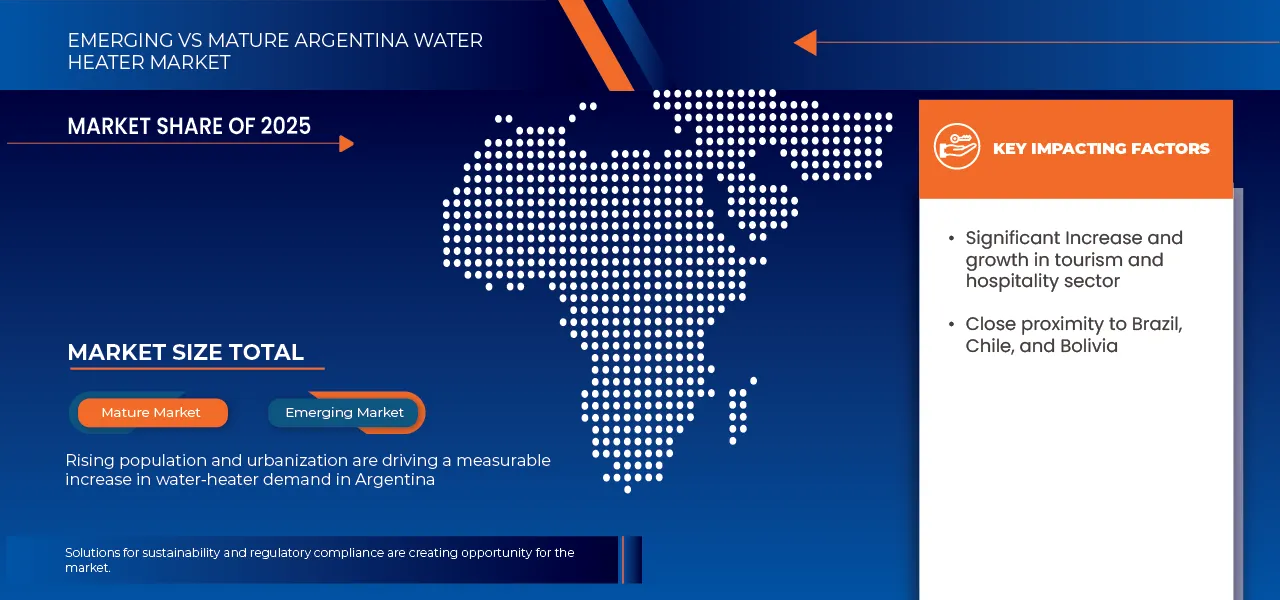
- The Argentina water heater market was valued at USD 722.88 million in 2025 and is expected to reach USD 1,098.71 million by 2033
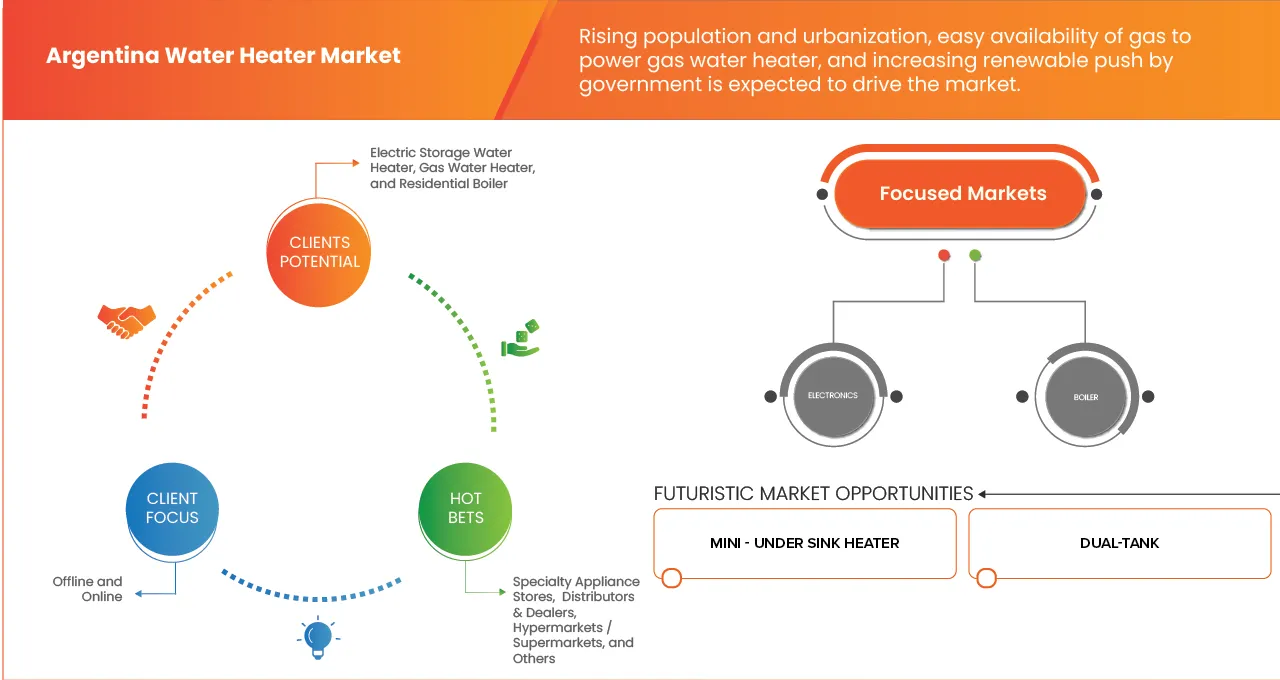
- During the forecast period of 2026 to 2033 the market is likely to grow at a CAGR of 5.4%, driven by the rising population and rapid urbanization in Argentina, and easy availability of gas to power gas water heater.
- This growth is further fueled by increasing renewable push by government), and increasing tourism and hospitality.
Argentina Water Heater Market Analysis
- The Argentina water heater market is experiencing rapid expansion due to the rising population and rapid urbanization in Argentina which are driving a measurable increase in water-heater demand by creating more households and changing daily hot-water consumption patterns.
- Easy availability of natural gas in Argentina strengthens demand for gas water heaters as it gives households and small businesses a reliable, low-cost, and familiar energy source that supports consistent hot-water use throughout the year.
- Increasing tourism and the expansion of Argentina’s hospitality sector create strong opportunities for water heaters as hotels, lodges, boutique hostels, Airbnb properties, resorts, and rural guesthouses depend heavily on reliable and high-capacity hot-water systems.
- Electric storage water heater segment is expected to dominate the market with a market share of 63.63%.
Report Scope and Argentina Water Heater Market Segmentation
|
Attributes |
Argentina Water Heater Key Market Insights |
|
Segments Covered |
|
|
Countries Covered |
Argentina |
|
Key Market Players |
|
|
Market Opportunities |
|
|
Value Added Data Infosets |
In addition to the insights on market scenarios such as market value, growth rate, segmentation, geographical coverage, and major players, the market reports curated by the Data Bridge Market Research also include in-depth expert analysis, geographically represented company-wise production and capacity, network layouts of distributors and partners, detailed and updated price trend analysis and deficit analysis of supply chain and demand. |
Argentina Water Heater Market Trends
“Rising Population and Urbanization”
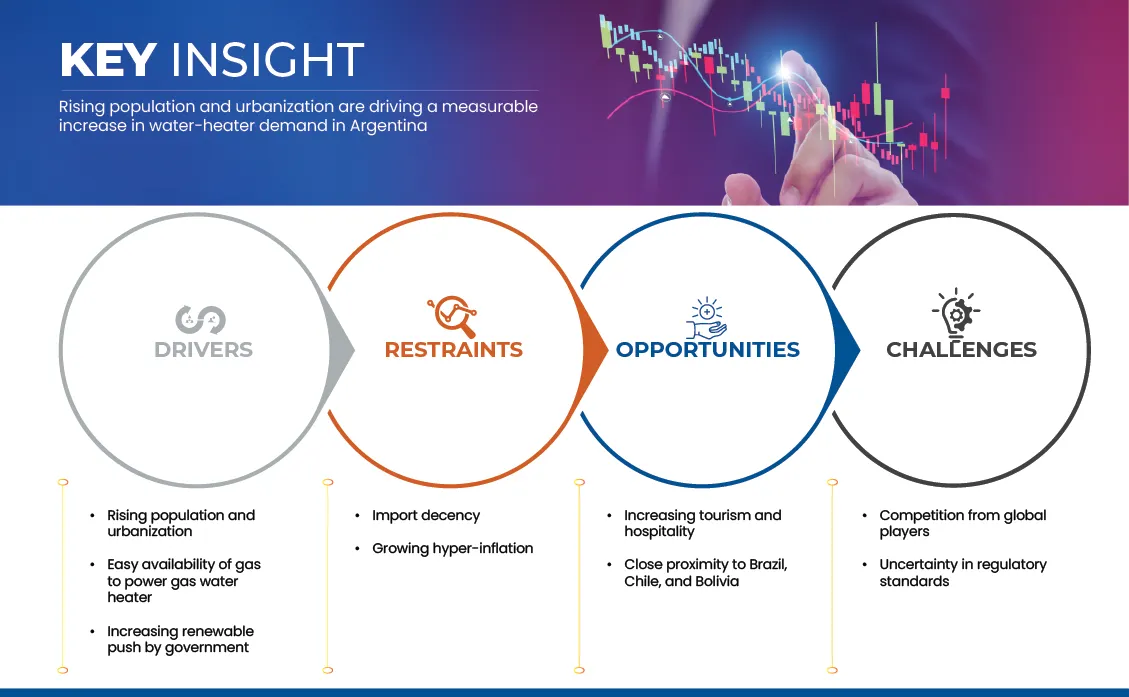
- The rising population and rapid urbanization in Argentina are driving a measurable increase in water-heater demand by creating more households and changing daily hot-water consumption patterns.
- Easy availability of natural gas in Argentina strengthens demand for gas water heaters as it gives households and small businesses a reliable, low-cost, and familiar energy source that supports consistent hot-water use throughout the year.
- Import dependency hampers demand for water heaters in Argentina as it exposes the market to currency volatility, supply-chain delays, and unpredictable retail pricing, all of which discourage both new purchases and timely replacement of old systems.
- Increasing tourism and the expansion of Argentina’s hospitality sector create strong opportunities for water heaters as hotels, lodges, boutique hostels, Airbnb properties, resorts, and rural guesthouses depend heavily on reliable and high-capacity hot-water systems.
- Uncertainty in regulatory standards creates significant challenges for the water-heater market in Argentina as it disrupts product planning, raises compliance risks, and increases operational costs for manufacturers, distributors, and installers.
Argentina Water Heater Market Dynamics
Driver
“Rising Population and Urbanization”
- The rising population and rapid urbanization in Argentina are driving a measurable increase in water-heater demand by creating more households and changing daily hot-water consumption patterns. Growing urbanization is leading to construction shifts toward multi-unit apartment blocks and mixed-use buildings where each new dwelling either needs its own hot-water appliance or contributes to demand for centralized systems. Developers and building managers are therefore specifying compact storage and instantaneous (tankless) units that fit constrained utility spaces and meet tenant expectations for on-demand hot water. Urban migration also concentrates peak usage. Mornings and evenings see higher simultaneous showering, laundry, and dishwashing events, which pushes both residential buyers and small commercial operators to select higher-capacity or faster-recovery models, expanding sales at the upper end of the market. Growing numbers of single-person and small-family households in cities favor compact, energy-efficient models designed for limited bathrooms and kitchenettes, encouraging manufacturers to introduce smaller, lower-cost SKUs and spurring aftermarket parts and service revenues.
- According to the United Nations Human Settlements Programme, Argentina is a highly urbanized country. Out of a total estimated population of about 44.500.000 for 2018, more than 92% live in urban areas. However, 47.6% of the country’s urban population is concentrated in only 8 agglomerations, with a predominance of the metropolitan area of Buenos Aires.
- According to the World Bank Group, the population of Argentina residing in urban areas of the country reached 93% in 2024 from 92% in 2019
- In conclusion, Argentina’s rising population and sustained urbanization are directly strengthening water-heater demand by increasing the number of urban households, intensifying daily hot-water usage, and reshaping residential infrastructure needs. This change in living patterns, combined with continuous population growth, ensures a steady and long-term expansion of water-heater requirements across both new construction and replacement segments.
Opportunity
“Increasing Tourism and Hospitality”
- Increasing tourism and the expansion of Argentina’s hospitality sector create strong opportunities for water heaters as hotels, lodges, boutique hostels, Airbnb properties, resorts, and rural guesthouses depend heavily on reliable and high-capacity hot-water systems to maintain service quality and meet guest expectations. Accommodation providers in the country are facing higher occupancy rates and more frequent peak-usage periods as international arrivals rise and domestic tourism strengthens. This increases demand for large-capacity storage heaters, centralized commercial systems, high-flow gas units, and modular setups that can handle multiple simultaneous showers, laundry operations, and kitchen loads. Many older hospitality properties also require modernization to remain competitive; owners replace outdated boilers with efficient gas or hybrid systems that reduce energy consumption, cut operational costs, and support sustainability-focused marketing. Boutique hotels and premium lodges increasingly position comfort as a differentiator, encouraging them to invest in higher-end heaters with faster recovery times and temperature-control features.
- In September 2024, Official data from the National Institute of Statistics and Census showed that 1.5 million individuals visited Argentina in the first 2 months of 2024.
- In 2022, acccording to WorldData, Argentina recorded a total of 3.89 million tourists in 2022, ranking 34th in the world in absolute terms. In the same year, Argentina generated around 3.47 billion US dollars in the tourism sector alone
- Argentina’s expanding tourism and hospitality sector is creating strong growth opportunities for the water-heater market by driving consistent demand for high-capacity, reliable, and energy-efficient systems. As hotels, hostels, resorts, and short-term rentals modernize their infrastructure to handle rising occupancy and enhance guest comfort, they increasingly invest in advanced gas, electric, hybrid, and solar-thermal solutions. The push for better service quality, combined with the growth of Airbnb and the development of accommodations in remote or eco-focused destinations, further broadens demand across both commercial and alternative lodging segments. This sustained tourism momentum positions the hospitality industry as a major driver of water-heater adoption in Argentina.
Restraint/Challenge
“Competiton From Global Players”
- Competition from global players creates multiple challenges for the water-heater market in Argentina as it intensifies price pressure, raises technology benchmarks, and disrupts the competitive balance for local manufacturers, distributors, and installers. International brands usually operate with stronger capital backing, large-scale production, and mature supply chains, enabling them to offer heaters at more competitive prices even after accounting for import costs. This puts local producers under severe margin pressure, especially small and mid-sized firms that rely on limited production runs and higher per-unit costs. Global players also introduce advanced technologies such as high-efficiency gas burners, digital temperature controls, anti-scale systems, heat-pump mechanisms, and solar-integrated designs that raise consumer expectations and shift demand toward premium features. Local companies often struggle to match these innovations due to limited R&D budgets, supply-chain constraints, and dependence on imported components, which weakens their market share.
Argentina Water Heater Market Scope
The Argentina water heater market is segmented into in one segment based on product type.
- By Product Type
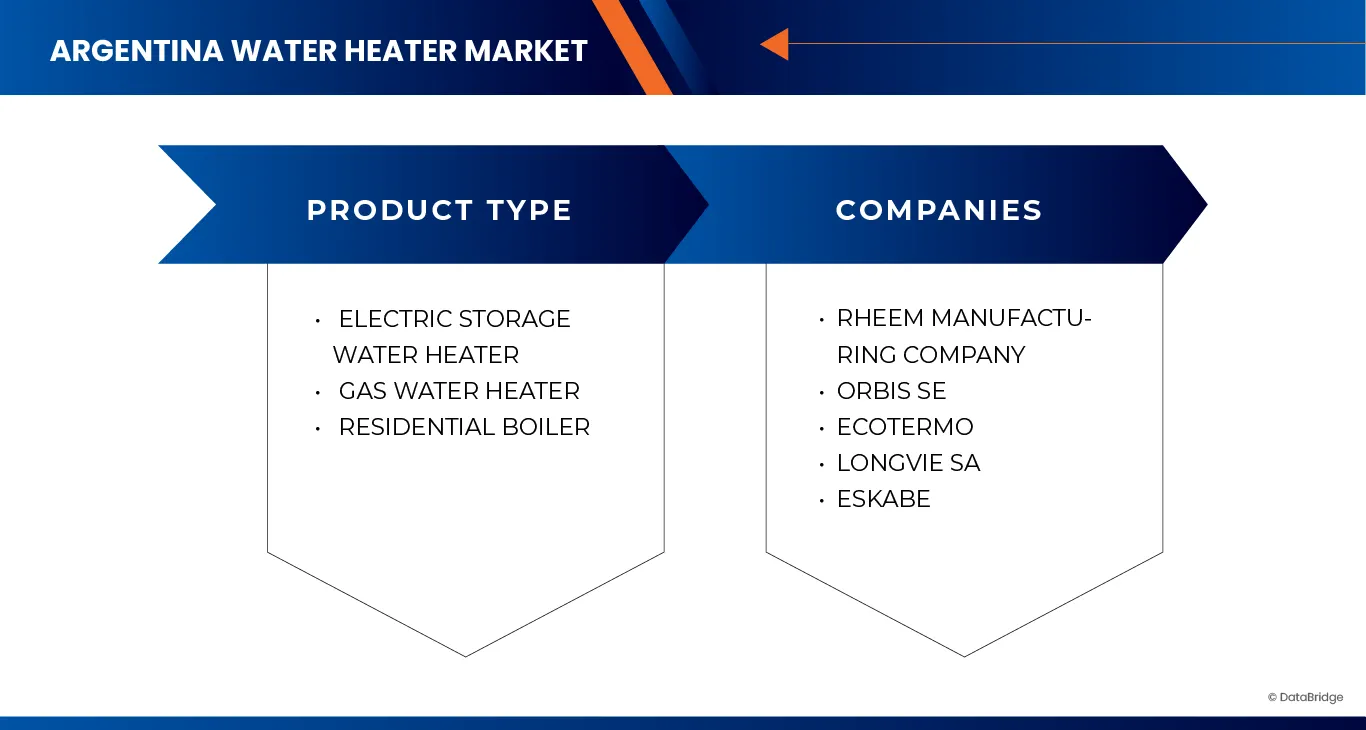
On the basis of Product type, the water heater market is segmented into residential boiler, electric storage water heater, gas water heater. In 2026, electric storage water heater segment is expected to dominate with the market share of 63.76%.
Electric storage water heater segment is also expected to register the highest CAGR of 5.6% due to a combination of rising urban household demand, improved energy efficiency standards, and increasing consumer preference for cost-effective and easy-to-install heating solutions. Argentina’s growing residential construction activities, particularly in urban centers, are driving the adoption of electric storage heaters because they are more suitable for apartments and smaller living spaces compared to gas systems, which often require more complex ventilation and installation requirements.
The Major Market Leaders Operating in the Market Are:
- ESKABE (Argentina)
- BAUDUCCO SA (Argentina)
- PEISA (Argentina)
- JIT Calderas (Argentina)
- LONGVIE (Argentina)
- Ecotermo (Argentina)
- Caldaia (Argentina)
- Orbis (Argentina)
- RHEEM MANUFACTURING COMPANY (United States)
Latest Developments in Argentina water heater market
- On February 11, 2025, Rheem officially unveiled its brand refresh titled “Engineered for Life” as part of its 100th‑anniversary celebration. The new branding emphasizes Rheem’s century-long legacy of innovation, durability, and reliability, positioning its products as built to support “everyday life.” At booth 2343, Rheem showcased a broad lineup of advanced and sustainable water-heating and HVAC solutions, including the ProTerra hybrid electric heat-pump water heater, the 50‑gallon Maximus condensing tank, and its IKONIC condensing tankless gas water heater, signaling a strong commitment to energy efficiency and environmental responsibility.
- In August 2025, Rheem celebrated its 100th anniversary with a series of global events, reflecting its century-long commitment to innovation, collaboration, and sustainability. Rheem used the milestone to highlight its progress toward a bold environmental pledge: launching a line of heating, cooling, and water‑heating products by 2025 that reduce greenhouse gas emissions by 50% (relative to its 2019 baseline.

- Interactive Data Analysis Dashboard
- Company Analysis Dashboard for high growth potential opportunities
- Research Analyst Access for customization & queries
- Competitor Analysis with Interactive dashboard
- Latest News, Updates & Trend analysis
- Harness the Power of Benchmark Analysis for Comprehensive Competitor Tracking
Table of Content
1 INTRODUCTION
1.1 OBJECTIVES OF THE STUDY
1.2 MARKET DEFINITION
1.3 OVERVIEW OF THE ARGENTINA WATER HEATER MARKET
1.4 LIMITATIONS
1.5 MARKETS COVERED
2 MARKET SEGMENTATION
2.1 MARKETS COVERED
2.2 YEARS CONSIDERED FOR THE STUDY
2.3 CURRENCY AND APPLICATION
2.4 DBMR TRIPOD DATA VALIDATION MODEL
2.5 MULTIVARIATE MODELLING
2.6 PRIMARY INTERVIEWS WITH KEY OPINION LEADERS
2.7 DBMR MARKET POSITION GRID
2.8 DBMR VENDOR SHARE ANALYSIS
2.9 SECONDARY SOURCES
2.1 ASSUMPTIONS
3 EXECUTIVE SUMMARY
4 PREMIUM INSIGHTS
4.1 PORTER'S FIVE FORCES ANALYSIS
4.2 IMPORT EXPORT SCENARIO
4.3 PRICING ANALYSIS
4.4 PRODUCTION CONSUMPTION ANALYSIS
4.5 PROFIT MARGINS SCENARIO ON ARGENTINA WATER HEATER
4.5.1 RETAIL / MASS-MARKET WATER HEATERS
4.5.2 PREMIUM & ENERGY-EFFICIENT UNITS
4.5.3 COMMERCIAL / INSTITUTIONAL INSTALLATIONS
4.5.4 SPECIALTY & SUSTAINABLE WATER HEATERS
4.6 INDUSTRY ECOSYSTEM ANALYSIS
4.6.1 PROMINENT COMPANIES
4.6.1.1 SMALL & MEDIUM-SIZED COMPANIES
4.6.2 RESEARCH AND DEVELOPMENT
4.7 INNOVATION TRACKER AND STRATEGIC ANALYSIS – ARGENTINA WATER HEATER MARKET
4.7.1 MAJOR DEALS AND STRATEGIC ALLIANCES ANALYSIS
4.7.1.1 JOINT VENTURES
4.7.1.2 MERGERS AND ACQUISITIONS
4.7.1.3 LICENSING AND PARTNERSHIP
4.7.1.4 TECHNOLOGY COLLABORATIONS
4.7.1.5 STRATEGIC DIVESTMENTS
4.7.2 NUMBER OF PRODUCTS IN DEVELOPMENT
4.7.3 STAGE OF DEVELOPMENT
4.7.4 TIMELINES AND MILESTONES
4.7.5 INNOVATION STRATEGIES AND METHODOLOGIES
4.7.6 RISK ASSESSMENT AND MITIGATION
4.7.7 FUTURE OUTLOOK
4.8 TECHNOLOGICAL ADVANCEMENTS
4.8.1 SMART AND ENERGY-EFFICIENT WATER HEATERS
4.8.2 TANKLESS AND ON-DEMAND SYSTEMS
4.8.3 SOLAR AND HYBRID WATER HEATERS
4.8.4 ECO-FRIENDLY AND LOW-EMISSION SOLUTIONS
4.8.5 INTEGRATION WITH SMART HOME SYSTEMS
4.9 PATENT ANALYSIS– ARGENTINA WATER HEATER MARKET
4.9.1 PATENT QUALITY AND STRENGTH
4.9.2 PATENT FAMILIES
4.9.3 LICENSING AND COLLABORATIONS
4.9.4 REGION PATENT LANDSCAPE
4.9.5 IP STRATEGY AND MANAGEMENT
4.1 CONSUMER BUYING BEHAVIOUR
4.10.1 GROUP 1 PREMIUM URBAN CONSUMERS
4.10.2 GROUP 2 MIDDLE-INCOME BUYERS
4.10.3 GROUP 3 VALUE-CONSCIOUS BUYERS
4.10.4 GROUP 4 LOW-BUDGET BUYERS
4.10.5 GROUP 5 PERFORMANCE-FOCUSED BUYERS WITH HIGHER SPENDING WILLINGNESS
4.10.6 GROUP 6 PREMIUM NICHE BUYERS WITH SPECIFIC NEEDS
4.11 RAW MATERIAL COVERAGE
4.11.1 STEEL
4.11.2 COPPER AND COPPER PARTS
4.11.3 INSULATION AND SEALING MATERIALS
4.11.4 HEATING ELEMENTS, BURNERS AND MECHANICAL PARTS
4.11.5 CONTROLS, THERMOSTATS, AND ELECTRONICS
4.11.6 SURFACE TREATMENTS, COATINGS, AND PACKING
4.12 SUPPLY CHAIN ANALYSIS
4.12.1 OVERVIEW
4.12.2 LOGISTIC COST SCENARIO
4.12.3 IMPORTANCE OF LOGISTICS SERVICE PROVIDERS
4.13 VALUE CHAIN ANALYSIS
4.14 VENDOR SELECTION CRITERIA
4.14.1 REGULATORY AND LEGAL FIT
4.14.2 CERTIFICATION AND INDEPENDENT TESTING
4.14.3 ENERGY EFFICIENCY AND LABELING
4.14.4 SAFETY, INSTALLATION, AND LOCAL SERVICE NETWORK
4.14.5 MANUFACTURING QUALITY SYSTEMS AND TRACEABILITY
4.14.6 SUPPLY CHAIN AND SPARE-PARTS POLICY
4.14.7 WARRANTY, LIABILITY, AND COMMERCIAL TERMS
5 ARGENTINA WATER HEATER MARKET, TOP WATER HEATER MODELS, BY SALES CHANNEL, 2024
5.1 OFFLINE
5.2 ONLINE
6 ARGENTINA WATER HEATER MARKET, BRAND SHARE ANALYSIS
6.1 BRAND SHARE ANALYSIS: ELECTRIC STORAGE WATER HEATER, BY VALUE
6.2 BRAND SHARE ANALYSIS: ELECTRIC STORAGE WATER HEATER, BY VOLUME
6.3 BRAND SHARE ANALYSIS: GAS WATER HEATER, BY VALUE
6.4 BRAND SHARE ANALYSIS: GAS WATER HEATER, BY VOLUME
6.5 BRAND SHARE ANALYSIS: RESIDENTIAL BOILER, BY VALUE
6.6 BRAND SHARE ANALYSIS: RESIDENTIAL BOILER, BY VOLUME
7 CLIMATE CHANGE SCENARIO
7.1 INTRODUCTION
7.2 ARGENTINA’S CLIMATE CHARACTERISTICS AND HEATING REQUIREMENTS
7.2.1 REGIONAL CLIMATIC DIVERSITY
7.2.2 SEASONAL VARIATION AND DEMAND PATTERNS
7.3 OBSERVED AND PROJECTED CLIMATE CHANGE TRENDS
7.3.1 OBSERVED CLIMATE DEVELOPMENTS
7.3.2 FUTURE PROJECTIONS
7.4 NATIONAL CLIMATE POLICY AND DECARBONIZATION COMMITMENTS
7.4.1 NATIONALLY DETERMINED CONTRIBUTION (NDC)
7.4.2 LONG-TERM PATHWAYS FOR EMISSIONS REDUCTION
7.5 STRUCTURAL CHARACTERISTICS OF ARGENTINA’S ENERGY SYSTEM
7.5.1 PREDOMINANCE OF NATURAL GAS
7.5.2 GROWTH IN RENEWABLE ELECTRICITY GENERATION
7.5.3 NATURAL GAS INFRASTRUCTURE AND EXPORT POTENTIAL
7.6 CLIMATE CHANGE IMPLICATIONS FOR WATER HEATING DEMAND
7.6.1 EVOLVING HEATING AND COOLING LOADS
7.6.2 STABILITY OF HOT WATER DEMAND
7.6.3 WATER AVAILABILITY AND ENERGY PLANNING
7.7 TRANSITION DYNAMICS FOR GAS HEATERS AND BOILERS
7.7.1 REGULATORY AND POLICY PRESSURES
7.7.2 GAS NETWORK RESILIENCE CONCERNS
7.7.3 POTENTIAL STRANDED ASSET RISKS
7.8 TECHNOLOGY PATHWAYS ALIGNED WITH A CLIMATE-CONSTRAINED FUTURE
7.8.1 ELECTRIC STORAGE WATER HEATERS
7.8.2 HEAT PUMP WATER HEATERS AND ADVANCED BOILERS
7.8.3 SOLAR THERMAL AND HYBRID SYSTEMS
7.8.4 EMERGING LOW-CARBON GAS ALTERNATIVES
7.9 SYSTEM-LEVEL CONSIDERATIONS FOR LONG-TERM PLANNING
7.9.1 ELECTRICITY GRID CAPACITY AND SMART INTEGRATION
7.9.2 BUILDING ENERGY PERFORMANCE
7.1 STRATEGIC IMPLICATIONS FOR THE WATER HEATER MARKET
7.10.1 MARKET SEGMENT OUTLOOK
7.10.2 RISK AND RESILIENCE CONSIDERATIONS
7.10.3 PATHWAYS FOR INNOVATION
7.11 CONCLUSION
8 COST ANALYSIS BREAKDOWN
8.1 INTRODUCTION
8.2 CAPITAL EXPENDITURE (CAPEX) COMPARISON
8.2.1 ELECTRIC STORAGE WATER HEATERS
8.2.2 GAS WATER HEATERS AND INSTANTANEOUS GAS UNITS
8.2.3 RESIDENTIAL BOILERS (GAS BOILERS)
8.3 INSTALLATION COSTS
8.3.1 ELECTRIC WATER HEATER INSTALLATION
8.3.2 GAS WATER HEATER INSTALLATION
8.3.3 BOILER INSTALLATION
8.4 OPERATIONAL EXPENDITURE (OPEX) COMPARISON
8.4.1 ENERGY PRICES FOR ELECTRICITY AND GAS
8.4.2 ELECTRIC WATER HEATER OPERATING COSTS
8.4.3 GAS WATER HEATER AND BOILER OPERATING COSTS
8.5 MAINTENANCE AND SERVICING COSTS
8.5.1 ELECTRIC WATER HEATERS
8.5.2 GAS WATER HEATERS
8.5.3 BOILERS
8.6 LIFECYCLE COST ASSESSMENT
8.6.1 ELECTRIC WATER HEATERS
8.6.2 GAS WATER HEATERS AND BOILERS
8.6.3 HYBRID AND SOLAR-SUPPORTED SOLUTIONS
8.7 EXTERNAL MARKET AND ECONOMIC DRIVERS
8.7.1 INFLATION AND PESO VOLATILITY
8.7.2 IMPORT REGULATIONS AND TARIFF STRUCTURES
8.7.3 ENERGY SUBSIDY POLICIES
8.8 COMPARATIVE SUMMARY
8.9 CONCLUSION
9 TARIFFS & IMPACT ON THE ARGENTINA WATER HEATER MARKET
9.1 CURRENT TARIFF RATE(S)
9.2 OUTLOOK: LOCAL PRODUCTION VS. IMPORT RELIANCE
9.3 VENDOR SELECTION CRITERIA DYNAMICS
9.4 IMPACT ON SUPPLY CHAIN
9.4.1 RAW MATERIAL PROCUREMENT
9.4.2 MANUFACTURING AND PRODUCTION
9.4.3 LOGISTICS AND DISTRIBUTION
9.4.4 PRICE PITCHING AND POSITION OF MARKET
9.5 INDUSTRY PARTICIPANTS: PROACTIVE MOVES
9.6 JOINT VENTURE ESTABLISHMENTS
9.7 IMPACT ON PRICES
9.8 REGULATORY INCLINATION
9.9 TRADE PARTNERSHIPS BETWEEN THE COUNTRIES
9.9.1 FREE TRADE AGREEMENTS
9.9.2 ALLIANCE ESTABLISHMENTS
9.1 STATUS ACCREDITATION (INCLUDING MFTN)
9.11 DOMESTIC COURSE OF CORRECTION
9.11.1 INCENTIVE SCHEMES TO BOOST PRODUCTION OUTPUTS
9.11.2 ESTABLISHMENT OF SPECIAL ECONOMIC ZONES / INDUSTRIAL PARKS
10 REGULATION COVERAGE
10.1 PRODUCT CODE
10.2 CERTIFIED STANDARDS
10.3 SAFETY STANDARDS
10.3.1 MATERIAL HANDLING & STORAGE
10.3.2 TRANSPORT & PRECAUTIONS
10.3.3 HAZARD IDENTIFICATION
11 MARKET OVERVIEW
11.1 DRIVERS
11.1.1 RISING POPULATION AND URBANIZATION
11.1.2 EASY AVAILABILITY OF GAS TO POWER GAS WATER HEATER
11.1.3 INCREASING RENEWABLE PUSH BY GOVERNMENT
11.2 RESTRAINTS
11.2.1 IMPORT DEPENDCY
11.2.2 GROWING HYPER-INFLATION
11.3 OPPORTUNITIES
11.3.1 INCREASING TOURISM AND HOSPITALITY
11.3.2 CLOSE PROXIMITY TO BRAZIL, CHILE, AND BOLIVIA
11.4 CHALLENGES
11.4.1 COMPETITION FROM GLOBAL PLAYERS
11.4.2 UNCERTAINTY IN REGULATORY STANDARDS
12 ARGENTINA WATER HEATER MARKET, BY PRODUCT
12.1 OVERVIEW
12.2 ELECTRIC STORAGE WATER HEATER
12.2.1 ELECTRIC STORAGE WATER HEATER, BY SALES CHANNEL
12.2.1.1 OFFLINE
12.2.1.1.1 SPECIALTY APPLIANCE STORES
12.2.1.1.2 DISTRIBUTORS & DEALERS
12.2.1.1.3 HYPERMARKETS / SUPERMARKETS
12.2.1.1.4 OTHERS
12.2.1.2 ONLINE
12.2.1.2.1 E-COMMERCE
12.2.1.2.2 OMNICHANNEL
12.2.1.2.3 D2C / BRAND WEBSITE
12.2.2 ELECTRIC STORAGE WATER HEATER, BY MAGNESIUM RODS TYPE
12.2.2.1 STANDARD
12.2.2.2 ELECTRONIC
12.2.3 ELECTRIC STORAGE WATER HEATER, BY HEATING RODS TYPE
12.2.3.1 U/W-SHAPED
12.2.3.2 STRAIGHT
12.2.4 ELECTRIC STORAGE WATER HEATER, BY TEMPERATURE CONTROL
12.2.4.1 ELECTRONIC DIGITAL DISPLAY
12.2.4.2 MECHANICAL
12.2.5 ELECTRIC STORAGE WATER HEATER BY PRODUCT TYPE
12.2.5.1 CYLINDRICAL
12.2.5.2 MINI - UNDER SINK HEATER
12.2.5.3 DUAL-TANK
12.2.6 ELECTRIC STORAGE WATER HEATER, BY STORAGE CAPACITY
12.2.6.1 30–50 LITERS
12.2.6.2 50–100 LITERS
12.2.6.3 BELOW 30 LITERS
12.2.6.4 100–250 LITERS
12.2.6.5 ABOVE 250 LITERS
12.2.7 ELECTRIC STORAGE WATER HEATER, BY PRICE TIER
12.2.7.1 MID-RANGE (200–700)
12.2.7.2 ECONOMY (UP TO 200)
12.2.7.3 PREMIUM (700 & ABOVE)
12.3 GAS WATER HEATER
12.3.1 GAS WATER HEATER, BY SALES CHANNEL
12.3.1.1 OFFLINE
12.3.1.1.1 SPECIALTY APPLIANCE STORES
12.3.1.1.2 DISTRIBUTORS & DEALERS
12.3.1.1.3 HYPERMARKETS / SUPERMARKETS
12.3.1.1.4 OTHERS
12.3.1.2 ONLINE
12.3.1.2.1 E-COMMERCE
12.3.1.2.2 OMNICHANNEL
12.3.1.2.3 D2C / BRAND WEBSITE
12.3.2 GAS WATER HEATER, BY COMBUSTION TECHNOLOGY
12.3.2.1 PARTIAL PREMIX
12.3.2.2 FULL PREMIX
12.3.2.3 RICH-LEAN STAGED COMBUSTION
12.3.3 GAS WATER HEATER, BY TEMPERATURE CONTROL
12.3.3.1 MECHANICAL
12.3.3.2 ELECTRONIC DIGITAL DISPLAY
12.3.4 GAS WATER HEATER, BY DRAFT TYPE
12.3.4.1 FORCED DRAFT
12.3.4.2 BALANCED DRAFT
12.3.4.3 NATURAL DRAFT
12.3.5 GAS WATER HEATER, BY BURNING METHOD
12.3.5.1 NON-CONDENSING
12.3.5.2 CONDENSING
12.3.6 GAS WATER HEATER, BY PRICE TIER
12.3.6.1 ECONOMY (UPTO 200)
12.3.6.2 MID-RANGE (200-700)
12.3.6.3 PREMIUM (700 & ABOVE)
12.3.7 GAS WATER HEATER, BY INPUT(BTU)
12.3.7.1 40,000 – 55,000 BTU
12.3.7.2 30,000 – 40,000 BTU
12.3.7.3 55,000 & ABOVE
12.3.8 GAS WATER HEATER, BY CAPACITY
12.3.8.1 8–12 LITER
12.3.8.2 5–7 LITER
12.3.8.3 12 LITER & ABOVE
12.4 RESIDENTIAL BOILER
12.4.1 RESIDENTIAL BOILER, BY SALES CHANNEL
12.4.1.1 OFFLINE
12.4.1.1.1 SPECIALTY APPLIANCE STORES
12.4.1.1.2 DISTRIBUTORS & DEALERS
12.4.1.1.3 HYPERMARKETS / SUPERMARKETS
12.4.1.1.4 OTHERS
12.4.1.2 ONLINE
12.4.1.2.1 E-COMMERCE
12.4.1.2.2 OMNICHANNEL
12.4.1.2.3 D2C / BRAND WEBSITE
12.4.2 RESIDENTIAL BOILER, BY COMBUSTION TECHNOLOGY
12.4.2.1 FULL PREMIX
12.4.2.2 PARTIAL PREMIX
12.4.2.3 RICH-LEAN STAGED COMBUSTION
12.4.3 RESIDENTIAL BOILER, BY TEMPERATURE CONTROL
12.4.3.1 ELECTRONIC DIGITAL DISPLAY
12.4.3.2 MECHANICAL
12.4.4 RESIDENTIAL BOILER, BY DRAFT TYPE
12.4.4.1 FORCED DRAFT
12.4.4.2 BALANCED DRAFT
12.4.4.3 NATURAL DRAFT
12.4.5 RESIDENTIAL BOILER, BURNING METHOD
12.4.5.1 CONDENSING
12.4.5.2 NON-CONDENSING
12.4.6 RESIDENTIAL BOILER, BY PRICE TIER
12.4.6.1 MID-RANGE (200–700)
12.4.6.2 PREMIUM (700 & ABOVE)
12.4.6.3 ECONOMY (UP TO 200)
12.4.7 RESIDENTIAL BOILER, BY ENERGY
12.4.7.1 GAS
12.4.7.2 ELECTRIC
13 ARGENTINA WATER HEATER MARKET, COMPANY LANDSCAPE
13.1 COMPANY SHARE ANALYSIS: ARGENTINA
14 SWOT ANALYSIS
15 COMPANY PROFILES
15.1 RHEEM ARGENTINA
15.1.1 COMPANY SNAPSHOT
15.1.2 PRODUCT PORTFOLIO
15.1.3 RECENT DEVELOPMENT
15.2 ORBIS
15.2.1 COMPANY SNAPSHOT
15.2.2 PRODUCT PORTFOLIO
15.2.3 RECENT DEVELOPMENT
15.3 ECOTERMO
15.3.1 COMPANY SNAPSHOT
15.3.2 PRODUCT PORTFOLIO
15.3.3 RECENT DEVELOPMENT
15.4 LONGVIE SA
15.4.1 COMPANY SNAPSHOT
15.4.2 REVENUE ANALYSIS
15.4.3 PRODUCT PORTFOLIO
15.4.4 RECENT DEVELOPMENTS/NEWS
15.5 ESKABE
15.5.1 COMPANY SNAPSHOT
15.5.2 PRODUCT PORTFOLIO
15.5.3 RECENT DEVELOPMENT
15.6 CABOSCH
15.6.1 COMPANY SNAPSHOT
15.6.2 PRODUCT PORTFOLIO
15.6.3 RECENT DEVELOPMENTS
15.7 CALDAIA
15.7.1 COMPANY SNAPSHOT
15.7.2 PRODUCT PORTFOLIO
15.7.3 RECENT DEVELOPMENT
15.8 JIT CALDERAS
15.8.1 COMPANY SNAPSHOT
15.8.2 PRODUCT PORTFOLIO
15.8.3 RECENT DEVELOPMENTS
15.9 MAXIMO BAUDUCCO S.A.
15.9.1 COMPANY SNAPSHOT
15.9.2 PRODUCT PORTFOLIO
15.9.3 RECENT DEVELOPMENT
15.1 PEISA
15.10.1 COMPANY SNAPSHOT
15.10.2 PRODUCT PORTFOLIO
15.10.3 RECENT DEVELOPMENT
16 QUESTIONNAIRE
17 RELATED REPORTS
List of Table
TABLE 1 ARGENTINA WATER HEATER MARKET, BY PRODUCT TYPE, 2018-2033 (USD THOUSAND)
TABLE 2 ARGENTINA WATER HEATER MARKET, BY PRODUCT TYPE, 2018-2033 (THOUSAND UNITS)
TABLE 3 ARGENTINA ELECTRIC STORAGE WATER HEATER IN WATER HEATER MARKET, BY SALES CHANNEL, 2018-2033 (USD THOUSAND)
TABLE 4 ARGENTINA OFFLINE IN WATER HEATER MARKET, BY TYPE, 2018-2033 (USD THOUSAND)
TABLE 5 ARGENTINA ONLINE IN WATER HEATER MARKET, BY TYPE, 2018-2033 (USD THOUSAND)
TABLE 6 ARGENTINA ELECTRIC STORAGE WATER HEATER IN WATER HEATER MARKET, BY MAGNESIUM RODS TYPE, 2018-2033 (USD THOUSAND)
TABLE 7 ARGENTINA ELECTRIC STORAGE WATER HEATER IN WATER HEATER MARKET, BY HEATING ROD SHAPE, 2018-2033 (USD THOUSAND)
TABLE 8 ARGENTINA ELECTRIC STORAGE WATER HEATER IN WATER HEATER MARKET, BY TEMPERATURE CONTROL, 2018-2033 (USD THOUSAND)
TABLE 9 ARGENTINA ELECTRIC STORAGE WATER HEATER IN WATER HEATER MARKET, BY PRODUCT TYPE, 2018-2033 (USD THOUSAND)
TABLE 10 ARGENTINA ELECTRIC STORAGE WATER HEATER IN WATER HEATER MARKET, BY STORAGE CAPACITY, 2018-2033 (USD THOUSAND)
TABLE 11 ARGENTINA ELECTRIC STORAGE WATER HEATER IN WATER HEATER MARKET, BY PRICE TIER, 2018-2033 (USD THOUSAND)
TABLE 12 ARGENTINA GAS WATER HEATER IN WATER HEATER MARKET, BY SALES CHANNEL, 2018-2033 (USD THOUSAND)
TABLE 13 ARGENTINA OFFLINE IN WATER HEATER MARKET, BY TYPE, 2018-2033 (USD THOUSAND)
TABLE 14 ARGENTINA ONLINE IN WATER HEATER MARKET, BY TYPE, 2018-2033 (USD THOUSAND)
TABLE 15 ARGENTINA GAS WATER HEATER IN WATER HEATER MARKET, BY COMBUSTION TECHNOLOGY, 2018-2033 (USD THOUSAND)
TABLE 16 ARGENTINA GAS WATER HEATER IN WATER HEATER MARKET, BY TEMPERATURE CONTROL, 2018-2033 (USD THOUSAND)
TABLE 17 ARGENTINA GAS WATER HEATER IN WATER HEATER MARKET, BY DRAFT TYPE, 2018-2033 (USD THOUSAND)
TABLE 18 ARGENTINA GAS WATER HEATER IN WATER HEATER MARKET, BY BURNING METHOD, 2018-2033 (USD THOUSAND)
TABLE 19 ARGENTINA GAS WATER HEATER IN WATER HEATER MARKET, BY PRICE TIER, 2018-2033 (USD THOUSAND)
TABLE 20 ARGENTINA GAS WATER HEATER IN WATER HEATER MARKET, BY INPUT (BTU), 2018-2033 (USD THOUSAND)
TABLE 21 ARGENTINA GAS WATER HEATER IN WATER HEATER MARKET, BY CAPACITY, 2018-2033 (USD THOUSAND)
TABLE 22 ARGENTINA RESIDENTIAL BOILER IN WATER HEATER MARKET, BY SALES CHANNEL, 2018-2033 (USD THOUSAND)
TABLE 23 ARGENTINA OFFLINE IN WATER HEATER MARKET, BY TYPE, 2018-2033 (USD THOUSAND)
TABLE 24 ARGENTINA ONLINE IN WATER HEATER MARKET, BY TYPE, 2018-2033 (USD THOUSAND)
TABLE 25 ARGENTINA RESIDENTIAL BOILER IN WATER HEATER MARKET, BY COMBUSTION TECHNOLOGY, 2018-2033 (USD THOUSAND)
TABLE 26 ARGENTINA RESIDENTIAL BOILER IN WATER HEATER MARKET, BY TEMPERATURE CONTROL, 2018-2033 (USD THOUSAND)
TABLE 27 ARGENTINA RESIDENTIAL BOILER IN WATER HEATER MARKET, BY DRAFT TYPE, 2018-2033 (USD THOUSAND)
TABLE 28 ARGENTINA RESIDENTIAL BOILER IN WATER HEATER MARKET, BY BURNING METHOD, 2018-2033 (USD THOUSAND)
TABLE 29 ARGENTINA RESIDENTIAL BOILER IN WATER HEATER MARKET, BY PRICE TIER, 2018-2033 (USD THOUSAND)
TABLE 30 ARGENTINA RESIDENTIAL BOILER IN WATER HEATER MARKET, BY ENERGY, 2018-2033 (USD THOUSAND)
List of Figure
FIGURE 1 ARGENTINA WATER HEATER MARKET: SEGMENTATION
FIGURE 2 ARGENTINA WATER HEATER MARKET: DATA TRIANGULATION
FIGURE 3 ARGENTINA WATER HEATER MARKET: DROC ANALYSIS
FIGURE 4 ARGENTINA WATER HEATER MARKET: GLOBAL VS REGIONAL ANALYSIS
FIGURE 5 ARGENTINA WATER HEATER MARKET: COMPANY RESEARCH ANALYSIS
FIGURE 6 ARGENTINA WATER HEATER MARKET: INTERVIEW DEMOGRAPHICS
FIGURE 7 ARGENTINA WATER HEATER MARKET: DBMR MARKET POSITION GRID
FIGURE 8 ARGENTINA WATER HEATER MARKET: VENDOR SHARE ANALYSIS
FIGURE 9 EXECUTIVE SUMMARY
FIGURE 10 STRATEGIC DECISIONS
FIGURE 11 THREE SEGMENTS COMPRISE THE ARGENTINA WATER HEATER MARKET, BY PRODUCT (2025)
FIGURE 12 ARGENTINA WATER HEATER MARKET: SEGMENTATION
FIGURE 13 RAPID RAILWAY INFRASTRUCTURE EXPANSION EXPECTED TO DRIVE THE ARGENTINA WATER HEATER MARKET IN THE FORECAST PERIOD OF 2026 TO 2033
FIGURE 14 COMPONENTS SEGMENT IS EXPECTED TO ACCOUNT FOR THE LARGEST SHARE OF THE ARGENTINA WATER HEATER MARKET IN 2026 & 2033
FIGURE 15 IMPORT EXPORT SCENARIO (USD THOUSAND)
FIGURE 16 ARGENTINA WATER HEATER MARKET, 2018-2033, AVERAGE SELLING PRICE (USD/UNIT), BY CATEGORY
FIGURE 17 ARGENTINA WATER HEATER MARKET, 2018-2033, AVERAGE SELLING PRICE (USD/UNIT), BY SALES CHANNEL
FIGURE 18 PRODUCTION CONSUMPTION ANALYSIS
FIGURE 19 COMPANY EQUIVALENT QUADRANT
FIGURE 20 PATENT ANALYSIS BY APPLICANTS
FIGURE 21 PATENT ANALYSIS BY YEAR
FIGURE 22 PATENT ANALYSIS BY COUNTRY
FIGURE 23 VENDOR SELECTION CRITERIA
FIGURE 24 ARGENTINA WATER HEATER MARKET: ELECTRIC STORAGE WATER HEATER, BY VALUE, BRAND SHARE 2024 (%)
FIGURE 25 ARGENTINA WATER HEATER MARKET: ELECTRIC STORAGE WATER HEATER, BY VOLUME, BRAND SHARE 2024 (%)
FIGURE 26 ARGENTINA WATER HEATER MARKET: GAS WATER HEATER, BY VALUE, BRAND SHARE 2024 (%)
FIGURE 27 ARGENTINA WATER HEATER MARKET: GAS WATER HEATER, BY VOLUME, BRAND SHARE 2024 (%)
FIGURE 28 ARGENTINA WATER HEATER MARKET: RESIDENTIAL BOILER, BY VALUE, BRAND SHARE 2024 (%)
FIGURE 29 ARGENTINA WATER HEATER MARKET: RESIDENTIAL BOILER, BY VOLUME, BRAND SHARE 2024 (%)
FIGURE 30 DROC ANALYSIS
FIGURE 31 ARGENTINA WATER HEATER MARKET, BY PRODUCT TYPE, 2024 (USD THOUSAND)
FIGURE 32 ARGENTINA WATER HEATER MARKET: COMPANY SHARE 2024 (%)

Argentina Water Heater Market, Supply Chain Analysis and Ecosystem Framework
To support market growth and help clients navigate the impact of geopolitical shifts, DBMR has integrated in-depth supply chain analysis into its Argentina Water Heater Market research reports. This addition empowers clients to respond effectively to global changes affecting their industries. The supply chain analysis section includes detailed insights such as Argentina Water Heater Market consumption and production by country, price trend analysis, the impact of tariffs and geopolitical developments, and import and export trends by country and HSN code. It also highlights major suppliers with data on production capacity and company profiles, as well as key importers and exporters. In addition to research, DBMR offers specialized supply chain consulting services backed by over a decade of experience, providing solutions like supplier discovery, supplier risk assessment, price trend analysis, impact evaluation of inflation and trade route changes, and comprehensive market trend analysis.
Data collection and base year analysis are done using data collection modules with large sample sizes. The stage includes obtaining market information or related data through various sources and strategies. It includes examining and planning all the data acquired from the past in advance. It likewise envelops the examination of information inconsistencies seen across different information sources. The market data is analysed and estimated using market statistical and coherent models. Also, market share analysis and key trend analysis are the major success factors in the market report. To know more, please request an analyst call or drop down your inquiry.
The key research methodology used by DBMR research team is data triangulation which involves data mining, analysis of the impact of data variables on the market and primary (industry expert) validation. Data models include Vendor Positioning Grid, Market Time Line Analysis, Market Overview and Guide, Company Positioning Grid, Patent Analysis, Pricing Analysis, Company Market Share Analysis, Standards of Measurement, Global versus Regional and Vendor Share Analysis. To know more about the research methodology, drop in an inquiry to speak to our industry experts.
Data Bridge Market Research is a leader in advanced formative research. We take pride in servicing our existing and new customers with data and analysis that match and suits their goal. The report can be customized to include price trend analysis of target brands understanding the market for additional countries (ask for the list of countries), clinical trial results data, literature review, refurbished market and product base analysis. Market analysis of target competitors can be analyzed from technology-based analysis to market portfolio strategies. We can add as many competitors that you require data about in the format and data style you are looking for. Our team of analysts can also provide you data in crude raw excel files pivot tables (Fact book) or can assist you in creating presentations from the data sets available in the report.













