


What is the Asia-Pacific Airless Dispenser Market Size and Growth Rate?
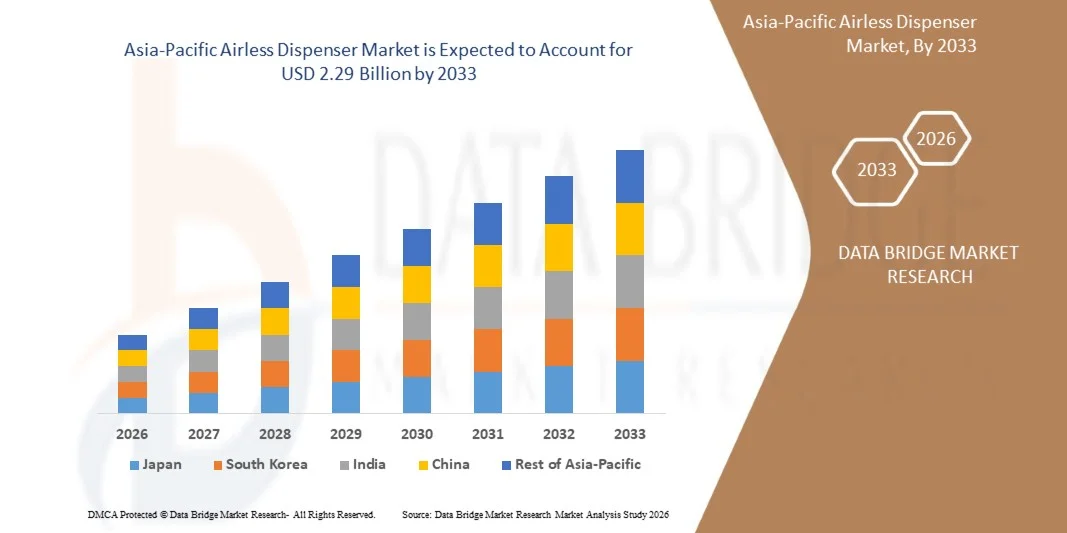
- As per Data Bridge Market Research Analysis the Asia-Pacific Airless Dispenser Market size was valued at USD 1.36 billion in 2025 and is expected to reach USD 2.29 billion by 2033, at a CAGR of 6.7% during the forecast period
- The market growth is largely fueled by the rising demand for hygienic, contamination-free packaging solutions across cosmetics, medical, and personal care industries. Airless dispensers maintain product integrity by preventing exposure to air, light, and microorganisms, ensuring longer shelf life and enhanced efficacy of formulations. The trend toward premium, travel-friendly, and aesthetically appealing packaging further drives adoption, as consumers increasingly seek convenience and functionality in everyday products
- Furthermore, increasing awareness of sustainability and waste reduction is boosting the adoption of airless dispenser technology. For instance, brands such as Estée Lauder and L’Oréal are leveraging airless packaging to minimize product wastage, provide controlled dispensing, and enhance consumer satisfaction. The convergence of eco-conscious packaging initiatives and premium product positioning is accelerating the uptake of airless dispensers across cosmetic, medical, and nutraceutical segments, significantly supporting industry growth
Market Size and Forecast:
- Global Market Value (2025): USD 1.36 billio
- Expected Market Value (2033): USD 2.29 billion
- Forecast CAGR (2026–2033): 6.7%
How Asia-Pacific Airless Dispenser Market Analysed?
- Airless dispensers are increasingly recognized as vital components of modern packaging solutions due to their ability to deliver precise dosing, prevent cross-contamination, and enhance user convenience. This makes them particularly attractive for skincare serums, creams, gels, and pharmaceutical topical formulations where dosage accuracy and hygiene are critical. Their compatibility with multiple materials such as plastic, glass, and metal also allows brands to differentiate products and maintain brand aesthetics while meeting functional requirements
- The escalating demand for airless dispensers is primarily fueled by innovation in dispensing mechanisms, material selection, and design customization. Advanced features such as vacuum-based pumping systems, twist-and-click mechanisms, and anti-leak seals are enabling brands to offer a superior user experience. Consumers increasingly prefer products that combine visual appeal with functional efficiency, driving manufacturers to adopt airless dispenser technologies across premium and mass-market segments
- China dominated the Asia-Pacific Airless Dispenser Market in 2025, due to its vast manufacturing capabilities, strong cosmetic and pharmaceutical industries, and growing consumer preference for hygienic, contamination-free packaging
- India is expected to be the fastest growing country in the Asia-Pacific Airless Dispenser Market during the forecast period due to rising disposable incomes, expanding middle-class households, and increasing awareness of hygienic and sustainable packaging solutions
- Plastic segment dominated the market with a market share of 63.8% in 2025, due to its lightweight nature, cost-effectiveness, and high durability. Plastic dispensers are widely used across cosmetics and pharmaceutical applications due to their ease of molding into various shapes and sizes while maintaining product safety. Their resistance to breakage and compatibility with diverse formulations makes them a preferred choice for mass-market and retail-ready packaging. In addition, advancements in recyclable and sustainable plastics are supporting growing demand among environmentally conscious consumers. Plastic dispensers also offer opportunities for brands to differentiate through design innovation, color, and finish options, driving adoption across multiple product lines
Report Scope and Asia-Pacific Airless Dispenser Market Segmentation
|
Attributes |
Airless Dispenser Key Market Insights |
|
Segments Covered |
|
|
Countries Covered |
Asia-Pacific
|
|
Key Market Players |
|
|
Market Opportunities |
|
|
Value Added Data Infosets |
In addition to the insights on market scenarios such as market value, growth rate, segmentation, geographical coverage, and major players, the market reports curated by the Data Bridge Market Research also include import export analysis, production capacity overview, production consumption analysis, price trend analysis, climate change scenario, supply chain analysis, value chain analysis, raw material/consumables overview, vendor selection criteria, PESTLE Analysis, Porter Analysis, and regulatory framework. |
What are the Asia-Pacific Airless Dispenser Market Trends?
“Growing Demand for Hygienic, Contamination-Free Packaging”
- The Asia-Pacific Airless Dispenser Market is witnessing a robust trend driven by increasing consumer demand for packaging solutions that offer maximum hygiene, contamination-free application, and precise product preservation. Airless dispensers are engineered to prevent air ingress and microbial contamination, maintaining product efficacy and freshness in skincare, cosmetics, pharmaceuticals, and food sectors
- For instance, leading brands such as AptarGroup and Quadpack have launched monomaterial and recyclable airless dispensers targeting premium cosmetic and pharmaceutical formulations. Their products are designed to minimize contact with air, thereby extending shelf life and enhancing product safety for sensitive ingredients and preservative-free formulas
- Rapid growth in clean-label and organic personal care categories is accelerating the adoption of airless technology. Brands are investing in airless dispensers to ensure active ingredient integrity, compliance with hygiene standards, and enhanced consumer experience, especially for high-value serums, creams, and medical ointments
- Innovation in packaging technology, such as smart dispensers with controlled dosage mechanisms, is expanding functionality and consumer convenience. These advancements enable marketers to offer precision dosing and reduce product waste, supporting sustainability and brand differentiation in competitive segments
- In addition, rising e-commerce and direct-to-consumer distribution channels are encouraging adoption of airless dispensers, as consumers prioritize shelf stability and safety for online purchases. The trend is consistent across North America, Europe, and Asia, reflecting global demand for premium, tamper-proof packaging formats
- The convergence of hygiene, shelf life extension, and sustainable packaging is setting new standards, with airless dispensers becoming essential for brands focused on product safety, environmental impact, and aesthetic appeal across personal care and healthcare industries
Asia-Pacific Airless Dispenser Market Dynamics
Driver
“Adoption of Airless Dispensers for Shelf Life and Precise Dosing”
- The growing adoption of airless dispensers by pharmaceuticals, cosmetics, and nutraceutical brands is a key driver for market growth, as these packaging systems provide extended shelf life and enable accurate, contamination-free dosing. Their design ensures consistent protection against air, bacteria, and moisture, preserving chemical stability and potency of high-value formulations
- For instance, L’Oréal and Johnson & Johnson have introduced advanced airless packaging lines for serums, sunscreens, and therapeutic creams, leveraging controlled dispensing, precision dosing, and reduced oxidation to deliver superior product performance and safety
- Major advantages of airless dispensers include limiting exposure to air, thereby preventing spoilage, color change, and ingredient degradation. This is particularly important for preservative-free and sensitive ingredient formulations aimed at health-conscious and allergic consumers
- Widespread adoption of airless dispensers in pharmaceutical packaging is improving dosage control and user convenience in prescription and OTC drugs. These systems facilitate clean, single-handed application and reduce dosing errors, enhancing compliance and patient safety
- The global expansion of premium and functional product categories—ranging from anti-aging creams to sterile wound care—continues to underpin the shift toward airless dispensing solutions. Manufacturers benefit from longer shelf life, improved product protection, and reduced risk of contamination during product use and storage
Restraint/Challenge
“High Production and Material Costs”
- High production and material costs remain a significant restraint for Asia-Pacific Airless Dispenser Market expansion. The engineering complexity of airless dispensing systems—requiring precise molding, assembly, and testing—results in higher manufacturing expenses and limits widespread adoption in cost-sensitive product categories
- For instance, companies such as Silgan Dispensing Systems and Eastman Chemical Company contend with high prices for medical-grade and recyclable polymers used in airless packaging. Additional investments in machinery, quality control, and regulatory compliance further increase operating costs, posing challenges for small and mid-size suppliers
- Customization requirements for specialty formulations, such as adjusting dosage mechanism and compatibility with viscosity, add to design and production costs, stressing margins for manufacturers targeting broad market segments
- Regional supply constraints for high-grade materials and limited access to advanced manufacturing technologies can hinder market entry for local players, restricting innovation and competition
- Addressing production and material cost challenges will require investment in automated assembly, scalable polymer technologies, and supply chain partnerships, enabling cost reduction while maintaining product performance. Adoption of refillable and eco-designed airless solutions may further support market growth and expand accessibility across diverse price points
Asia-Pacific Airless Dispenser Market Scope
The market is segmented on the basis of product type, material, packaging type, distribution channel, and end-user.
• By Product Type
On the basis of product type, the Asia-Pacific Airless Dispenser Market is segmented into pumps, twist and click, and droppers. The pumps segment dominated the market with the largest market revenue share in 2025, driven by its versatility and efficient dispensing mechanism. Pumps offer precise product delivery, reducing wastage and ensuring hygienic application, which appeals to both cosmetics and medical industries. Consumers and brands often prefer pump airless dispensers for their ease of use and ability to preserve product integrity over extended periods. Their compatibility with a wide range of viscosities and formulations enhances their adoption across skincare, pharmaceutical, and personal care products. In addition, pumps integrate well with premium packaging designs, increasing their appeal among high-end brands and end-users.
The twist and click segment is anticipated to witness the fastest growth rate from 2026 to 2033, fueled by increasing consumer preference for interactive and user-friendly dispensing solutions. For instance, cosmetic brands such as L’Oréal are adopting twist and click airless dispensers to offer controlled product access and enhance user engagement. Their compact and portable design makes them suitable for travel and on-the-go usage, particularly in luxury and specialty skincare products. Twist and click dispensers also provide a secure, leak-proof solution, making them attractive to both consumers and manufacturers seeking convenience and hygiene. The innovation in mechanical design and aesthetic customization further supports rapid adoption in premium product lines.
• By Material
On the basis of material, the Asia-Pacific Airless Dispenser Market is segmented into plastic, glass, metal, and others. The plastic segment dominated the market with the largest market revenue share of 63.8% in 2025, owing to its lightweight nature, cost-effectiveness, and high durability. Plastic dispensers are widely used across cosmetics and pharmaceutical applications due to their ease of molding into various shapes and sizes while maintaining product safety. Their resistance to breakage and compatibility with diverse formulations makes them a preferred choice for mass-market and retail-ready packaging. In addition, advancements in recyclable and sustainable plastics are supporting growing demand among environmentally conscious consumers. Plastic dispensers also offer opportunities for brands to differentiate through design innovation, color, and finish options, driving adoption across multiple product lines.
The glass segment is expected to witness the fastest CAGR from 2026 to 2033, driven by its premium appeal and perceived quality among luxury cosmetic and skincare brands. For instance, Estée Lauder has increasingly adopted glass airless dispensers to convey sophistication and enhance consumer perception of product value. Glass provides superior protection against chemical interaction and preserves formulation efficacy for sensitive ingredients, particularly in high-end serums and creams. Its transparent or tinted design allows consumers to view product levels while maintaining brand aesthetics. The growing trend toward luxury packaging and sustainability initiatives in glass recycling further supports its rapid adoption in the premium segment.
• By Packaging Type
On the basis of packaging type, the Asia-Pacific Airless Dispenser Market is segmented into bottles, jars, and tubes. The bottles segment dominated the market with the largest market revenue share in 2025, due to its widespread adoption across cosmetics, medical, and personal care industries. Bottles offer precise dispensing, reduce contamination risks, and maintain product stability over extended use, which is particularly critical for serums, lotions, and liquid formulations. Their ergonomic design and compatibility with pumps and other dispensing mechanisms enhance usability and consumer convenience. In addition, bottles provide ample scope for branding and aesthetic customization, appealing to premium and mass-market brands alike. Their standardization in manufacturing processes and supply chains also makes bottles the most cost-effective and scalable solution for large-scale production.
The jars segment is anticipated to witness the fastest growth rate from 2026 to 2033, fueled by the rising popularity of skincare and specialty products in premium and artisanal categories. For instance, brands such as Drunk Elephant have embraced airless jars to offer controlled dispensing for creams and balms while ensuring product hygiene. Airless jar technology preserves product integrity by minimizing air exposure and preventing contamination. Their visually appealing design and ability to showcase product textures make them attractive to consumers seeking luxury experiences. Continuous innovations in jar sealing mechanisms and material combinations further accelerate market adoption.
• By Distribution Channel
On the basis of distribution channel, the Asia-Pacific Airless Dispenser Market is segmented into cosmetic stores, pharmacies, supermarkets/hypermarkets, e-commerce, specialty stores, and others. The e-commerce segment dominated the market with the largest market revenue share in 2025, driven by the growing consumer preference for online shopping and direct-to-consumer sales models. E-commerce platforms provide easy access to a wide variety of products, enabling consumers to compare brands, read reviews, and make informed purchasing decisions. The digital retail environment also allows brands to launch new products and limited editions efficiently while collecting consumer feedback. In addition, online channels support global reach, helping both established and emerging brands tap into international markets without significant physical presence.
The specialty stores segment is expected to witness the fastest CAGR from 2026 to 2033, fueled by increasing demand for curated and premium product selections. For instance, Sephora and similar specialty retailers are expanding their airless dispenser product offerings to attract high-spending consumers seeking niche or innovative formulations. Specialty stores provide an immersive shopping experience, expert guidance, and personalized recommendations, which enhances consumer trust and loyalty. The focus on premium and luxury skincare products sold through specialty channels supports rapid adoption of innovative packaging formats such as airless dispensers. Their exclusive product range and targeted consumer base further accelerate growth in this segment.
• By End-User
On the basis of end-user, the Asia-Pacific Airless Dispenser Market is segmented into cosmetics, medical, food and beverages, and others. The cosmetics segment dominated the market with the largest market revenue share in 2025, driven by the rising demand for skincare, haircare, and personal care products across global markets. Airless dispensers in cosmetics help maintain product integrity, prevent contamination, and provide precise dosage, which is critical for high-value serums, creams, and lotions. Brands increasingly adopt airless packaging to convey premium quality and ensure consistent user experience across product lines. In addition, cosmetic applications benefit from the aesthetic versatility of airless dispensers, allowing brands to innovate in design and branding to attract end-users. Rising awareness of hygiene, product efficacy, and sustainable packaging also supports strong demand in the cosmetic sector.
The medical segment is anticipated to witness the fastest growth rate from 2026 to 2033, fueled by increasing adoption in pharmaceutical and healthcare applications requiring precise, sterile dispensing. For instance, companies such as BD (Becton Dickinson) are utilizing airless dispensers for topical medications, gels, and liquid formulations that require accurate dosing and contamination prevention. Airless technology ensures product stability, protects active ingredients, and supports compliance with strict regulatory standards in healthcare. The growing focus on patient safety, ease of administration, and portability further drives adoption in hospitals, clinics, and home healthcare settings. Continuous innovation in dispensing mechanisms tailored to medical applications enhances the segment’s rapid growth potential.
Asia-Pacific Airless Dispenser Market Regional Analysis
- China dominated the Asia-Pacific Airless Dispenser Market with the largest revenue share in 2025, driven by its vast manufacturing capabilities, strong cosmetic and pharmaceutical industries, and growing consumer preference for hygienic, contamination-free packaging
- Robust government regulations on product safety, combined with rising demand for premium skincare and personal care products, reinforce China’s leadership in the regional market
- The presence of leading domestic packaging manufacturers, collaborations with global cosmetic brands, and the introduction of innovative, cost-effective airless solutions continue to consolidate China’s dominant position during the forecast period. Expanding e-commerce platforms, increasing brand awareness, and a growing urban population further strengthen market penetration across both tier-1 and tier-2 cities
Japan Asia-Pacific Airless Dispenser Market Insight
The Japan market is anticipated to grow steadily from 2025 to 2033, supported by its advanced cosmetic, pharmaceutical, and healthcare sectors and a strong focus on product safety and innovation. Japanese consumers are increasingly adopting premium airless dispensers for skincare, medical, and personal care applications, reflecting the country’s emphasis on precision, hygiene, and reliability. The demand for compact, multifunctional, and travel-friendly dispenser designs is rising due to urban lifestyles and smaller living spaces. Continuous R&D investments, collaborations between domestic and international brands, and a preference for sustainable and high-quality packaging solutions reinforce the market’s steady growth outlook. Japan’s commitment to safety, innovation, and consumer trust underpins its strong regional positioning.
India Asia-Pacific Airless Dispenser Market Insight
India is projected to register the fastest CAGR in the Asia-Pacific Airless Dispenser Market during 2025–2033, fueled by rising disposable incomes, expanding middle-class households, and increasing awareness of hygienic and sustainable packaging solutions. Rapid growth of the cosmetics, personal care, and pharmaceutical sectors, along with government initiatives supporting product safety standards, are accelerating adoption. The demand for affordable, easy-to-use, and travel-friendly airless dispensers is particularly strong among young consumers and first-time users. Expanding retail distribution, booming e-commerce platforms, and partnerships with global brands are enhancing product accessibility across urban and semi-urban regions. Growing consumer focus on quality, hygiene, and premium product experiences ensures India’s emergence as the fastest-growing market in the region.
Which are the Top Companies in Asia-Pacific Airless Dispenser Market?
The airless dispenser industry is primarily led by well-established companies, including:
- LUMSON S.p.A (Italy)
- HCP Packaging (China)
- APC PACKAGING (U.S.)
- AptarGroup, Inc. (U.S.)
- Albéa Services S.A.S (France)
- Quadpack (Spain)
- Silgan Holdings Inc. (U.S.)
- Qosmedix (U.S.)
- Nemera (France)
- LABLABO (France)
- CHONGWOO (South Korea)
- Verla International, Ltd. (U.S.)
- SHENZHEN BONA PHARMA TECHNOLOGY CO., LTD (China)
- FLOCON, INC. (U.S.)
- Anomatic (U.S.)
- Fusion Packaging I, LLC (U.S.)
- Berlin Packaging | Premi Industries (Italy)
What are the Latest Developments in Asia-Pacific Airless Dispenser Market?
- In October 2022, Silgan Dispensing announced the development of ReVive™ 2cc and 4cc Dispensers following recyclability recognition from The Association of Plastics Recyclers (APR). This recognition confirmed that the new dispensers were recyclable in the North American markets, which strongly aligns with the market's increasing focus on circular economy principles and sustainable packaging design
- In July 2021, Baralan unveiled DEA, an acronym for "Developing the Evolution of Airless," a new line of products made of glass airless containers with multiple uses. DEA is one of the first airless systems where the filled product comes into direct contact with its glass container since it lacks an interior plastic component, offering a more environmentally friendly primary packaging approach with fewer components
- In January 2021, APC Packaging launched its airless refillable system for the beauty industry. This innovative patented system utilizes polypropylene throughout the entire structure and can be effectively combined with Post-Consumer Recycled (PCR) materials to significantly reduce the product's carbon footprint and overall environmental impact, meeting the growing demand for sustainable beauty solutions
- In November 2020, RAEPAK Ltd announced the launch of dual dispensing packaging solution. The new solution offered the capability of combining two separate products as one item. The new product is multi-functional, fashionable, unique and stylish end-products that will be delivered in a single package. The new product increased the product portfolio of the company.
- In September 2020, HCP Packaging completed the acquisition of Hetian Packaging (Huai'an) Co., Ltd., which is engaged in aluminum parts forming and anodising factories. The acquisition will help the company in integrating aluminum in its already existing cosmetic container manufacturing capabilities. The new acquisition has led to the formation of 5 manufacturing companies in China and will help in expanding its product portfolio by building aluminum packaging

- Interactive Data Analysis Dashboard
- Company Analysis Dashboard for high growth potential opportunities
- Research Analyst Access for customization & queries
- Competitor Analysis with Interactive dashboard
- Latest News, Updates & Trend analysis
- Harness the Power of Benchmark Analysis for Comprehensive Competitor Tracking
Asia Pacific Airless Dispenser Market, Supply Chain Analysis and Ecosystem Framework
To support market growth and help clients navigate the impact of geopolitical shifts, DBMR has integrated in-depth supply chain analysis into its Asia Pacific Airless Dispenser Market research reports. This addition empowers clients to respond effectively to global changes affecting their industries. The supply chain analysis section includes detailed insights such as Asia Pacific Airless Dispenser Market consumption and production by country, price trend analysis, the impact of tariffs and geopolitical developments, and import and export trends by country and HSN code. It also highlights major suppliers with data on production capacity and company profiles, as well as key importers and exporters. In addition to research, DBMR offers specialized supply chain consulting services backed by over a decade of experience, providing solutions like supplier discovery, supplier risk assessment, price trend analysis, impact evaluation of inflation and trade route changes, and comprehensive market trend analysis.
Data collection and base year analysis are done using data collection modules with large sample sizes. The stage includes obtaining market information or related data through various sources and strategies. It includes examining and planning all the data acquired from the past in advance. It likewise envelops the examination of information inconsistencies seen across different information sources. The market data is analysed and estimated using market statistical and coherent models. Also, market share analysis and key trend analysis are the major success factors in the market report. To know more, please request an analyst call or drop down your inquiry.
The key research methodology used by DBMR research team is data triangulation which involves data mining, analysis of the impact of data variables on the market and primary (industry expert) validation. Data models include Vendor Positioning Grid, Market Time Line Analysis, Market Overview and Guide, Company Positioning Grid, Patent Analysis, Pricing Analysis, Company Market Share Analysis, Standards of Measurement, Global versus Regional and Vendor Share Analysis. To know more about the research methodology, drop in an inquiry to speak to our industry experts.
Data Bridge Market Research is a leader in advanced formative research. We take pride in servicing our existing and new customers with data and analysis that match and suits their goal. The report can be customized to include price trend analysis of target brands understanding the market for additional countries (ask for the list of countries), clinical trial results data, literature review, refurbished market and product base analysis. Market analysis of target competitors can be analyzed from technology-based analysis to market portfolio strategies. We can add as many competitors that you require data about in the format and data style you are looking for. Our team of analysts can also provide you data in crude raw excel files pivot tables (Fact book) or can assist you in creating presentations from the data sets available in the report.













