


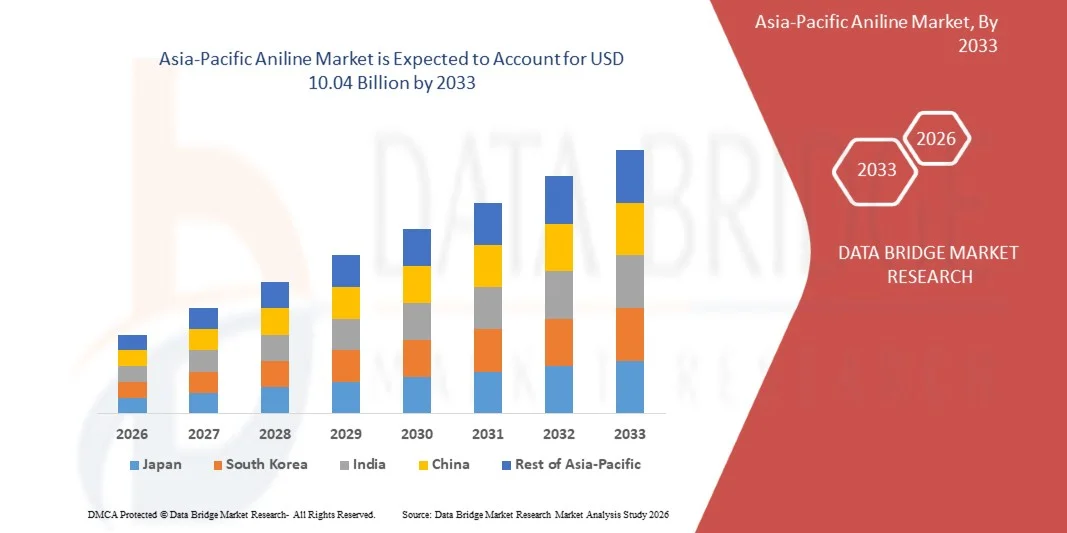
Asia-Pacific Aniline Market Size
- The Asia-Pacific Aniline Market size was valued at USD 6.18 billion in 2025 and is expected to reach USD 10.04 billion by 2033, at a CAGR of 6.4% during the forecast period
- The growth of the Asia-Pacific Aniline Market is primarily driven by rising demand for MDI (methylene diphenyl diisocyanate) in polyurethane production, expanding applications in construction, automotive, and furniture industries, and increasing industrialization in emerging economies, which boosts the need for insulation materials and coatings.
- In addition, the market is supported by advancements in chemical manufacturing, expanding use of aniline in pharmaceuticals, dyes, and rubber-processing chemicals, and growing investments in sustainable production technologies. These factors collectively accelerate market adoption and significantly contribute to the overall expansion of the industry.
Asia-Pacific Aniline Market Analysis
- The Asia-Pacific Aniline Market encompasses the production, processing, and utilization of aniline in polyurethane, dyes & pigments, rubber-processing chemicals, and pharmaceutical intermediates, driven by rapid infrastructure development, growth in automotive manufacturing, and rising demand for insulation materials in construction and energy projects across the region.
- The rising adoption of aniline is propelled by expanding polyurethane foam applications, increasing investment in chemical manufacturing, and manufacturers’ strategic shift toward higher-efficiency, specialty-grade derivatives, aimed at meeting growing regional requirements for durable coatings, advanced polymers, and flexible foam solutions across industrial and consumer sectors
- China is expected to dominate the Asia-Pacific Aniline Market with the largest market share of 23.84% in 2026 and is also projected to record the highest CAGR during the forecast period, driven by rapid expansion of the country’s polyurethane and construction industries, strong investments in downstream chemical manufacturing under the Saudi Vision 2030 initiative, and the presence of large-scale MDI and isocyanate production facilities. In addition, growing demand for insulation materials in infrastructure, energy, and industrial projects, along with strategic partnerships between global chemical players and domestic producers, is further strengthening Saudi Arabia’s leadership in aniline consumption and production capacity across the region.
- The Nitrobenzene Hydrogenation segment is expected to dominate the Asia-Pacific Aniline Market with the largest market share of 69.66% in 2026, primarily due to its established role as the most efficient, cost-effective, and industrially scalable method for aniline production. This process benefits from high conversion rates, reliable yield consistency, and compatibility with large-volume petrochemical operations, making it the preferred technology among regional manufacturers. Additionally, increasing investment in downstream polyurethane and MDI production, coupled with expanding chemical processing capacity across Saudi Arabia and the broader GCC, continues to strengthen demand for nitrobenzene hydrogenation as the leading production route in the Asia-Pacific.
Report Scope and Asia-Pacific Aniline Market Segmentation
|
Attributes |
Asia-Pacific Aniline Key Market Insights |
|
Segments Covered |
|
|
Countries Covered |
Asia-Pacific
|
|
Key Market Players |
|
|
Market Opportunities |
|
|
Value Added Data Infosets |
In addition to the insights on market scenarios such as market value, growth rate, segmentation, geographical coverage, and major players, the market reports curated by the Data Bridge Market Research also include import export analysis, production capacity overview, production consumption analysis, price trend analysis, climate change scenario, supply chain analysis, value chain analysis, raw material/consumables overview, vendor selection criteria, PESTLE Analysis, Porter Analysis, and regulatory framework. |
Asia-Pacific Aniline Market Trends
“Strong Demand from Polyurethane / MDI”
- Rising industrial preference for high-performance polyurethane systems acts as a strong driver for the global Asia-Pacific Aniline Market, as aniline is the essential precursor for MDI production. Industries such as construction, automotive, insulation, and appliances increasingly prioritize materials that deliver durability, thermal efficiency and lightweight performance—directly increasing consumption of MDI and, therefore, aniline.
- Demand growth incentivizes MDI producers and integrated chemical manufacturers to expand capacity, secure raw material supply chains, and invest in advanced catalytic technologies to improve efficiency and yield. As a result, aniline producers scale operations, broaden supply footprints, and enhance process optimization to meet long-term polyurethane market needs.
- In 2025, construction sector assessments across Asia and the Middle East highlighted accelerated infrastructure development and rising adoption of energy-efficient building materials, reinforcing the need for rigid polyurethane foam—one of the largest downstream applications of aniline-derived MDI.
- In 2024, multiple chemical industry outlook reports signaled strong growth in automotive production, especially in EV manufacturing, where polyurethane foams and coatings are used for lightweighting, noise insulation and interior comfort—further amplifying demand for aniline-based MDI.
- In 2025, global material-innovation briefings emphasized the shift toward high-performance, sustainable insulation and cushioning materials, noting that polyurethane solutions continue to dominate due to superior thermal, mechanical and structural properties. This industry orientation accelerates demand for aniline as a critical feedstock supporting polyurethane and MDI value chains.
Asia-Pacific Aniline Market Dynamics
Driver
“Rising demand for mdi-based polyurethanes in construction, automotive, and appliances”
- Growth in polyurethane-centered innovations across construction, automotive, and appliance manufacturing acts as a principal demand driver for the global Asia-Pacific Aniline Market, because aniline is the core feedstock for MDI, which is essential in producing rigid and flexible polyurethane foams, coatings, adhesives and insulation materials. Manufacturers in these end-use sectors continue to prioritise materials that provide superior energy efficiency, structural strength, lightweighting, and durability—needs that strongly favour MDI-based polyurethanes. This sustained shift accelerates aniline consumption and stimulates investment in higher-capacity, more efficient MDI production systems. Evidence from industry outlooks and manufacturing policy frameworks further supports continuous expansion of polyurethane-oriented value chains in construction and mobility sectors.
- In 2025, several global chemical producers announced capacity expansions in MDI and polyurethane systems to meet rising construction-driven demand for rigid insulation foams, which are increasingly mandated in building codes focused on thermal efficiency and sustainability. These expansions signal strong, long-term demand pull for upstream aniline production.
- Industry leaders such as BASF, Huntsman, Wanhua, and Covestro are advancing process efficiency, expanding integrated aniline–MDI facilities, and developing specialised polyurethane formulations for next-generation automotive interiors, EV battery insulation, comfort foams, and durable appliance components. These capacity additions and product innovations highlight how high-performance polyurethane applications directly reinforce growth in aniline consumption.
- At the same time, global sustainability and energy-efficiency initiatives—including green-building certifications, insulation standards, and lightweighting policies—are creating favourable conditions for polyurethane adoption, thereby increasing the need for MDI and its precursor aniline. Regulations promoting energy-efficient construction and low-emission vehicles significantly strengthen demand for MDI-based material solutions.
- Together, these developments illustrate how the convergence of functional performance requirements, regulatory sustainability pressures, and rapid innovation within polyurethane technology is driving continuous growth, diversification, and upstream investment within the aniline sector. The structural alignment between MDI demand and polyurethane market expansion ensures that aniline remains a strategically critical chemical in global industrial manufacturing.
Restraint/Challenge
“Benzene price volatility and exposure to cyclical aromatics margins”
- Volatility in benzene prices functions as a major restraint for the global Asia-Pacific Aniline Market, because benzene is the primary feedstock, and fluctuations in crude oil, refinery operations, and aromatics supply-demand cycles directly influence aniline production costs and profit margins. Producers and downstream MDI manufacturers face continuous margin pressure when benzene values move unpredictably forcing operational adjustments, shorter planning cycles, and more conservative production strategies. This dynamic often limits the ability of aniline suppliers to maintain stable pricing or commit to long-term supply agreements, constraining investment confidence across the value chain.
- For instance – In 2024–2025, global benzene markets experienced sharp fluctuations due to a combination of refinery outages, shifts in reformate economics, and variable styrene and cyclohexane operating rates, which tightened aromatics balances and caused significant cost instability for aniline manufacturers. These disruptions highlighted the sensitivity of the aniline industry to external feedstock shocks and cyclical aromatics profitability.
- Industry leaders such as BASF, Covestro, and Wanhua have reported the need for careful inventory management, hedging strategies, and selective run-rate optimization during high benzene price phases, demonstrating how volatility in upstream aromatics markets forces producers to alter operational behaviour and delay new investment during unfavorable cycles.
- In parallel, global chemical-sector analyses emphasize that benzene–MDI value chains are increasingly exposed to cyclical downturns driven by macroeconomic slowdowns, reduced construction activity, or weaker automotive manufacturing, which compress aromatics margins and reduce the ability of producers to pass through cost increases. These cyclical downturns amplify the financial and operational risks associated with benzene-derived aniline production.
- Together, these conditions illustrate how the convergence of feedstock volatility, cyclical aromatics margins, and macroeconomic sensitivity poses a sustained structural challenge to the aniline sector, limiting margin stability and influencing investment decisions, capacity utilization, and long-term planning across global aniline–MDI markets.
Asia-Pacific Aniline Market Scope
The Asia-Pacific Malt Extracts and Kvass Wort Concentrates Market is segmented into six segments based on Production Process, Grade & purity, Manufacturing Process, Application, End User, Distribution Channel
- By Production Process
On the basis of production process, the Asia-Pacific Aniline Market is segmented into Nitrobenzene Hydrogenation, Integrated Nitration–Hydrogenation (Benzene-to-Aniline), Bio-Based Routes (Pilot/Emerging), Other Emerging Pathways. In 2026, the Nitrobenzene Hydrogenation segment is expected to dominate the market with a market share of 23.84% Rye is growing with the CAGR of 7.4 % in the forecast period 2026 to 2033, largely because this route remains the most established, cost-efficient, and industrially scalable production technology for aniline. The process benefits from mature reactor designs, well-optimized catalysts, and broad global availability of nitrobenzene, enabling manufacturers to achieve high yields, consistent product quality, and reliable large-volume output. Additionally, the strong integration of major MDI producers with nitrobenzene aniline value chains further reinforces its cost competitiveness, reducing exposure to supply disruptions and enhancing operational efficiency.
- By Grade & Purity
On the basis of grade & purity, the Asia-Pacific Aniline Market is segmented into Standard Industrial Grade (≥99.5%), High Purity Grade (≥99.9%) and Salts and Formulations. In 2026, the Standard Industrial Grade (≥99.5%) segment is expected to dominate the market with a market share of 70.06% growing with the CAGR of 6.6% in the forecast period 2026 to 2033, primarily because this purity level meets the bulk requirements of major downstream applications—particularly MDI production for polyurethane foams used in construction, automotive, and appliance manufacturing. The grade offers an optimal balance of cost-effectiveness and performance, enabling large-scale producers to operate efficiently while maintaining consistent chemical specifications for high-volume industrial processes.
- By Application
On the basis of Application, the Asia-Pacific Aniline Market is segmented into Methylene Diphenyl Diisocyanate (MDI) Production, Rubber Processing Chemicals, Dyes & Pigments, Agrochemicals, Pharmaceuticals and Others. In 2026, the Methylene Diphenyl Diisocyanate (MDI) Production segment is expected to dominate the market with a share of 56.02% is growing with the CAGR of 6.8% in the forecast period 2026 to 2033, due to primarily because MDI is the largest and most critical downstream application of aniline globally. MDI serves as the key building block for polyurethane foams used extensively in construction insulation, automotive components, furniture, bedding, refrigeration systems, and various industrial materials. The continued expansion of infrastructure projects, energy-efficient building standards, lightweight automotive manufacturing, and durable appliance production reinforces strong, sustained demand for MDI.
- By End user
On the basis of End User, the Asia-Pacific Aniline Market is segmented into Automotive, Furniture & Appliances, Textiles & Leather, Electrical & Electronics, Construction and Others In 2026, the Automotive segment is expected to dominate the market with a market share of 39.62% is growing with the CAGR of 6.9% in the forecast period 2026 to 2033, due to the extensive use of malt extracts and kvass wort concentrates in both alcoholic and non-alcoholic drink formulations. Their ability to enhance flavor, sweetness, color, and fermentation efficiency, along with rising consumer demand for craft, functional, and natural beverages, strongly drives this segment’s growth.
- By distribution channel
On the basis of distribution channel, the market is segmented into Direct and Retail. In 2026, the Direct segment is expected to dominate the market with a market share of 72.60% growing with the CAGR of 6.9% in the forecast period 2026 to 2033, due to primarily because large-scale industrial consumers such as MDI manufacturers, polyurethane producers, and chemical intermediates companies prefer direct procurement from suppliers to ensure consistent supply, bulk volumes, and competitive pricing. Direct sales enable streamlined logistics, long-term supply agreements, and integrated quality assurance, which are critical for maintaining uninterrupted production in highly specialized downstream processes.
Asia-Pacific Aniline Market Regional Analysis
- Asia-Pacific is capturing a regional share of 52.46% in 2026, supported by well-established industrial demand and emerging applications in construction insulation, automotive components, and specialty chemicals. The region also demonstrates the strongest CAGR of 6.4%, indicating rapid growth compared with other regions. Expansion is driven by rising infrastructure development, adoption of energy-efficient building materials, and increasing investments in automotive and appliance manufacturing that rely on MDI-derived polyurethane products.
- The region benefits from the presence of key domestic and regional chemical manufacturers, supportive trade policies, and favorable regulatory and pricing conditions, all of which facilitate market penetration and ensure consistent supply for industrial consumers. Additionally, initiatives to promote sustainable and high-performance materials in construction and automotive sectors strengthen the long-term growth outlook for aniline in Asia-Pacific.
China Asia-Pacific Aniline Market Insight
The China Asia-Pacific Aniline Market is poised for strong growth, supported by the rapid expansion of the country’s polyurethane value chain, especially driven by rising demand for MDI in construction, automotive, and appliance industries. The Saudi polyurethane market is projected to grow at a significant rate, with its MDI segment expanding due to Vision 2030–led infrastructure development and industrial diversification.
Asia-Pacific Aniline Market Share
The Aniline industry is primarily led by well-established companies, including:
- BASF (Germany)
- Covestro AG (Germany)
- Wanhua (China)
- China Risun Group Limited (China)
- Bondalti (Portugal)
- Sumitomo Chemical Co., Ltd. (Japan)
- Gujarat Narmada Valley Fertilizers & Chemicals Limited (India)
- Merck & Co., Inc. (U. S)
- LANXESS (Germany)
- Panoli Intermediates India Pvt. Ltd. (India)
- Huntsman International LLC (U.S.)
- Tokyo Chemical Industry Co., Ltd. (Japan)
- JSK Chemicals (India)
- Henan Sinowin Chemical Industry Co., Ltd. (China)
Latest Developments in Asia-Pacific Aniline Market
- In 2024, Covestro launched a pilot plant in Leverkusen, Germany, to produce bio-based aniline from plant-derived biomass. This initiative marked a significant milestone in sustainable chemical manufacturing, as it demonstrated the technical feasibility of producing aniline entirely from renewable sources using a combination of fermentation and catalytic conversion. The bio-based aniline is primarily used for MDI (methylene diphenyl diisocyanate) production, a key component in polyurethane foams for insulation, furniture, and automotive applications. By scaling up this technology, Covestro is reducing reliance on petroleum-based feedstocks and advancing the global push toward environmentally friendly chemical processes.
- In April 2024, the French biotech company Pili successfully industrialized the production of a bio-based aniline derivative, specifically anthranilic acid, using microbial fermentation. The company produced several tons at commercial scale, enabling the material to be used in dyes, pigments, and other fine chemicals. Pili’s achievement highlights how biotechnology can offer scalable, renewable alternatives to traditional petrochemical routes while reducing environmental impact. It also demonstrates growing market acceptance for bio-based intermediates in industries that rely heavily on aromatic compounds.
- In 2025, BASF announced plans to expand its MDI capacity in Shanghai, China, and as part of its “Winning Ways” strategy, the company is upgrading its nitrobenzene/aniline unit to operate longer each year (from ~7,500 to ~8,000 hours). Because aniline is a key precursor to MDI, the expansion naturally raises upstream aniline demand, supporting additional capacity growth. This move further strengthens BASF’s integrated value chain in Asia-Pacific, enhancing long-term supply security for both intermediates and downstream polyurethane products.

- Interactive Data Analysis Dashboard
- Company Analysis Dashboard for high growth potential opportunities
- Research Analyst Access for customization & queries
- Competitor Analysis with Interactive dashboard
- Latest News, Updates & Trend analysis
- Harness the Power of Benchmark Analysis for Comprehensive Competitor Tracking
Table of Content
1 INTRODUCTION
1.1 OBJECTIVES OF THE STUDY
1.2 MARKET DEFINITION
1.3 OVERVIEW
1.4 LIMITATIONS
1.5 MARKETS COVERED
2 MARKET SEGMENTATION
2.1 MARKETS COVERED
2.2 GEOGRAPHICAL SCOPE
2.3 YEARS CONSIDERED FOR THE STUDY
2.4 CURRENCY AND PRICING
2.5 DBMR TRIPOD DATA VALIDATION MODEL
2.6 MULTIVARIATE MODELING
2.7 TIMELINE CURVE
2.8 PRIMARY INTERVIEWS WITH KEY OPINION LEADERS
2.9 DBMR MARKET POSITION GRID
2.1 DBMR VENDOR SHARE ANALYSIS
2.11 MARKET APPLICATION COVERAGE GRID
2.12 SECONDARY SOURCES
2.13 ASSUMPTIONS
3 EXECUTIVE SUMMARY
4 PREMIUM INSIGHTS
4.1 PORTER’S FIVE FORCES
4.2 PRICING ANALYSIS
4.3 VENDOR SELECTION CRITERIA
4.3.1 MATERIAL SOURCING AND QUALITY
4.3.2 MANUFACTURING CAPABILITIES
4.3.3 COST COMPETITIVENESS
4.3.4 FLEXIBLITY AND COLLABORATIONS
4.3.5 SUPPLY CHAIN RELIABILITY
4.3.6 SUSTAINABILITY PRACTICES
4.4 BRAND OUTLOOK
4.4.1 COMPANY VS BRAND OVERVIEW
4.5 CLIMATE CHANGE SCENARIO – ASIA-PACIFIC ANILINE MARKET
4.5.1 INTRODUCTION
4.5.2 ENVIRONMENTAL CONCERNS
4.5.3 INDUSTRY RESPONSE
4.5.4 GOVERNMENT’S ROLE
4.5.5 ANALYST RECOMMENDATIONS
4.5.6 CONCLUSION
4.6 CONSUMER BUYING BEHAVIOUR
4.6.1 GROUP 1 PREMIUM CHEMICAL PRODUCERS
4.6.2 GROUP 2 PRICE-SENSITIVE MID-SIZED FORMULATORS
4.6.3 GROUP 3 INDUSTRIAL USERS WITH LOGISTICS FOCUS
4.6.4 GROUP 4 COST-FOCUSED SMALL PROCESSORS / TRADERS
4.6.5 GROUP 5 SPECIALTY APPLICATION MANUFACTURERS
4.6.6 GROUP 6 EMERGING MARKET LARGE BUYERS
4.7 COST ANALYSIS BREAKDOWN — ASIA-PACIFIC ANILINE MARKET
4.7.1 RAW MATERIAL COSTS
4.7.2 UTILITIES AND ENERGY CONSUMPTION
4.7.3 LABOUR, WORKFORCE CAPABILITIES, AND STAFFING COSTS
4.7.4 PROCESS TECHNOLOGY, EQUIPMENT, AND MAINTENANCE COSTS
4.7.5 ENVIRONMENTAL COMPLIANCE AND SAFETY MANAGEMENT COSTS
4.7.6 PACKAGING AND PRODUCT HANDLING COSTS
4.7.7 LOGISTICS, TRANSPORTATION, AND STORAGE COSTS
4.7.8 OVERHEADS, ADMINISTRATIVE, AND SUPPORT COSTS
4.7.9 CONCLUSION
4.8 INDUSTRY ECOSYSTEM ANALYSIS — ASIA-PACIFIC ANILINE MARKET
4.8.1 INTRODUCTION
4.8.2 PROMINENT COMPANIES
4.8.3 SMALL & MEDIUM-SIZED COMPANIES
4.8.4 END USERS
4.8.5 CONCLUSION
4.9 INNOVATION TRACKER AND STRATEGIC ANALYSIS
4.9.1 MAJOR DEALS AND STRATEGIC ALLIANCES ANALYSIS — ASIA-PACIFIC ANILINE MARKET
4.9.1.1 Joint Ventures
4.9.1.2 Mergers and Acquisitions
4.9.1.3 Licensing and Partnership
4.9.1.4 Technology Collaborations
4.9.1.5 Strategic Divestments
4.9.2 NUMBER OF PRODUCTS IN DEVELOPMENT
4.9.3 STAGE OF DEVELOPMENT
4.9.4 TIMELINES AND MILESTONES
4.9.5 INNOVATION STRATEGIES AND METHODOLOGIES
4.9.6 RISK ASSESSMENT AND MITIGATION
4.9.7 FUTURE OUTLOOK
4.1 PATENT ANALYSIS
4.10.1 PATENT QUALITY AND STRENGTH
4.10.2 EGION PATENT LANDSCAPE
4.10.3 IP STRATEGY AND MANAGEMENT
4.10.4 PATENT FAMILIES
4.10.5 LICENSING & COLLABORATION
4.11 PROFIT MARGINS SCENARIO — ASIA-PACIFIC ANILINE MARKET
4.11.1 FEEDSTOCK VOLATILITY AND MARGIN SENSITIVITY
4.11.2 OPERATIONAL EFFICIENCY AND COST-POSITIONING MARGINS
4.11.3 ENVIRONMENTAL COMPLIANCE, SAFETY INVESTMENTS, AND MARGIN PRESSURE
4.11.4 DOWNSTREAM DEMAND CYCLES AND MARGIN REALIZATION
4.11.5 REGIONAL COMPETITIVENESS AND MARGIN DIVERGENCE
4.11.6 COMPETITIVE INTENSITY AND MARGIN EROSION RISK
4.11.7 CONCLUSION
4.12 RAW MATERIAL COVERAGE
4.12.1 NITROBENZENE
4.12.2 BENZENE
4.12.3 HYDROGEN
4.12.4 CATALYST
4.13 SUPPLY CHAIN ANALYSIS
4.13.1 INTRODUCTION
4.13.2 RAW MATERIAL SOURCING & PROCUREMENT
4.13.2.1 Feedstock Acquisition
4.13.2.2 Supplier Qualification & Quality Assurance
4.13.2.3 Risk Mitigation & Sustainability
4.13.3 PROCESSING & MANUFACTURING (CHEMICAL SYNTHESIS)
4.13.3.1 Nitration of Benzene
4.13.3.2 Hydrogenation to Aniline
4.13.3.3 Purification & Finishing
4.13.3.4 By-product and Waste Management
4.13.3.5 Occupational Safety & Process Safety
4.13.4 LOGISTICS, PACKAGING & DISTRIBUTION
4.13.4.1 Packaging for Transport
4.13.4.2 Storage and Warehousing
4.13.4.3 Transportation & Regulatory Compliance
4.13.4.4 Risk Management in Transit
4.13.5 COMMERCIAL CHANNELS & END-USE DISTRIBUTION
4.13.5.1 Primary End-Use Markets
4.13.5.2 Sales & Contracting Models
4.13.5.3 Value-Added Services
4.13.5.4 Logistics Alignment with Demand Patterns
4.13.6 QUALITY MANAGEMENT, TRACEABILITY & REGULATORY COMPLIANCE
4.13.6.1 Quality Assurance & Control
4.13.6.2 Regulatory Governance
4.13.6.3 Documentation Systems & Information Flow
4.13.7 RISK MANAGEMENT ACROSS THE SUPPLY CHAIN
4.13.7.1 Supply Risk
4.13.7.2 Process Safety Risk
4.13.7.3 Logistical Risk
4.13.7.4 Regulatory & Compliance Risk
4.13.7.5 Quality Risk
4.13.8 SUSTAINABILITY AND FUTURE TRENDS
4.13.8.1 Environmental Footprint Reduction
4.13.8.2 Circular Economy Initiatives
4.13.8.3 Regulatory & Policy Drivers
4.13.8.4 Technology Innovation
4.13.9 CONCLUSION
4.14 TECHNOLOGICAL ADVANCEMENT
4.14.1 ADVANCED CATALYTIC HYDROGENATION SYSTEMS
4.14.2 CLEANER AND SAFER NITRATION TECHNOLOGIES
4.14.3 BIO-BASED AND RENEWABLE-FEEDSTOCK ANILINE DEVELOPMENT
4.14.4 DIGITALIZATION, AUTOMATION, AND INDUSTRY 4.0 IN ANILINE PRODUCTION
4.14.5 EFFLUENT TREATMENT, EMISSION CONTROL, AND ENVIRONMENTAL TECHNOLOGIES
4.14.6 ENERGY EFFICIENCY AND HEAT-RECOVERY INNOVATIONS
4.14.7 WASTE MINIMIZATION, BY-PRODUCT UTILIZATION, AND CIRCULAR-ECONOMY APPROACHES
4.14.8 APPLICATION-SPECIFIC INNOVATION IN ANILINE DERIVATIVES
4.14.9 CONCLUSION
4.15 VALUE CHAIN ANALYSIS
4.15.1 RAW MATERIAL SOURCING & PRODUCTION
4.15.2 PROCESSING & MANUFACTURING
4.15.3 DISTRIBUTION & LOGISTICS
4.15.4 SALES & MARKETING
4.15.5 BUYERS / END USERS
4.15.6 CONCLUSION
5 TARIFFS & IMPACT ON THE MARKET
5.1 CURRENT TARIFF RATE(S) IN MARKET
5.2 OUTLOOK: LOCAL PRODUCTION VERSUS IMPORT RELIANCE
5.3 VENDOR SELECTION CRITERIA DYNAMICS
5.4 IMPACT ON SUPPLY CHAIN
5.4.1 RAW MATERIAL PROCUREMENT
5.4.2 MANUFACTURING AND PRODUCTION
5.4.3 LOGISTICS AND DISTRIBUTION
5.4.4 PRICE PITCHING AND MARKET POSITION
5.5 IMPACT ON PRICES
5.5.1 DIRECT IMPACT ON LANDED COSTS
5.5.2 IMPACT ON DOMESTIC PRODUCER PRICING POWER
5.6 CONCLUSION
6 REGULATION COVERAGE — ASIA-PACIFIC ANILINE MARKET
6.1 INTRODUCTION:
6.2 PRODUCT CODES
6.2.1 CHEMICAL IDENTIFIERS
6.2.2 HARMONIZED SYSTEM AND TARIFF CODES
6.2.3 INDEX AND INVENTORY LISTINGS
6.3 CERTIFIED STANDARDS
6.3.1 INTERNATIONAL STANDARDS AND QUALITY SYSTEMS
6.3.2 PACKAGING AND CERTIFICATION FOR TRADE
6.3.3 ANALYTICAL AND ENVIRONMENTAL TESTING STANDARDS
6.4 SAFETY STANDARDS
6.4.1 MATERIAL HANDLING & STORAGE
6.4.2 TRANSPORT & PRECAUTIONS
6.4.3 HAZARD IDENTIFICATION
6.5 CONCLUSION
7 MARKET OVERVIEW
7.1 DRIVERS
7.1.1 RISING DEMAND FOR MDI-BASED POLYURETHANES IN CONSTRUCTION, AUTOMOTIVE, AND APPLIANCES
7.1.2 GROWTH IN RUBBER PROCESSING AND TIRE MANUFACTURING
7.1.3 HIGH DEMAND OF DYES, PIGMENTS & SPECIALTY CHEMICALS
7.1.4 RISING DEMAND FROM PHARMACEUTICALS AND AGROCHEMICALS
7.2 RESTRAINTS
7.2.1 BENZENE PRICE VOLATILITY AND EXPOSURE TO CYCLICAL AROMATICS MARGINS
7.2.2 STRINGENT ENVIRONMENTAL, HEALTH, AND SAFETY REGULATIONS FOR TOXIC AND HAZARDOUS SUBSTANCES
7.3 OPPORTUNITIES
7.3.1 BIO-BASED ANILINE DEVELOPMENT
7.3.2 CATALYST AND PROCESS INTENSIFICATION FOR ENERGY EFFICIENCY AND LOWER EMISSIONS
7.3.3 CAPACITY EXPANSIONS ACROSS ASIA-PACIFIC AND INTEGRATED UPSTREAM BENZENE ADVANTAGES
7.4 CHALLENGES
7.4.1 COMPLIANCE WITH REACH/TSCA AND OCCUPATIONAL EXPOSURE LIMITS ACROSS REGIONS
7.4.2 LOGISTICS AND HANDLING CONSTRAINTS FOR HAZARDOUS MATERIALS IN BULK SHIPMENTS
8 ASIA-PACIFIC ANILINE MARKET, BY PRODUCTION PROCESS
8.1 ASIA-PACIFIC ANILINE MARKET, BY PRODUCTION PROCESS, 2018-2033 (USD THOUSAND)
8.2 ASIA-PACIFIC NITROBENZENE HYDROGENATION IN ANILINE MARKET, BY REACTOR CONFIGURATION, 2018-2033 (USD THOUSAND)
8.3 NITROBENZENE HYDROGENATION
8.4 INTEGRATED NITRATION–HYDROGENATION (BENZENE-TO-ANILINE)
8.5 BIO-BASED ROUTES (PILOT/EMERGING)
8.6 OTHER EMERGING PATHWAYS
8.7 ASIA-PACIFIC NITROBENZENE HYDROGENATION IN ANILINE MARKET, BY REACTOR CONFIGURATION, 2018-2033 (USD THOUSAND)
8.7.1 FIXED-BED TRICKLE FLOW REACTORS
8.7.2 SLURRY-PHASE REACTORS
8.7.3 OTHERS
8.8 ASIA-PACIFIC NITROBENZENE HYDROGENATION IN ANILINE MARKET, BY CATALYST TYPE, 2018-2033 (USD THOUSAND)
8.8.1 RANEY NICKEL
8.8.2 PALLADIUM ON CARBON (PD/C)
8.8.3 COPPER-CHROMITE
8.8.4 PLATINUM ON CARBON (PT/C)
8.8.5 OTHERS
8.9 ASIA-PACIFIC NITROBENZENE HYDROGENATION IN ANILINE MARKET, BY REGION, 2018-2033 (USD THOUSAND)
8.9.1 ASIA PACIFIC
8.9.2 EUROPE
8.9.3 NORTH AMERICA
8.9.4 SOUTH AMERICA
8.9.5 MIDDLE EAST & AFRICA
8.1 ASIA-PACIFIC INTEGRATED NITRATION–HYDROGENATION (BENZENE-TO-ANILINE) IN ANILINE MARKET, BY NITRATION TECHNOLOGY, 2018-2033 (USD THOUSAND)
8.10.1 MIXED ACID ROUTE (HNO₃/H₂SO₄)
8.10.2 ORGANIC NITRATION ROUTE
8.10.3 OTHERS
8.11 ASIA-PACIFIC INTEGRATED NITRATION–HYDROGENATION (BENZENE-TO-ANILINE) IN ANILINE MARKET, BY HYDROGENATION MODE, 2018-2033 (USD THOUSAND)
8.11.1 CONTINUOUS
8.11.2 BATCH
8.12 ASIA-PACIFIC INTEGRATED NITRATION–HYDROGENATION (BENZENE-TO-ANILINE) IN ANILINE MARKET, BY REGION, 2018-2033 (USD THOUSAND)
8.12.1 ASIA PACIFIC
8.12.2 EUROPE
8.12.3 NORTH AMERICA
8.12.4 SOUTH AMERICA
8.12.5 MIDDLE EAST & AFRICA
8.13 ASIA-PACIFIC BIO-BASED ROUTES (PILOT/EMERGING) IN ANILINE MARKET, BY FEEDSTOCK, 2018-2033 (USD THOUSAND)
8.13.1 BIO-BASED NITROBENZENE PRECURSORS
8.13.2 FERMENTATION-DERIVED INTERMEDIATES
8.13.3 OTHERS
8.14 ASIA-PACIFIC BIO-BASED ROUTES (PILOT/EMERGING) IN ANILINE MARKET, BY REGION, 2018-2033 (USD THOUSAND)
8.14.1 ASIA PACIFIC
8.14.2 EUROPE
8.14.3 NORTH AMERICA
8.14.4 SOUTH AMERICA
8.14.5 MIDDLE EAST & AFRICA
8.15 ASIA-PACIFIC OTHER EMERGING PATHWAYS IN ANILINE MARKET, BY TYPE, 2018-2033 (USD THOUSAND)
8.15.1 CATALYTIC AMINATION OF PHENOL/CHLOROBENZENE
8.15.2 ELECTROCATALYTIC / LOW-CARBON PROCESSES
8.15.3 DIRECT AMINATION OF BENZENE VIA NOVEL CATALYST SYSTEMS
8.15.4 PLASMA-ASSISTED NITRATION & HYDROGENATION
8.15.5 CO₂-DERIVED AROMATIC INTERMEDIATES (CARBON-UTILIZATION)
8.15.6 OTHERS
8.16 ASIA-PACIFIC OTHER EMERGING PATHWAYS IN ANILINE MARKET, BY REGION, 2018-2033 (USD THOUSAND)
8.16.1 ASIA PACIFIC
8.16.2 EUROPE
8.16.3 NORTH AMERICA
8.16.4 SOUTH AMERICA
8.16.5 MIDDLE EAST & AFRICA
9 ASIA-PACIFIC ANILINE MARKET, BY GRADE & PURITY
9.1 ASIA-PACIFIC ANILINE MARKET, BY PRODUCTION PROCESS, 2018-2033 (USD THOUSAND)
9.2 ASIA-PACIFIC ANILINE MARKET, BY GRADE & PURITY, 2018-2033 (USD THOUSAND)
9.3 STANDARD INDUSTRIAL GRADE (≥99.5%)
9.4 HIGH PURITY GRADE (≥99.9%)
9.5 SALTS AND FORMULATIONS
9.6 ASIA-PACIFIC STANDARD INDUSTRIAL GRADE (≥99.5%) IN ANILINE MARKET, BY PACKAGING, 2018-2033 (USD THOUSAND)
9.6.1 ISO TANKS
9.6.2 DRUMS
9.6.3 IBC
9.6.4 OTHERS
9.7 ASIA-PACIFIC STANDARD INDUSTRIAL GRADE (≥99.5%) IN ANILINE MARKET, BY REGION, 2018-2033 (USD THOUSAND)
9.7.1 ASIA PACIFIC
9.7.2 EUROPE
9.7.3 NORTH AMERICA
9.7.4 SOUTH AMERICA
9.7.5 MIDDLE EAST & AFRICA
9.8 ASIA-PACIFIC HIGH PURITY GRADE (≥99.9%) IN ANILINE MARKET, BY APPLICATION, 2018-2033 (USD THOUSAND)
9.8.1 PHARMACEUTICAL INTERMEDIATES
9.8.2 SPECIALTY DYES & PIGMENTS
9.8.3 OTHERS
9.9 ASIA-PACIFIC HIGH PURITY GRADE (≥99.9%) IN ANILINE MARKET, BY REGION, 2018-2033 (USD THOUSAND)
9.9.1 ASIA PACIFIC
9.9.2 EUROPE
9.9.3 NORTH AMERICA
9.9.4 SOUTH AMERICA
9.9.5 MIDDLE EAST & AFRICA
9.1 ASIA-PACIFIC SALTS AND FORMULATIONS IN ANILINE MARKET, BY TYPE, 2018-2033 (USD THOUSAND)
9.10.1 ANILINE HYDROCHLORIDE
9.10.2 BLENDED GRADES FOR RUBBER CHEMICALS
9.10.3 ANILINE SULFATE
9.10.4 STABILIZED ANILINE SOLUTIONS
9.10.5 CUSTOM SALT FORMULATIONS
9.10.6 ANILINE ACETATE
9.10.7 OTHERS
9.11 ASIA-PACIFIC SALTS AND FORMULATIONS IN ANILINE MARKET, BY REGION, 2018-2033 (USD THOUSAND)
9.11.1 ASIA PACIFIC
9.11.2 EUROPE
9.11.3 NORTH AMERICA
9.11.4 SOUTH AMERICA
9.11.5 MIDDLE EAST & AFRICA
10 ASIA-PACIFIC ANILINE MARKET, BY APPLICATION
10.1 ASIA-PACIFIC ANILINE MARKET, BY PRODUCTION PROCESS, 2018-2033 (USD THOUSAND)
10.2 ASIA-PACIFIC ANILINE MARKET, BY APPLICATION, 2018-2032 (USD THOUSAND)
10.3 METHYLENE DIPHENYL DIISOCYANATE (MDI) PRODUCTION
10.4 RUBBER PROCESSING CHEMICALS
10.5 DYES & PIGMENTS
10.6 AGROCHEMICALS
10.7 PHARMACEUTICALS
10.8 OTHERS
10.9 ASIA-PACIFIC METHYLENE DIPHENYL DIISOCYANATE (MDI) PRODUCTION IN ANILINE MARKET, BY TYPE, 2018-2033 (USD THOUSAND)
10.9.1 RIGID FOAMS
10.9.2 FLEXIBLE FOAMS
10.9.3 OTHERS
10.1 ASIA-PACIFIC RIGID FOAMS IN ANILINE MARKET, BY TYPE, 2018-2033 (USD THOUSAND)
10.10.1 BUILDING INSULATION PANELS
10.10.2 REFRIGERATION INSULATION
10.10.3 OTHERS
10.11 ASIA-PACIFIC FLEXIBLE FOAMS IN ANILINE MARKET, BY TYPE, 2018-2033 (USD THOUSAND)
10.11.1 FURNITURE & BEDDING
10.11.2 AUTOMOTIVE SEATING
10.11.3 OTHERS
10.12 ASIA-PACIFIC METHYLENE DIPHENYL DIISOCYANATE (MDI) PRODUCTION IN ANILINE MARKET, BY REGION, 2018-2033 (USD THOUSAND)
10.12.1 ASIA PACIFIC
10.12.2 EUROPE
10.12.3 NORTH AMERICA
10.12.4 SOUTH AMERICA
10.12.5 MIDDLE EAST & AFRICA
10.13 ASIA-PACIFIC RUBBER PROCESSING CHEMICALS IN ANILINE MARKET, BY TYPE, 2018-2033 (USD THOUSAND)
10.13.1 ANTIOXIDANTS (PPDS)
10.13.2 ACCELERATORS & OTHER INTERMEDIATES
10.13.3 OTHERS
10.14 ASIA-PACIFIC RUBBER PROCESSING CHEMICALS IN ANILINE MARKET, BY REGION, 2018-2033 (USD THOUSAND)
10.14.1 ASIA PACIFIC
10.14.2 EUROPE
10.14.3 NORTH AMERICA
10.14.4 SOUTH AMERICA
10.14.5 MIDDLE EAST & AFRICA
10.15 ASIA-PACIFIC DYES & PIGMENTS IN ANILINE MARKET, BY TYPE, 2018-2033 (USD THOUSAND)
10.15.1 AZO DYES INTERMEDIATES
10.15.2 SULFUR DYES INTERMEDIATES
10.15.3 OTHERS
10.16 ASIA-PACIFIC DYES & PIGMENTS IN ANILINE MARKET, BY REGION, 2018-2033 (USD THOUSAND)
10.16.1 ASIA PACIFIC
10.16.2 EUROPE
10.16.3 NORTH AMERICA
10.16.4 SOUTH AMERICA
10.16.5 MIDDLE EAST & AFRICA
10.17 ASIA-PACIFIC AGROCHEMICALS IN ANILINE MARKET, BY TYPE, 2018-2033 (USD THOUSAND)
10.17.1 HERBICIDE INTERMEDIATES
10.17.2 OTHER CROP PROTECTION INTERMEDIATES
10.18 ASIA-PACIFIC AGROCHEMICALS IN ANILINE MARKET, BY REGION, 2018-2033 (USD THOUSAND)
10.18.1 ASIA PACIFIC
10.18.2 EUROPE
10.18.3 NORTH AMERICA
10.18.4 SOUTH AMERICA
10.18.5 MIDDLE EAST & AFRICA
10.19 ASIA-PACIFIC PHARMACEUTICALS IN ANILINE MARKET, BY TYPE, 2018-2033 (USD THOUSAND)
10.19.1 API INTERMEDIATES
10.19.2 PROCESSING AIDS
10.2 ASIA-PACIFIC PHARMACEUTICALS IN ANILINE MARKET, BY REGION, 2018-2033 (USD THOUSAND)
10.20.1 ASIA PACIFIC
10.20.2 EUROPE
10.20.3 NORTH AMERICA
10.20.4 SOUTH AMERICA
10.20.5 MIDDLE EAST & AFRICA
10.21 ASIA-PACIFIC OTHERS IN ANILINE MARKET, BY REGION, 2018-2033 (USD THOUSAND)
10.21.1 ASIA PACIFIC
10.21.2 EUROPE
10.21.3 NORTH AMERICA
10.21.4 SOUTH AMERICA
10.21.5 MIDDLE EAST & AFRICA
11 ASIA-PACIFIC ANILINE MARKET, BY END USER
11.1 ASIA-PACIFIC ANILINE MARKET, BY PRODUCTION PROCESS, 2018-2033 (USD THOUSAND)
11.2 ASIA-PACIFIC ANILINE MARKET, BY END USER, 2018-2033 (USD THOUSAND)
11.3 AUTOMOTIVE
11.4 FURNITURE & APPLIANCES
11.5 TEXTILES & LEATHER
11.6 ELECTRICAL & ELECTRONICS
11.7 CONSTRUCTION
11.8 OTHERS
11.9 ASIA-PACIFIC AUTOMOTIVE IN ANILINE MARKET, BY TYPE, 2018-2033 (USD THOUSAND)
11.9.1 OEM APPLICATIONS
11.9.2 AFTERMARKET APPLICATIONS
11.1 ASIA-PACIFIC AUTOMOTIVE IN ANILINE MARKET, BY REGION, 2018-2033 (USD THOUSAND)
11.10.1 ASIA PACIFIC
11.10.2 EUROPE
11.10.3 NORTH AMERICA
11.10.4 SOUTH AMERICA
11.10.5 MIDDLE EAST & AFRICA
11.11 ASIA-PACIFIC FURNITURE & APPLIANCES IN ANILINE MARKET, BY TYPE, 2018-2033 (USD THOUSAND)
11.11.1 BEDDING & UPHOLSTERY
11.11.2 REFRIGERATION & HVAC
11.11.3 OTHERS
11.12 ASIA-PACIFIC FURNITURE & APPLIANCES IN ANILINE MARKET, BY REGION, 2018-2033 (USD THOUSAND)
11.12.1 ASIA PACIFIC
11.12.2 EUROPE
11.12.3 NORTH AMERICA
11.12.4 SOUTH AMERICA
11.12.5 MIDDLE EAST & AFRICA
11.13 ASIA-PACIFIC TEXTILES & LEATHER IN ANILINE MARKET, BY TYPE, 2018-2033 (USD THOUSAND)
11.13.1 DYEING
11.13.2 FINISHING
11.13.3 OTHERS
11.14 ASIA-PACIFIC TEXTILES & LEATHER IN ANILINE MARKET, BY REGION, 2018-2033 (USD THOUSAND)
11.14.1 ASIA PACIFIC
11.14.2 EUROPE
11.14.3 NORTH AMERICA
11.14.4 SOUTH AMERICA
11.14.5 MIDDLE EAST & AFRICA
11.15 ASIA-PACIFIC ELECTRICAL & ELECTRONICS IN ANILINE MARKET, BY TYPE, 2018-2033 (USD THOUSAND)
11.15.1 INSULATION FOAMS
11.15.2 ENCAPSULATION MATERIALS
11.15.3 OTHERS
11.16 ASIA-PACIFIC ELECTRICAL & ELECTRONICS IN ANILINE MARKET, BY REGION, 2018-2033 (USD THOUSAND)
11.16.1 ASIA PACIFIC
11.16.2 EUROPE
11.16.3 NORTH AMERICA
11.16.4 SOUTH AMERICA
11.16.5 MIDDLE EAST & AFRICA
11.17 ASIA-PACIFIC CONSTRUCTION IN ANILINE MARKET, BY TYPE, 2018-2033 (USD THOUSAND)
11.17.1 RESIDENTIAL
11.17.2 COMMERCIAL & INDUSTRIAL
11.17.3 OTHERS
11.18 ASIA-PACIFIC CONSTRUCTION IN ANILINE MARKET, BY REGION, 2018-2033 (USD THOUSAND)
11.18.1 ASIA PACIFIC
11.18.2 EUROPE
11.18.3 NORTH AMERICA
11.18.4 SOUTH AMERICA
11.18.5 MIDDLE EAST & AFRICA
11.19 ASIA-PACIFIC OTHERS IN ANILINE MARKET, BY REGION, 2018-2033 (USD THOUSAND)
11.19.1 ASIA PACIFIC
11.19.2 EUROPE
11.19.3 NORTH AMERICA
11.19.4 SOUTH AMERICA
11.19.5 MIDDLE EAST & AFRICA
12 ASIA-PACIFIC ANILINE MARKET, BY DISTRIBUTION CHANNEL
12.1 ASIA-PACIFIC ANILINE MARKET, BY PRODUCTION PROCESS, 2018-2033 (USD THOUSAND)
12.2 ASIA-PACIFIC ANILINE MARKET, BY DISTRIBUTION CHANNEL, 2018-2033 (USD THOUSAND)
12.3 DIRECT
12.4 INDIRECT
12.5 ASIA-PACIFIC DIRECT IN ANILINE MARKET, BY REGION, 2018-2033 (USD THOUSAND)
12.5.1 ASIA PACIFIC
12.5.2 EUROPE
12.5.3 NORTH AMERICA
12.5.4 SOUTH AMERICA
12.5.5 MIDDLE EAST & AFRICA
12.6 ASIA-PACIFIC INDIRECT IN ANILINE MARKET, BY TYPE, 2018-2033 (USD THOUSAND)
12.6.1 ONLINE
12.6.2 OFFLINE
12.7 ASIA-PACIFIC INDIRECT IN ANILINE MARKET, BY REGION, 2018-2033 (USD THOUSAND)
12.7.1 ASIA PACIFIC
12.7.2 EUROPE
12.7.3 NORTH AMERICA
12.7.4 SOUTH AMERICA
12.7.5 MIDDLE EAST & AFRICA
13 ASIA-PACIFIC ANILINE MARKET, BY REGION
13.1 ASIA-PACIFIC
13.1.1 CHINA
13.1.2 INDIA
13.1.3 JAPAN
13.1.4 SOUTH KOREA
13.1.5 AUSTRALIA
13.1.6 THAILAND
13.1.7 INDONESIA
13.1.8 MALAYSIA
13.1.9 SINGAPORE
13.1.10 PHILIPPINES
13.1.11 TAIWAN
13.1.12 HONG KONG
13.1.13 NEW ZEALAND
14 ASIA-PACIFIC ANILINE MARKET: COMPANY LANDSCAPE
14.1 MANUFACTURER COMPANY SHARE ANALYSIS: GLOBAL
15 SWOT ANALYSIS
16 DISTRIBUTORS COMPANY PROFILE
16.1 AZELIS
16.1.1 COMPANY SNAPSHOT
16.1.2 REVENUE ANALYSIS
16.1.3 PRODUCT PORTFOLIO
16.1.4 RECENT DEVELOPMENT
16.2 KESSLER CHEMICAL, INC.
16.2.1 COMPANY SNAPSHOT
16.2.2 PRODUCT PORTFOLIO
16.2.3 RECENT DEVELOPMENT
16.3 SHILPA CHEMSPEC INTERNATIONAL PVT LTD.
16.3.1 COMPANY SNAPSHOT
16.3.2 PRODUCT PORTFOLIO
16.3.3 RECENT DEVELOPMENT
16.4 TRADE SYNDICATE
16.4.1 COMPANY SNAPSHOT
16.4.2 PRODUCT PORTFOLIO
16.4.3 RECENT DEVELOPMENT
16.5 UNIVAR SOLUTIONS LLC
16.5.1 COMPANY SNAPSHOT
16.5.2 PRODUCT PORTFOLIO
16.5.3 RECENT DEVELOPMENT
17 MANUFACTURERS COMPANY PROFILE
17.1 BASF SE
17.1.1 COMPANY SNAPSHOT
17.1.2 REVENUE ANALYSIS
17.1.3 COMPANY SHARE ANALYSIS
17.1.4 PRODUCT PORTFOLIO
17.1.5 RECENT DEVELOPMENT
17.2 COVESTRO AG
17.2.1 COMPANY SNAPSHOT
17.2.2 REVENUE ANALYSIS
17.2.3 COMPANY SHARE ANALYSIS
17.2.4 PRODUCT PORTFOLIO
17.2.5 RECENT DEVELOPMENT
17.3 CHINA RISUN GROUP LIMITED
17.3.1 COMPANY SNAPSHOT
17.3.2 REVENUE ANALYSIS
17.3.3 COMPANY SHARE ANALYSIS
17.3.4 PRODUCT PORTFOLIO
17.3.5 RECENT DEVELOPMENT
17.4 WANHUA CHEMICAL GROUP CO., LTD.
17.4.1 COMPANY SNAPSHOT
17.4.2 REVENUE ANALYSIS
17.4.3 COMPANY SHARE ANALYSIS
17.4.4 PRODUCT PORTFOLIO
17.4.5 RECENT DEVELOPMENT
17.5 BONDALTI
17.5.1 COMPANY SNAPSHOT
17.5.2 COMPANY SHARE ANALYSIS
17.5.3 PRODUCT PORTFOLIO
17.5.4 RECENT DEVELOPMENT
17.6 GUJARAT NARMADA VALLEY FERTILIZERS & CHEMICALS LIMITED
17.6.1 COMPANY SNAPSHOT
17.6.2 REVENUE ANALYSIS
17.6.3 PRODUCT PORTFOLIO
17.6.4 RECENT DEVELOPMENT
17.7 HENAN SINOWIN CHEMICAL INDUSTRY CO., LTD.
17.7.1 COMPANY SNAPSHOT
17.7.2 PRODUCT PORTFOLIO
17.7.3 RECENT DEVELOPMENT
17.8 HUNTSMAN CORPORATION
17.8.1 COMPANY SNAPSHOT
17.8.2 REVENUE ANALYSIS
17.8.3 PRODUCT PORTFOLIO
17.9 JSK CHEMICALS AHMEDABAD
17.9.1 COMPANY SNAPSHOT
17.9.2 PRODUCT PORTFOLIO
17.9.3 RECENT DEVELOPMENT
17.1 LANXESS
17.10.1 COMPANY SNAPSHOT
17.10.2 REVENUE ANALYSIS
17.10.3 PRODUCT PORTFOLIO
17.10.4 RECENT DEVELOPMENT
17.11 MERCK (SIGMA-ALDRICH)
17.11.1 COMPANY SNAPSHOT
17.11.2 PRODUCT PORTFOLIO
17.11.3 RECENT DEVELOPMENT
17.12 PANOLI INTERMEDIATES INDIA PVT.
17.12.1 COMPANY SNAPSHOT
17.12.2 PRODUCT PORTFOLIO
17.12.3 RECENT DEVELOPMENT
17.13 SUMITOMO CHEMICAL CO., LTD.
17.13.1 COMPANY SNAPSHOT
17.13.2 REVENUE ANALYSIS
17.13.3 PRODUCT PORTFOLIO
17.13.4 RECENT DEVELOPMENT
17.14 TOKYO CHEMICAL INDUSTRY (INDIA) PVT. LTD.
17.14.1 COMPANY SNAPSHOT
17.14.2 PRODUCT PORTFOLIO
17.14.3 RECENT DEVELOPMENT
18 QUESTIONNAIRE
19 RELATED REPORTS
List of Table
TABLE 1 BRAND COMPARATIVE ANALYSIS
TABLE 2 COMPANY VS BRAND OVERVIEW
TABLE 3 KEY PERFORMANCE INDICATORS (KPIS) & METRICS FOR CLIMATE-CHANGE READINESS
TABLE 4 INDIAN AUTOMOBILE PRODUCTION TRENDS:
TABLE 5 PRODUCER PRICE INDEX BY INDUSTRY: SYNTHETIC DYE AND PIGMENT MANUFACTURING:
TABLE 6 ASIA-PACIFIC ANILINE MARKET, BY PRODUCTION PROCESS, 2018-2033 (USD THOUSAND)
TABLE 7 ASIA-PACIFIC NITROBENZENE HYDROGENATION IN ANILINE MARKET, BY REACTOR CONFIGURATION, 2018-2033 (USD THOUSAND)
TABLE 8 ASIA-PACIFIC NITROBENZENE HYDROGENATION IN ANILINE MARKET, BY CATALYST TYPE, 2018-2033 (USD THOUSAND)
TABLE 9 ASIA-PACIFIC NITROBENZENE HYDROGENATION IN ANILINE MARKET, BY REGION, 2018-2033 (USD THOUSAND)
TABLE 10 ASIA-PACIFIC INTEGRATED NITRATION–HYDROGENATION (BENZENE-TO-ANILINE) IN ANILINE MARKET, BY NITRATION TECHNOLOGY, 2018-2033 (USD THOUSAND)
TABLE 11 ASIA-PACIFIC INTEGRATED NITRATION–HYDROGENATION (BENZENE-TO-ANILINE) IN ANILINE MARKET, BY HYDROGENATION MODE, 2018-2033 (USD THOUSAND)
TABLE 12 ASIA-PACIFIC INTEGRATED NITRATION–HYDROGENATION (BENZENE-TO-ANILINE) IN ANILINE MARKET, BY REGION, 2018-2033 (USD THOUSAND)
TABLE 13 ASIA-PACIFIC BIO-BASED ROUTES (PILOT/EMERGING) IN ANILINE MARKET, BY FEEDSTOCK, 2018-2033 (USD THOUSAND)
TABLE 14 ASIA-PACIFIC BIO-BASED ROUTES (PILOT/EMERGING) IN ANILINE MARKET, BY REGION, 2018-2033 (USD THOUSAND)
TABLE 15 ASIA-PACIFIC OTHER EMERGING PATHWAYS IN ANILINE MARKET, BY TYPE, 2018-2033 (USD THOUSAND)
TABLE 16 ASIA-PACIFIC OTHER EMERGING PATHWAYS IN ANILINE MARKET, BY REGION, 2018-2033 (USD THOUSAND)
TABLE 17 ASIA-PACIFIC ANILINE MARKET, BY GRADE & PURITY, 2018-2033 (USD THOUSAND)
TABLE 18 ASIA-PACIFIC STANDARD INDUSTRIAL GRADE (≥99.5%) IN ANILINE MARKET, BY PACKAGING, 2018-2033 (USD THOUSAND)
TABLE 19 ASIA-PACIFIC STANDARD INDUSTRIAL GRADE (≥99.5%) IN ANILINE MARKET, BY REGION, 2018-2033 (USD THOUSAND)
TABLE 20 ASIA-PACIFIC HIGH PURITY GRADE (≥99.9%) IN ANILINE MARKET, BY APPLICATION, 2018-2033 (USD THOUSAND)
TABLE 21 ASIA-PACIFIC HIGH PURITY GRADE (≥99.9%) IN ANILINE MARKET, BY REGION, 2018-2033 (USD THOUSAND)
TABLE 22 ASIA-PACIFIC SALTS AND FORMULATIONS IN ANILINE MARKET, BY TYPE, 2018-2033 (USD THOUSAND)
TABLE 23 ASIA-PACIFIC SALTS AND FORMULATIONS IN ANILINE MARKET, BY REGION, 2018-2033 (USD THOUSAND)
TABLE 24 ASIA-PACIFIC ANILINE MARKET, BY APPLICATION, 2018-2032 (USD THOUSAND)
TABLE 25 ASIA-PACIFIC METHYLENE DIPHENYL DIISOCYANATE (MDI) PRODUCTION IN ANILINE MARKET, BY TYPE, 2018-2033 (USD THOUSAND)
TABLE 26 ASIA-PACIFIC RIGID FOAMS IN ANILINE MARKET, BY TYPE, 2018-2033 (USD THOUSAND)
TABLE 27 ASIA-PACIFIC FLEXIBLE FOAMS IN ANILINE MARKET, BY TYPE, 2018-2033 (USD THOUSAND)
TABLE 28 ASIA-PACIFIC METHYLENE DIPHENYL DIISOCYANATE (MDI) PRODUCTION IN ANILINE MARKET, BY REGION, 2018-2033 (USD THOUSAND)
TABLE 29 ASIA-PACIFIC RUBBER PROCESSING CHEMICALS IN ANILINE MARKET, BY TYPE, 2018-2033 (USD THOUSAND)
TABLE 30 ASIA-PACIFIC RUBBER PROCESSING CHEMICALS IN ANILINE MARKET, BY REGION, 2018-2033 (USD THOUSAND)
TABLE 31 ASIA-PACIFIC DYES & PIGMENTS IN ANILINE MARKET, BY TYPE, 2018-2033 (USD THOUSAND)
TABLE 32 ASIA-PACIFIC DYES & PIGMENTS IN ANILINE MARKET, BY REGION, 2018-2033 (USD THOUSAND)
TABLE 33 ASIA-PACIFIC AGROCHEMICALS IN ANILINE MARKET, BY TYPE, 2018-2033 (USD THOUSAND)
TABLE 34 ASIA-PACIFIC AGROCHEMICALS IN ANILINE MARKET, BY REGION, 2018-2033 (USD THOUSAND)
TABLE 35 ASIA-PACIFIC PHARMACEUTICALS IN ANILINE MARKET, BY TYPE, 2018-2033 (USD THOUSAND)
TABLE 36 ASIA-PACIFIC PHARMACEUTICALS IN ANILINE MARKET, BY REGION, 2018-2033 (USD THOUSAND)
TABLE 37 ASIA-PACIFIC OTHERS IN ANILINE MARKET, BY REGION, 2018-2033 (USD THOUSAND)
TABLE 38 ASIA-PACIFIC ANILINE MARKET, BY END USER, 2018-2033 (USD THOUSAND)
TABLE 39 ASIA-PACIFIC AUTOMOTIVE IN ANILINE MARKET, BY TYPE, 2018-2033 (USD THOUSAND)
TABLE 40 ASIA-PACIFIC AUTOMOTIVE IN ANILINE MARKET, BY REGION, 2018-2033 (USD THOUSAND)
TABLE 41 ASIA-PACIFIC FURNITURE & APPLIANCES IN ANILINE MARKET, BY TYPE, 2018-2033 (USD THOUSAND)
TABLE 42 ASIA-PACIFIC FURNITURE & APPLIANCES IN ANILINE MARKET, BY REGION, 2018-2033 (USD THOUSAND)
TABLE 43 ASIA-PACIFIC TEXTILES & LEATHER IN ANILINE MARKET, BY TYPE, 2018-2033 (USD THOUSAND)
TABLE 44 ASIA-PACIFIC TEXTILES & LEATHER IN ANILINE MARKET, BY REGION, 2018-2033 (USD THOUSAND)
TABLE 45 ASIA-PACIFIC ELECTRICAL & ELECTRONICS IN ANILINE MARKET, BY TYPE, 2018-2033 (USD THOUSAND)
TABLE 46 ASIA-PACIFIC ELECTRICAL & ELECTRONICS IN ANILINE MARKET, BY REGION, 2018-2033 (USD THOUSAND)
TABLE 47 ASIA-PACIFIC CONSTRUCTION IN ANILINE MARKET, BY TYPE, 2018-2033 (USD THOUSAND)
TABLE 48 ASIA-PACIFIC CONSTRUCTION IN ANILINE MARKET, BY REGION, 2018-2033 (USD THOUSAND)
TABLE 49 ASIA-PACIFIC OTHERS IN ANILINE MARKET, BY REGION, 2018-2033 (USD THOUSAND)
TABLE 50 ASIA-PACIFIC ANILINE MARKET, BY DISTRIBUTION CHANNEL, 2018-2033 (USD THOUSAND)
TABLE 51 ASIA-PACIFIC DIRECT IN ANILINE MARKET, BY REGION, 2018-2033 (USD THOUSAND)
TABLE 52 ASIA-PACIFIC INDIRECT IN ANILINE MARKET, BY REGION, 2018-2033 (USD THOUSAND)
TABLE 53 ASIA-PACIFIC ANILINE MARKET, 2018-2033 (USD THOUSAND)
TABLE 54 ASIA-PACIFIC ANILINE MARKET, BY COUNTRY, 2018-2033 (USD THOUSAND)
TABLE 55 ASIA-PACIFIC
TABLE 56 ASIA-PACIFIC ANILINE MARKET, BY PRODUCTION PROCESS, 2018-2033 (USD THOUSAND)
TABLE 57 ASIA-PACIFIC NITROBENZENE HYDROGENATION IN ANILINE MARKET, BY REACTOR CONFIGURATION, 2018-2033 (USD THOUSAND)
TABLE 58 ASIA-PACIFIC NITROBENZENE HYDROGENATION IN ANILINE MARKET, BY CATALYST TYPE, 2018-2033 (USD THOUSAND)
TABLE 59 ASIA-PACIFIC INTEGRATED NITRATION–HYDROGENATION (BENZENE-TO-ANILINE) IN ANILINE MARKET, BY NITRATION TECHNOLOGY, 2018-2033 (USD THOUSAND)
TABLE 60 ASIA-PACIFIC INTEGRATED NITRATION–HYDROGENATION (BENZENE-TO-ANILINE) IN ANILINE MARKET, BY HYDROGENATION MODE, 2018-2033 (USD THOUSAND)
TABLE 61 ASIA-PACIFIC BIO-BASED ROUTES (PILOT/EMERGING) IN ANILINE MARKET, BY FEEDSTOCK, 2018-2033 (USD THOUSAND)
TABLE 62 ASIA-PACIFIC OTHER EMERGING PATHWAYS IN ANILINE MARKET, BY TYPE, 2018-2033 (USD THOUSAND)
TABLE 63 ASIA-PACIFIC ANILINE MARKET, BY GRADE & PURITY, 2018-2033 (USD THOUSAND)
TABLE 64 ASIA-PACIFIC STANDARD INDUSTRIAL GRADE (≥99.5%) IN ANILINE MARKET, BY PACKAGING, 2018-2033 (USD THOUSAND)
TABLE 65 ASIA-PACIFIC HIGH PURITY GRADE (≥99.9%) IN ANILINE MARKET, BY APPLICATION, 2018-2033 (USD THOUSAND)
TABLE 66 ASIA-PACIFIC SALTS AND FORMULATIONS IN ANILINE MARKET, BY TYPE, 2018-2033 (USD THOUSAND)
TABLE 67 ASIA-PACIFIC ANILINE MARKET, BY APPLICATION, 2018-2032 (USD THOUSAND)
TABLE 68 ASIA-PACIFIC METHYLENE DIPHENYL DIISOCYANATE (MDI) PRODUCTION IN ANILINE MARKET, BY TYPE, 2018-2033 (USD THOUSAND)
TABLE 69 ASIA-PACIFIC RIGID FOAMS IN ANILINE MARKET, BY TYPE, 2018-2033 (USD THOUSAND)
TABLE 70 ASIA-PACIFIC FLEXIBLE FOAMS IN ANILINE MARKET, BY TYPE, 2018-2033 (USD THOUSAND)
TABLE 71 ASIA-PACIFIC RUBBER PROCESSING CHEMICALS IN ANILINE MARKET, BY TYPE, 2018-2033 (USD THOUSAND)
TABLE 72 ASIA-PACIFIC DYES & PIGMENTS IN ANILINE MARKET, BY TYPE, 2018-2033 (USD THOUSAND)
TABLE 73 ASIA-PACIFIC AGROCHEMICALS IN ANILINE MARKET, BY TYPE, 2018-2033 (USD THOUSAND)
TABLE 74 ASIA-PACIFIC PHARMACEUTICALS IN ANILINE MARKET, BY TYPE, 2018-2033 (USD THOUSAND)
TABLE 75 ASIA-PACIFIC ANILINE MARKET, BY END USER, 2018-2033 (USD THOUSAND)
TABLE 76 ASIA-PACIFIC AUTOMOTIVE IN ANILINE MARKET, BY TYPE, 2018-2033 (USD THOUSAND)
TABLE 77 ASIA-PACIFIC FURNITURE & APPLIANCES IN ANILINE MARKET, BY TYPE, 2018-2033 (USD THOUSAND)
TABLE 78 ASIA-PACIFIC TEXTILES & LEATHER IN ANILINE MARKET, BY TYPE, 2018-2033 (USD THOUSAND)
TABLE 79 ASIA-PACIFIC ELECTRICAL & ELECTRONICS IN ANILINE MARKET, BY TYPE, 2018-2033 (USD THOUSAND)
TABLE 80 ASIA-PACIFIC CONSTRUCTION IN ANILINE MARKET, BY TYPE, 2018-2033 (USD THOUSAND)
TABLE 81 ASIA-PACIFIC ANILINE MARKET, BY DISTRIBUTION CHANNEL, 2018-2033 (USD THOUSAND)
TABLE 82 ASIA-PACIFIC INDIRECT IN ANILINE MARKET, BY TYPE, 2018-2033 (USD THOUSAND)
TABLE 83 CHINA ANILINE MARKET, BY PRODUCTION PROCESS, 2018-2033 (USD THOUSAND)
TABLE 84 CHINA NITROBENZENE HYDROGENATION IN ANILINE MARKET, BY REACTOR CONFIGURATION, 2018-2033 (USD THOUSAND)
TABLE 85 CHINA NITROBENZENE HYDROGENATION IN ANILINE MARKET, BY CATALYST TYPE, 2018-2033 (USD THOUSAND)
TABLE 86 CHINA INTEGRATED NITRATION–HYDROGENATION (BENZENE-TO-ANILINE) IN ANILINE MARKET, BY NITRATION TECHNOLOGY, 2018-2033 (USD THOUSAND)
TABLE 87 CHINA INTEGRATED NITRATION–HYDROGENATION (BENZENE-TO-ANILINE) IN ANILINE MARKET, BY HYDROGENATION MODE, 2018-2033 (USD THOUSAND)
TABLE 88 CHINA BIO-BASED ROUTES (PILOT/EMERGING) IN ANILINE MARKET, BY FEEDSTOCK, 2018-2033 (USD THOUSAND)
TABLE 89 CHINA OTHER EMERGING PATHWAYS IN ANILINE MARKET, BY TYPE, 2018-2033 (USD THOUSAND)
TABLE 90 CHINA ANILINE MARKET, BY GRADE & PURITY, 2018-2033 (USD THOUSAND)
TABLE 91 CHINA STANDARD INDUSTRIAL GRADE (≥99.5%) IN ANILINE MARKET, BY PACKAGING, 2018-2033 (USD THOUSAND)
TABLE 92 CHINA HIGH PURITY GRADE (≥99.9%) IN ANILINE MARKET, BY APPLICATION, 2018-2033 (USD THOUSAND)
TABLE 93 CHINA SALTS AND FORMULATIONS IN ANILINE MARKET, BY TYPE, 2018-2033 (USD THOUSAND)
TABLE 94 CHINA ANILINE MARKET, BY APPLICATION, 2018-2032 (USD THOUSAND)
TABLE 95 CHINA METHYLENE DIPHENYL DIISOCYANATE (MDI) PRODUCTION IN ANILINE MARKET, BY TYPE, 2018-2033 (USD THOUSAND)
TABLE 96 CHINA RIGID FOAMS IN ANILINE MARKET, BY TYPE, 2018-2033 (USD THOUSAND)
TABLE 97 CHINA FLEXIBLE FOAMS IN ANILINE MARKET, BY TYPE, 2018-2033 (USD THOUSAND)
TABLE 98 CHINA RUBBER PROCESSING CHEMICALS IN ANILINE MARKET, BY TYPE, 2018-2033 (USD THOUSAND)
TABLE 99 CHINA DYES & PIGMENTS IN ANILINE MARKET, BY TYPE, 2018-2033 (USD THOUSAND)
TABLE 100 CHINA AGROCHEMICALS IN ANILINE MARKET, BY TYPE, 2018-2033 (USD THOUSAND)
TABLE 101 CHINA PHARMACEUTICALS IN ANILINE MARKET, BY TYPE, 2018-2033 (USD THOUSAND)
TABLE 102 CHINA ANILINE MARKET, BY END USER, 2018-2033 (USD THOUSAND)
TABLE 103 CHINA AUTOMOTIVE IN ANILINE MARKET, BY TYPE, 2018-2033 (USD THOUSAND)
TABLE 104 CHINA FURNITURE & APPLIANCES IN ANILINE MARKET, BY TYPE, 2018-2033 (USD THOUSAND)
TABLE 105 CHINA TEXTILES & LEATHER IN ANILINE MARKET, BY TYPE, 2018-2033 (USD THOUSAND)
TABLE 106 CHINA ELECTRICAL & ELECTRONICS IN ANILINE MARKET, BY TYPE, 2018-2033 (USD THOUSAND)
TABLE 107 CHINA CONSTRUCTION IN ANILINE MARKET, BY TYPE, 2018-2033 (USD THOUSAND)
TABLE 108 CHINA ANILINE MARKET, BY DISTRIBUTION CHANNEL, 2018-2033 (USD THOUSAND)
TABLE 109 CHINA INDIRECT IN ANILINE MARKET, BY TYPE, 2018-2033 (USD THOUSAND)
TABLE 110 INDIA ANILINE MARKET, BY PRODUCTION PROCESS, 2018-2033 (USD THOUSAND)
TABLE 111 INDIA NITROBENZENE HYDROGENATION IN ANILINE MARKET, BY REACTOR CONFIGURATION, 2018-2033 (USD THOUSAND)
TABLE 112 INDIA NITROBENZENE HYDROGENATION IN ANILINE MARKET, BY CATALYST TYPE, 2018-2033 (USD THOUSAND)
TABLE 113 INDIA INTEGRATED NITRATION–HYDROGENATION (BENZENE-TO-ANILINE) IN ANILINE MARKET, BY NITRATION TECHNOLOGY, 2018-2033 (USD THOUSAND)
TABLE 114 INDIA INTEGRATED NITRATION–HYDROGENATION (BENZENE-TO-ANILINE) IN ANILINE MARKET, BY HYDROGENATION MODE, 2018-2033 (USD THOUSAND)
TABLE 115 INDIA BIO-BASED ROUTES (PILOT/EMERGING) IN ANILINE MARKET, BY FEEDSTOCK, 2018-2033 (USD THOUSAND)
TABLE 116 INDIA OTHER EMERGING PATHWAYS IN ANILINE MARKET, BY TYPE, 2018-2033 (USD THOUSAND)
TABLE 117 INDIA ANILINE MARKET, BY GRADE & PURITY, 2018-2033 (USD THOUSAND)
TABLE 118 INDIA STANDARD INDUSTRIAL GRADE (≥99.5%) IN ANILINE MARKET, BY PACKAGING, 2018-2033 (USD THOUSAND)
TABLE 119 INDIA HIGH PURITY GRADE (≥99.9%) IN ANILINE MARKET, BY APPLICATION, 2018-2033 (USD THOUSAND)
TABLE 120 INDIA SALTS AND FORMULATIONS IN ANILINE MARKET, BY TYPE, 2018-2033 (USD THOUSAND)
TABLE 121 INDIA ANILINE MARKET, BY APPLICATION, 2018-2032 (USD THOUSAND)
TABLE 122 INDIA METHYLENE DIPHENYL DIISOCYANATE (MDI) PRODUCTION IN ANILINE MARKET, BY TYPE, 2018-2033 (USD THOUSAND)
TABLE 123 INDIA RIGID FOAMS IN ANILINE MARKET, BY TYPE, 2018-2033 (USD THOUSAND)
TABLE 124 INDIA FLEXIBLE FOAMS IN ANILINE MARKET, BY TYPE, 2018-2033 (USD THOUSAND)
TABLE 125 INDIA RUBBER PROCESSING CHEMICALS IN ANILINE MARKET, BY TYPE, 2018-2033 (USD THOUSAND)
TABLE 126 INDIA DYES & PIGMENTS IN ANILINE MARKET, BY TYPE, 2018-2033 (USD THOUSAND)
TABLE 127 INDIA AGROCHEMICALS IN ANILINE MARKET, BY TYPE, 2018-2033 (USD THOUSAND)
TABLE 128 INDIA PHARMACEUTICALS IN ANILINE MARKET, BY TYPE, 2018-2033 (USD THOUSAND)
TABLE 129 INDIA ANILINE MARKET, BY END USER, 2018-2033 (USD THOUSAND)
TABLE 130 INDIA AUTOMOTIVE IN ANILINE MARKET, BY TYPE, 2018-2033 (USD THOUSAND)
TABLE 131 INDIA FURNITURE & APPLIANCES IN ANILINE MARKET, BY TYPE, 2018-2033 (USD THOUSAND)
TABLE 132 INDIA TEXTILES & LEATHER IN ANILINE MARKET, BY TYPE, 2018-2033 (USD THOUSAND)
TABLE 133 INDIA ELECTRICAL & ELECTRONICS IN ANILINE MARKET, BY TYPE, 2018-2033 (USD THOUSAND)
TABLE 134 INDIA CONSTRUCTION IN ANILINE MARKET, BY TYPE, 2018-2033 (USD THOUSAND)
TABLE 135 INDIA ANILINE MARKET, BY DISTRIBUTION CHANNEL, 2018-2033 (USD THOUSAND)
TABLE 136 INDIA INDIRECT IN ANILINE MARKET, BY TYPE, 2018-2033 (USD THOUSAND)
TABLE 137 JAPAN ANILINE MARKET, BY PRODUCTION PROCESS, 2018-2033 (USD THOUSAND)
TABLE 138 JAPAN NITROBENZENE HYDROGENATION IN ANILINE MARKET, BY REACTOR CONFIGURATION, 2018-2033 (USD THOUSAND)
TABLE 139 JAPAN NITROBENZENE HYDROGENATION IN ANILINE MARKET, BY CATALYST TYPE, 2018-2033 (USD THOUSAND)
TABLE 140 JAPAN INTEGRATED NITRATION–HYDROGENATION (BENZENE-TO-ANILINE) IN ANILINE MARKET, BY NITRATION TECHNOLOGY, 2018-2033 (USD THOUSAND)
TABLE 141 JAPAN INTEGRATED NITRATION–HYDROGENATION (BENZENE-TO-ANILINE) IN ANILINE MARKET, BY HYDROGENATION MODE, 2018-2033 (USD THOUSAND)
TABLE 142 JAPAN BIO-BASED ROUTES (PILOT/EMERGING) IN ANILINE MARKET, BY FEEDSTOCK, 2018-2033 (USD THOUSAND)
TABLE 143 JAPAN OTHER EMERGING PATHWAYS IN ANILINE MARKET, BY TYPE, 2018-2033 (USD THOUSAND)
TABLE 144 JAPAN ANILINE MARKET, BY GRADE & PURITY, 2018-2033 (USD THOUSAND)
TABLE 145 JAPAN STANDARD INDUSTRIAL GRADE (≥99.5%) IN ANILINE MARKET, BY PACKAGING, 2018-2033 (USD THOUSAND)
TABLE 146 JAPAN HIGH PURITY GRADE (≥99.9%) IN ANILINE MARKET, BY APPLICATION, 2018-2033 (USD THOUSAND)
TABLE 147 JAPAN SALTS AND FORMULATIONS IN ANILINE MARKET, BY TYPE, 2018-2033 (USD THOUSAND)
TABLE 148 JAPAN ANILINE MARKET, BY APPLICATION, 2018-2032 (USD THOUSAND)
TABLE 149 JAPAN METHYLENE DIPHENYL DIISOCYANATE (MDI) PRODUCTION IN ANILINE MARKET, BY TYPE, 2018-2033 (USD THOUSAND)
TABLE 150 JAPAN RIGID FOAMS IN ANILINE MARKET, BY TYPE, 2018-2033 (USD THOUSAND)
TABLE 151 JAPAN FLEXIBLE FOAMS IN ANILINE MARKET, BY TYPE, 2018-2033 (USD THOUSAND)
TABLE 152 JAPAN RUBBER PROCESSING CHEMICALS IN ANILINE MARKET, BY TYPE, 2018-2033 (USD THOUSAND)
TABLE 153 JAPAN DYES & PIGMENTS IN ANILINE MARKET, BY TYPE, 2018-2033 (USD THOUSAND)
TABLE 154 JAPAN AGROCHEMICALS IN ANILINE MARKET, BY TYPE, 2018-2033 (USD THOUSAND)
TABLE 155 JAPAN PHARMACEUTICALS IN ANILINE MARKET, BY TYPE, 2018-2033 (USD THOUSAND)
TABLE 156 JAPAN ANILINE MARKET, BY END USER, 2018-2033 (USD THOUSAND)
TABLE 157 JAPAN AUTOMOTIVE IN ANILINE MARKET, BY TYPE, 2018-2033 (USD THOUSAND)
TABLE 158 JAPAN FURNITURE & APPLIANCES IN ANILINE MARKET, BY TYPE, 2018-2033 (USD THOUSAND)
TABLE 159 JAPAN TEXTILES & LEATHER IN ANILINE MARKET, BY TYPE, 2018-2033 (USD THOUSAND)
TABLE 160 JAPAN ELECTRICAL & ELECTRONICS IN ANILINE MARKET, BY TYPE, 2018-2033 (USD THOUSAND)
TABLE 161 JAPAN CONSTRUCTION IN ANILINE MARKET, BY TYPE, 2018-2033 (USD THOUSAND)
TABLE 162 JAPAN ANILINE MARKET, BY DISTRIBUTION CHANNEL, 2018-2033 (USD THOUSAND)
TABLE 163 JAPAN INDIRECT IN ANILINE MARKET, BY TYPE, 2018-2033 (USD THOUSAND)
TABLE 164 SOUTH KOREA ANILINE MARKET, BY PRODUCTION PROCESS, 2018-2033 (USD THOUSAND)
TABLE 165 SOUTH KOREA NITROBENZENE HYDROGENATION IN ANILINE MARKET, BY REACTOR CONFIGURATION, 2018-2033 (USD THOUSAND)
TABLE 166 SOUTH KOREA NITROBENZENE HYDROGENATION IN ANILINE MARKET, BY CATALYST TYPE, 2018-2033 (USD THOUSAND)
TABLE 167 SOUTH KOREA INTEGRATED NITRATION–HYDROGENATION (BENZENE-TO-ANILINE) IN ANILINE MARKET, BY NITRATION TECHNOLOGY, 2018-2033 (USD THOUSAND)
TABLE 168 SOUTH KOREA INTEGRATED NITRATION–HYDROGENATION (BENZENE-TO-ANILINE) IN ANILINE MARKET, BY HYDROGENATION MODE, 2018-2033 (USD THOUSAND)
TABLE 169 SOUTH KOREA BIO-BASED ROUTES (PILOT/EMERGING) IN ANILINE MARKET, BY FEEDSTOCK, 2018-2033 (USD THOUSAND)
TABLE 170 SOUTH KOREA OTHER EMERGING PATHWAYS IN ANILINE MARKET, BY TYPE, 2018-2033 (USD THOUSAND)
TABLE 171 SOUTH KOREA ANILINE MARKET, BY GRADE & PURITY, 2018-2033 (USD THOUSAND)
TABLE 172 SOUTH KOREA STANDARD INDUSTRIAL GRADE (≥99.5%) IN ANILINE MARKET, BY PACKAGING, 2018-2033 (USD THOUSAND)
TABLE 173 SOUTH KOREA HIGH PURITY GRADE (≥99.9%) IN ANILINE MARKET, BY APPLICATION, 2018-2033 (USD THOUSAND)
TABLE 174 SOUTH KOREA SALTS AND FORMULATIONS IN ANILINE MARKET, BY TYPE, 2018-2033 (USD THOUSAND)
TABLE 175 SOUTH KOREA ANILINE MARKET, BY APPLICATION, 2018-2032 (USD THOUSAND)
TABLE 176 SOUTH KOREA METHYLENE DIPHENYL DIISOCYANATE (MDI) PRODUCTION IN ANILINE MARKET, BY TYPE, 2018-2033 (USD THOUSAND)
TABLE 177 SOUTH KOREA RIGID FOAMS IN ANILINE MARKET, BY TYPE, 2018-2033 (USD THOUSAND)
TABLE 178 SOUTH KOREA FLEXIBLE FOAMS IN ANILINE MARKET, BY TYPE, 2018-2033 (USD THOUSAND)
TABLE 179 SOUTH KOREA RUBBER PROCESSING CHEMICALS IN ANILINE MARKET, BY TYPE, 2018-2033 (USD THOUSAND)
TABLE 180 SOUTH KOREA DYES & PIGMENTS IN ANILINE MARKET, BY TYPE, 2018-2033 (USD THOUSAND)
TABLE 181 SOUTH KOREA AGROCHEMICALS IN ANILINE MARKET, BY TYPE, 2018-2033 (USD THOUSAND)
TABLE 182 SOUTH KOREA PHARMACEUTICALS IN ANILINE MARKET, BY TYPE, 2018-2033 (USD THOUSAND)
TABLE 183 SOUTH KOREA ANILINE MARKET, BY END USER, 2018-2033 (USD THOUSAND)
TABLE 184 SOUTH KOREA AUTOMOTIVE IN ANILINE MARKET, BY TYPE, 2018-2033 (USD THOUSAND)
TABLE 185 SOUTH KOREA FURNITURE & APPLIANCES IN ANILINE MARKET, BY TYPE, 2018-2033 (USD THOUSAND)
TABLE 186 SOUTH KOREA TEXTILES & LEATHER IN ANILINE MARKET, BY TYPE, 2018-2033 (USD THOUSAND)
TABLE 187 SOUTH KOREA ELECTRICAL & ELECTRONICS IN ANILINE MARKET, BY TYPE, 2018-2033 (USD THOUSAND)
TABLE 188 SOUTH KOREA CONSTRUCTION IN ANILINE MARKET, BY TYPE, 2018-2033 (USD THOUSAND)
TABLE 189 SOUTH KOREA ANILINE MARKET, BY DISTRIBUTION CHANNEL, 2018-2033 (USD THOUSAND)
TABLE 190 SOUTH KOREA INDIRECT IN ANILINE MARKET, BY TYPE, 2018-2033 (USD THOUSAND)
TABLE 191 AUSTRALIA ANILINE MARKET, BY PRODUCTION PROCESS, 2018-2033 (USD THOUSAND)
TABLE 192 AUSTRALIA NITROBENZENE HYDROGENATION IN ANILINE MARKET, BY REACTOR CONFIGURATION, 2018-2033 (USD THOUSAND)
TABLE 193 AUSTRALIA NITROBENZENE HYDROGENATION IN ANILINE MARKET, BY CATALYST TYPE, 2018-2033 (USD THOUSAND)
TABLE 194 AUSTRALIA INTEGRATED NITRATION–HYDROGENATION (BENZENE-TO-ANILINE) IN ANILINE MARKET, BY NITRATION TECHNOLOGY, 2018-2033 (USD THOUSAND)
TABLE 195 AUSTRALIA INTEGRATED NITRATION–HYDROGENATION (BENZENE-TO-ANILINE) IN ANILINE MARKET, BY HYDROGENATION MODE, 2018-2033 (USD THOUSAND)
TABLE 196 AUSTRALIA BIO-BASED ROUTES (PILOT/EMERGING) IN ANILINE MARKET, BY FEEDSTOCK, 2018-2033 (USD THOUSAND)
TABLE 197 AUSTRALIA OTHER EMERGING PATHWAYS IN ANILINE MARKET, BY TYPE, 2018-2033 (USD THOUSAND)
TABLE 198 AUSTRALIA ANILINE MARKET, BY GRADE & PURITY, 2018-2033 (USD THOUSAND)
TABLE 199 AUSTRALIA STANDARD INDUSTRIAL GRADE (≥99.5%) IN ANILINE MARKET, BY PACKAGING, 2018-2033 (USD THOUSAND)
TABLE 200 AUSTRALIA HIGH PURITY GRADE (≥99.9%) IN ANILINE MARKET, BY APPLICATION, 2018-2033 (USD THOUSAND)
TABLE 201 AUSTRALIA SALTS AND FORMULATIONS IN ANILINE MARKET, BY TYPE, 2018-2033 (USD THOUSAND)
TABLE 202 AUSTRALIA ANILINE MARKET, BY APPLICATION, 2018-2032 (USD THOUSAND)
TABLE 203 AUSTRALIA METHYLENE DIPHENYL DIISOCYANATE (MDI) PRODUCTION IN ANILINE MARKET, BY TYPE, 2018-2033 (USD THOUSAND)
TABLE 204 AUSTRALIA RIGID FOAMS IN ANILINE MARKET, BY TYPE, 2018-2033 (USD THOUSAND)
TABLE 205 AUSTRALIA FLEXIBLE FOAMS IN ANILINE MARKET, BY TYPE, 2018-2033 (USD THOUSAND)
TABLE 206 AUSTRALIA RUBBER PROCESSING CHEMICALS IN ANILINE MARKET, BY TYPE, 2018-2033 (USD THOUSAND)
TABLE 207 AUSTRALIA DYES & PIGMENTS IN ANILINE MARKET, BY TYPE, 2018-2033 (USD THOUSAND)
TABLE 208 AUSTRALIA AGROCHEMICALS IN ANILINE MARKET, BY TYPE, 2018-2033 (USD THOUSAND)
TABLE 209 AUSTRALIA PHARMACEUTICALS IN ANILINE MARKET, BY TYPE, 2018-2033 (USD THOUSAND)
TABLE 210 AUSTRALIA ANILINE MARKET, BY END USER, 2018-2033 (USD THOUSAND)
TABLE 211 AUSTRALIA AUTOMOTIVE IN ANILINE MARKET, BY TYPE, 2018-2033 (USD THOUSAND)
TABLE 212 AUSTRALIA FURNITURE & APPLIANCES IN ANILINE MARKET, BY TYPE, 2018-2033 (USD THOUSAND)
TABLE 213 AUSTRALIA TEXTILES & LEATHER IN ANILINE MARKET, BY TYPE, 2018-2033 (USD THOUSAND)
TABLE 214 AUSTRALIA ELECTRICAL & ELECTRONICS IN ANILINE MARKET, BY TYPE, 2018-2033 (USD THOUSAND)
TABLE 215 AUSTRALIA CONSTRUCTION IN ANILINE MARKET, BY TYPE, 2018-2033 (USD THOUSAND)
TABLE 216 AUSTRALIA ANILINE MARKET, BY DISTRIBUTION CHANNEL, 2018-2033 (USD THOUSAND)
TABLE 217 AUSTRALIA INDIRECT IN ANILINE MARKET, BY TYPE, 2018-2033 (USD THOUSAND)
TABLE 218 THAILAND ANILINE MARKET, BY PRODUCTION PROCESS, 2018-2033 (USD THOUSAND)
TABLE 219 THAILAND NITROBENZENE HYDROGENATION IN ANILINE MARKET, BY REACTOR CONFIGURATION, 2018-2033 (USD THOUSAND)
TABLE 220 THAILAND NITROBENZENE HYDROGENATION IN ANILINE MARKET, BY CATALYST TYPE, 2018-2033 (USD THOUSAND)
TABLE 221 THAILAND INTEGRATED NITRATION–HYDROGENATION (BENZENE-TO-ANILINE) IN ANILINE MARKET, BY NITRATION TECHNOLOGY, 2018-2033 (USD THOUSAND)
TABLE 222 THAILAND INTEGRATED NITRATION–HYDROGENATION (BENZENE-TO-ANILINE) IN ANILINE MARKET, BY HYDROGENATION MODE, 2018-2033 (USD THOUSAND)
TABLE 223 THAILAND BIO-BASED ROUTES (PILOT/EMERGING) IN ANILINE MARKET, BY FEEDSTOCK, 2018-2033 (USD THOUSAND)
TABLE 224 THAILAND OTHER EMERGING PATHWAYS IN ANILINE MARKET, BY TYPE, 2018-2033 (USD THOUSAND)
TABLE 225 THAILAND ANILINE MARKET, BY GRADE & PURITY, 2018-2033 (USD THOUSAND)
TABLE 226 THAILAND STANDARD INDUSTRIAL GRADE (≥99.5%) IN ANILINE MARKET, BY PACKAGING, 2018-2033 (USD THOUSAND)
TABLE 227 THAILAND HIGH PURITY GRADE (≥99.9%) IN ANILINE MARKET, BY APPLICATION, 2018-2033 (USD THOUSAND)
TABLE 228 THAILAND SALTS AND FORMULATIONS IN ANILINE MARKET, BY TYPE, 2018-2033 (USD THOUSAND)
TABLE 229 THAILAND ANILINE MARKET, BY APPLICATION, 2018-2032 (USD THOUSAND)
TABLE 230 THAILAND METHYLENE DIPHENYL DIISOCYANATE (MDI) PRODUCTION IN ANILINE MARKET, BY TYPE, 2018-2033 (USD THOUSAND)
TABLE 231 THAILAND RIGID FOAMS IN ANILINE MARKET, BY TYPE, 2018-2033 (USD THOUSAND)
TABLE 232 THAILAND FLEXIBLE FOAMS IN ANILINE MARKET, BY TYPE, 2018-2033 (USD THOUSAND)
TABLE 233 THAILAND RUBBER PROCESSING CHEMICALS IN ANILINE MARKET, BY TYPE, 2018-2033 (USD THOUSAND)
TABLE 234 THAILAND DYES & PIGMENTS IN ANILINE MARKET, BY TYPE, 2018-2033 (USD THOUSAND)
TABLE 235 THAILAND AGROCHEMICALS IN ANILINE MARKET, BY TYPE, 2018-2033 (USD THOUSAND)
TABLE 236 THAILAND PHARMACEUTICALS IN ANILINE MARKET, BY TYPE, 2018-2033 (USD THOUSAND)
TABLE 237 THAILAND ANILINE MARKET, BY END USER, 2018-2033 (USD THOUSAND)
TABLE 238 THAILAND AUTOMOTIVE IN ANILINE MARKET, BY TYPE, 2018-2033 (USD THOUSAND)
TABLE 239 THAILAND FURNITURE & APPLIANCES IN ANILINE MARKET, BY TYPE, 2018-2033 (USD THOUSAND)
TABLE 240 THAILAND TEXTILES & LEATHER IN ANILINE MARKET, BY TYPE, 2018-2033 (USD THOUSAND)
TABLE 241 THAILAND ELECTRICAL & ELECTRONICS IN ANILINE MARKET, BY TYPE, 2018-2033 (USD THOUSAND)
TABLE 242 THAILAND CONSTRUCTION IN ANILINE MARKET, BY TYPE, 2018-2033 (USD THOUSAND)
TABLE 243 THAILAND ANILINE MARKET, BY DISTRIBUTION CHANNEL, 2018-2033 (USD THOUSAND)
TABLE 244 THAILAND INDIRECT IN ANILINE MARKET, BY TYPE, 2018-2033 (USD THOUSAND)
TABLE 245 INDONESIA ANILINE MARKET, BY PRODUCTION PROCESS, 2018-2033 (USD THOUSAND)
TABLE 246 INDONESIA NITROBENZENE HYDROGENATION IN ANILINE MARKET, BY REACTOR CONFIGURATION, 2018-2033 (USD THOUSAND)
TABLE 247 INDONESIA NITROBENZENE HYDROGENATION IN ANILINE MARKET, BY CATALYST TYPE, 2018-2033 (USD THOUSAND)
TABLE 248 INDONESIA INTEGRATED NITRATION–HYDROGENATION (BENZENE-TO-ANILINE) IN ANILINE MARKET, BY NITRATION TECHNOLOGY, 2018-2033 (USD THOUSAND)
TABLE 249 INDONESIA INTEGRATED NITRATION–HYDROGENATION (BENZENE-TO-ANILINE) IN ANILINE MARKET, BY HYDROGENATION MODE, 2018-2033 (USD THOUSAND)
TABLE 250 INDONESIA BIO-BASED ROUTES (PILOT/EMERGING) IN ANILINE MARKET, BY FEEDSTOCK, 2018-2033 (USD THOUSAND)
TABLE 251 INDONESIA OTHER EMERGING PATHWAYS IN ANILINE MARKET, BY TYPE, 2018-2033 (USD THOUSAND)
TABLE 252 INDONESIA ANILINE MARKET, BY GRADE & PURITY, 2018-2033 (USD THOUSAND)
TABLE 253 INDONESIA STANDARD INDUSTRIAL GRADE (≥99.5%) IN ANILINE MARKET, BY PACKAGING, 2018-2033 (USD THOUSAND)
TABLE 254 INDONESIA HIGH PURITY GRADE (≥99.9%) IN ANILINE MARKET, BY APPLICATION, 2018-2033 (USD THOUSAND)
TABLE 255 INDONESIA SALTS AND FORMULATIONS IN ANILINE MARKET, BY TYPE, 2018-2033 (USD THOUSAND)
TABLE 256 INDONESIA ANILINE MARKET, BY APPLICATION, 2018-2032 (USD THOUSAND)
TABLE 257 INDONESIA METHYLENE DIPHENYL DIISOCYANATE (MDI) PRODUCTION IN ANILINE MARKET, BY TYPE, 2018-2033 (USD THOUSAND)
TABLE 258 INDONESIA RIGID FOAMS IN ANILINE MARKET, BY TYPE, 2018-2033 (USD THOUSAND)
TABLE 259 INDONESIA FLEXIBLE FOAMS IN ANILINE MARKET, BY TYPE, 2018-2033 (USD THOUSAND)
TABLE 260 INDONESIA RUBBER PROCESSING CHEMICALS IN ANILINE MARKET, BY TYPE, 2018-2033 (USD THOUSAND)
TABLE 261 INDONESIA DYES & PIGMENTS IN ANILINE MARKET, BY TYPE, 2018-2033 (USD THOUSAND)
TABLE 262 INDONESIA AGROCHEMICALS IN ANILINE MARKET, BY TYPE, 2018-2033 (USD THOUSAND)
TABLE 263 INDONESIA PHARMACEUTICALS IN ANILINE MARKET, BY TYPE, 2018-2033 (USD THOUSAND)
TABLE 264 INDONESIA ANILINE MARKET, BY END USER, 2018-2033 (USD THOUSAND)
TABLE 265 INDONESIA AUTOMOTIVE IN ANILINE MARKET, BY TYPE, 2018-2033 (USD THOUSAND)
TABLE 266 INDONESIA FURNITURE & APPLIANCES IN ANILINE MARKET, BY TYPE, 2018-2033 (USD THOUSAND)
TABLE 267 INDONESIA TEXTILES & LEATHER IN ANILINE MARKET, BY TYPE, 2018-2033 (USD THOUSAND)
TABLE 268 INDONESIA ELECTRICAL & ELECTRONICS IN ANILINE MARKET, BY TYPE, 2018-2033 (USD THOUSAND)
TABLE 269 INDONESIA CONSTRUCTION IN ANILINE MARKET, BY TYPE, 2018-2033 (USD THOUSAND)
TABLE 270 INDONESIA ANILINE MARKET, BY DISTRIBUTION CHANNEL, 2018-2033 (USD THOUSAND)
TABLE 271 INDONESIA INDIRECT IN ANILINE MARKET, BY TYPE, 2018-2033 (USD THOUSAND)
TABLE 272 MALAYSIA ANILINE MARKET, BY PRODUCTION PROCESS, 2018-2033 (USD THOUSAND)
TABLE 273 MALAYSIA NITROBENZENE HYDROGENATION IN ANILINE MARKET, BY REACTOR CONFIGURATION, 2018-2033 (USD THOUSAND)
TABLE 274 MALAYSIA NITROBENZENE HYDROGENATION IN ANILINE MARKET, BY CATALYST TYPE, 2018-2033 (USD THOUSAND)
TABLE 275 MALAYSIA INTEGRATED NITRATION–HYDROGENATION (BENZENE-TO-ANILINE) IN ANILINE MARKET, BY NITRATION TECHNOLOGY, 2018-2033 (USD THOUSAND)
TABLE 276 MALAYSIA INTEGRATED NITRATION–HYDROGENATION (BENZENE-TO-ANILINE) IN ANILINE MARKET, BY HYDROGENATION MODE, 2018-2033 (USD THOUSAND)
TABLE 277 MALAYSIA BIO-BASED ROUTES (PILOT/EMERGING) IN ANILINE MARKET, BY FEEDSTOCK, 2018-2033 (USD THOUSAND)
TABLE 278 MALAYSIA OTHER EMERGING PATHWAYS IN ANILINE MARKET, BY TYPE, 2018-2033 (USD THOUSAND)
TABLE 279 MALAYSIA ANILINE MARKET, BY GRADE & PURITY, 2018-2033 (USD THOUSAND)
TABLE 280 MALAYSIA STANDARD INDUSTRIAL GRADE (≥99.5%) IN ANILINE MARKET, BY PACKAGING, 2018-2033 (USD THOUSAND)
TABLE 281 MALAYSIA HIGH PURITY GRADE (≥99.9%) IN ANILINE MARKET, BY APPLICATION, 2018-2033 (USD THOUSAND)
TABLE 282 MALAYSIA SALTS AND FORMULATIONS IN ANILINE MARKET, BY TYPE, 2018-2033 (USD THOUSAND)
TABLE 283 MALAYSIA ANILINE MARKET, BY APPLICATION, 2018-2032 (USD THOUSAND)
TABLE 284 MALAYSIA METHYLENE DIPHENYL DIISOCYANATE (MDI) PRODUCTION IN ANILINE MARKET, BY TYPE, 2018-2033 (USD THOUSAND)
TABLE 285 MALAYSIA RIGID FOAMS IN ANILINE MARKET, BY TYPE, 2018-2033 (USD THOUSAND)
TABLE 286 MALAYSIA FLEXIBLE FOAMS IN ANILINE MARKET, BY TYPE, 2018-2033 (USD THOUSAND)
TABLE 287 MALAYSIA RUBBER PROCESSING CHEMICALS IN ANILINE MARKET, BY TYPE, 2018-2033 (USD THOUSAND)
TABLE 288 MALAYSIA DYES & PIGMENTS IN ANILINE MARKET, BY TYPE, 2018-2033 (USD THOUSAND)
TABLE 289 MALAYSIA AGROCHEMICALS IN ANILINE MARKET, BY TYPE, 2018-2033 (USD THOUSAND)
TABLE 290 MALAYSIA PHARMACEUTICALS IN ANILINE MARKET, BY TYPE, 2018-2033 (USD THOUSAND)
TABLE 291 MALAYSIA ANILINE MARKET, BY END USER, 2018-2033 (USD THOUSAND)
TABLE 292 MALAYSIA AUTOMOTIVE IN ANILINE MARKET, BY TYPE, 2018-2033 (USD THOUSAND)
TABLE 293 MALAYSIA FURNITURE & APPLIANCES IN ANILINE MARKET, BY TYPE, 2018-2033 (USD THOUSAND)
TABLE 294 MALAYSIA TEXTILES & LEATHER IN ANILINE MARKET, BY TYPE, 2018-2033 (USD THOUSAND)
TABLE 295 MALAYSIA ELECTRICAL & ELECTRONICS IN ANILINE MARKET, BY TYPE, 2018-2033 (USD THOUSAND)
TABLE 296 MALAYSIA CONSTRUCTION IN ANILINE MARKET, BY TYPE, 2018-2033 (USD THOUSAND)
TABLE 297 MALAYSIA ANILINE MARKET, BY DISTRIBUTION CHANNEL, 2018-2033 (USD THOUSAND)
TABLE 298 MALAYSIA INDIRECT IN ANILINE MARKET, BY TYPE, 2018-2033 (USD THOUSAND)
TABLE 299 SINGAPORE ANILINE MARKET, BY PRODUCTION PROCESS, 2018-2033 (USD THOUSAND)
TABLE 300 SINGAPORE NITROBENZENE HYDROGENATION IN ANILINE MARKET, BY REACTOR CONFIGURATION, 2018-2033 (USD THOUSAND)
TABLE 301 SINGAPORE NITROBENZENE HYDROGENATION IN ANILINE MARKET, BY CATALYST TYPE, 2018-2033 (USD THOUSAND)
TABLE 302 SINGAPORE INTEGRATED NITRATION–HYDROGENATION (BENZENE-TO-ANILINE) IN ANILINE MARKET, BY NITRATION TECHNOLOGY, 2018-2033 (USD THOUSAND)
TABLE 303 SINGAPORE INTEGRATED NITRATION–HYDROGENATION (BENZENE-TO-ANILINE) IN ANILINE MARKET, BY HYDROGENATION MODE, 2018-2033 (USD THOUSAND)
TABLE 304 SINGAPORE BIO-BASED ROUTES (PILOT/EMERGING) IN ANILINE MARKET, BY FEEDSTOCK, 2018-2033 (USD THOUSAND)
TABLE 305 SINGAPORE OTHER EMERGING PATHWAYS IN ANILINE MARKET, BY TYPE, 2018-2033 (USD THOUSAND)
TABLE 306 SINGAPORE ANILINE MARKET, BY GRADE & PURITY, 2018-2033 (USD THOUSAND)
TABLE 307 SINGAPORE STANDARD INDUSTRIAL GRADE (≥99.5%) IN ANILINE MARKET, BY PACKAGING, 2018-2033 (USD THOUSAND)
TABLE 308 SINGAPORE HIGH PURITY GRADE (≥99.9%) IN ANILINE MARKET, BY APPLICATION, 2018-2033 (USD THOUSAND)
TABLE 309 SINGAPORE SALTS AND FORMULATIONS IN ANILINE MARKET, BY TYPE, 2018-2033 (USD THOUSAND)
TABLE 310 SINGAPORE ANILINE MARKET, BY APPLICATION, 2018-2032 (USD THOUSAND)
TABLE 311 SINGAPORE METHYLENE DIPHENYL DIISOCYANATE (MDI) PRODUCTION IN ANILINE MARKET, BY TYPE, 2018-2033 (USD THOUSAND)
TABLE 312 SINGAPORE RIGID FOAMS IN ANILINE MARKET, BY TYPE, 2018-2033 (USD THOUSAND)
TABLE 313 SINGAPORE FLEXIBLE FOAMS IN ANILINE MARKET, BY TYPE, 2018-2033 (USD THOUSAND)
TABLE 314 SINGAPORE RUBBER PROCESSING CHEMICALS IN ANILINE MARKET, BY TYPE, 2018-2033 (USD THOUSAND)
TABLE 315 SINGAPORE DYES & PIGMENTS IN ANILINE MARKET, BY TYPE, 2018-2033 (USD THOUSAND)
TABLE 316 SINGAPORE AGROCHEMICALS IN ANILINE MARKET, BY TYPE, 2018-2033 (USD THOUSAND)
TABLE 317 SINGAPORE PHARMACEUTICALS IN ANILINE MARKET, BY TYPE, 2018-2033 (USD THOUSAND)
TABLE 318 SINGAPORE ANILINE MARKET, BY END USER, 2018-2033 (USD THOUSAND)
TABLE 319 SINGAPORE AUTOMOTIVE IN ANILINE MARKET, BY TYPE, 2018-2033 (USD THOUSAND)
TABLE 320 SINGAPORE FURNITURE & APPLIANCES IN ANILINE MARKET, BY TYPE, 2018-2033 (USD THOUSAND)
TABLE 321 SINGAPORE TEXTILES & LEATHER IN ANILINE MARKET, BY TYPE, 2018-2033 (USD THOUSAND)
TABLE 322 SINGAPORE ELECTRICAL & ELECTRONICS IN ANILINE MARKET, BY TYPE, 2018-2033 (USD THOUSAND)
TABLE 323 SINGAPORE CONSTRUCTION IN ANILINE MARKET, BY TYPE, 2018-2033 (USD THOUSAND)
TABLE 324 SINGAPORE ANILINE MARKET, BY DISTRIBUTION CHANNEL, 2018-2033 (USD THOUSAND)
TABLE 325 SINGAPORE INDIRECT IN ANILINE MARKET, BY TYPE, 2018-2033 (USD THOUSAND)
TABLE 326 PHILIPPINES ANILINE MARKET, BY PRODUCTION PROCESS, 2018-2033 (USD THOUSAND)
TABLE 327 PHILIPPINES NITROBENZENE HYDROGENATION IN ANILINE MARKET, BY REACTOR CONFIGURATION, 2018-2033 (USD THOUSAND)
TABLE 328 PHILIPPINES NITROBENZENE HYDROGENATION IN ANILINE MARKET, BY CATALYST TYPE, 2018-2033 (USD THOUSAND)
TABLE 329 PHILIPPINES INTEGRATED NITRATION–HYDROGENATION (BENZENE-TO-ANILINE) IN ANILINE MARKET, BY NITRATION TECHNOLOGY, 2018-2033 (USD THOUSAND)
TABLE 330 PHILIPPINES INTEGRATED NITRATION–HYDROGENATION (BENZENE-TO-ANILINE) IN ANILINE MARKET, BY HYDROGENATION MODE, 2018-2033 (USD THOUSAND)
TABLE 331 PHILIPPINES BIO-BASED ROUTES (PILOT/EMERGING) IN ANILINE MARKET, BY FEEDSTOCK, 2018-2033 (USD THOUSAND)
TABLE 332 PHILIPPINES OTHER EMERGING PATHWAYS IN ANILINE MARKET, BY TYPE, 2018-2033 (USD THOUSAND)
TABLE 333 PHILIPPINES ANILINE MARKET, BY GRADE & PURITY, 2018-2033 (USD THOUSAND)
TABLE 334 PHILIPPINES STANDARD INDUSTRIAL GRADE (≥99.5%) IN ANILINE MARKET, BY PACKAGING, 2018-2033 (USD THOUSAND)
TABLE 335 PHILIPPINES HIGH PURITY GRADE (≥99.9%) IN ANILINE MARKET, BY APPLICATION, 2018-2033 (USD THOUSAND)
TABLE 336 PHILIPPINES SALTS AND FORMULATIONS IN ANILINE MARKET, BY TYPE, 2018-2033 (USD THOUSAND)
TABLE 337 PHILIPPINES ANILINE MARKET, BY APPLICATION, 2018-2032 (USD THOUSAND)
TABLE 338 PHILIPPINES METHYLENE DIPHENYL DIISOCYANATE (MDI) PRODUCTION IN ANILINE MARKET, BY TYPE, 2018-2033 (USD THOUSAND)
TABLE 339 PHILIPPINES RIGID FOAMS IN ANILINE MARKET, BY TYPE, 2018-2033 (USD THOUSAND)
TABLE 340 PHILIPPINES FLEXIBLE FOAMS IN ANILINE MARKET, BY TYPE, 2018-2033 (USD THOUSAND)
TABLE 341 PHILIPPINES RUBBER PROCESSING CHEMICALS IN ANILINE MARKET, BY TYPE, 2018-2033 (USD THOUSAND)
TABLE 342 PHILIPPINES DYES & PIGMENTS IN ANILINE MARKET, BY TYPE, 2018-2033 (USD THOUSAND)
TABLE 343 PHILIPPINES AGROCHEMICALS IN ANILINE MARKET, BY TYPE, 2018-2033 (USD THOUSAND)
TABLE 344 PHILIPPINES PHARMACEUTICALS IN ANILINE MARKET, BY TYPE, 2018-2033 (USD THOUSAND)
TABLE 345 PHILIPPINES ANILINE MARKET, BY END USER, 2018-2033 (USD THOUSAND)
TABLE 346 PHILIPPINES AUTOMOTIVE IN ANILINE MARKET, BY TYPE, 2018-2033 (USD THOUSAND)
TABLE 347 PHILIPPINES FURNITURE & APPLIANCES IN ANILINE MARKET, BY TYPE, 2018-2033 (USD THOUSAND)
TABLE 348 PHILIPPINES TEXTILES & LEATHER IN ANILINE MARKET, BY TYPE, 2018-2033 (USD THOUSAND)
TABLE 349 PHILIPPINES ELECTRICAL & ELECTRONICS IN ANILINE MARKET, BY TYPE, 2018-2033 (USD THOUSAND)
TABLE 350 PHILIPPINES CONSTRUCTION IN ANILINE MARKET, BY TYPE, 2018-2033 (USD THOUSAND)
TABLE 351 PHILIPPINES ANILINE MARKET, BY DISTRIBUTION CHANNEL, 2018-2033 (USD THOUSAND)
TABLE 352 PHILIPPINES INDIRECT IN ANILINE MARKET, BY TYPE, 2018-2033 (USD THOUSAND)
TABLE 353 TAIWAN ANILINE MARKET, BY PRODUCTION PROCESS, 2018-2033 (USD THOUSAND)
TABLE 354 TAIWAN NITROBENZENE HYDROGENATION IN ANILINE MARKET, BY REACTOR CONFIGURATION, 2018-2033 (USD THOUSAND)
TABLE 355 TAIWAN NITROBENZENE HYDROGENATION IN ANILINE MARKET, BY CATALYST TYPE, 2018-2033 (USD THOUSAND)
TABLE 356 TAIWAN INTEGRATED NITRATION–HYDROGENATION (BENZENE-TO-ANILINE) IN ANILINE MARKET, BY NITRATION TECHNOLOGY, 2018-2033 (USD THOUSAND)
TABLE 357 TAIWAN INTEGRATED NITRATION–HYDROGENATION (BENZENE-TO-ANILINE) IN ANILINE MARKET, BY HYDROGENATION MODE, 2018-2033 (USD THOUSAND)
TABLE 358 TAIWAN BIO-BASED ROUTES (PILOT/EMERGING) IN ANILINE MARKET, BY FEEDSTOCK, 2018-2033 (USD THOUSAND)
TABLE 359 TAIWAN OTHER EMERGING PATHWAYS IN ANILINE MARKET, BY TYPE, 2018-2033 (USD THOUSAND)
TABLE 360 TAIWAN ANILINE MARKET, BY GRADE & PURITY, 2018-2033 (USD THOUSAND)
TABLE 361 TAIWAN STANDARD INDUSTRIAL GRADE (≥99.5%) IN ANILINE MARKET, BY PACKAGING, 2018-2033 (USD THOUSAND)
TABLE 362 TAIWAN HIGH PURITY GRADE (≥99.9%) IN ANILINE MARKET, BY APPLICATION, 2018-2033 (USD THOUSAND)
TABLE 363 TAIWAN SALTS AND FORMULATIONS IN ANILINE MARKET, BY TYPE, 2018-2033 (USD THOUSAND)
TABLE 364 TAIWAN ANILINE MARKET, BY APPLICATION, 2018-2032 (USD THOUSAND)
TABLE 365 TAIWAN METHYLENE DIPHENYL DIISOCYANATE (MDI) PRODUCTION IN ANILINE MARKET, BY TYPE, 2018-2033 (USD THOUSAND)
TABLE 366 TAIWAN RIGID FOAMS IN ANILINE MARKET, BY TYPE, 2018-2033 (USD THOUSAND)
TABLE 367 TAIWAN FLEXIBLE FOAMS IN ANILINE MARKET, BY TYPE, 2018-2033 (USD THOUSAND)
TABLE 368 TAIWAN RUBBER PROCESSING CHEMICALS IN ANILINE MARKET, BY TYPE, 2018-2033 (USD THOUSAND)
TABLE 369 TAIWAN DYES & PIGMENTS IN ANILINE MARKET, BY TYPE, 2018-2033 (USD THOUSAND)
TABLE 370 TAIWAN AGROCHEMICALS IN ANILINE MARKET, BY TYPE, 2018-2033 (USD THOUSAND)
TABLE 371 TAIWAN PHARMACEUTICALS IN ANILINE MARKET, BY TYPE, 2018-2033 (USD THOUSAND)
TABLE 372 TAIWAN ANILINE MARKET, BY END USER, 2018-2033 (USD THOUSAND)
TABLE 373 TAIWAN AUTOMOTIVE IN ANILINE MARKET, BY TYPE, 2018-2033 (USD THOUSAND)
TABLE 374 TAIWAN FURNITURE & APPLIANCES IN ANILINE MARKET, BY TYPE, 2018-2033 (USD THOUSAND)
TABLE 375 TAIWAN TEXTILES & LEATHER IN ANILINE MARKET, BY TYPE, 2018-2033 (USD THOUSAND)
TABLE 376 TAIWAN ELECTRICAL & ELECTRONICS IN ANILINE MARKET, BY TYPE, 2018-2033 (USD THOUSAND)
TABLE 377 TAIWAN CONSTRUCTION IN ANILINE MARKET, BY TYPE, 2018-2033 (USD THOUSAND)
TABLE 378 TAIWAN ANILINE MARKET, BY DISTRIBUTION CHANNEL, 2018-2033 (USD THOUSAND)
TABLE 379 TAIWAN INDIRECT IN ANILINE MARKET, BY TYPE, 2018-2033 (USD THOUSAND)
TABLE 380 HONG KONG ANILINE MARKET, BY PRODUCTION PROCESS, 2018-2033 (USD THOUSAND)
TABLE 381 HONG KONG NITROBENZENE HYDROGENATION IN ANILINE MARKET, BY REACTOR CONFIGURATION, 2018-2033 (USD THOUSAND)
TABLE 382 HONG KONG NITROBENZENE HYDROGENATION IN ANILINE MARKET, BY CATALYST TYPE, 2018-2033 (USD THOUSAND)
TABLE 383 HONG KONG INTEGRATED NITRATION–HYDROGENATION (BENZENE-TO-ANILINE) IN ANILINE MARKET, BY NITRATION TECHNOLOGY, 2018-2033 (USD THOUSAND)
TABLE 384 HONG KONG INTEGRATED NITRATION–HYDROGENATION (BENZENE-TO-ANILINE) IN ANILINE MARKET, BY HYDROGENATION MODE, 2018-2033 (USD THOUSAND)
TABLE 385 HONG KONG BIO-BASED ROUTES (PILOT/EMERGING) IN ANILINE MARKET, BY FEEDSTOCK, 2018-2033 (USD THOUSAND)
TABLE 386 HONG KONG OTHER EMERGING PATHWAYS IN ANILINE MARKET, BY TYPE, 2018-2033 (USD THOUSAND)
TABLE 387 HONG KONG ANILINE MARKET, BY GRADE & PURITY, 2018-2033 (USD THOUSAND)
TABLE 388 HONG KONG STANDARD INDUSTRIAL GRADE (≥99.5%) IN ANILINE MARKET, BY PACKAGING, 2018-2033 (USD THOUSAND)
TABLE 389 HONG KONG HIGH PURITY GRADE (≥99.9%) IN ANILINE MARKET, BY APPLICATION, 2018-2033 (USD THOUSAND)
TABLE 390 HONG KONG SALTS AND FORMULATIONS IN ANILINE MARKET, BY TYPE, 2018-2033 (USD THOUSAND)
TABLE 391 HONG KONG ANILINE MARKET, BY APPLICATION, 2018-2032 (USD THOUSAND)
TABLE 392 HONG KONG METHYLENE DIPHENYL DIISOCYANATE (MDI) PRODUCTION IN ANILINE MARKET, BY TYPE, 2018-2033 (USD THOUSAND)
TABLE 393 HONG KONG RIGID FOAMS IN ANILINE MARKET, BY TYPE, 2018-2033 (USD THOUSAND)
TABLE 394 HONG KONG FLEXIBLE FOAMS IN ANILINE MARKET, BY TYPE, 2018-2033 (USD THOUSAND)
TABLE 395 HONG KONG RUBBER PROCESSING CHEMICALS IN ANILINE MARKET, BY TYPE, 2018-2033 (USD THOUSAND)
TABLE 396 HONG KONG DYES & PIGMENTS IN ANILINE MARKET, BY TYPE, 2018-2033 (USD THOUSAND)
TABLE 397 HONG KONG AGROCHEMICALS IN ANILINE MARKET, BY TYPE, 2018-2033 (USD THOUSAND)
TABLE 398 HONG KONG PHARMACEUTICALS IN ANILINE MARKET, BY TYPE, 2018-2033 (USD THOUSAND)
TABLE 399 HONG KONG ANILINE MARKET, BY END USER, 2018-2033 (USD THOUSAND)
TABLE 400 HONG KONG AUTOMOTIVE IN ANILINE MARKET, BY TYPE, 2018-2033 (USD THOUSAND)
TABLE 401 HONG KONG FURNITURE & APPLIANCES IN ANILINE MARKET, BY TYPE, 2018-2033 (USD THOUSAND)
TABLE 402 HONG KONG TEXTILES & LEATHER IN ANILINE MARKET, BY TYPE, 2018-2033 (USD THOUSAND)
TABLE 403 HONG KONG ELECTRICAL & ELECTRONICS IN ANILINE MARKET, BY TYPE, 2018-2033 (USD THOUSAND)
TABLE 404 HONG KONG CONSTRUCTION IN ANILINE MARKET, BY TYPE, 2018-2033 (USD THOUSAND)
TABLE 405 HONG KONG ANILINE MARKET, BY DISTRIBUTION CHANNEL, 2018-2033 (USD THOUSAND)
TABLE 406 HONG KONG INDIRECT IN ANILINE MARKET, BY TYPE, 2018-2033 (USD THOUSAND)
TABLE 407 NEW ZEALAND ANILINE MARKET, BY PRODUCTION PROCESS, 2018-2033 (USD THOUSAND)
TABLE 408 NEW ZEALAND NITROBENZENE HYDROGENATION IN ANILINE MARKET, BY REACTOR CONFIGURATION, 2018-2033 (USD THOUSAND)
TABLE 409 NEW ZEALAND NITROBENZENE HYDROGENATION IN ANILINE MARKET, BY CATALYST TYPE, 2018-2033 (USD THOUSAND)
TABLE 410 NEW ZEALAND INTEGRATED NITRATION–HYDROGENATION (BENZENE-TO-ANILINE) IN ANILINE MARKET, BY NITRATION TECHNOLOGY, 2018-2033 (USD THOUSAND)
TABLE 411 NEW ZEALAND INTEGRATED NITRATION–HYDROGENATION (BENZENE-TO-ANILINE) IN ANILINE MARKET, BY HYDROGENATION MODE, 2018-2033 (USD THOUSAND)
TABLE 412 NEW ZEALAND BIO-BASED ROUTES (PILOT/EMERGING) IN ANILINE MARKET, BY FEEDSTOCK, 2018-2033 (USD THOUSAND)
TABLE 413 NEW ZEALAND OTHER EMERGING PATHWAYS IN ANILINE MARKET, BY TYPE, 2018-2033 (USD THOUSAND)
TABLE 414 NEW ZEALAND ANILINE MARKET, BY GRADE & PURITY, 2018-2033 (USD THOUSAND)
TABLE 415 NEW ZEALAND STANDARD INDUSTRIAL GRADE (≥99.5%) IN ANILINE MARKET, BY PACKAGING, 2018-2033 (USD THOUSAND)
TABLE 416 NEW ZEALAND HIGH PURITY GRADE (≥99.9%) IN ANILINE MARKET, BY APPLICATION, 2018-2033 (USD THOUSAND)
TABLE 417 NEW ZEALAND SALTS AND FORMULATIONS IN ANILINE MARKET, BY TYPE, 2018-2033 (USD THOUSAND)
TABLE 418 NEW ZEALAND ANILINE MARKET, BY APPLICATION, 2018-2032 (USD THOUSAND)
TABLE 419 NEW ZEALAND METHYLENE DIPHENYL DIISOCYANATE (MDI) PRODUCTION IN ANILINE MARKET, BY TYPE, 2018-2033 (USD THOUSAND)
TABLE 420 NEW ZEALAND RIGID FOAMS IN ANILINE MARKET, BY TYPE, 2018-2033 (USD THOUSAND)
TABLE 421 NEW ZEALAND FLEXIBLE FOAMS IN ANILINE MARKET, BY TYPE, 2018-2033 (USD THOUSAND)
TABLE 422 NEW ZEALAND RUBBER PROCESSING CHEMICALS IN ANILINE MARKET, BY TYPE, 2018-2033 (USD THOUSAND)
TABLE 423 NEW ZEALAND DYES & PIGMENTS IN ANILINE MARKET, BY TYPE, 2018-2033 (USD THOUSAND)
TABLE 424 NEW ZEALAND AGROCHEMICALS IN ANILINE MARKET, BY TYPE, 2018-2033 (USD THOUSAND)
TABLE 425 NEW ZEALAND PHARMACEUTICALS IN ANILINE MARKET, BY TYPE, 2018-2033 (USD THOUSAND)
TABLE 426 NEW ZEALAND ANILINE MARKET, BY END USER, 2018-2033 (USD THOUSAND)
TABLE 427 NEW ZEALAND AUTOMOTIVE IN ANILINE MARKET, BY TYPE, 2018-2033 (USD THOUSAND)
TABLE 428 NEW ZEALAND FURNITURE & APPLIANCES IN ANILINE MARKET, BY TYPE, 2018-2033 (USD THOUSAND)
TABLE 429 NEW ZEALAND TEXTILES & LEATHER IN ANILINE MARKET, BY TYPE, 2018-2033 (USD THOUSAND)
TABLE 430 NEW ZEALAND ELECTRICAL & ELECTRONICS IN ANILINE MARKET, BY TYPE, 2018-2033 (USD THOUSAND)
TABLE 431 NEW ZEALAND CONSTRUCTION IN ANILINE MARKET, BY TYPE, 2018-2033 (USD THOUSAND)
TABLE 432 NEW ZEALAND ANILINE MARKET, BY DISTRIBUTION CHANNEL, 2018-2033 (USD THOUSAND)
TABLE 433 NEW ZEALAND INDIRECT IN ANILINE MARKET, BY TYPE, 2018-2033 (USD THOUSAND)
TABLE 434 REST OF ASIA-PACIFIC
TABLE 435 REST OF ASIA-PACIFIC ANILINE MARKET, BY PRODUCTION PROCESS, 2018-2033 (USD THOUSAND)
TABLE 436 REST OF ASIA-PACIFIC NITROBENZENE HYDROGENATION IN ANILINE MARKET, BY REACTOR CONFIGURATION, 2018-2033 (USD THOUSAND)
TABLE 437 REST OF ASIA-PACIFIC NITROBENZENE HYDROGENATION IN ANILINE MARKET, BY CATALYST TYPE, 2018-2033 (USD THOUSAND)
TABLE 438 REST OF ASIA-PACIFIC INTEGRATED NITRATION–HYDROGENATION (BENZENE-TO-ANILINE) IN ANILINE MARKET, BY NITRATION TECHNOLOGY, 2018-2033 (USD THOUSAND)
TABLE 439 REST OF ASIA-PACIFIC INTEGRATED NITRATION–HYDROGENATION (BENZENE-TO-ANILINE) IN ANILINE MARKET, BY HYDROGENATION MODE, 2018-2033 (USD THOUSAND)
TABLE 440 REST OF ASIA-PACIFIC BIO-BASED ROUTES (PILOT/EMERGING) IN ANILINE MARKET, BY FEEDSTOCK, 2018-2033 (USD THOUSAND)
TABLE 441 REST OF ASIA-PACIFIC OTHER EMERGING PATHWAYS IN ANILINE MARKET, BY TYPE, 2018-2033 (USD THOUSAND)
TABLE 442 REST OF ASIA-PACIFIC ANILINE MARKET, BY GRADE & PURITY, 2018-2033 (USD THOUSAND)
TABLE 443 REST OF ASIA-PACIFIC STANDARD INDUSTRIAL GRADE (≥99.5%) IN ANILINE MARKET, BY PACKAGING, 2018-2033 (USD THOUSAND)
TABLE 444 REST OF ASIA-PACIFIC HIGH PURITY GRADE (≥99.9%) IN ANILINE MARKET, BY APPLICATION, 2018-2033 (USD THOUSAND)
TABLE 445 REST OF ASIA-PACIFIC SALTS AND FORMULATIONS IN ANILINE MARKET, BY TYPE, 2018-2033 (USD THOUSAND)
TABLE 446 REST OF ASIA-PACIFIC ANILINE MARKET, BY APPLICATION, 2018-2032 (USD THOUSAND)
TABLE 447 REST OF ASIA-PACIFIC METHYLENE DIPHENYL DIISOCYANATE (MDI) PRODUCTION IN ANILINE MARKET, BY TYPE, 2018-2033 (USD THOUSAND)
TABLE 448 REST OF ASIA-PACIFIC RIGID FOAMS IN ANILINE MARKET, BY TYPE, 2018-2033 (USD THOUSAND)
TABLE 449 REST OF ASIA-PACIFIC FLEXIBLE FOAMS IN ANILINE MARKET, BY TYPE, 2018-2033 (USD THOUSAND)
TABLE 450 REST OF ASIA-PACIFIC RUBBER PROCESSING CHEMICALS IN ANILINE MARKET, BY TYPE, 2018-2033 (USD THOUSAND)
TABLE 451 REST OF ASIA-PACIFIC DYES & PIGMENTS IN ANILINE MARKET, BY TYPE, 2018-2033 (USD THOUSAND)
TABLE 452 REST OF ASIA-PACIFIC AGROCHEMICALS IN ANILINE MARKET, BY TYPE, 2018-2033 (USD THOUSAND)
TABLE 453 REST OF ASIA-PACIFIC PHARMACEUTICALS IN ANILINE MARKET, BY TYPE, 2018-2033 (USD THOUSAND)
TABLE 454 REST OF ASIA-PACIFIC ANILINE MARKET, BY END USER, 2018-2033 (USD THOUSAND)
TABLE 455 REST OF ASIA-PACIFIC AUTOMOTIVE IN ANILINE MARKET, BY TYPE, 2018-2033 (USD THOUSAND)
TABLE 456 REST OF ASIA-PACIFIC FURNITURE & APPLIANCES IN ANILINE MARKET, BY TYPE, 2018-2033 (USD THOUSAND)
TABLE 457 REST OF ASIA-PACIFIC TEXTILES & LEATHER IN ANILINE MARKET, BY TYPE, 2018-2033 (USD THOUSAND)
TABLE 458 REST OF ASIA-PACIFIC ELECTRICAL & ELECTRONICS IN ANILINE MARKET, BY TYPE, 2018-2033 (USD THOUSAND)
TABLE 459 REST OF ASIA-PACIFIC CONSTRUCTION IN ANILINE MARKET, BY TYPE, 2018-2033 (USD THOUSAND)
TABLE 460 REST OF ASIA-PACIFIC ANILINE MARKET, BY DISTRIBUTION CHANNEL, 2018-2033 (USD THOUSAND)
TABLE 461 REST OF ASIA-PACIFIC INDIRECT IN ANILINE MARKET, BY TYPE, 2018-2033 (USD THOUSAND)
List of Figure
FIGURE 1 ASIA-PACIFIC ANILINE MARKET
FIGURE 2 ASIA-PACIFIC ANILINE MARKET: DATA TRIANGULATION
FIGURE 3 ASIA-PACIFIC ANILINE MARKET: DROC ANALYSIS
FIGURE 4 ASIA-PACIFIC ANILINE MARKET: ASIA-PACIFIC VS REGIONAL MARKET ANALYSIS
FIGURE 5 ASIA-PACIFIC ANILINE MARKET: COMPANY RESEARCH ANALYSIS
FIGURE 6 ASIA-PACIFIC ANILINE MARKET: MULTIVARIATE MODELLING
FIGURE 7 ASIA-PACIFIC ANILINE MARKET: INTERVIEW DEMOGRAPHICS
FIGURE 8 ASIA-PACIFIC ANILINE MARKET: DBMR MARKET POSITION GRID
FIGURE 9 ASIA-PACIFIC ANILINE MARKET: VENDOR SHARE ANALYSIS
FIGURE 10 MARKET DISTRIBUTION CHANNEL COVERAGE GRID
FIGURE 11 EXECUTIVE SUMMARY
FIGURE 12 ASIA-PACIFIC ANILINE MARKET: SEGMENTATION
FIGURE 13 RISING DEMAND FOR MDI-BASED POLYURETHANES IN CONSTRUCTION, AUTOMOTIVE, AND APPLIANCES IS EXPECTED TO DRIVE THE ASIA-PACIFIC ANILINE MARKET IN THE FORECAST PERIOD OF 2026 TO 2033
FIGURE 14 THE NITROBENZENE HYDROGENATION SEGMENT IS EXPECTED TO ACCOUNT FOR THE LARGEST MARKET SHARE OF THE ASIA-PACIFIC ANILINE MARKET IN 2026 AND 2033
FIGURE 15 ASIA-PACIFIC ANILINE MARKET, 2025-2033, AVERAGE SELLING PRICE (USD/KG)
FIGURE 16 VENDOR SELECTION CRITERIA
FIGURE 17 PATENT ANALYSIS BY IPC CODE
FIGURE 18 PATENT ANALYSIS BY COUNTRIES
FIGURE 19 PATENT ANALYSIS BY YEAR
FIGURE 20 PATENT ANALYSIS BY APPLICANT
FIGURE 21 DROC ANALYSIS
FIGURE 22 ASIA-PACIFIC ANILINE MARKET: BY PRODUCTION PROCESS, 2025
FIGURE 23 ASIA-PACIFIC ANILINE MARKET: BY GRADE & PURITY, 2025
FIGURE 24 ASIA-PACIFIC ANILINE MARKET: BY APPLICATION, 2025
FIGURE 25 ASIA-PACIFIC ANILINE MARKET: BY END USER, 2025
FIGURE 26 ASIA-PACIFIC ANILINE MARKET: BY DISTRIBUTION CHANNEL, 2025
FIGURE 27 ASIA-PACIFIC ANILINE MARKET: SNAPSHOT
FIGURE 28 ASIA-PACIFIC ANILINE MARKET: COMPANY SHARE 2025 (%)

Asia Pacific Aniline Market, Supply Chain Analysis and Ecosystem Framework
To support market growth and help clients navigate the impact of geopolitical shifts, DBMR has integrated in-depth supply chain analysis into its Asia Pacific Aniline Market research reports. This addition empowers clients to respond effectively to global changes affecting their industries. The supply chain analysis section includes detailed insights such as Asia Pacific Aniline Market consumption and production by country, price trend analysis, the impact of tariffs and geopolitical developments, and import and export trends by country and HSN code. It also highlights major suppliers with data on production capacity and company profiles, as well as key importers and exporters. In addition to research, DBMR offers specialized supply chain consulting services backed by over a decade of experience, providing solutions like supplier discovery, supplier risk assessment, price trend analysis, impact evaluation of inflation and trade route changes, and comprehensive market trend analysis.
Data collection and base year analysis are done using data collection modules with large sample sizes. The stage includes obtaining market information or related data through various sources and strategies. It includes examining and planning all the data acquired from the past in advance. It likewise envelops the examination of information inconsistencies seen across different information sources. The market data is analysed and estimated using market statistical and coherent models. Also, market share analysis and key trend analysis are the major success factors in the market report. To know more, please request an analyst call or drop down your inquiry.
The key research methodology used by DBMR research team is data triangulation which involves data mining, analysis of the impact of data variables on the market and primary (industry expert) validation. Data models include Vendor Positioning Grid, Market Time Line Analysis, Market Overview and Guide, Company Positioning Grid, Patent Analysis, Pricing Analysis, Company Market Share Analysis, Standards of Measurement, Global versus Regional and Vendor Share Analysis. To know more about the research methodology, drop in an inquiry to speak to our industry experts.
Data Bridge Market Research is a leader in advanced formative research. We take pride in servicing our existing and new customers with data and analysis that match and suits their goal. The report can be customized to include price trend analysis of target brands understanding the market for additional countries (ask for the list of countries), clinical trial results data, literature review, refurbished market and product base analysis. Market analysis of target competitors can be analyzed from technology-based analysis to market portfolio strategies. We can add as many competitors that you require data about in the format and data style you are looking for. Our team of analysts can also provide you data in crude raw excel files pivot tables (Fact book) or can assist you in creating presentations from the data sets available in the report.













