


Anticoagulation Therapy Market Size
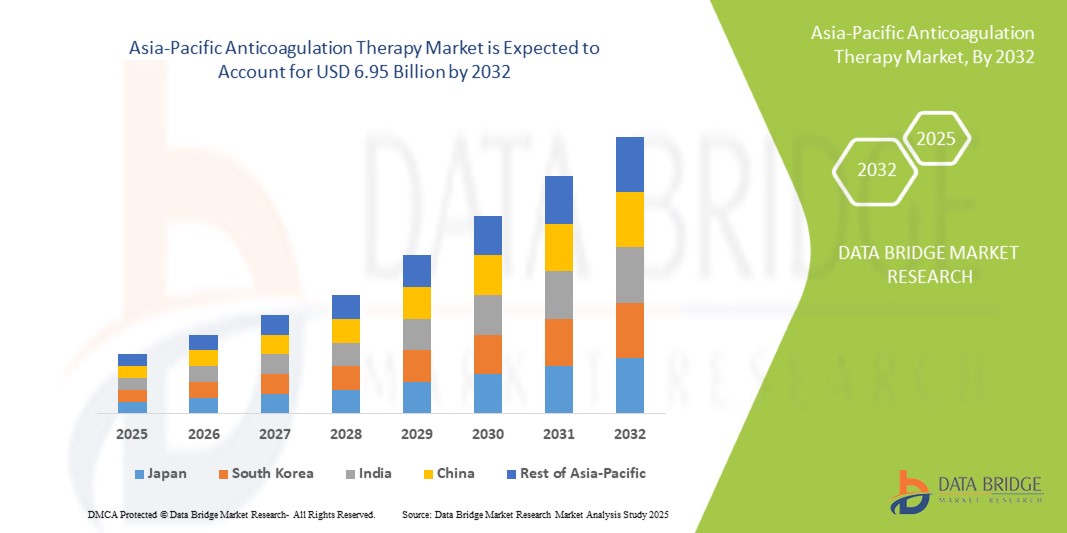
- The Asia-Pacific Anticoagulation Therapy Market was valued at USD 3.68 billion in 2024 and is expected to reach USD 6.95 billion by 2032.
- During the forecast period of 2025 to 2032, the market is projected to grow at a CAGR of 8.2%, primarily driven by the rising incidence of thromboembolic disorders, atrial fibrillation, and deep vein thrombosis (DVT) in the region.
- This growth is further propelled by factors such as the aging population, sedentary lifestyles, enhanced diagnostic infrastructure, and an increasing focus on preventive cardiovascular care.
Anticoagulation Therapy Market Analysis
- The Asia-Pacific Anticoagulation Therapy Market is poised for substantial growth through 2032, registering a CAGR of 8.2% from 2025 to 2032.
- The increasing use of direct oral anticoagulants (DOACs) due to their convenience and improved safety profile is significantly impacting prescribing trends.
- The market benefits from advancements in personalized medicine, expanded healthcare coverage, and growing awareness about stroke prevention strategies.
- Government support, pharmaceutical innovation, and a surge in clinical trial activity for next-generation anticoagulants are strengthening the region’s therapeutic landscape, particularly in emerging markets like India, Indonesia, and the Philippines
Report Scope and Asia-Pacific Anticoagulation Therapy Market Segmentation
|
Attributes |
Asia-Pacific Anticoagulation Therapy Market Key Market Insights |
|
Segments Covered |
|
|
Countries Covered |
Asia-Pacific
|
|
Key Market Players |
|
|
Market Opportunities |
|
|
Value Added Data Infosets |
In addition to the insights on market scenarios such as market value, growth rate, segmentation, geographical coverage, and major players, the market reports curated by the Data Bridge Market Research also include import export analysis, production capacity overview, production consumption analysis, price trend analysis, climate change scenario, supply chain analysis, value chain analysis, raw material/consumables overview, vendor selection criteria, PESTLE Analysis, Porter Analysis, and regulatory framework. |
Asia-Pacific Anticoagulation Therapy Market Trends
“Growing Shift Toward Direct Oral Anticoagulants (DOACs) and Personalized Regimens”
- A prominent trend in the Asia-Pacific anticoagulation therapy market is the increasing preference for direct oral anticoagulants over traditional therapies like warfarin due to their predictable pharmacokinetics and reduced need for monitoring.
- Treatment guidelines are now integrating pharmacogenomics and patient-specific risk factors to personalize anticoagulant therapy, especially in complex comorbid populations.
- For example, DOACs such as apixaban and rivaroxaban have gained widespread adoption across Japan, China, and Australia for stroke prevention in atrial fibrillation.
- Technological innovations such as point-of-care INR testing and mobile health platforms are improving therapeutic adherence and outcome monitoring.
- Rising burden of lifestyle diseases, aging populations, and sedentary behavior across urban centers are contributing to growing demand for chronic anticoagulation therapy.
Market Dynamics
Driver
“Rising Incidence of Cardiovascular and Thromboembolic Disorders”
The rising prevalence of atrial fibrillation, stroke, and venous thromboembolism across Asia-Pacific is significantly boosting the demand for long-term anticoagulation therapy.
Examples:
- According to the Asia Pacific Heart Rhythm Society, atrial fibrillation affects over 20 million people in the region, with a growing burden in China and India.
- Growing awareness among healthcare providers regarding early initiation of anticoagulation in high-risk patients is driving market growth.
“Government Initiatives and Expanding Insurance Coverage”
Public and private healthcare systems are increasingly investing in preventive cardiology and stroke prevention, which includes anticoagulation access as a strategic priority.
Examples:
- Japan and South Korea have integrated DOACs into national reimbursement schemes to improve accessibility.
- Government-funded screening programs for high-risk elderly populations are improving early detection and treatment rates across Southeast Asia.
Opportunity
“Advancement in Drug Formulations and Digital Therapeutics”
The market is witnessing significant opportunities with the introduction of next-generation anticoagulants, extended-release formulations, and integration of digital tools for medication management.
Examples:
- Research in India and Singapore is focusing on cost-effective biosimilars of branded anticoagulants to improve accessibility in low-income groups.
- AI-enabled apps for anticoagulation dosage optimization and adherence tracking are being piloted across Malaysia, Australia, and Indonesia.
- Emerging markets like Vietnam and the Philippines show growing potential for customized anticoagulant solutions tailored to diverse ethnic and metabolic profiles.
Restraint/Challenge
“Limited Access and Monitoring Infrastructure in Rural and Underserved Areas”
- Despite therapeutic advancements, countries like Indonesia, the Philippines, and remote regions of India and Thailand still struggle with limited access to coagulation monitoring tools.
- Late diagnosis, especially among asymptomatic atrial fibrillation patients, results in higher stroke incidence and poor outcomes.
- The high cost of branded DOACs and lack of universal reimbursement across many Asia-Pacific countries limit adoption in lower-income populations.
- Furthermore, physician hesitancy, lack of clinical training, and patient non-compliance with long-term regimens remain key challenges to widespread therapy adoption
Asia-Pacific Anticoagulation Therapy Market Market Scope
The market is segmented on the basis of drug class, therepy class, end-users, and distribution channel.
|
Segmentation |
Sub-Segmentation |
|
Drug Class |
|
|
Therepy type |
|
|
End-Users |
|
|
Distribution Channel |
|
Asia-Pacific Anticoagulation Therapy Market Regional Analysis
“China is the Dominant Region in the Asia-Pacific Anticoagulation Therapy Market”
- Countries like China, Japan, and South Korea dominate the market due to large aging populations, high prevalence of cardiovascular diseases, and widespread adoption of novel oral anticoagulants (NOACs).
- Governments across these nations are investing in advanced cardiovascular care units and integrating AI-powered diagnostics to improve stroke prevention programs.
“Southeast Asia and South Asia Show Promising Growth Potential”
- Increased healthcare awareness, improving access to specialty drugs, and rising cardiovascular screenings are boosting market penetration.
- India, Indonesia, and the Philippines are emerging as high-potential markets due to expanding healthcare infrastructure and increased incidence of atrial fibrillation and venous thromboembolism.
- Growing use of telemedicine and generic anticoagulant therapies is supporting broader access in remote and underserved regions.
Asia-Pacific Anticoagulation Therapy Market Share
The competitive landscape offers detailed insights into leading market players. These include company profiles, financial metrics, R&D investments, product portfolios, global operations, production capabilities, strategic moves, strengths, weaknesses, and their role in shaping the cardiovascular therapeutics segment.
The Major Market Leaders Operating in the Market Include:
- Bayer AG
- Bristol-Myers Squibb Company
- Pfizer Inc.
- Daiichi Sankyo Company, Limited
- Boehringer Ingelheim International GmbH
- Johnson & Johnson Services, Inc.
- Sanofi
- Aspen Pharmacare
- Abbott Laboratories
- Dr. Reddy's Laboratories
- Cipla Ltd.
- Lupin Pharmaceuticals
- Torrent Pharmaceuticals
- Aurobindo Pharma
- Medley Pharmaceuticals
Latest Developments in Asia-Pacific Anticoagulation Therapy Market
- In February 2023, Daiichi Sankyo launched an expanded version of edoxaban in Japan targeting high-risk elderly patients with atrial fibrillation.
- In May 2022, Cipla introduced a cost-effective generic version of apixaban in India to increase access for low-income cardiac patients.
- In 2024, Australia’s Therapeutic Goods Administration approved an AI-based decision support tool to optimize personalized anticoagulant therapy in hospitals.
- The report also emphasized the growing importance of real-world evidence, continuous formulation innovation, and regional manufacturing capacity to enhance drug affordability and availability. Increased focus on digital therapeutic integration and patient monitoring tools is shaping the future of anticoagulant care in the Asia-Pacific region.

- Interactive Data Analysis Dashboard
- Company Analysis Dashboard for high growth potential opportunities
- Research Analyst Access for customization & queries
- Competitor Analysis with Interactive dashboard
- Latest News, Updates & Trend analysis
- Harness the Power of Benchmark Analysis for Comprehensive Competitor Tracking
Data collection and base year analysis are done using data collection modules with large sample sizes. The stage includes obtaining market information or related data through various sources and strategies. It includes examining and planning all the data acquired from the past in advance. It likewise envelops the examination of information inconsistencies seen across different information sources. The market data is analysed and estimated using market statistical and coherent models. Also, market share analysis and key trend analysis are the major success factors in the market report. To know more, please request an analyst call or drop down your inquiry.
The key research methodology used by DBMR research team is data triangulation which involves data mining, analysis of the impact of data variables on the market and primary (industry expert) validation. Data models include Vendor Positioning Grid, Market Time Line Analysis, Market Overview and Guide, Company Positioning Grid, Patent Analysis, Pricing Analysis, Company Market Share Analysis, Standards of Measurement, Global versus Regional and Vendor Share Analysis. To know more about the research methodology, drop in an inquiry to speak to our industry experts.
Data Bridge Market Research is a leader in advanced formative research. We take pride in servicing our existing and new customers with data and analysis that match and suits their goal. The report can be customized to include price trend analysis of target brands understanding the market for additional countries (ask for the list of countries), clinical trial results data, literature review, refurbished market and product base analysis. Market analysis of target competitors can be analyzed from technology-based analysis to market portfolio strategies. We can add as many competitors that you require data about in the format and data style you are looking for. Our team of analysts can also provide you data in crude raw excel files pivot tables (Fact book) or can assist you in creating presentations from the data sets available in the report.












