


What is the Asia-Pacific Bioinformatics Market Size and Growth Rate?
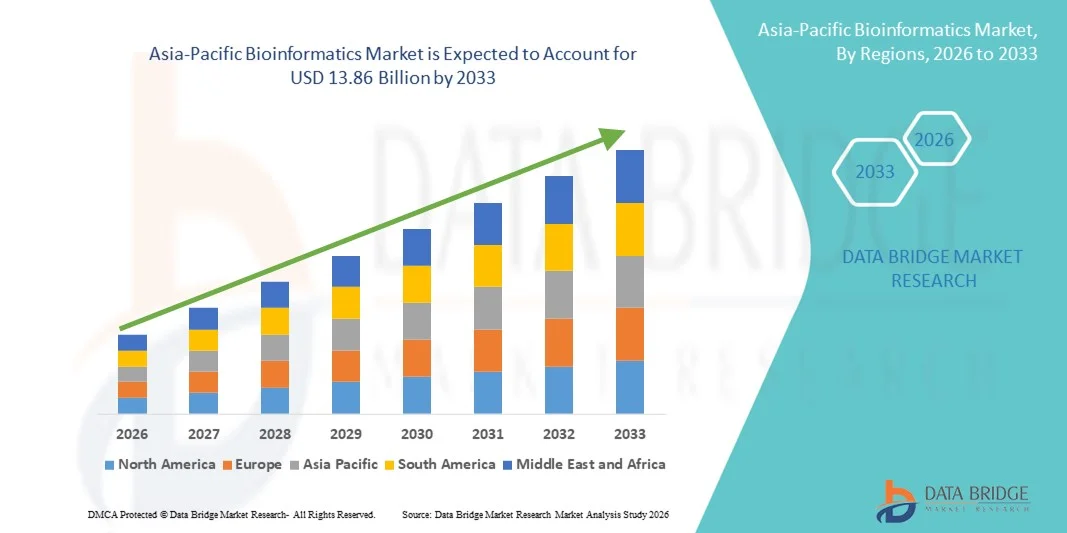
- As per Data Bridge Market Research analysis, the Asia-Pacific bioinformatics market size was valued at USD 3.74 billion in 2025 and is expected to reach USD 13.86 billion by 2033, at a CAGR of 17.80% during the forecast period
- The market growth is largely fueled by the increasing adoption of high-throughput sequencing, genomics, and molecular research, leading to the growing need for advanced computational tools and data analysis solutions in both research and clinical settings
- Furthermore, rising demand for personalized medicine, drug discovery, and precision healthcare, coupled with advancements in AI, machine learning, and cloud-based bioinformatics platforms, is establishing bioinformatics solutions as essential tools for data-driven decision-making. These converging factors are accelerating the adoption of bioinformatics technologies, thereby significantly boosting the industry's growth
Market Size & Forecast
- Global Market Value (2025): USD 3.74 billion
- Expected Market Value (2033): USD 13.86 billion
- Forecast CAGR (2026-2033): 17.80%
What are the Major Takeaways of Asia-Pacific Bioinformatics Market?
- Bioinformatics solutions, offering advanced computational tools and data analysis platforms for genomics, proteomics, and drug discovery, are increasingly vital components of modern research and clinical workflows in both academic and healthcare settings due to their ability to handle complex biological data efficiently
- The escalating demand for bioinformatics is primarily fueled by the growing adoption of next-generation sequencing, precision medicine, and AI-driven analytical platforms, along with the rising need for personalized healthcare and efficient drug discovery pipeline
- China dominated the bioinformatics market with the largest revenue share of 38.7% in 2025, driven by significant investments in genomics research, a strong presence of leading bioinformatics companies, and increasing adoption of cloud-based and AI-powered bioinformatics solutions across hospitals, research institutes, and pharmaceutical companies
- India is expected to be the fastest-growing region in the bioinformatics market during the forecast period, with a projected CAGR of 15.2%, due to increasing biotech and pharmaceutical research activities, government support for bioinformatics initiatives, and the rising number of startups developing cost-effective analytical tools and software solutions
- The Individual Purchase segment dominated the largest market revenue share of 53.4% in 2025, driven by the preference of research labs and biotech companies for licensed software or services per user
Report Scope and Bioinformatics Market Segmentation
|
Attributes |
Bioinformatics Key Market Insights |
|
Segments Covered |
|
|
Countries Covered |
Asia-Pacific
|
|
Key Market Players |
|
|
Market Opportunities |
|
|
Value Added Data Infosets |
In addition to the insights on market scenarios such as market value, growth rate, segmentation, geographical coverage, and major players, the market reports curated by the Data Bridge Market Research also include in-depth expert analysis, patient epidemiology, pipeline analysis, pricing analysis, and regulatory framework. |
What is the Key Trend in the Asia-Pacific Bioinformatics Market?
Enhanced Convenience Through Advanced Data Analysis and Genomic Insights
- A significant and accelerating trend in the Bioinformatics market is the growing adoption of high-throughput sequencing, multi-omics data integration, and cloud-based analysis platforms. These developments are enabling researchers, clinicians, and pharmaceutical companies to analyze complex biological data more efficiently and derive actionable insights for precision medicine
- For instance, in 2025, the Genome Institute of Singapore partnered with Illumina and QIAGEN to implement an integrated bioinformatics platform that consolidates genomic, transcriptomic, and proteomic data, accelerating research in cancer genomics and rare diseases
- Cloud computing and AI-enabled bioinformatics pipelines are facilitating large-scale data storage, analysis, and interpretation, allowing researchers to manage massive datasets without extensive local infrastructure
- The integration of bioinformatics tools into clinical workflows is enabling personalized medicine approaches, such as patient-specific treatment plans and biomarker discovery, improving treatment outcomes and reducing trial-and-error in therapy selection
- This trend toward faster, more precise, and integrated bioinformatics solutions is reshaping research and clinical expectations, encouraging adoption of advanced computational tools across universities, hospitals, and pharmaceutical companies
- Demand for efficient and scalable bioinformatics solutions is growing across genomics research, drug discovery, and clinical diagnostics sectors, as stakeholders increasingly prioritize data-driven insights, faster decision-making, and reproducible results
Asia-Pacific Bioinformatics Market Dynamics
Driver
Increasing Investment in Genomics Research and Personalized Medicine
- Rising investments in genomics, proteomics, and other high-throughput molecular research, coupled with the growing focus on personalized medicine, are key drivers for the expanding demand for bioinformatics solutions
- For instance, in 2024, Japan’s National Cancer Center launched a nationwide initiative to integrate bioinformatics platforms for tumor genomic profiling, strengthening the Clinical Genomics and Drug Discovery segments while accelerating adoption in both public and private research institutions
- Growing awareness among healthcare providers and researchers about the benefits of predictive analytics, biomarker discovery, and patient-specific therapy design is driving adoption of bioinformatics tools
- Expansion of government-funded initiatives, public-private collaborations, and academic research programs across China, India, and South Korea is further stimulating market growth
- Increased access to cloud computing, high-performance computing clusters, and bioinformatics software suites is enabling research centers and pharmaceutical companies to implement sophisticated analyses more efficiently
Restraint/Challenge
High Costs, Data Security Concerns, and Limited Skilled Workforce
- Despite growing demand, high costs associated with advanced sequencing technologies, computational infrastructure, and licensed bioinformatics software remain a significant barrier, particularly for smaller research centers or emerging-market institutions
- For instance, a 2023 survey of Southeast Asian universities revealed that over 50% of genomics research labs cited limited funding for bioinformatics infrastructure as a key constraint, restricting large-scale adoption of multi-omics analysis pipelines
- Data security and privacy concerns related to patient genomic information can hinder adoption of cloud-based bioinformatics platforms, particularly in clinical applications.
- A shortage of skilled bioinformaticians and computational biologists capable of handling complex datasets poses challenges for research institutions and clinical labs
- Variability in regulatory frameworks across countries, especially concerning clinical genomics and patient data, can slow cross-border collaboration and commercial adoption of bioinformatics solutions
- Limited standardization in bioinformatics workflows and software interoperability can reduce efficiency and reproducibility, affecting research outcomes
- Addressing these challenges through investment in workforce training, development of affordable and scalable platforms, robust data security measures, and harmonization of regulatory guidelines will be crucial for sustained market growth in the Asia-Pacific region
How is the Asia-Pacific Bioinformatics Market Segmented?
The market is segmented on the basis of type, sector, application, purchase mode, method, and end-user.
- By Type
On the basis of type, the Bioinformatics market is segmented into Knowledge Management Tools, Bioinformatics Software, and Services. The Bioinformatics Software segment dominated the largest market revenue share of 48.7% in 2025, driven by its essential role in data analysis, visualization, and interpretation across genomics, proteomics, and other omics research. Software platforms enable researchers to process large-scale biological datasets efficiently, reducing errors and turnaround time. Hospitals, research labs, and academic institutions rely on software for accurate analysis of sequencing data. Integration with cloud computing and high-performance computing systems enhances usability and scalability. Adoption is supported by collaborations between software developers and biotech companies. Continuous updates and new algorithm development improve predictive capabilities. Multi-omics data integration further strengthens adoption. User-friendly interfaces and workflow automation enhance researcher productivity. The software segment supports personalized medicine research, drug development, and clinical diagnostics. Licensing models and subscription-based access improve affordability. Overall, bioinformatics software dominates due to critical utility, broad adoption, and technological innovation.
The Services segment is expected to witness the fastest CAGR of 21.3% from 2026 to 2033, driven by increasing demand for outsourced bioinformatics analysis in genomics, transcriptomics, and proteomics projects. CROs, academic research centers, and biotech companies are leveraging specialized bioinformatics services to accelerate research. Services provide access to expert analysts and customized solutions, reducing in-house resource requirements. Growth is fueled by the rising volume of sequencing data and need for sophisticated analysis pipelines. Integration with AI and machine learning enhances analytical depth. Cloud-based service platforms improve accessibility and scalability. Investment in service-oriented infrastructure by biotech firms expands market reach. Outsourced services are increasingly preferred in multi-site clinical studies. Collaboration with pharmaceutical companies boosts demand for data analysis. Urban research hubs are driving adoption due to high project volume. Service contracts and partnerships facilitate long-term engagement. Overall, bioinformatics services are growing rapidly due to scalability, expertise access, and increasing outsourcing trends.
- By Sector
On the basis of sector, the Bioinformatics market is segmented into Medical Biotechnology, Academics, Animal Biotechnology, Agricultural Biotechnology, Environmental Biotechnology, Forensic Biotechnology, and Others. The Medical Biotechnology segment dominated the largest market revenue share of 42.1% in 2025, owing to high adoption of bioinformatics tools in genomics, drug development, and clinical research. Hospitals, pharmaceutical companies, and CROs heavily rely on bioinformatics for precision medicine, target identification, and biomarker discovery. Rising prevalence of chronic diseases and cancer drives demand for advanced analysis. Integration with next-generation sequencing and proteomics workflows improves efficiency. Government funding and grants support research adoption. Multi-omics studies and AI integration enhance clinical insights. Regulatory approval processes for therapeutics leverage bioinformatics analysis. Adoption is high in urban research clusters and academic medical centers. Collaboration with software providers ensures up-to-date analytical capabilities. Overall, medical biotechnology dominates due to the critical need for bioinformatics in translational research and drug development.
The Academics segment is expected to witness the fastest CAGR of 20.5% from 2026 to 2033, driven by increasing focus on genomics and systems biology research in universities and research institutes. Adoption is fueled by funding for bioinformatics infrastructure and curriculum integration. Academic projects require bioinformatics tools for evolutionary studies, functional genomics, and large-scale data analysis. Cloud computing and open-source software platforms facilitate research at lower costs. Collaborative research networks support multi-institutional studies. Emerging research topics like synthetic biology and personalized medicine drive software usage. Training programs improve skill development and adoption among students and faculty. Increasing publication output in genomics and proteomics raises demand for bioinformatics tools. Government and private grants enhance access to advanced platforms. Integration with high-performance computing systems accelerates complex analyses. Overall, academic adoption is growing rapidly due to research expansion, training needs, and computational advancements.
- By Application
On the basis of application, the Bioinformatics market is segmented into Genomics & Drug Development, Proteomics, Evolutionary Studies, Agricultural Studies, Veterinary Science, Metabolomics, Transcriptomics, and Others. The Genomics & Drug Development segment dominated the largest market revenue share of 44.5% in 2025, driven by its crucial role in target discovery, candidate screening, and personalized medicine initiatives. Pharmaceutical companies and clinical research organizations rely on bioinformatics tools to accelerate drug development. Integration with AI and machine learning enhances predictive accuracy. Adoption is supported by collaborations with biotech startups and research institutes. Multi-omics data analysis improves biomarker identification. Cloud-based platforms facilitate high-throughput sequencing data handling. Hospitals and academic centers use genomics data for disease profiling. Personalized medicine initiatives increase demand for patient-specific data analysis. Regulatory bodies recognize bioinformatics-aided workflows for drug approval. Automation and workflow management improve efficiency. Overall, genomics & drug development dominates due to critical impact on R&D, clinical translation, and precision therapy.
The Proteomics segment is expected to witness the fastest CAGR of 21.1% from 2026 to 2033, fueled by rising interest in protein expression studies, biomarker discovery, and therapeutic target validation. Hospitals, CROs, and biotech firms are increasingly leveraging proteomics data. Advances in mass spectrometry and high-throughput techniques enhance data generation. Bioinformatics software enables efficient processing, annotation, and visualization of proteomics datasets. Integration with transcriptomics and metabolomics provides multi-layered biological insights. Outsourced proteomics services expand adoption among smaller labs. Academic research in systems biology drives demand. Training in proteomics workflows improves tool utilization. Pharmaceutical R&D benefits from protein-protein interaction modeling. Government grants and research funding support proteomics projects. Overall, proteomics adoption is growing rapidly due to research focus, technological advancement, and integrative capabilities.
- By Purchase Mode
On the basis of purchase mode, the Bioinformatics market is segmented into Group Purchase and Individual Purchase. The Individual Purchase segment dominated the largest market revenue share of 53.4% in 2025, driven by the preference of research labs and biotech companies for licensed software or services per user. Individual licenses allow customization and scalability according to project requirements. Adoption is supported by flexibility in subscription models and cloud deployment. Researchers benefit from direct access to updates, technical support, and training resources. Software and analysis tools are optimized for individual workflows, increasing productivity. Academic users prefer individual licenses for classroom and laboratory use. Integration with cloud platforms facilitates collaboration. Urban research hubs drive adoption through high project volume. Licensing and compliance protocols ensure proper software usage. Overall, individual purchase dominates due to flexibility, user control, and widespread adoption.
The Group Purchase segment is expected to witness the fastest CAGR of 19.6% from 2026 to 2033, fueled by institutional procurement strategies in universities, research centers, and hospitals. Group licenses reduce per-user cost, support large-scale deployment, and simplify administrative management. Adoption is increasing for collaborative projects and multi-site research programs. Government-funded institutions favor group purchasing to maximize budget efficiency. Cloud-based group licenses enable multi-user access and workflow integration. Collaboration with software vendors enhances institutional support. Training programs for large teams improve usability. Overall, group purchase is growing rapidly due to cost-efficiency, scalability, and institutional adoption trends.
- By Method
On the basis of method, the Bioinformatics market is segmented into Genomics and Proteomics. The Genomics segment dominated the largest market revenue share of 49.2% in 2025, owing to widespread use in sequencing, variant analysis, and personalized medicine. Hospitals, biotech companies, and research labs rely heavily on genomics data for diagnostics and therapeutic development. Integration with high-throughput sequencing platforms improves efficiency. Cloud computing and AI enhance data processing and interpretation. Multi-omics integration strengthens research outcomes. Academic and clinical research drives continuous demand. Regulatory support for genomics-based diagnostics increases adoption. Training in genomics workflows enhances accuracy and productivity. Overall, genomics dominates due to broad applicability, data-rich outputs, and clinical relevance.
The Proteomics segment is expected to witness the fastest CAGR of 20.8% from 2026 to 2033, driven by increasing research in protein expression, biomarker discovery, and systems biology studies. Hospitals and pharmaceutical companies leverage bioinformatics tools for proteomics analysis. Advances in mass spectrometry, sample preparation, and computational tools improve data accuracy. Academic research in functional proteomics expands adoption. Integration with transcriptomics and metabolomics enables multi-layered insights. Outsourced services and software platforms support smaller labs. Urban research hubs accelerate growth. Overall, proteomics is growing rapidly due to technological advances, research demand, and integrative analysis.
- By End-User
On the basis of end-user, the Bioinformatics market is segmented into Research and Academic Institutes, Clinical Research Organizations, Biotech and Pharmaceutical Companies, Research Laboratories, Hospitals, and Others. The Biotech and Pharmaceutical Companies segment dominated the largest market revenue share of 46.8% in 2025, supported by the high demand for bioinformatics in drug discovery, target validation, and therapeutic development. Companies rely on software, services, and high-throughput tools for R&D efficiency. Integration with AI, machine learning, and multi-omics platforms improves analysis quality. Clinical trials and translational research increase bioinformatics utilization. Collaboration with academic institutions strengthens research pipelines. Funding and investment in R&D drive adoption. Overall, biotech and pharma dominate due to critical reliance on bioinformatics for innovation and commercialization.
The Research and Academic Institutes segment is expected to witness the fastest CAGR of 21.0% from 2026 to 2033, driven by increasing adoption of bioinformatics tools for genomics, proteomics, and evolutionary studies. Academic programs integrate software and services into research and training. Funding from government and private grants supports platform acquisition. Collaboration networks enable multi-institutional research. High adoption in universities and dedicated research centers fuels growth. Overall, academic institutes are growing rapidly due to research expansion, educational integration, and technological adoption.
Asia-Pacific Bioinformatics Market Regional Analysis
- The Asia-Pacific Bioinformatics market is poised to grow at the fastest CAGR of 15.2% during the forecast period of 2026 to 2033
- Driven by increasing biotechnology and pharmaceutical research activities, rising healthcare investments, and growing adoption of advanced computational tools in genomics and drug discovery. Countries such as India, China, and Japan are witnessing rapid expansion in bioinformatics infrastructure, supported by government initiatives promoting research and innovation
- The region’s rising focus on precision medicine, AI-driven analytics, and cloud-based bioinformatics solutions is further accelerating adoption across hospitals, research institutes, and pharmaceutical companies
China Bioinformatics Market Insight
The China bioinformatics market dominated the Asia-Pacific region with the largest revenue share of 38.7% in 2025, driven by significant investments in genomics research, a strong presence of leading bioinformatics companies, and increasing adoption of cloud-based and AI-powered bioinformatics solutions. Hospitals, research institutes, and pharmaceutical companies are actively deploying advanced analytical platforms for genomics, proteomics, and drug discovery applications. Government initiatives supporting precision medicine and large-scale genomics projects, alongside strong domestic innovation in software and computational tools, are key factors propelling market growth.
India Bioinformatics Market Insight
The India bioinformatics market is expected to be the fastest-growing country in the Asia-Pacific region during the forecast period, with a projected CAGR of 15.2%. Growth is driven by expanding biotech and pharmaceutical research activities, strong government support for bioinformatics initiatives, and the rising number of startups developing cost-effective analytical tools and software solutions. Increasing collaborations between academic institutions and industry, coupled with a growing focus on precision medicine and genomics, is accelerating the adoption of bioinformatics platforms across the country.
Which are the Top Companies in Asia-Pacific Bioinformatics Market?
The Bioinformatics industry is primarily led by well-established companies, including:
- Illumina (U.S.)
- Thermo Fisher Scientific (U.S.)
- QIAGEN (Netherlands)
- Agilent Technologies (U.S.)
- BGI Genomics (China)
- PerkinElmer (U.S.)
- Waters Corporation (U.S.)
- Roche Sequencing Solutions (Switzerland)
- Bio-Rad Laboratories (U.S.)
- Dassault Systèmes BIOVIA (France)
- GENEWIZ (U.S.)
- DNAnexus (U.S.)
- Partek Incorporated (U.S.)
- Sophia Genetics (Switzerland)
- Eurofins Scientific (Luxembourg)
- WuXi NextCODE (China)
- Genedata (Switzerland)
- Fabric Genomics (U.S.)
- Strand Life Sciences (India)
- Seven Bridges Genomics (U.S.)
What are the Recent Developments in Asia-Pacific Bioinformatics Market?
- In April 2023, Agilent Technologies, a global leader in analytical laboratory technologies, announced a strategic partnership with Theragen Bio to advance bioinformatic solutions for cancer genomic profiling in South Korea, combining Agilent’s genomic assay expertise with localized bioinformatics software to enhance precision oncology research
- In October 2023, BioBam Bioinformatics launched OmicsBox 3.1, an updated bioinformatics software platform designed for advanced omics data analysis and interpretation, aimed at helping scientists streamline workflows for genomics, transcriptomics, and proteomics research
- In February 2024, Metabolon, Inc. introduced a new integrated bioinformatics platform that brings together comprehensive data analysis tools — including pathway analysis, PCA, and biomarker lenses — to support deeper biological insights in metabolomics research
- In April 2025, Signios Bio launched its AI‑driven multi‑omics bioinformatics service platform after separating from MedGenome’s former research division, offering genomics, proteomics, metabolomics, and spatial biology analysis solutions to accelerate discovery and precision medicine research
- In August 2025, Zifo, a global informatics and AI solutions provider, launched a new AI Antibody Engineering app on Snowflake Marketplace, enabling scalable and secure bioinformatics workflows that accelerate therapeutic antibody design and optimization using advanced protein language models
- In September 2025, BGI Genomics announced expanded AI‑powered bioinformatics support for Saudi Arabia’s Vision 2030 healthcare initiative, enhancing genomic data analysis for population health and precision medicine efforts as part of regional healthcare transformation
- In November 2025, QIAGEN completed the acquisition of Parse Biosciences, expanding its single‑cell RNA sequencing and bioinformatics capabilities to support enhanced data analysis workflows for drug discovery, disease research, and precision medicine
- In February 2025, Illumina, Inc. expanded its DRAGEN bioinformatics platform, introducing enhanced AI‑driven variant interpretation and automated genomic reporting tools to improve analysis accuracy and data turnaround in clinical genomics applications

- Interactive Data Analysis Dashboard
- Company Analysis Dashboard for high growth potential opportunities
- Research Analyst Access for customization & queries
- Competitor Analysis with Interactive dashboard
- Latest News, Updates & Trend analysis
- Harness the Power of Benchmark Analysis for Comprehensive Competitor Tracking
Data collection and base year analysis are done using data collection modules with large sample sizes. The stage includes obtaining market information or related data through various sources and strategies. It includes examining and planning all the data acquired from the past in advance. It likewise envelops the examination of information inconsistencies seen across different information sources. The market data is analysed and estimated using market statistical and coherent models. Also, market share analysis and key trend analysis are the major success factors in the market report. To know more, please request an analyst call or drop down your inquiry.
The key research methodology used by DBMR research team is data triangulation which involves data mining, analysis of the impact of data variables on the market and primary (industry expert) validation. Data models include Vendor Positioning Grid, Market Time Line Analysis, Market Overview and Guide, Company Positioning Grid, Patent Analysis, Pricing Analysis, Company Market Share Analysis, Standards of Measurement, Global versus Regional and Vendor Share Analysis. To know more about the research methodology, drop in an inquiry to speak to our industry experts.
Data Bridge Market Research is a leader in advanced formative research. We take pride in servicing our existing and new customers with data and analysis that match and suits their goal. The report can be customized to include price trend analysis of target brands understanding the market for additional countries (ask for the list of countries), clinical trial results data, literature review, refurbished market and product base analysis. Market analysis of target competitors can be analyzed from technology-based analysis to market portfolio strategies. We can add as many competitors that you require data about in the format and data style you are looking for. Our team of analysts can also provide you data in crude raw excel files pivot tables (Fact book) or can assist you in creating presentations from the data sets available in the report.













