


What is the Asia-Pacific Artificial Intelligence (AI) in Drug Discovery Market Size and Overview ?
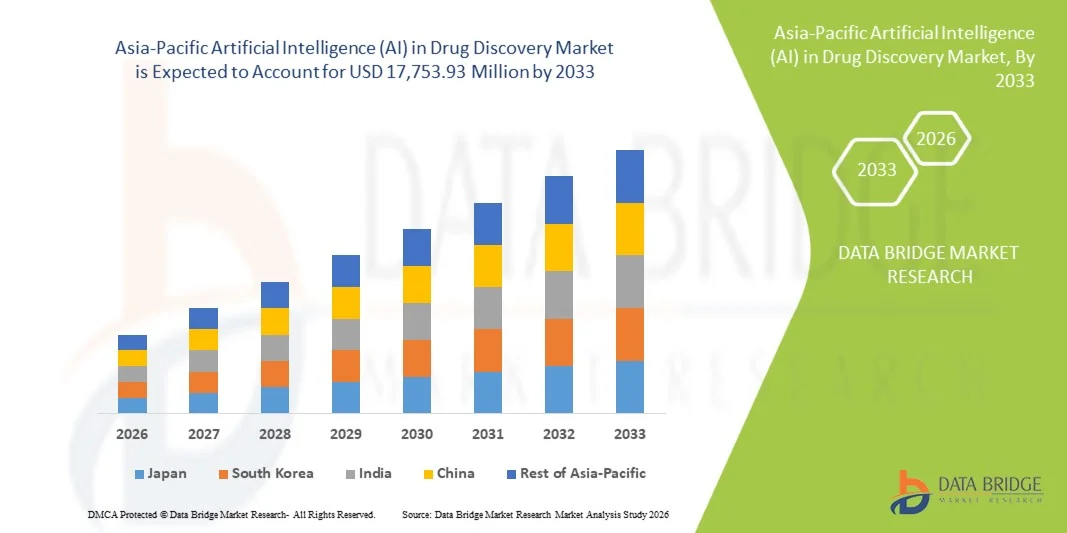
As per Data Bridge Market Research Analysis the Asia-Pacific Artificial Intelligence (AI) in drug discovery market was valued at USD 660.36 million in 2025 and is projected to reach USD 17,753.93 million by 2033, growing at a CAGR of 50.9% from 2026 to 2033. The market is witnessing strong expansion driven by increasing adoption of AI-powered platforms in pharmaceutical research, rising investments in precision medicine, and growing demand for faster and cost-efficient drug development processes across emerging and developed economies in the region.
The growing burden of chronic and complex diseases, coupled with the need to reduce the time and cost associated with traditional drug discovery, is accelerating the integration of machine learning, deep learning, and generative AI tools in early-stage research. In addition, supportive government initiatives for digital healthcare, expanding biotech startup ecosystems, and collaborations between pharmaceutical companies and AI technology providers are further boosting adoption. AI-driven target identification, lead optimization, and predictive modeling are increasingly becoming essential components of modern drug discovery workflows across Asia-Pacific markets.
Market Size & Forecast
- Global Market Value (2025): USD 660.36 Million
- Expected Market Value (2033): USD 17,753.93 Million
- Forecast CAGR (2026–2033): 50.9%
- Leading Country in 2025: China
- Fastest Growing Country: India
What are the Major Takeaways of Asia-Pacific Artificial Intelligence (AI) in Drug Discovery Market ?
- China dominated the Asia Artificial Intelligence (AI) in Drug Discovery market with the largest revenue share of 38.6% in 2025, supported by strong pharmaceutical manufacturing capabilities, rapid AI integration in biotech firms, and significant government-backed investments in life sciences innovation.
- The Machine Learning segment led the market with a 42.6% share in 2025, driven by its widespread application in predictive modeling, compound screening, and drug-target interaction analysis.
- India is expected to be the fastest-growing country at a CAGR of 19.4% from 2026 to 2033, fueled by expanding contract research organizations (CROs), rising digital health adoption, and increasing collaboration between AI startups and pharmaceutical companies.
- Deep Learning are the fastest-growing technology, projected to register a CAGR of 23.1%, reflecting the surge in demand for its superior capability in handling complex biological data such as protein structures and genomic sequences.
- The Small Molecule segment dominated the drug type category with a 58.7% revenue share in 2025, led by its strong compatibility with AI-driven screening platforms and established manufacturing processes.
- Software accounted for 63.2% of the market, preferred by its widespread adoption of AI platforms, predictive analytics tools, and drug modeling system.
- The Neurodegenerative Diseases segment is the fastest-growing indication category, with a CAGR of 22.8%, driven by rising prevalence of Alzheimer’s and Parkinson’s diseases in aging populations.
Report Scope and Asia-Pacific Artificial Intelligence (AI) in Drug Discovery Market Segmentation
|
Attributes |
Asia-Pacific Artificial Intelligence (AI) in Drug Discovery Key Market Insights |
|
Segments Covered |
|
|
Countries Covered |
Asia-Pacific
|
|
Key Market Players |
|
|
Market Opportunities |
|
|
Value Added Data Infosets |
In addition to the insights on market scenarios such as market value, growth rate, segmentation, geographical coverage, and major players, the market reports curated by the Data Bridge Market Research also include in-depth expert analysis, patient epidemiology, pipeline analysis, pricing analysis, and regulatory framework. |
What is the Key Trend in the Asia-Pacific Artificial Intelligence (AI) in Drug Discovery Market ?
Trend: Expansion of AI-Driven Precision Drug Discovery Platforms
Pharmaceutical and biotech companies across Asia are increasingly shifting toward AI-enabled precision drug discovery platforms to improve speed, accuracy, and success rates in early-stage R&D. These platforms integrate machine learning, generative AI, and multi-omics data (genomics, proteomics, and metabolomics) to identify novel drug targets and optimize lead compounds more efficiently than traditional methods. This shift is also enabling personalized medicine approaches, particularly in oncology and rare diseases, where patient-specific biological data can be modeled computationally to predict treatment response.
For instance, in January 2025, Insilico Medicine expanded its AI-driven drug discovery operations in China, strengthening its pipeline for oncology drug candidates using deep learning-based molecular generation and reinforcement learning models. This development highlights how AI platforms are moving from experimental tools to core drug discovery infrastructure across Asia.
Asia-Pacific Artificial Intelligence (AI) in Drug Discovery Market Dynamics
Key Market Driver: Rising Demand for Cost-Effective and Faster Drug Development
The increasing prevalence of cancer, cardiovascular disorders, and neurological diseases across Asia is placing significant pressure on pharmaceutical companies to accelerate drug discovery timelines while reducing R&D expenditure. Traditional drug development often takes over a decade with high failure rates, making AI-based solutions highly attractive for risk reduction and efficiency improvement. AI technologies enable virtual screening of billions of compounds, predictive toxicity analysis, and faster lead optimization, which significantly reduces reliance on expensive laboratory experiments. This is particularly valuable in Asia, where pharmaceutical companies are scaling innovation capabilities but still face cost constraints compared to Western markets.
For instance, in March 2024, Exscientia collaborated with a Japan-based pharmaceutical company to accelerate AI-assisted precision oncology drug design. The partnership leveraged automated molecular modeling and active learning algorithms to shorten compound selection cycles and improve candidate quality.
Key Restraint/Challenge: Limited Data Standardization and High Integration Complexity
Despite strong adoption momentum, the Asia AI in drug discovery market faces significant challenges related to fragmented biomedical datasets and inconsistent data quality across research institutions, hospitals, and biotech firms. AI systems require large, standardized, and well-annotated datasets to deliver accurate predictions, but many organizations struggle with siloed data environments and regulatory differences across countries. Additionally, integrating AI platforms with legacy pharmaceutical R&D workflows is complex, as many companies still rely on traditional experimental pipelines. This leads to operational inefficiencies, model training limitations, and slower deployment of AI-driven insights in real-world drug development.
For instance, in June 2023, several biotech firms in India reported delays in validating AI-based drug discovery models due to inconsistent clinical trial datasets and fragmented genomic data sources across multiple research institutions. This reflects a broader structural limitation in scaling AI adoption uniformly across the region.
Key Market Opportunity: Expansion of AI-Enabled Drug Discovery Ecosystems and Collaborations
The major opportunity in the Asia market lies in the rapid expansion of collaborative ecosystems involving pharmaceutical companies, AI startups, academic institutions, and government-backed research organizations. These collaborations are enabling shared access to high-performance computing infrastructure, large biological datasets, and advanced AI algorithms, which significantly lowers entry barriers for innovation. Cloud-based platforms are further democratizing access to AI drug discovery tools, allowing smaller biotech firms and research labs to participate in high-level drug development without heavy infrastructure investments. This ecosystem-based approach is especially strong in countries such as China, South Korea, and Japan, where national initiatives are actively promoting AI-driven healthcare innovation.
For instance, in September 2025, a consortium of South Korean biotech companies launched a national AI drug discovery platform designed to support collaborative research, large-scale virtual screening, and shared compound libraries. This initiative demonstrates how ecosystem-level integration is becoming a key growth driver for the region.
How is the Asia-Pacific Artificial Intelligence (AI) in Drug Discovery Market Segmented ?
The Asia-Pacific Artificial Intelligence (AI) in drug discovery market is segmented on the basis of application, technology, drug type, offering, indication, and end use.
- By Application
On the basis of application, the Asia-Pacific AI in drug discovery market is segmented into novel drug candidates, drug optimization and repurposing, preclinical testing and approval, drug monitoring, finding new disease-associated targets and pathways, understanding disease mechanisms, aggregating and synthesizing information, formation & qualification of hypotheses, de novo drug design, finding drug targets of an old drug, and others. The Novel Drug Candidates segment dominated the market with a 29.8% share in 2025, driven by the strong demand for AI-enabled acceleration of early-stage drug discovery pipelines. Pharmaceutical companies across Asia-Pacific are increasingly using AI models to identify new chemical entities faster and with higher success probabilities. This segment benefits from large-scale genomic datasets and improved predictive modeling accuracy. AI-based virtual screening and molecular simulation tools are significantly reducing preclinical discovery timelines. Growing investment in oncology and rare disease research is further strengthening demand. Continuous advancements in generative AI are enhancing compound novelty and efficiency.
The De Novo Drug Design segment is expected to be the fastest-growing at a CAGR of 22.4% from 2026 to 2033, driven by the increasing use of generative AI and deep learning models to create entirely new molecular structures. This approach eliminates dependency on existing compound libraries and enables faster identification of high-potential drug candidates. Pharmaceutical firms are increasingly adopting AI-driven generative chemistry platforms for precision medicine development. Rising demand for highly specific oncology and neurodegenerative disease therapies is accelerating adoption. Cloud-based computational infrastructure is further supporting scalability of de novo design models. Expanding collaborations between AI startups and biotech companies are also fueling growth across Asia-Pacific markets.
- By Technology
On the basis of technology, the market is segmented into machine learning, deep learning, natural language processing, and others. The Machine Learning segment dominated the market with a 42.6% share in 2025, due to its widespread application in predictive modeling, compound screening, and drug-target interaction analysis. Machine learning algorithms are extensively used by pharmaceutical companies to analyze large biological datasets and identify potential drug candidates. The technology is highly effective in improving accuracy and reducing false-positive results in early-stage research. Strong integration with cheminformatics and bioinformatics platforms is further enhancing its adoption. Continuous improvement in algorithm efficiency and data availability is reinforcing market leadership. It remains the foundational technology for most AI drug discovery systems in Asia-Pacific.
The Deep Learning segment is projected to be the fastest-growing at a CAGR of 23.1% from 2026 to 2033, driven by its superior capability in handling complex biological data such as protein structures and genomic sequences. Deep learning models enable more accurate prediction of drug-target interactions and disease pathways. Increasing availability of high-performance computing infrastructure is accelerating adoption across research organizations. Pharmaceutical companies are leveraging deep neural networks for generative drug design and toxicity prediction. Growing demand for precision medicine and personalized therapies is further boosting adoption. Rapid advancements in transformer-based models are significantly enhancing drug discovery capabilities.
- By Drug Type
On the basis of drug type, the market is segmented into small molecule and large molecule drugs. The Small Molecule segment dominated the market with a 58.7% share in 2025, driven by its strong compatibility with AI-driven screening platforms and established manufacturing processes. Small molecules are easier to model computationally, making them ideal for AI-based virtual screening and optimization. Pharmaceutical companies prefer this segment due to lower development costs and faster regulatory pathways. It is widely used in oncology, cardiovascular, and metabolic disease research. AI technologies significantly enhance lead identification and structure-activity relationship analysis in this segment. Strong historical data availability further supports model training and prediction accuracy.
The Large Molecule segment is expected to be the fastest-growing at a CAGR of 21.7% from 2026 to 2033, driven by rising demand for biologics, monoclonal antibodies, and protein-based therapies. AI is increasingly used to model complex protein structures and predict biological interactions. Advances in structural biology and computational protein folding are accelerating adoption. Pharmaceutical companies are investing heavily in biologics for cancer and autoimmune diseases. AI-based optimization tools are improving stability and efficacy of large molecules. Growing pipeline of biologic drugs across Asia-Pacific is further driving segment expansion.
- By Offering
On the basis of offering, the market is segmented into software and services. The Software segment dominated the market with a 63.2% share in 2025, driven by widespread adoption of AI platforms, predictive analytics tools, and drug modeling systems. Software solutions are central to AI-driven drug discovery workflows, enabling simulation, data integration, and compound screening. Pharmaceutical companies are increasingly investing in integrated AI platforms for end-to-end drug development. Cloud-based software deployment is enhancing scalability and accessibility. Continuous updates and algorithm improvements are strengthening software adoption. Strong demand for automation in R&D workflows is further reinforcing dominance.
The Services segment is expected to be the fastest-growing at a CAGR of 20.9% from 2026 to 2033, driven by rising demand for AI consulting, model training, and data management services. Many pharmaceutical firms lack in-house AI expertise, increasing reliance on external service providers. CROs and AI startups are offering specialized drug discovery support services. Integration, customization, and maintenance services are becoming critical for AI adoption. Expansion of outsourcing trends in pharmaceutical R&D is further driving growth. Increasing complexity of AI systems is also boosting demand for managed services.
- By Indication
On the basis of indication, the market is segmented into immuno-oncology, neurodegenerative diseases, cardiovascular diseases, metabolic diseases, and others. The Immuno-Oncology segment dominated the market with a 39.5% share in 2025, driven by the high global cancer burden and strong focus on precision oncology research in Asia-Pacific. AI is widely used to identify tumor biomarkers, predict immune responses, and design targeted therapies. Pharmaceutical companies are heavily investing in cancer drug pipelines supported by AI analytics. High availability of oncology datasets enhances model accuracy and discovery speed. Increasing adoption of immunotherapy is further strengthening segment dominance. Continuous innovation in cancer treatment strategies supports sustained growth.
The Neurodegenerative Diseases segment is expected to be the fastest-growing at a CAGR of 22.8% from 2026 to 2033, driven by rising prevalence of Alzheimer’s and Parkinson’s diseases in aging populations. AI is increasingly used to identify early biomarkers and predict disease progression. Drug discovery in this area benefits from AI-driven pattern recognition in neurological datasets. Limited treatment options are pushing high investment in R&D. Pharmaceutical companies are leveraging AI to accelerate CNS drug development. Growing focus on early diagnosis and intervention is further supporting expansion.
- By End Use
On the basis of end use, the market is segmented into contract research organizations (CROs), pharmaceutical & biotechnology companies, research centers and academic institutes, and others. The Pharmaceutical & Biotechnology Companies segment dominated the market with a 52.4% share in 2025, driven by strong investment capacity and direct involvement in drug development pipelines. These companies are early adopters of AI technologies to enhance efficiency in discovery and clinical development. Integration of AI into internal R&D workflows is improving decision-making and reducing failure rates. Large datasets and proprietary compounds provide strong advantages for model training. Strategic partnerships with AI firms are further strengthening capabilities. Continuous digital transformation initiatives support long-term dominance.
The Contract Research Organizations (CROs) segment is expected to be the fastest-growing at a CAGR of 21.9% from 2026 to 2033, driven by increasing outsourcing of drug discovery activities by pharmaceutical companies. CROs are adopting AI platforms to offer faster and more cost-effective research services. Expansion of virtual drug discovery models is enhancing service efficiency. Growing demand for flexible R&D capacity is boosting outsourcing trends. CROs are investing in advanced AI infrastructure to remain competitive. Rising collaboration between CROs and biotech startups is further accelerating growth.
Which Region Holds the Largest Share of the Asia-Pacific Artificial Intelligence (AI) in Drug Discovery Market ?
China dominated the Asia Artificial Intelligence (AI) in Drug Discovery market with the largest revenue share of 38.6% in 2025, supported by strong pharmaceutical manufacturing capabilities, rapid AI integration in biotech firms, and significant government-backed investments in life sciences innovation. The country also benefits from extensive genomic databases, a rapidly growing biotech ecosystem, and increasing collaborations between AI technology providers and pharmaceutical companies. Rising deployment of machine learning and deep learning platforms across target identification, lead optimization, and precision medicine applications is further accelerating market growth. Continuous advancements in computational biology, favorable regulatory support for innovation, and growing focus on accelerating novel drug development continue to strengthen China’s leadership position in the Asia-Pacific market.
The India Artificial Intelligence (AI) in Drug Discovery Market Insight
The India AI in drug discovery market is witnessing strong growth due to expanding pharmaceutical outsourcing activities, rising AI adoption in biotech startups, and increasing government focus on digital healthcare innovation. The country’s growing Contract Research Organization (CRO) ecosystem and strong availability of skilled data science talent are supporting rapid integration of AI in early-stage drug development. In addition, increasing prevalence of chronic diseases and rising demand for cost-effective drug discovery solutions are accelerating adoption across pharmaceutical companies and academic institutions. Growing collaborations between global pharma firms and Indian biotech companies are further strengthening market expansion.
Japan Artificial Intelligence (AI) in Drug Discovery Market Insight
The Japan AI in drug discovery market is experiencing steady growth driven by strong pharmaceutical R&D infrastructure, advanced computational biology capabilities, and rising adoption of precision medicine approaches. Pharmaceutical companies and research institutes are increasingly using AI for molecular screening, biomarker discovery, and toxicity prediction. In addition, government support for digital transformation in healthcare and increasing investment in aging-related disease research are boosting AI adoption. Integration of robotics, big data analytics, and deep learning platforms is further enhancing drug discovery efficiency in Japan.
China Artificial Intelligence (AI) in Drug Discovery Market Insight
The China AI in drug discovery market is expanding rapidly due to strong government backing for AI and biotechnology innovation, large-scale pharmaceutical manufacturing capabilities, and increasing investment in life sciences R&D. The country benefits from vast biomedical datasets, a strong AI startup ecosystem, and growing collaboration between pharmaceutical companies and technology providers. AI is widely used in target identification, lead optimization, and oncology drug development. Continuous expansion of domestic biotech firms and increasing participation in global drug discovery partnerships are further strengthening China’s leadership in the region.
South Korea Artificial Intelligence (AI) in Drug Discovery Market Insight
The South Korea AI in drug discovery market is growing steadily due to strong government-led innovation programs, advanced digital healthcare infrastructure, and increasing investment in AI-based biotech research. Pharmaceutical companies and academic institutes are increasingly adopting AI platforms for drug screening, protein modeling, and clinical trial optimization. The country’s strong semiconductor and data infrastructure also supports high-performance computing required for AI drug discovery. In addition, growing collaborations between biotech firms and AI startups are accelerating innovation in precision medicine and rare disease treatment.
Which are the Top Companies in Asia-Pacific Artificial Intelligence (AI) in Drug Discovery Market ?
The Asia-Pacific Artificial Intelligence (AI) in drug discovery industry is primarily led by well-established companies, including:
- Exscientia (U.K.)
- BenevolentAI (U.K.)
- Isomorphic Labs (U.K.)
- Evotec SE (Germany)
- BioNTech SE (Germany)
- Merck KGaA (Germany)
- Bayer AG (Germany)
- AstraZeneca (U.K.)
- GSK plc (U.K.)
- Sanofi (France)
- Servier (France)
- Owkin (France)
- Ginkgo Bioworks (U.S.)
- Recursion Pharmaceuticals (U.S.)
- Schrödinger Inc. (U.S.)
- Novartis AG (Switzerland)
- Roche Holding AG (Switzerland)
- Johnson & Johnson Services, Inc. (U.S.)
- Pfizer Inc. (U.S.)
- Insilico Medicine (Hong Kong)
What are Latest Developments in Asia-Pacific Artificial Intelligence (AI) in Drug Discovery Market ?
- In February 2025, Exscientia expanded its AI-driven drug discovery collaborations across Asia-Pacific to accelerate precision oncology and immunology drug development programs. The initiative integrates machine learning models with automated chemistry and biological testing systems to streamline drug discovery workflows and reduce R&D costs. It also aims to improve success rates in early-stage pipelines, further strengthening the region’s position as a rapidly expanding hub for AI-powered pharmaceutical innovation
- In June 2024, Insilico Medicine announced the advancement of its AI-designed drug INS018_055 into Phase II clinical trials, further validating its generative AI drug discovery platform. The drug targets idiopathic pulmonary fibrosis and demonstrated promising outcomes derived from AI-based target identification and molecule generation techniques. This development highlighted the increasing maturity of AI systems in delivering clinically viable drug candidates and reinforced Asia-Pacific’s growing leadership in next-generation pharmaceutical innovation
- In March 2023, Insilico Medicine published Phase I clinical trial results for its AI-discovered drug INS018_055 in Nature Medicine, validating the effectiveness of generative AI in drug development. The drug, developed for idiopathic pulmonary fibrosis, was designed using AI-based molecular generation and deep learning systems, confirming that AI-generated compounds can successfully progress into human clinical trials. This milestone significantly reduced early-stage discovery timelines and marked a breakthrough for AI-driven biotech innovation across Asia-Pacific
- In June 2022, Exscientia expanded its collaboration with Sumitomo Pharma in Japan to advance AI-designed drug discovery programs focused on oncology and neuroscience therapies. The partnership integrates AI-powered molecular design with pharmaceutical R&D workflows, improving efficiency in lead identification and optimization while reducing development timelines. This collaboration reflects Japan’s increasing adoption of AI in precision medicine and demonstrates the growing role of cross-border partnerships between global AI firms and Asian pharmaceutical companies
- In August 2021, XtalPi, a China-based AI drug discovery company, completed its IPO on the Hong Kong Stock Exchange, marking one of the largest public listings in the AI biotechnology sector in Asia. The listing significantly strengthened investor confidence in AI-driven drug discovery platforms and highlighted the growing commercialization of computational chemistry and AI-based molecular simulation technologies in the region. XtalPi leverages quantum physics, machine learning, and cloud computing to accelerate early-stage drug discovery and compound optimization, reinforcing China’s position as a key hub for AI-enabled life sciences innovation

- Interactive Data Analysis Dashboard
- Company Analysis Dashboard for high growth potential opportunities
- Research Analyst Access for customization & queries
- Competitor Analysis with Interactive dashboard
- Latest News, Updates & Trend analysis
- Harness the Power of Benchmark Analysis for Comprehensive Competitor Tracking
Data collection and base year analysis are done using data collection modules with large sample sizes. The stage includes obtaining market information or related data through various sources and strategies. It includes examining and planning all the data acquired from the past in advance. It likewise envelops the examination of information inconsistencies seen across different information sources. The market data is analysed and estimated using market statistical and coherent models. Also, market share analysis and key trend analysis are the major success factors in the market report. To know more, please request an analyst call or drop down your inquiry.
The key research methodology used by DBMR research team is data triangulation which involves data mining, analysis of the impact of data variables on the market and primary (industry expert) validation. Data models include Vendor Positioning Grid, Market Time Line Analysis, Market Overview and Guide, Company Positioning Grid, Patent Analysis, Pricing Analysis, Company Market Share Analysis, Standards of Measurement, Global versus Regional and Vendor Share Analysis. To know more about the research methodology, drop in an inquiry to speak to our industry experts.
Data Bridge Market Research is a leader in advanced formative research. We take pride in servicing our existing and new customers with data and analysis that match and suits their goal. The report can be customized to include price trend analysis of target brands understanding the market for additional countries (ask for the list of countries), clinical trial results data, literature review, refurbished market and product base analysis. Market analysis of target competitors can be analyzed from technology-based analysis to market portfolio strategies. We can add as many competitors that you require data about in the format and data style you are looking for. Our team of analysts can also provide you data in crude raw excel files pivot tables (Fact book) or can assist you in creating presentations from the data sets available in the report.













