


What is the Asia-Pacific Artificial Turf Market Size and Growth Rate?
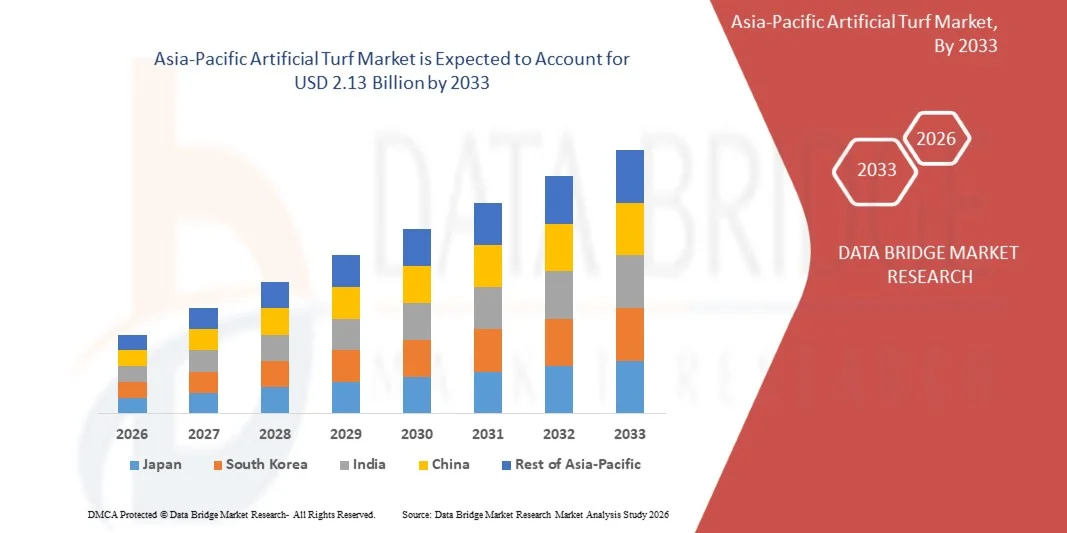
- As per Data Bridge Market Research analysis the Asia-Pacific artificial turf market was valued at USD 1.39 billion in 2025 and is projected to reach USD 2.13 billion by 2033, growing at a CAGR of 5.50% from 2026 to 2033.
- The market is experiencing consistent growth driven by increasing adoption of artificial turf in sports facilities, landscaping, residential applications, and commercial spaces, along with rising demand for low-maintenance and water-efficient surfaces.
- Growing urbanization, limited water availability, and increasing investments in sports infrastructure across Asia-Pacific are further encouraging governments, businesses, and property developers to adopt artificial turf as a durable and cost-effective alternative to natural grass.
Market Size & Forecast
- Market Value (2025): USD 1.39 Billion
- Expected Market Value (2033): USD 2.13 Billion
- Forecast CAGR (2026–2033): 5.50%
- Leading Country in 2025: China
- Fastest Growing Country: Japan
What are the Major Takeaways of the Asia-Pacific Artificial Turf Market?
- China artificial turf market captured the largest revenue share in 2025 within Asia-Pacific, fueled by rapid urbanization, extensive sports infrastructure development, and increasing investment in recreational and commercial facilities.
- Japan artificial turf market is expected to witness significant growth from 2026 to 2033, driven by increasing demand for durable sports surfaces, urban landscaping, and recreational facilities. Limited urban space, high maintenance requirements for natural grass, and the country's emphasis on efficient land utilization are encouraging the adoption of artificial turf.
- The polyethylene segment held the largest market revenue share in 2025, driven by its widespread use in sports fields, residential landscaping, commercial spaces, and recreational facilities. Polyethylene turf is preferred due to its softness, durability, natural appearance, and resistance to heavy foot traffic and varying climatic conditions across Asia-Pacific.
- The nylon segment is projected to register the fastest growth at a CAGR from 2026 to 2033, driven by increasing demand for high-performance artificial turf in sports and commercial applications. Its superior strength, resilience, and ability to withstand heavy usage support its adoption in professional sports facilities and high-traffic areas.
- The sand (silica) infill segment held the largest market revenue share in 2025, driven by its widespread use in sports fields, landscaping, and recreational applications. Silica sand is preferred due to its affordability, availability, stability, and ability to support turf blades while improving surface performance.
- The organic infill segment is projected to register the fastest growth at a CAGR from 2026 to 2033, driven by increasing environmental awareness and demand for sustainable artificial turf solutions. Rising adoption of natural and biodegradable infill materials is supporting segment expansion across sports facilities, landscaping projects, and commercial applications.
Report Scope and Asia-Pacific Artificial Turf Market Segmentation
|
Attributes |
Asia-Pacific Artificial Turf Key Market Insights |
|
Segments Covered |
|
|
Countries Covered |
Asia-Pacific
|
|
Key Market Players |
|
|
Market Opportunities |
|
|
Value Added Data Infosets |
In addition to the insights on market scenarios such as market value, growth rate, segmentation, geographical coverage, and major players, the market reports curated by the Data Bridge Market Research also include import export analysis, production capacity overview, production consumption analysis, price trend analysis, climate change scenario, supply chain analysis, value chain analysis, raw material/consumables overview, vendor selection criteria, PESTLE Analysis, Porter Analysis, and regulatory framework. |
What is the Key Trend in the Asia-Pacific Artificial Turf Market?
- Sports federations and governments across Asia-Pacific are increasingly investing in artificial turf facilities to expand year-round access to football and grassroots sports, particularly where high usage and climatic conditions make natural grass difficult to maintain.
- For instance, in May 2025, FIFA inaugurated its first FIFA Arena mini-pitch in Asia at Bodindecha (Sing Singhaseni) School in Bangkok, Thailand, featuring highly durable artificial turf designed to withstand heavy year-round use.
- Manufacturers are increasingly developing non-infill and low-maintenance artificial turf systems that improve surface stability, simplify maintenance, and reduce the environmental impact associated with conventional infill materials.
- For instance, in May 2025, CCGrass supplied its Leap non-infill football turf for Thailand’s first FIFA Arena pitch in Bangkok, with the system designed to provide consistent ball behavior while reducing maintenance requirements and environmental impact.
- As sports infrastructure development accelerates across Asia-Pacific, the combination of durable surfaces, reduced maintenance requirements, and increasing grassroots participation is expected to strengthen demand for advanced artificial turf systems across football and other sporting applications.
What are the Key Drivers of the Asia-Pacific Artificial Turf Market?
- The expansion of sports infrastructure and increasing investment in professional and grassroots football facilities are significantly increasing demand for artificial turf, particularly in countries seeking durable surfaces capable of supporting frequent and year-round use.
- For instance, in June 2024, FIFA reported that Malaysia’s new National Training Centre in Putrajaya would include three full-size pitches, including one artificial turf pitch, supported by approximately USD 5.2 million from the FIFA Forward Development Programme and additional Malaysian government funding of approximately USD 9.5 million.
- Artificial turf is also gaining adoption in regions where climatic and maintenance conditions make natural grass challenging, providing sports organizations with more consistent playing surfaces and greater facility utilization.
- For instance, in May 2024, FIFA reported that Bhutan received USD 1.17 million in funding for the installation of four artificial turf pitches across Dagana, Punakha, and Thimphu, supporting national leagues, grassroots football, and youth development.
- With continued investment in sports facilities, growing grassroots participation, and the need for durable all-weather playing surfaces, artificial turf is expected to remain an important component of sports infrastructure development across the Asia-Pacific region.
Which Factors are Challenging the Growth of the Asia-Pacific Artificial Turf Market?
- The high initial installation cost of artificial turf systems, combined with expenses related to specialized installation, maintenance, replacement, and surface certification, can limit adoption among smaller sports organizations and budget-constrained facilities.
- These cost considerations can be particularly challenging in emerging Asia-Pacific markets, where sports facilities often depend on government funding, federation support, or development programs to finance new artificial turf installations.
- For instance, in October 2025, FIFA reported that more than USD 1.04 million from the FIFA Forward Programme was used to install two new artificial pitches in Dhaka, Bangladesh, demonstrating the substantial funding required for large-scale artificial turf infrastructure projects.
- In addition, artificial turf requires appropriate maintenance and quality assurance to preserve playing performance, safety, and durability, with FIFA requiring certified football turf systems to meet defined testing requirements.
- The combination of high upfront investment, recurring maintenance requirements, and the need for certified installation continues to challenge adoption, particularly among smaller facilities and price-sensitive markets across Asia-Pacific.
How is the Asia-Pacific Artificial Turf Market Segmented?
The Asia-Pacific artificial turf market is segmented on the basis of type, infill materials, pile height, back coating, distribution channel, and end-user.
- By Type
On the basis of type, the Asia-Pacific artificial turf market is segmented into nylon, polypropylene, polyethylene, polyamides, jute, rubber, and others. The polyethylene segment held the largest market revenue share in 2025, driven by its widespread use in sports fields, residential landscaping, commercial spaces, and recreational facilities. Polyethylene turf is preferred due to its softness, durability, natural appearance, and resistance to heavy foot traffic and varying climatic conditions across Asia-Pacific.
The nylon segment is projected to register the fastest growth at a CAGR from 2026 to 2033, driven by increasing demand for high-performance artificial turf in sports and commercial applications. Its superior strength, resilience, and ability to withstand heavy usage support its adoption in professional sports facilities and high-traffic areas.
- By Infill Materials
On the basis of infill materials, the Asia-Pacific artificial turf market is segmented into petroleum-based, organic infill, sand (silica) infill, and others. The sand (silica) infill segment held the largest market revenue share in 2025, driven by its widespread use in sports fields, landscaping, and recreational applications. Silica sand is preferred due to its affordability, availability, stability, and ability to support turf blades while improving surface performance.
The organic infill segment is projected to register the fastest growth at a CAGR from 2026 to 2033, driven by increasing environmental awareness and demand for sustainable artificial turf solutions. Rising adoption of natural and biodegradable infill materials is supporting segment expansion across sports facilities, landscaping projects, and commercial applications.
- By Pile Height
On the basis of pile height, the Asia-Pacific artificial turf market is segmented into less than 10 mm, 10-30 mm, 30-50 mm, 50-70 mm, 70-100 mm, and more than 100 mm. The 30-50 mm segment held the largest market revenue share in 2025, driven by its widespread use in sports fields, recreational areas, residential landscaping, and commercial applications. This pile height provides a balance between durability, appearance, cushioning, and maintenance requirements.
The 50-70 mm segment is projected to register the fastest growth at a CAGR from 2026 to 2033, driven by increasing adoption in premium landscaping, playgrounds, sports facilities, and recreational spaces. Its enhanced cushioning, realistic appearance, and ability to withstand frequent usage are accelerating segment expansion.
- By Back Coating
On the basis of back coating, the Asia-Pacific artificial turf market is segmented into PU and latex. The latex segment held the largest market revenue share in 2025, driven by its widespread use across residential landscaping, sports fields, and commercial applications. Latex backing is preferred due to its cost-effectiveness, flexibility, strong adhesion, and established manufacturing processes.
The PU segment is projected to register the fastest growth at a CAGR from 2026 to 2033, driven by increasing demand for durable and high-performance artificial turf systems. Polyurethane backing provides improved dimensional stability, resistance to moisture, and enhanced durability, supporting its adoption in sports facilities and demanding commercial applications.
- By Distribution Channel
On the basis of distribution channel, the Asia-Pacific artificial turf market is segmented into direct sales/B2B, e-commerce, specialty stores, convenience stores, and others. The direct sales/B2B segment held the largest market revenue share in 2025, driven by bulk procurement for sports facilities, commercial projects, hotels, airports, and large landscaping applications. Direct distribution enables customized solutions, project-based pricing, technical support, and efficient supply for large-scale installations.
The e-commerce segment is projected to register the fastest growth at a CAGR from 2026 to 2033, driven by increasing digitalization, rising online purchasing, and growing consumer access to artificial turf products. Online platforms provide convenient product comparison, broader product availability, and simplified purchasing for residential and small commercial landscaping applications.
- By End-User
On the basis of end-user, the Asia-Pacific artificial turf market is segmented into households, sports & leisure, restaurant, hotels, airports, commercial offices, pet areas, and others. The sports & leisure segment held the largest market revenue share in 2025, driven by increasing investments in football fields, training facilities, recreational spaces, and multi-purpose sports infrastructure. Artificial turf is preferred in these applications due to its durability, consistent performance, and ability to support intensive usage.
The households segment is projected to register the fastest growth at a CAGR from 2026 to 2033, driven by increasing demand for low-maintenance landscaping, water-efficient outdoor surfaces, and aesthetically appealing residential spaces. Rising urbanization, limited outdoor maintenance time, and growing adoption of artificial lawns are accelerating segment expansion across Asia-Pacific.
Which Region Holds the Largest Share of the Asia-Pacific Artificial Turf Market?
- China artificial turf market captured the largest revenue share in 2025 within Asia-Pacific, fueled by rapid urbanization, extensive sports infrastructure development, and increasing investment in recreational and commercial facilities.
- The country's growing focus on football development, sports venues, schools, and public recreational spaces is supporting demand for artificial turf. Moreover, the presence of established domestic manufacturers, expanding construction activities, and increasing preference for durable and low-maintenance landscaping solutions are further contributing to market growth.
Japan Artificial Turf Market Insight
Japan artificial turf market is expected to witness significant growth from 2026 to 2033, driven by increasing demand for durable sports surfaces, urban landscaping, and recreational facilities. Limited urban space, high maintenance requirements for natural grass, and the country's emphasis on efficient land utilization are encouraging the adoption of artificial turf. Furthermore, artificial turf is increasingly being used in residential gardens, sports facilities, schools, and commercial properties, where consistent appearance and reduced maintenance requirements support its growing adoption.
Which are the Top Companies in Asia-Pacific Artificial Turf Market?
The Asia-Pacific artificial turf industry is primarily led by well-established companies, including:
- CCGrass (China)
- Jiangsu VIVATURF Co., Limited (China)
- Citygreen Turf (China)
- Shandong Biyuan Artificial Turf Co., Ltd. (China)
- Mighty Grass Co., Ltd. (China)
- Jiangsu Great Wall Sporting Goods Co., Ltd. (China)
- K&B JUNWOO Co., Ltd. (South Korea)
- Qingdao Qinghe Artificial Turf Co., Ltd. (China)
- Liaoning Senfeng New Material Technology Co., Ltd. (China)
- Taiwan Synthetic Turf Enterprise Co., Ltd. (Taiwan)
- Shanghai Green Turf Co., Ltd. (China)
- Sino Grass (China)
- Liancheng Technology Co., Ltd. (China)
- Jiangsu Huaneng Synthetic Grass Co., Ltd. (China)
- YarnTex (India)
What are Latest Developments in Asia-Pacific Artificial Turf Market?
- In May 2026, Austin Independent School District (AISD), through its sports-facility modernization program, advanced artificial turf replacement and installation projects across its athletic facilities, including House Park Stadium, as part of the district’s USD 2.4 billion bond program. The upgrades are intended to modernize sports infrastructure, improve field performance, and provide more durable playing surfaces, supporting continued demand for artificial turf in educational and recreational facilities.
- In February 2026, Moore Park All-Weather sporting field in Sydney introduced a cork-based infill system during a full field resurfacing initiative, replacing conventional rubber-crumb materials. The development aims to address health and environmental concerns while providing a more sustainable synthetic turf solution, highlighting the growing shift toward environmentally responsible infill technologies and supporting demand for sustainable artificial turf across the Asia-Pacific market.

- Interactive Data Analysis Dashboard
- Company Analysis Dashboard for high growth potential opportunities
- Research Analyst Access for customization & queries
- Competitor Analysis with Interactive dashboard
- Latest News, Updates & Trend analysis
- Harness the Power of Benchmark Analysis for Comprehensive Competitor Tracking
Asia Pacific Artificial Turf Market, Supply Chain Analysis and Ecosystem Framework
To support market growth and help clients navigate the impact of geopolitical shifts, DBMR has integrated in-depth supply chain analysis into its Asia Pacific Artificial Turf Market research reports. This addition empowers clients to respond effectively to global changes affecting their industries. The supply chain analysis section includes detailed insights such as Asia Pacific Artificial Turf Market consumption and production by country, price trend analysis, the impact of tariffs and geopolitical developments, and import and export trends by country and HSN code. It also highlights major suppliers with data on production capacity and company profiles, as well as key importers and exporters. In addition to research, DBMR offers specialized supply chain consulting services backed by over a decade of experience, providing solutions like supplier discovery, supplier risk assessment, price trend analysis, impact evaluation of inflation and trade route changes, and comprehensive market trend analysis.
Data collection and base year analysis are done using data collection modules with large sample sizes. The stage includes obtaining market information or related data through various sources and strategies. It includes examining and planning all the data acquired from the past in advance. It likewise envelops the examination of information inconsistencies seen across different information sources. The market data is analysed and estimated using market statistical and coherent models. Also, market share analysis and key trend analysis are the major success factors in the market report. To know more, please request an analyst call or drop down your inquiry.
The key research methodology used by DBMR research team is data triangulation which involves data mining, analysis of the impact of data variables on the market and primary (industry expert) validation. Data models include Vendor Positioning Grid, Market Time Line Analysis, Market Overview and Guide, Company Positioning Grid, Patent Analysis, Pricing Analysis, Company Market Share Analysis, Standards of Measurement, Global versus Regional and Vendor Share Analysis. To know more about the research methodology, drop in an inquiry to speak to our industry experts.
Data Bridge Market Research is a leader in advanced formative research. We take pride in servicing our existing and new customers with data and analysis that match and suits their goal. The report can be customized to include price trend analysis of target brands understanding the market for additional countries (ask for the list of countries), clinical trial results data, literature review, refurbished market and product base analysis. Market analysis of target competitors can be analyzed from technology-based analysis to market portfolio strategies. We can add as many competitors that you require data about in the format and data style you are looking for. Our team of analysts can also provide you data in crude raw excel files pivot tables (Fact book) or can assist you in creating presentations from the data sets available in the report.













