


Asia-Pacific Automotive Logistics Market Size
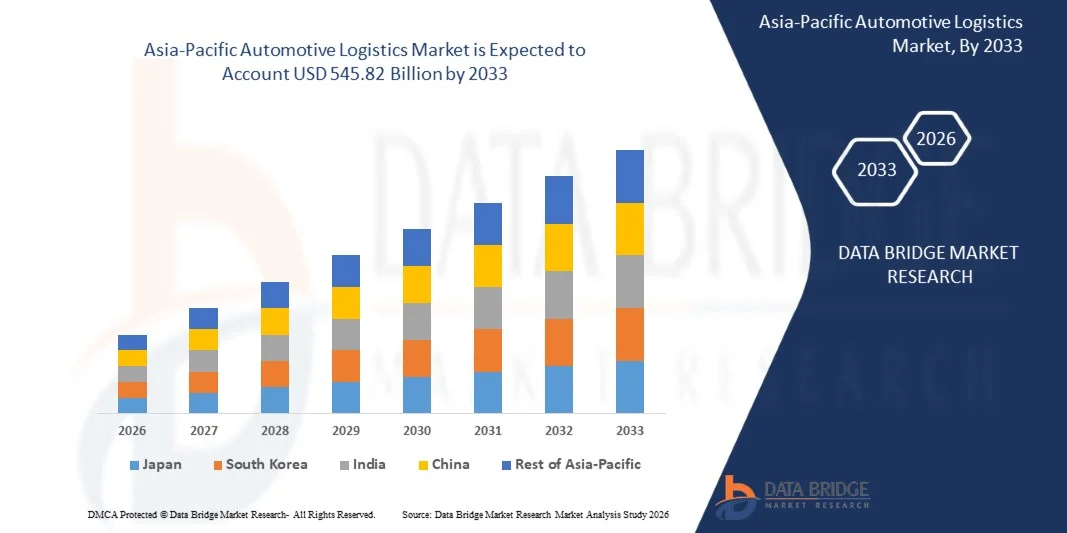
- The Asia-Pacific Automotive Logistics Market size was valued at USD 308.33 billion in 2025 and is expected to reach USD 545.82 billion by 2033, at a CAGR of 7.4% during the forecast period
- The Asia-Pacific Automotive Logistics Market growth is largely fueled by the rising production and global trade of automobiles, supported by expanding automotive manufacturing hubs and increasing demand for efficient supply chain management across OEMs and suppliers
- Furthermore, growing adoption of advanced logistics technologies such as real-time tracking systems, warehouse automation, and digital supply chain platforms is improving operational efficiency and reducing transportation delays, thereby strengthening market expansion
Asia-Pacific Automotive Logistics Market Analysis
- Automotive logistics refers to the planning, coordination, and execution of the movement, storage, and distribution of vehicles, parts, and components across the automotive supply chain, including inbound, outbound, and aftermarket logistics
- The increasing demand for automotive logistics services is primarily driven by the expansion of the automotive industry, rising complexity of global supply chains, and growing need for just-in-time delivery systems to ensure seamless production and distribution continuity
- China dominated the Asia-Pacific Automotive Logistics Market in 2025, due to its massive automotive manufacturing ecosystem, high vehicle production output, and strong export capabilities
- India is expected to be the fastest growing country in the Asia-Pacific Automotive Logistics Market during the forecast period due to rapid expansion of automobile manufacturing, rising domestic vehicle demand, and infrastructure development
- Outbound logistics segment dominated the market with a market share of 47.3% in 2025, due to the high volume of finished vehicle distribution from manufacturing plants to dealerships and export hubs. OEMs and logistics providers prioritize efficient outbound networks to ensure timely delivery, reduce inventory holding costs, and support large-scale production cycles
Report Scope and Asia-Pacific Automotive Logistics Market Segmentation
|
Attributes |
Automotive Logistics Key Market Insights |
|
Segments Covered |
|
|
Countries Covered |
Asia-Pacific
|
|
Key Market Players |
|
|
Market Opportunities |
|
|
Value Added Data Infosets |
In addition to the market insights such as market value, growth rate, market segments, geographical coverage, market players, and market scenario, the market report curated by the Data Bridge Market Research team includes in-depth expert analysis, import/export analysis, pricing analysis, production consumption analysis, and pestle analysis. |
Asia-Pacific Automotive Logistics Market Trends
“Rising Integration of Digital Supply Chain and Automation Technologies”
- A significant trend in the Asia-Pacific Automotive Logistics Market is the increasing integration of digital supply chain platforms, automation systems, and real-time tracking technologies that enhance visibility, coordination, and efficiency across complex automotive distribution networks. This integration is transforming traditional logistics operations into data-driven ecosystems that improve delivery accuracy and reduce operational delays
- For instance, DHL International GmbH and DB Schenker are widely implementing digital control towers and automated warehouse management systems to optimize vehicle and parts distribution across global automotive supply chains. These systems improve shipment tracking accuracy and enable faster response to disruptions in transportation flows
- The adoption of robotics and automated material handling systems in automotive warehousing is expanding, allowing faster sorting, packaging, and movement of automotive components across distribution centers. This trend is improving operational throughput while reducing dependency on manual handling processes in high-volume logistics environments
- The increasing use of IoT-enabled fleet management and telematics solutions is enhancing real-time visibility of vehicle movement, temperature control for sensitive parts, and predictive maintenance of transport fleets. This is strengthening supply chain reliability and reducing downtime across logistics operations
- Automotive manufacturers and logistics providers are increasingly collaborating on integrated digital platforms to synchronize production schedules with distribution timelines, improving just-in-time delivery performance. This is helping reduce inventory holding costs and ensuring smoother supply chain coordination across regions
- The market is witnessing stronger adoption of cloud-based logistics management systems that enable seamless data exchange between OEMs, suppliers, and logistics providers. This rising digital transformation is reinforcing efficiency, transparency, and scalability across automotive logistics networks globally
Asia-Pacific Automotive Logistics Market Dynamics
Driver
“Expansion of Global Automotive Production and Cross-Border Trade Networks”
- The expansion of global automotive manufacturing and increasing cross-border trade activities is driving strong demand for efficient logistics services that can manage the complex movement of vehicles, components, and spare parts across international supply chains. This growth is being supported by rising vehicle production in emerging and developed automotive hubs
- For instance, KUEHNE + NAGEL and DSV are actively supporting global automotive OEMs by managing inbound and outbound logistics operations across major production clusters in Europe, Asia, and North America. Their integrated transport solutions ensure timely delivery of components required for large-scale vehicle assembly operations
- The increasing globalization of automotive supply chains has led to greater dependency on synchronized logistics networks that connect multiple manufacturing and assembly locations. This has intensified the need for efficient freight forwarding, warehousing, and distribution services across regions
- Rising demand for passenger and commercial vehicles in emerging markets is encouraging manufacturers to expand production capacity, thereby increasing logistics requirements for both finished vehicles and spare parts. This expansion is strengthening the overall demand for automotive logistics services
- The continuous expansion of global trade agreements and automotive export-import activities is further strengthening logistics flows across international borders. This sustained growth in production and trade networks remains a key driver supporting the Asia-Pacific Automotive Logistics Market
Restraint/Challenge
“Supply Chain Disruptions and Rising Transportation Cost Volatility”
- The Asia-Pacific Automotive Logistics Market faces significant challenges due to frequent supply chain disruptions caused by geopolitical tensions, port congestion, labor shortages, and fluctuating fuel prices, which impact the timely movement of automotive goods. These disruptions create uncertainty and increase operational risks for logistics providers
- For instance, CEVA Logistics and DB Schenker have experienced operational delays during global shipping congestion events that affected automotive component deliveries across major trade routes. Such disruptions highlight vulnerabilities in global logistics networks and affect supply chain reliability
- Rising transportation costs driven by fuel price volatility and increasing freight charges are placing additional pressure on automotive logistics providers. These cost fluctuations make long-term planning difficult and reduce profit margins across logistics operations
- Dependence on international shipping routes and multimodal transport systems increases exposure to external risks such as port strikes and regulatory changes. This creates inefficiencies in scheduling and impacts the consistency of delivery timelines for automotive manufacturers
- The ongoing uncertainty in global trade conditions continues to affect investment decisions and operational planning in automotive logistics networks. These combined factors contribute to cost instability and supply chain inefficiencies across the industry
Asia-Pacific Automotive Logistics Market Scope
The market is segmented on the basis of logistics service, function, stage, distribution, and transportation mode.
• By Logistics Service
On the basis of logistics service, the Asia-Pacific Automotive Logistics Market is segmented into inbound logistics, outbound logistics, aftermarket logistics, and reverse logistics. The outbound logistics segment dominated the largest market revenue share of 47.3% in 2025, driven by the high volume of finished vehicle distribution from manufacturing plants to dealerships and export hubs. OEMs and logistics providers prioritize efficient outbound networks to ensure timely delivery, reduce inventory holding costs, and support large-scale production cycles. Strong integration of tracking systems and route optimization solutions further strengthens this segment’s dominance across global automotive supply chains.
The reverse logistics segment is anticipated to witness the fastest growth rate from 2026 to 2033, driven by increasing focus on vehicle recycling, returns management, and end-of-life component recovery. The expansion of electric vehicles has further intensified demand for battery return and refurbishment flows, strengthening reverse supply chains. Automotive companies are investing in structured reverse logistics systems to improve sustainability compliance and cost recovery from used parts. Growing circular economy initiatives are also accelerating the adoption of reverse logistics networks in the automotive industry.
• By Function
On the basis of function, the Asia-Pacific Automotive Logistics Market is segmented into warehousing, material handling, transportation, and management services. The transportation segment held the largest market revenue share in 2025, driven by the critical need for continuous movement of vehicles, components, and assemblies across production and distribution networks. Road-based and multimodal transportation systems remain essential for maintaining just-in-time manufacturing operations in the automotive sector. High dependency on efficient freight movement and cross-border vehicle shipment further reinforces the dominance of this segment.
The management services segment is expected to witness the fastest growth rate from 2026 to 2033, fueled by rising adoption of digital logistics platforms, supply chain analytics, and integrated fleet management solutions. Automotive companies are increasingly focusing on end-to-end visibility, demand forecasting, and logistics optimization through advanced management systems. The growing complexity of global supply chains is encouraging outsourcing of logistics planning and coordination functions. This shift toward intelligent and data-driven logistics management is accelerating segment expansion.
• By Stage
On the basis of stage, the Asia-Pacific Automotive Logistics Market is segmented into raw materials stage, finished product, final product delivery, and sub-assembly modules. The finished product segment dominated the largest market revenue share in 2025, driven by large-scale movement of fully assembled vehicles from production plants to distribution centers and dealerships. High production output from major automotive manufacturing hubs strengthens the demand for structured finished vehicle logistics networks. Efficient handling, storage, and transportation of completed vehicles remain critical to maintaining supply chain performance.
The sub-assembly modules segment is anticipated to witness the fastest growth rate from 2026 to 2033, driven by increasing modular vehicle production and just-in-time manufacturing practices. Automotive manufacturers are relying more on pre-assembled modules to reduce assembly time and improve production flexibility. This shift is increasing demand for precise logistics coordination between component suppliers and assembly plants. Expansion of global supplier networks is further accelerating the movement of sub-assemblies across regions.
• By Distribution
On the basis of distribution, the Asia-Pacific Automotive Logistics Market is segmented into domestic and international. The domestic segment dominated the largest market revenue share in 2025, driven by strong intra-country vehicle movement and localized manufacturing ecosystems. High production concentration within major automotive hubs supports efficient domestic supply chain networks and reduces transportation complexity. Established road and rail infrastructure further enhances the efficiency of domestic vehicle and parts distribution.
The international segment is expected to witness the fastest growth rate from 2026 to 2033, fueled by rising global trade in automobiles, components, and electric vehicles. Automotive manufacturers are expanding export operations to access emerging markets and optimize production costs. Increasing cross-border supply chain integration and free trade agreements are supporting international logistics expansion. Growing demand for vehicles in developing economies is further strengthening global distribution networks.
• By Transportation Mode
On the basis of transportation mode, the Asia-Pacific Automotive Logistics Market is segmented into roadways, railways, maritime, and airways. The roadways segment held the largest market revenue share in 2025, driven by its flexibility, extensive network coverage, and ability to support door-to-door delivery of vehicles and components. Road transport remains essential for short to medium-distance logistics within and between manufacturing clusters. Its adaptability to varying shipment sizes and frequency requirements further supports its dominance in automotive logistics operations.
The railways segment is anticipated to witness the fastest growth rate from 2026 to 2033, driven by increasing focus on cost-efficient and low-emission transportation solutions. Automotive companies are shifting toward rail-based logistics for long-distance vehicle movement to reduce congestion and fuel consumption. Expansion of dedicated freight corridors and intermodal connectivity is enhancing rail logistics efficiency. Sustainability initiatives and government investments in rail infrastructure are further accelerating segment growth.
Asia-Pacific Automotive Logistics Market Regional Analysis
- China dominated the Asia-Pacific Automotive Logistics Market with the largest revenue share in 2025, driven by its massive automotive manufacturing ecosystem, high vehicle production output, and strong export capabilities
- The country benefits from integrated supply chain networks connecting OEMs, tier-1 suppliers, and global distributors, ensuring efficient movement of components and finished vehicles. Rapid expansion of electric vehicle manufacturing and strong government support for smart logistics infrastructure further strengthen market leadership
- Advanced port infrastructure, high-capacity rail freight corridors, and digitalized logistics platforms continue to consolidate China’s dominant position across regional and global automotive supply chains
Japan Asia-Pacific Automotive Logistics Market Insight
The Japan market is anticipated to grow steadily from 2026 to 2033, supported by its highly advanced automotive industry and strong emphasis on precision logistics and just-in-time delivery systems. Japanese automakers focus on highly synchronized supply chains, requiring efficient coordination between suppliers, assembly plants, and distributors. Increasing adoption of automation, robotics, and AI-driven logistics management enhances operational efficiency across the country. Strong integration of domestic production networks and consistent investments in sustainable logistics solutions reinforce Japan’s stable and innovation-driven market outlook.
India Asia-Pacific Automotive Logistics Market Insight
India is projected to register the fastest CAGR in the Asia-Pacific Automotive Logistics Market during 2026–2033, driven by rapid expansion of automobile manufacturing, rising domestic vehicle demand, and infrastructure development. Growing investments in highways, dedicated freight corridors, and logistics parks are improving connectivity and reducing transportation time across regions. Increasing presence of global OEMs and tiered supplier networks is strengthening supply chain efficiency. Expansion of e-commerce-enabled vehicle distribution and rising adoption of organized logistics services further accelerate India’s emergence as the fastest-growing market in the region.
Asia-Pacific Automotive Logistics Market Share
The automotive logistics industry is primarily led by well-established companies, including:
- DHL International GmbH (Germany)
- XPO Logistics, Inc. (U.S.)
- KUEHNE + NAGEL (Switzerland)
- Penske Automotive Group, Inc. (U.S.)
- BLG LOGISTICS GROUP AG & Co. KG (Germany)
- Neovia Logistics Services, LLC (U.S.)
- DACHSER (Germany)
- SCHNELLENCKE GROUP AG & CO. KG (Germany)
- DB SCHENKER (Germany)
- Ryder System, Inc. (U.S.)
- CEVA Logistics (Switzerland)
- Expeditors International of Washington, Inc. (U.S.)
- Hitachi Transport System, Ltd. (Japan)
- Yusen Logistics Co., Ltd. (Japan)
- Kintetsu World Express, Inc. (Japan)
- DSV (Denmark)
Latest Developments in Asia-Pacific Automotive Logistics Market
- In June 2025, Nippon Express Holdings, Japan Freight Railway, and T2 completed a 500 km autonomous truck-plus-rail pilot from Kanagawa to Kobe, strengthening multimodal integration in automotive logistics and addressing critical driver shortages in long-distance freight operations. This initiative enhances efficiency by combining autonomous trucking with rail transport, reducing dependency on human labor while improving route optimization and delivery reliability. It also supports cost reduction and operational stability across automotive supply chains, where timely movement of components and vehicles is essential for maintaining production schedules and distribution performance
- In May 2025, DHL established an EV Centre of Excellence in Australia to strengthen regional electric vehicle battery supply chain capabilities, significantly advancing specialized logistics infrastructure for the rapidly growing EV sector. This development enhances safe handling, storage, and distribution of high-value and sensitive battery components, improving overall supply chain reliability. It also supports the Asia-Pacific Automotive Logistics Market by enabling faster and more efficient EV deployment across the region, aligning with rising electrification trends and sustainability-driven transportation transformation
- In March 2025, XPO expanded its ExpressNow service across Europe, enhancing time-critical logistics solutions for OEMs and aftermarket customers within the automotive sector. This expansion improves delivery speed and flexibility for urgent shipments such as spare parts and production-critical components, reducing downtime risks in manufacturing and repair operations. It also strengthens just-in-time supply chain performance, enabling automotive companies to maintain higher efficiency and responsiveness across increasingly complex distribution networks
- In March 2023, Tata Motors received an order for 1,000 XPRES-T EVs from OHM E Logistics Pvt. Ltd. in Hyderabad for electric cab transportation services, reinforcing the integration of electric mobility into urban logistics operations. This deployment supports the expansion of sustainable fleet solutions, improving last-mile connectivity efficiency while reducing emissions in commercial transportation systems. It also reflects growing adoption of EV-based logistics models in India, contributing to cleaner and more cost-efficient urban mobility ecosystems
- In December 2022, Tata Motors signed a contract with Everest Fleet Pvt. Ltd. for the delivery of 5,000 XPRES-T EVs, marking a significant step toward large-scale electrification of fleet operations in the automotive logistics sector. This agreement strengthens the adoption of electric vehicles in commercial transport, improving operational efficiency and reducing long-term fuel and maintenance costs for fleet operators. It also supports the broader shift toward sustainable mobility solutions, enhancing environmental performance and accelerating EV penetration in urban logistics networks

- Interactive Data Analysis Dashboard
- Company Analysis Dashboard for high growth potential opportunities
- Research Analyst Access for customization & queries
- Competitor Analysis with Interactive dashboard
- Latest News, Updates & Trend analysis
- Harness the Power of Benchmark Analysis for Comprehensive Competitor Tracking
Data collection and base year analysis are done using data collection modules with large sample sizes. The stage includes obtaining market information or related data through various sources and strategies. It includes examining and planning all the data acquired from the past in advance. It likewise envelops the examination of information inconsistencies seen across different information sources. The market data is analysed and estimated using market statistical and coherent models. Also, market share analysis and key trend analysis are the major success factors in the market report. To know more, please request an analyst call or drop down your inquiry.
The key research methodology used by DBMR research team is data triangulation which involves data mining, analysis of the impact of data variables on the market and primary (industry expert) validation. Data models include Vendor Positioning Grid, Market Time Line Analysis, Market Overview and Guide, Company Positioning Grid, Patent Analysis, Pricing Analysis, Company Market Share Analysis, Standards of Measurement, Global versus Regional and Vendor Share Analysis. To know more about the research methodology, drop in an inquiry to speak to our industry experts.
Data Bridge Market Research is a leader in advanced formative research. We take pride in servicing our existing and new customers with data and analysis that match and suits their goal. The report can be customized to include price trend analysis of target brands understanding the market for additional countries (ask for the list of countries), clinical trial results data, literature review, refurbished market and product base analysis. Market analysis of target competitors can be analyzed from technology-based analysis to market portfolio strategies. We can add as many competitors that you require data about in the format and data style you are looking for. Our team of analysts can also provide you data in crude raw excel files pivot tables (Fact book) or can assist you in creating presentations from the data sets available in the report.













