


Asia-Pacific Benign Prostatic Hyperplasia Devices Market Size
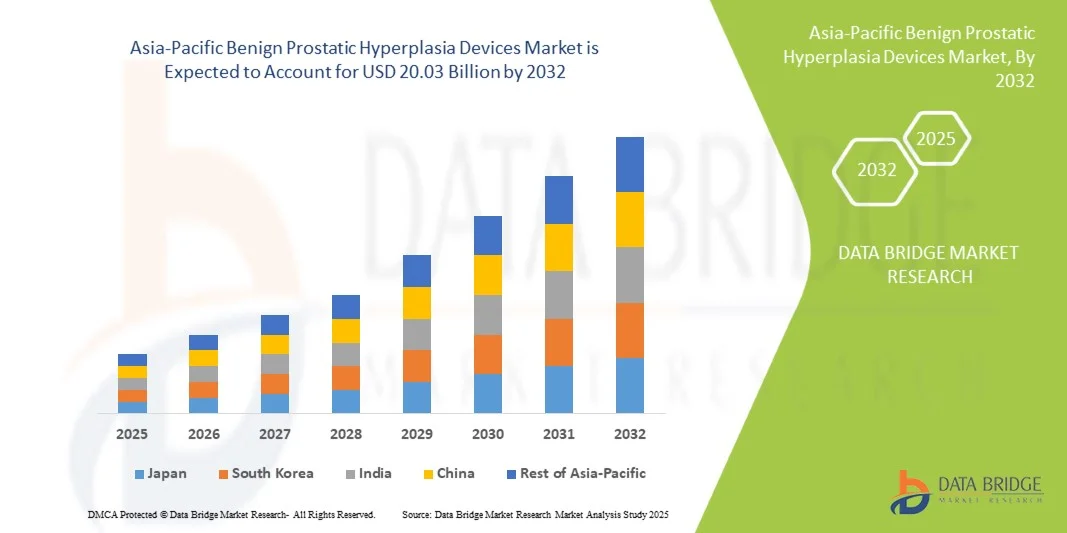
- The Asia-Pacific Benign Prostatic Hyperplasia Devices Market size was valued at USD 7.70 billion in 2024 and is expected to reach USD 20.03 billion by 2032, at a CAGR of 12.70% during the forecast period
- The market growth is largely fueled by the increasing prevalence of benign prostatic hyperplasia (BPH) among the aging male population, coupled with growing awareness about minimally invasive treatment options that enhance patient recovery and comfort
- Furthermore, technological advancements in medical devices—such as laser therapies, prostatic urethral lift systems, and transurethral microwave therapies—are accelerating the adoption of benign prostatic hyperplasia devices solutions, thereby significantly boosting the industry's growth
Asia-Pacific Benign Prostatic Hyperplasia Devices Market Analysis
- Benign Prostatic Hyperplasia (BPH) devices, offering advanced minimally invasive treatment options such as laser therapy, prostatic urethral lift systems, and transurethral microwave therapy, are increasingly vital in modern urological care due to their enhanced efficacy, reduced recovery times, and minimal side effects compared to traditional surgical procedures
- The escalating demand for benign prostatic hyperplasia devices is primarily fueled by the rising prevalence of BPH among the aging population, increasing awareness about advanced treatment options, and a growing preference for non-surgical and outpatient-based procedures
- China dominated the Asia-Pacific Benign Prostatic Hyperplasia Devices Market with the largest revenue share of 41.5% in 2024, characterized by a rapidly aging male population, improved healthcare infrastructure, and strong government initiatives promoting medical technology advancements. The country is witnessing substantial growth in BPH device adoption, driven by domestic innovation and increased availability of advanced urological equipment
- India is expected to be the fastest-growing region in the Asia-Pacific Benign Prostatic Hyperplasia Devices Market during the forecast period, fueled by rising healthcare expenditure, expanding access to urology care, and increasing awareness about early prostate health management
- The Transurethral Resection of the Prostate (TURP) segment dominated the market, accounting for the largest revenue share of 38.4% in 2024, owing to its status as the gold-standard surgical procedure for treating moderate to severe cases of BPH
Report Scope and Asia-Pacific Benign Prostatic Hyperplasia Devices Market Segmentation
|
Attributes |
Benign Prostatic Hyperplasia Devices Key Market Insights |
|
Segments Covered |
|
|
Countries Covered |
Asia-Pacific
|
|
Key Market Players |
|
|
Market Opportunities |
|
|
Value Added Data Infosets |
In addition to the insights on market scenarios such as market value, growth rate, segmentation, geographical coverage, and major players, the market reports curated by the Data Bridge Market Research also include in-depth expert analysis, patient epidemiology, pipeline analysis, pricing analysis, and regulatory framework. |
Asia-Pacific Benign Prostatic Hyperplasia Devices Market Trends
“Enhanced Treatment Precision Through AI and Robotic Assistance”
- A significant and accelerating trend in the benign prostatic hyperplasia (BPH) devices market is the deepening integration of artificial intelligence (AI) and robotic technologies within surgical and minimally invasive treatment systems. This integration is revolutionizing patient outcomes by improving surgical accuracy, reducing recovery time, and enabling better decision-making in clinical settings
- For instance, several transurethral resection and laser therapy systems are now being enhanced with AI-based analytics and robotic precision tools that assist urologists in identifying affected tissues and executing procedures with greater accuracy. These systems also support real-time imaging and data feedback for optimized prostate treatment
- AI integration in BPH devices allows predictive modeling, patient-specific treatment planning, and continuous postoperative monitoring. Certain advanced systems use AI-driven algorithms to detect early signs of complications and provide recommendations for post-surgical care. Robotic-assisted procedures, such as those performed using automated resection systems, further improve efficiency by minimizing human error and enhancing control during surgery
- The growing adoption of robotic and AI-enabled devices in hospitals and specialty clinics is creating a transformative impact on the overall BPH treatment landscape, as healthcare providers prioritize minimally invasive techniques and precision-based care
- This trend toward technologically advanced, data-driven, and patient-centric treatment systems is reshaping expectations within the urology field. Consequently, companies such as Boston Scientific Corporation and Olympus Corporation are developing AI-powered and robot-assisted BPH treatment solutions designed to enhance procedural accuracy, safety, and clinical outcomes
- The rising demand for next-generation BPH treatment devices that offer intelligent assistance, data connectivity, and precision targeting is rapidly increasing across both developed and emerging healthcare markets, driven by the growing elderly population and the rising prevalence of prostate disorders
Asia-Pacific Benign Prostatic Hyperplasia Devices Market Dynamics
Driver
“Rising Geriatric Population and Growing Demand for Minimally Invasive Treatments”
- The increasing global prevalence of benign prostatic hyperplasia among the aging male population is a major factor driving the demand for advanced treatment devices. As life expectancy rises, the number of men affected by urinary obstruction and lower urinary tract symptoms associated with BPH continues to grow
- For instance, in April 2024, Olympus Corporation launched a next-generation laser enucleation system specifically designed to improve procedural efficiency and patient recovery time in BPH surgeries. Such innovations by key market players are expected to propel the Benign Prostatic Hyperplasia Devices industry during the forecast period
- Minimally invasive treatment methods, including laser therapy, prostatic urethral lift systems, and transurethral resection procedures, are gaining significant traction as patients and clinicians seek effective solutions with reduced hospitalization time and fewer side effects
- In addition, the growing awareness of advanced urological care, improvements in diagnostic precision, and rising healthcare investments in developing countries are fueling market expansion
- The increasing availability of portable and patient-friendly treatment devices, along with favorable reimbursement policies in developed regions, is also contributing to the overall market growth trajectory
Restraint/Challenge
“High Cost of Advanced Devices and Limited Access in Low-Income Regions”
- The high cost associated with advanced BPH treatment devices and surgical systems poses a substantial challenge, particularly in developing economies where healthcare infrastructure and spending capacity remain limited
- For instance, robotic and laser-assisted systems often require significant initial investment and ongoing maintenance, which can restrict their adoption to large hospitals or specialized urology centers
- Furthermore, a shortage of trained urologists and technical personnel to operate these complex systems limits the expansion of advanced treatment options in resource-constrained regions
- Addressing these challenges through the introduction of cost-effective alternatives, government-supported healthcare programs, and training initiatives for healthcare professionals will be crucial for expanding accessibility
- While technological advancements are gradually reducing overall treatment costs, the affordability gap and limited awareness among patients regarding minimally invasive BPH therapies continue to hinder market penetration in certain regions
- Overcoming these restraints through strategic collaborations, increased investments in local healthcare systems, and education about early diagnosis and advanced treatment options will be essential for ensuring sustained market growth in the global Benign Prostatic Hyperplasia Devices sector
Asia-Pacific Benign Prostatic Hyperplasia Devices Market Scope
The market is segmented on the basis of procedure type and end user.
• By Procedure Type
On the basis of procedure type, the Benign Prostatic Hyperplasia (BPH) Devices market is segmented into Transurethral Resection of the Prostate (TURP), Prostatic Urethral Lift (PUL), Prostatectomy, Laser Surgery, Transurethral Microwave Therapy (TUMT), Transurethral Needle Ablation of the Prostate (TUNA), Prostatic Stenting/Implants, and Others. The Transurethral Resection of the Prostate (TURP) segment dominated the market, accounting for the largest revenue share of 38.4% in 2024, owing to its status as the gold-standard surgical procedure for treating moderate to severe cases of BPH. TURP’s effectiveness in improving urinary flow, long-standing clinical success, and wide availability across hospitals globally continue to reinforce its market dominance. Moreover, the growing geriatric population and increased prevalence of prostate enlargement among men above 50 years further contribute to the segment’s leadership position. Continuous technological improvements in resectoscopes and surgical precision tools are also enhancing procedural outcomes, minimizing complications, and ensuring sustained demand for TURP devices through 2032.
The Prostatic Urethral Lift (PUL) segment is anticipated to register the fastest CAGR of 12.6% from 2025 to 2032, driven by its minimally invasive nature, reduced recovery time, and ability to preserve sexual function compared to traditional surgical methods. PUL procedures are gaining popularity among younger and middle-aged patients seeking effective symptom relief without long hospital stays. The growing adoption of novel implant-based systems such as UroLift and government support for outpatient urology procedures are also fueling demand. Increasing awareness of patient comfort, reduced postoperative pain, and expanding reimbursement coverage for minimally invasive BPH treatments are expected to accelerate the PUL segment’s growth trajectory throughout the forecast period.
• By End User
On the basis of end user, the Asia-Pacific Benign Prostatic Hyperplasia Devices Market is segmented into Hospitals and Clinics, Ambulatory Surgical Centers (ASCs), and Others. The Hospitals and Clinics segment held the largest revenue share of 64.7% in 2024, owing to the widespread availability of advanced surgical infrastructure, skilled urologists, and comprehensive postoperative care facilities. Hospitals remain the preferred treatment centers for BPH surgeries, particularly for patients requiring complex interventions such as TURP, laser therapy, or prostatectomy. The increasing number of hospital-based urology departments, coupled with government funding for urological care and the integration of advanced imaging technologies, continues to strengthen this segment’s dominance. Additionally, the growing burden of prostate-related disorders and higher patient admissions for minimally invasive treatments reinforce the segment’s market position through 2032.
The Ambulatory Surgical Centers (ASCs) segment is projected to witness the fastest CAGR of 11.3% from 2025 to 2032, driven by the global shift toward outpatient care and cost-effective treatment delivery models. ASCs offer shorter procedure times, reduced hospital stays, and lower treatment costs, making them increasingly attractive to both patients and healthcare providers. Advancements in laser and minimally invasive device technologies have enabled safe same-day BPH procedures in ambulatory settings. Moreover, favorable reimbursement policies, the rising number of specialized urology ASCs, and increasing patient preference for convenience and quicker recovery are expected to drive robust growth in this segment during the forecast period.
Asia-Pacific Benign Prostatic Hyperplasia Devices Market Regional Analysis
- The Asia-Pacific benign prostatic hyperplasia (BPH) devices market is projected to grow at the fastest CAGR during the forecast period from 2025 to 2032, driven by the rising prevalence of prostate disorders, expanding healthcare infrastructure, and increased investments in advanced medical technologies across countries such as China, Japan, and India
- Growing awareness about early diagnosis and the preference for minimally invasive treatment options are further accelerating the adoption of BPH devices in the region
- Moreover, supportive government initiatives aimed at improving urological healthcare and encouraging technological innovation are boosting regional market growth
China Asia-Pacific Benign Prostatic Hyperplasia Devices Market Insight
The China Asia-Pacific Benign Prostatic Hyperplasia Devices Market dominated the Asia-Pacific region with the largest revenue share of 41.5% in 2024, characterized by a rapidly aging male population, improved healthcare infrastructure, and strong government initiatives promoting medical technology advancements. The country is witnessing substantial growth in BPH device adoption, driven by domestic innovation, favorable reimbursement policies, and the increasing availability of advanced urological equipment in hospitals and specialty clinics. Additionally, China’s focus on expanding access to modern healthcare services across urban and rural areas continues to fuel market expansion.
India Asia-Pacific Benign Prostatic Hyperplasia Devices Market Insight
The India Asia-Pacific Benign Prostatic Hyperplasia Devices Market is expected to be the fastest-growing within the Asia-Pacific region during the forecast period, driven by rising healthcare expenditure, expanding access to urology care, and increasing awareness about early prostate health management. The growing prevalence of BPH among the aging male population, coupled with government-led initiatives to improve diagnostic and surgical capabilities, is significantly contributing to market growth. Furthermore, the entry of international medical device companies and the rising adoption of cost-effective, minimally invasive treatment systems are expected to further propel the Indian market in the coming years.
Asia-Pacific Benign Prostatic Hyperplasia Devices Market Share
The Benign Prostatic Hyperplasia Devices industry is primarily led by well-established companies, including:
- Boston Scientific Corporation (U.S.)
- Teleflex Incorporated (U.S.)
- Olympus Corporation (Japan)
- Medtronic (Ireland)
- Cook Medical (U.S.)
- Biolitec AG (Germany)
- BD (U.S.)
- Zephyr Surgical Implants (Switzerland)
- Richard Wolf GmbH (Germany)
- Procept BioRobotics Corporation (U.S.)
- Panaxia Medical (Israel)
- Coloplast A/S (Denmark)
- Allium Medical Solutions (Israel)
- AngioDynamics, Inc. (U.S.)
- Advin Health Care (India)
- SBD Medical (U.K.)
- HealthTronics, Inc. (U.S.)
- ROCAMED (Monaco)
Latest Developments in Asia-Pacific Benign Prostatic Hyperplasia Devices Market
- In September 2021, Boston Scientific Corporation announced the completion of its acquisition of the global surgical business of Lumenis, significantly expanding its portfolio in urology lasers and minimally invasive BPH devices. This acquisition strengthened Boston Scientific’s position in high-power holmium and thulium laser therapy for BPH, positioning the company to accelerate device innovation and global distribution for prostate treatment
- In May 2023, Teleflex Incorporated published long-term data on its UroLift System for prostatic urethral lift (PUL) procedures, demonstrating fewer complications compared with other minimally invasive BPH treatments. This data publication reinforced the value proposition of the PUL device in outpatient settings and is expected to drive wider adoption of implant-based BPH interventions globally
- In June 2023, Olympus Corporation launched a new electrosurgical generator model (ESG-410) designed for BPH and bladder-cancer applications, offering multiple vaporization buttons, band electrodes, resection loops, and needles. The new system enhances procedural flexibility in hospitals and specialty clinics and supports broader adoption of advanced TURP and laser hybrid procedures for enlarged prostate treatment

- Interactive Data Analysis Dashboard
- Company Analysis Dashboard for high growth potential opportunities
- Research Analyst Access for customization & queries
- Competitor Analysis with Interactive dashboard
- Latest News, Updates & Trend analysis
- Harness the Power of Benchmark Analysis for Comprehensive Competitor Tracking
Data collection and base year analysis are done using data collection modules with large sample sizes. The stage includes obtaining market information or related data through various sources and strategies. It includes examining and planning all the data acquired from the past in advance. It likewise envelops the examination of information inconsistencies seen across different information sources. The market data is analysed and estimated using market statistical and coherent models. Also, market share analysis and key trend analysis are the major success factors in the market report. To know more, please request an analyst call or drop down your inquiry.
The key research methodology used by DBMR research team is data triangulation which involves data mining, analysis of the impact of data variables on the market and primary (industry expert) validation. Data models include Vendor Positioning Grid, Market Time Line Analysis, Market Overview and Guide, Company Positioning Grid, Patent Analysis, Pricing Analysis, Company Market Share Analysis, Standards of Measurement, Global versus Regional and Vendor Share Analysis. To know more about the research methodology, drop in an inquiry to speak to our industry experts.
Data Bridge Market Research is a leader in advanced formative research. We take pride in servicing our existing and new customers with data and analysis that match and suits their goal. The report can be customized to include price trend analysis of target brands understanding the market for additional countries (ask for the list of countries), clinical trial results data, literature review, refurbished market and product base analysis. Market analysis of target competitors can be analyzed from technology-based analysis to market portfolio strategies. We can add as many competitors that you require data about in the format and data style you are looking for. Our team of analysts can also provide you data in crude raw excel files pivot tables (Fact book) or can assist you in creating presentations from the data sets available in the report.













