


Asia-Pacific Biomarkers Market Size
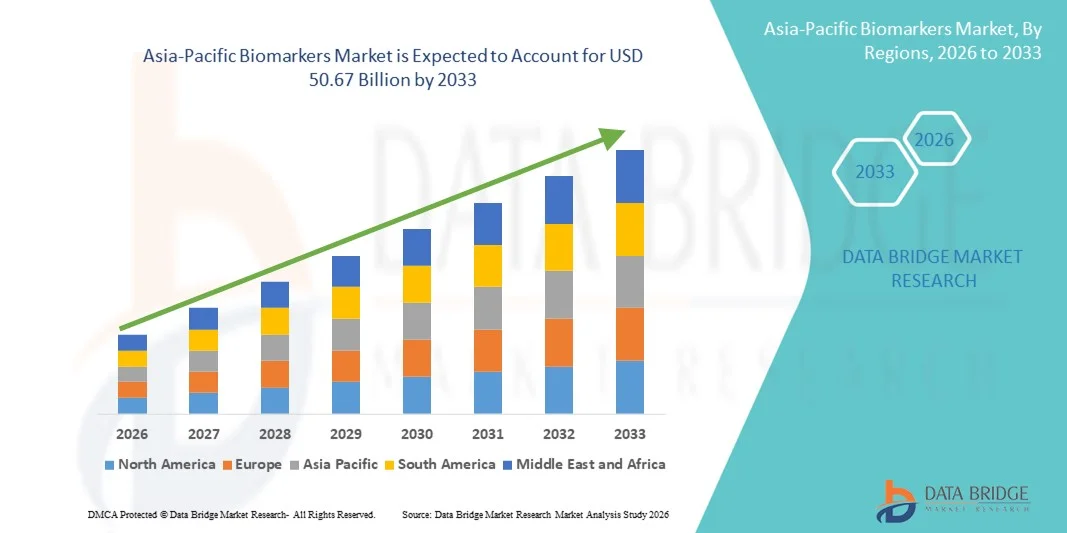
- The Asia-Pacific biomarkers market size was valued at USD 14.73 billion in 2025 and is expected to reach USD 50.67 billion by 2033, at a CAGR of 16.70% during the forecast period
- The market growth is largely fueled by the increasing prevalence of chronic diseases such as cancer, cardiovascular disorders, and neurological conditions, along with the growing adoption of precision medicine and personalized treatment approaches across healthcare systems worldwide
- Furthermore, rising demand for early disease detection, advancements in genomics and proteomics technologies, expanding clinical research activities, and the integration of biomarkers into drug development and diagnostic workflows are establishing biomarkers as essential tools in modern healthcare. These converging factors are accelerating the uptake of Biomarkers solutions, thereby significantly boosting the industry’s growth
Asia-Pacific Biomarkers Market Analysis
- Biomarkers, which are measurable biological indicators used for disease diagnosis, prognosis, and therapeutic monitoring, are increasingly vital components of modern healthcare systems due to their critical role in precision medicine, early disease detection, and targeted drug development
- The escalating demand for biomarkers is primarily fueled by the rising global burden of chronic diseases, growing investments in genomics and proteomics research, increasing clinical trials, and expanding adoption of companion diagnostics in oncology and other therapeutic areas
- China dominated the biomarkers market with the largest revenue share of 35.6% in 2025, driven by expanding biotechnology and pharmaceutical industries, increasing government funding for biomedical research, large patient population, and rapid adoption of advanced diagnostic technologies across hospitals and research institutions
- India is expected to be the fastest-growing region in the biomarkers market during the forecast period, expanding at a CAGR of 11.4% from 2026 to 2033, supported by growing clinical research activities, rising healthcare expenditure, increasing focus on precision medicine, and strengthening diagnostic infrastructure
- The cancer segment held the largest market revenue share of 48.5% in 2025, driven by the rapidly increasing cancer burden across APAC countries
Report Scope and Biomarkers Market Segmentation
|
Attributes |
Biomarkers Key Market Insights |
|
Segments Covered |
|
|
Countries Covered |
Asia-Pacific
|
|
Key Market Players |
|
|
Market Opportunities |
|
|
Value Added Data Infosets |
In addition to the insights on market scenarios such as market value, growth rate, segmentation, geographical coverage, and major players, the market reports curated by the Data Bridge Market Research also include in-depth expert analysis, patient epidemiology, pipeline analysis, pricing analysis, and regulatory framework. |
Asia-Pacific Biomarkers Market Trends
Growing Adoption of Precision Medicine and Companion Diagnostics
- A significant and accelerating trend in the biomarkers market is the increasing adoption of precision medicine approaches that rely on validated biomarkers for disease diagnosis, prognosis, and treatment selection. Healthcare providers are increasingly utilizing molecular and genetic biomarkers to tailor therapies based on individual patient profiles, particularly in oncology and chronic disease management
- For instance, in 2024, Roche expanded the use of its companion diagnostic biomarker testing solutions across Asia-Pacific oncology centers to support targeted cancer therapies, enabling more accurate treatment selection for patients with specific genetic mutations
- The growing integration of genomic, proteomic, and metabolomic biomarkers into clinical workflows is improving early disease detection and therapeutic monitoring
- Advancements in next-generation sequencing (NGS) technologies and liquid biopsy techniques are accelerating the identification and validation of novel biomarkers for complex diseases
- Increasing collaborations between pharmaceutical companies and diagnostic firms are promoting the co-development of biomarker-based targeted therapies and companion diagnostics, further strengthening market growth
Asia-Pacific Biomarkers Market Dynamics
Driver
Rising Prevalence of Chronic Diseases and Expanding Oncology Research
- The increasing global burden of chronic diseases such as cancer, cardiovascular disorders, neurological conditions, and autoimmune diseases is a major driver of the Biomarkers market. Biomarkers play a critical role in early diagnosis, disease monitoring, and personalized treatment planning
- For instance, the growing adoption of HER2, EGFR, and PD-L1 biomarkers in oncology has significantly improved targeted therapy outcomes, leading to widespread clinical use across hospitals and specialized cancer centers
- Rising investments in pharmaceutical research and development are accelerating biomarker discovery and validation processes, particularly in oncology and immunotherapy
- The expansion of clinical trials focusing on targeted therapies and biologics is increasing the demand for reliable biomarker-based patient stratification tools
- Government initiatives supporting precision medicine programs and genomic research are further strengthening the infrastructure required for biomarker testing and implementation
- In addition, increasing awareness among healthcare professionals regarding the clinical benefits of biomarker-driven treatment decisions is supporting broader adoption across diagnostic laboratories
Restraint/Challenge
High Development Costs and Regulatory Complexities
- The high cost associated with biomarker discovery, validation, and commercialization poses a significant challenge for market growth. Extensive clinical trials, laboratory validation, and regulatory approvals require substantial financial investment and time
- For instance, the development of companion diagnostics linked to targeted cancer therapies often requires multi-phase clinical studies and regulatory approvals from agencies such as the FDA and EMA, which can delay product launches and increase overall costs
- Limited standardization of biomarker testing methodologies across laboratories can result in variability in results, affecting clinical reliability
- Reimbursement challenges and limited insurance coverage for advanced biomarker testing in certain regions restrict patient access to precision diagnostics
- Ethical concerns and data privacy regulations related to genetic testing may also slow adoption in some markets
- Overcoming these challenges will require streamlined regulatory pathways, improved reimbursement policies, collaborative research efforts, and cost-efficient technological innovations to make biomarker testing more accessible globally
Asia-Pacific Biomarkers Market Scope
The market is segmented on the basis of type, product, mechanism, application, and disease indication.
- By Type
On the basis of type, the Asia-Pacific (APAC) Biomarkers market is segmented into safety biomarkers, efficacy biomarkers, and validation biomarkers. The safety biomarkers segment dominated the largest market revenue share of 38.9% in 2025, driven by the increasing emphasis on toxicity assessment and patient safety during drug development. Regulatory agencies across APAC increasingly require comprehensive safety profiling before product approvals. Rising clinical trial activities in China, India, Japan, and South Korea significantly contribute to demand. Pharmaceutical companies rely heavily on safety biomarkers to detect adverse drug reactions at early stages. Expansion of contract research organizations further strengthens utilization. Growing investments in oncology and biologics research also support segment growth. Technological advancements in molecular diagnostics improve sensitivity and specificity of safety detection. Increasing healthcare expenditure and research funding across emerging economies enhance adoption. Academic–industry collaborations accelerate biomarker validation processes. Strong pipeline of investigational drugs sustains continuous demand. Improved laboratory infrastructure across the region further boosts implementation. The segment is projected to grow at a CAGR of 11.4% from 2026 to 2033.
The efficacy biomarkers segment is expected to witness the fastest CAGR of 13.2% from 2026 to 2033, fueled by the rising adoption of targeted and precision therapies. These biomarkers help determine therapeutic response and optimize treatment outcomes. Increasing demand for personalized medicine significantly accelerates growth. Growing biologics and immunotherapy pipelines across APAC further strengthen expansion. Pharmaceutical firms increasingly integrate efficacy biomarkers to reduce clinical trial failure rates. Technological progress in companion diagnostics enhances segment adoption. Rising focus on value-based healthcare supports performance-driven treatment models. Expanding genomic profiling initiatives further drive growth momentum.
- By Product
On the basis of product, the APAC Biomarkers market is segmented into consumables, services, software, and growth hormone therapy. The consumables segment held the largest market revenue share of 44.6% in 2025, owing to continuous demand for assay kits, reagents, and testing materials. High research activity and biomarker-based diagnostics drive recurring purchases. Expansion of clinical laboratories across urban centers significantly contributes to revenue. Increasing number of biomarker-driven clinical trials further boosts demand. Technological advancements in assay technologies enhance throughput and efficiency. Growing academic research funding supports laboratory expansion. Rising prevalence of chronic diseases increases diagnostic testing volumes. Strong distribution networks across APAC improve accessibility of consumables. Favorable government policies promoting domestic manufacturing further strengthen supply chains. Continuous innovation in multiplex testing kits enhances growth prospects. The segment is projected to grow at a CAGR of 10.8% during the forecast period.
The software segment is anticipated to register the fastest CAGR of 14.1% from 2026 to 2033, driven by increasing adoption of bioinformatics and AI-based analytics in biomarker discovery. Advanced software solutions enable large-scale genomic and proteomic data interpretation. Rising integration of digital health technologies significantly supports expansion. Increasing demand for data-driven clinical decision-making further accelerates growth. Growing volume of omics data generated from next-generation sequencing platforms necessitates robust data management and analytical tools. Pharmaceutical and biotechnology companies increasingly invest in cloud-based biomarker analysis platforms to enhance scalability and collaboration. Integration of machine learning algorithms improves predictive modeling and biomarker validation accuracy. Rising implementation of electronic health records (EHR) systems facilitates seamless integration of biomarker data into clinical workflows. Increasing partnerships between software developers and research institutions further promote innovation. Automation of complex analytical processes reduces turnaround time and operational costs. Expanding use of real-world data and population health analytics strengthens precision medicine initiatives. Continuous advancements in cybersecurity solutions also enhance data protection and regulatory compliance. In addition, growing demand for interoperable and user-friendly analytical platforms is expected to sustain strong growth in the software segment throughout the forecast period.
- By Mechanism
On the basis of mechanism, the APAC Biomarkers market is segmented into genetic, epigenetic, proteomic, lipidomic, and other mechanisms. The genetic segment dominated the largest revenue share of 36.7% in 2025, supported by widespread adoption of next-generation sequencing technologies. Growing focus on identifying gene mutations linked to cancer and rare disorders strengthens demand. Government-funded genomic research programs across APAC contribute significantly to expansion. Increasing awareness of hereditary disease screening enhances utilization. Technological improvements in PCR and sequencing platforms improve diagnostic accuracy. Rising collaborations between biotech firms and research institutions support innovation. Expanding precision oncology programs further sustain segment growth. The segment is projected to grow at a CAGR of 12.0% from 2026 to 2033.
The proteomic segment is expected to witness the fastest CAGR of 14.5% from 2026 to 2033, driven by growing research into protein-based disease markers. Proteomics plays a critical role in early cancer detection and neurological disorder diagnosis. Increasing investment in mass spectrometry and protein analysis platforms accelerates adoption. Rising focus on biomarker-based therapeutic monitoring further supports expansion. Advancements in high-throughput proteomic technologies enable large-scale identification of disease-specific protein signatures. Growing application of proteomics in drug target identification and validation further strengthens segment demand. Pharmaceutical companies increasingly rely on proteomic biomarkers to evaluate drug efficacy and toxicity during clinical trials. Expansion of precision oncology programs across APAC significantly contributes to revenue growth. Increasing academic and government-funded research initiatives promote deeper exploration of protein expression patterns. Integration of proteomics with genomics and metabolomics enhances comprehensive disease profiling. Rising prevalence of chronic and complex disorders drives demand for advanced diagnostic tools. Improvements in bioinformatics platforms facilitate accurate protein data interpretation and clinical translation. In addition, expanding collaborations between research institutes and biotechnology firms are expected to sustain strong growth momentum in the proteomic segment throughout the forecast period.
- By Application
On the basis of application, the APAC Biomarkers market is segmented into diagnostics development, drug discovery and development, personalized medicine, disease risk assessment, and others. The drug discovery and development segment accounted for the largest revenue share of 40.3% in 2025, driven by expanding pharmaceutical R&D investments across APAC. Biomarkers significantly reduce drug development timelines and improve clinical success rates. Increasing partnerships between global pharma companies and regional biotech firms strengthen innovation. Rising oncology and immunotherapy research further supports dominance. Adoption of translational research models enhances biomarker integration. Expanding clinical trial networks across the region sustain demand. The segment is projected to grow at a CAGR of 11.7% during the forecast period.
The personalized medicine segment is expected to register the fastest CAGR of 15.2% from 2026 to 2033, fueled by increasing demand for patient-specific therapeutic strategies. Advances in genomic sequencing and companion diagnostics significantly accelerate growth. Rising healthcare digitization and molecular profiling initiatives support expansion. Growing awareness regarding precision healthcare across APAC further strengthens market penetration. Increasing adoption of targeted therapies in oncology and rare diseases further drives biomarker utilization in personalized treatment planning. Governments across several APAC countries are investing in national genomics programs, which significantly enhance large-scale biomarker discovery and implementation. Expanding collaborations between biotechnology firms and academic research institutions accelerate innovation in companion diagnostic development. The integration of artificial intelligence and machine learning tools in genomic data analysis improves treatment prediction accuracy. Rising patient preference for tailored therapies with fewer side effects also contributes to segment growth. Increasing availability of advanced diagnostic laboratories in urban centers enhances accessibility to precision testing.
- By Disease Indication
On the basis of disease indication, the APAC Biomarkers market is segmented into cancer, cardiovascular disorders, neurological disorders, immunological disorders, and others. The cancer segment held the largest market revenue share of 48.5% in 2025, driven by the rapidly increasing cancer burden across APAC countries. Tumor biomarkers are widely used for early detection, prognosis, and therapy monitoring. Expanding government screening initiatives significantly contribute to growth. Rising adoption of liquid biopsy technologies enhances clinical outcomes. Increasing oncology-focused R&D investments further strengthen segment leadership. Strong pipeline of targeted cancer therapies supports sustained demand. Growing healthcare awareness and diagnostic infrastructure expansion also contribute to revenue growth. The segment is projected to grow at a CAGR of 12.6% during the forecast period.
The neurological disorders segment is anticipated to witness the fastest CAGR of 14.8% from 2026 to 2033, driven by increasing prevalence of Alzheimer’s, Parkinson’s, and other neurodegenerative diseases. Growing research efforts to identify early-stage neurological biomarkers significantly accelerate growth. Rising aging population across APAC further supports expansion. Increased funding for neurodegenerative disease research enhances innovation. Expanding diagnostic capabilities and improved awareness are expected to sustain rapid segment growth throughout the forecast period.
Asia-Pacific Biomarkers Market Regional Analysis
- The Asia-Pacific biomarkers market is projected to witness substantial growth during the forecast period of 2026 to 2033, supported by expanding healthcare infrastructure, rising investments in life sciences research, and the increasing burden of chronic and infectious diseases across the region. Countries such as China, India, and Japan are at the forefront of this expansion due to strong government backing for biotechnology innovation, growing pharmaceutical manufacturing capabilities, and the rapid adoption of advanced diagnostic technologies
- The rising focus on precision medicine, early disease detection, and personalized treatment strategies is significantly accelerating biomarker research and commercialization
- Furthermore, collaborations between academic institutions, biotechnology firms, and pharmaceutical companies are strengthening clinical research pipelines and driving the development of novel diagnostic and prognostic biomarkers across oncology, cardiology, neurology, and infectious diseases
China Biomarkers Market Insight
China biomarkers market dominated the Biomarkers market with the largest revenue share of 35.6% in 2025, driven by its rapidly expanding biotechnology and pharmaceutical industries, increasing government funding for biomedical research, and a large patient population requiring advanced diagnostic solutions. The country has significantly invested in precision medicine initiatives, genomic sequencing programs, and the modernization of hospital laboratories, which has accelerated the adoption of biomarker-based diagnostics. Strong domestic manufacturers, expanding clinical trial activities, and supportive regulatory reforms have further enhanced market penetration. In addition, the integration of advanced technologies such as molecular diagnostics and next-generation sequencing across major hospitals and research institutions has strengthened China’s leadership position within the Asia-Pacific biomarkers landscape.
India Biomarkers Market Insight
India biomarkers market is expected to be the fastest-growing region in the Biomarkers market during the forecast period, expanding at a CAGR of 11.4% from 2026 to 2033. The growth is supported by increasing clinical research activities, rising healthcare expenditure, and a growing focus on precision medicine and personalized treatment approaches. Government initiatives aimed at strengthening diagnostic infrastructure, expanding biotechnology parks, and encouraging pharmaceutical innovation are contributing to the development of biomarker-based diagnostics. Furthermore, the rising prevalence of chronic diseases, increasing awareness regarding early disease detection, and the expansion of private diagnostic laboratories are accelerating biomarker adoption. As multinational pharmaceutical companies expand their clinical trial operations in India, the demand for validated and reliable biomarkers for drug development and patient stratification is expected to rise significantly, positioning the country as a key high-growth market in the Asia-Pacific region.
Asia-Pacific Biomarkers Market Share
The Biomarkers industry is primarily led by well-established companies, including:
- F. Hoffmann-La Roche Ltd. (Switzerland)
- Thermo Fisher Scientific Inc. (U.S.)
- Abbott (U.S.)
- Siemens Healthineers AG (Germany)
- Danaher Corporation (U.S.)
- Bio-Rad Laboratories, Inc. (U.S.)
- QIAGEN N.V. (Netherlands)
- PerkinElmer, Inc. (U.S.)
- Agilent Technologies, Inc. (U.S.)
- Illumina, Inc. (U.S.)
- Becton, Dickinson and Company (U.S.)
- Merck KGaA (Germany)
- Waters Corporation (U.S.)
- Shimadzu Corporation (Japan)
- Bio-Techne Corporation (U.S.)
- Charles River Laboratories International, Inc. (U.S.)
- Eurofins Scientific (Luxembourg)
- Myriad Genetics, Inc. (U.S.)
- Exact Sciences Corporation (U.S.)
- Guardant Health, Inc. (U.S.)
Latest Developments in Asia-Pacific Biomarkers Market
- In January 2025, Thermo Fisher Scientific partnered with the UK Biobank Pharma Proteomics Project (UKB-PPP) to conduct one of the world’s largest proteomics biomarker studies, utilizing the Olink Explore Platform to analyze more than 5,400 proteins from 600,000 human samples — a key initiative aimed at accelerating biomarker discovery for diverse diseases and therapeutic targets
- In January 2025, Merck established a multi-year collaboration with Opentrons Labworks to automate biology assay kits using the Opentrons Flex robotic workstation, enhancing workflows critical to protein sample preparation and molecular assays essential for biomarker discovery and validation
- In April 2025, Roche introduced the Elecsys PRO-C3 test, a new biomarker-based diagnostic aimed at evaluating liver fibrosis severity in patients with metabolic dysfunction-associated steatotic liver disease (MASLD), reflecting innovation in biomarkers for chronic disease diagnostics
- In April 2025, Eurofins Scientific completed the acquisition of SYNLAB’s clinical diagnostics operations in Spain, significantly expanding its biomarker services capabilities by increasing access to patient samples and strengthening molecular diagnostics and pathological testing services
- In May 2025, the U.S. Food and Drug Administration (FDA) cleared the first-ever blood test for Alzheimer’s disease, developed by Fujirebio Diagnostics and branded as Lumipulse, which measures blood biomarkers (pTau217 and β-amyloid 1-42) to indicate amyloid plaque buildup — a major milestone in non-invasive biomarker diagnostics

- Interactive Data Analysis Dashboard
- Company Analysis Dashboard for high growth potential opportunities
- Research Analyst Access for customization & queries
- Competitor Analysis with Interactive dashboard
- Latest News, Updates & Trend analysis
- Harness the Power of Benchmark Analysis for Comprehensive Competitor Tracking
Data collection and base year analysis are done using data collection modules with large sample sizes. The stage includes obtaining market information or related data through various sources and strategies. It includes examining and planning all the data acquired from the past in advance. It likewise envelops the examination of information inconsistencies seen across different information sources. The market data is analysed and estimated using market statistical and coherent models. Also, market share analysis and key trend analysis are the major success factors in the market report. To know more, please request an analyst call or drop down your inquiry.
The key research methodology used by DBMR research team is data triangulation which involves data mining, analysis of the impact of data variables on the market and primary (industry expert) validation. Data models include Vendor Positioning Grid, Market Time Line Analysis, Market Overview and Guide, Company Positioning Grid, Patent Analysis, Pricing Analysis, Company Market Share Analysis, Standards of Measurement, Global versus Regional and Vendor Share Analysis. To know more about the research methodology, drop in an inquiry to speak to our industry experts.
Data Bridge Market Research is a leader in advanced formative research. We take pride in servicing our existing and new customers with data and analysis that match and suits their goal. The report can be customized to include price trend analysis of target brands understanding the market for additional countries (ask for the list of countries), clinical trial results data, literature review, refurbished market and product base analysis. Market analysis of target competitors can be analyzed from technology-based analysis to market portfolio strategies. We can add as many competitors that you require data about in the format and data style you are looking for. Our team of analysts can also provide you data in crude raw excel files pivot tables (Fact book) or can assist you in creating presentations from the data sets available in the report.













