


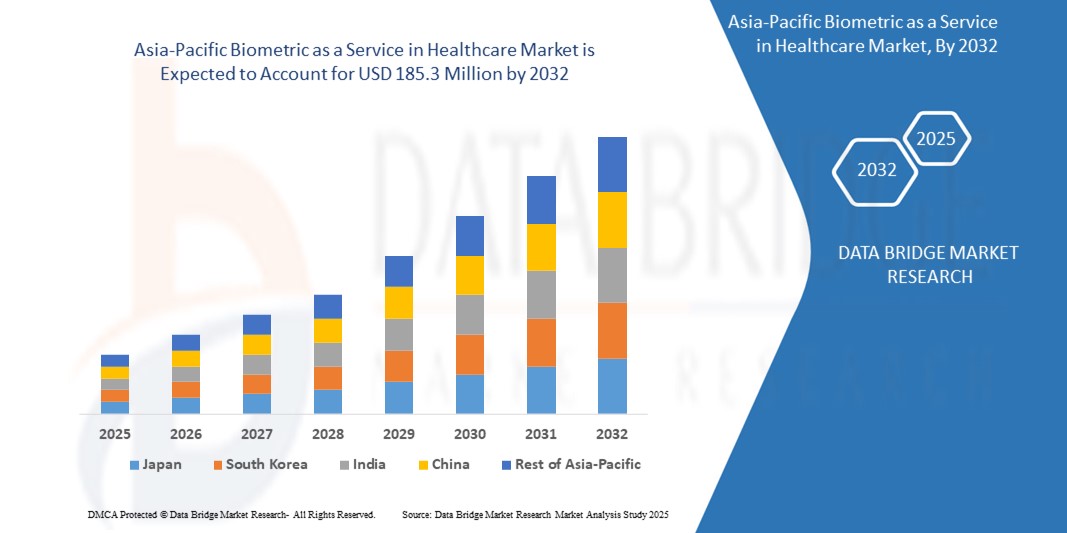
Asia-Pacific Biometric as a Service in Healthcare Market Size
- The Asia-Pacific Biometric as a Service in Healthcare Market size was valued at USD 74.4 million in 2024 and is expected to reach USD 185.3 million by 2032, at a CAGR of 13.9% during the forecast period.
- This growth is driven by the growing need to accurately identify patients and prevent duplicate medical records is driving biometric adoption.
Asia-Pacific Biometric as a Service in Healthcare Market Analysis
- The growing need to accurately identify patients and prevent duplicate medical records is driving biometric adoption. In densely populated countries like India and China, biometric systems are increasingly used to link patients with their medical history across hospitals and clinics.
- Rapid adoption of electronic health records (EHR), telemedicine, and mobile health (mHealth) platforms across APAC boosts the demand for secure access solutions. Biometrics ensure identity verification across platforms, enhancing trust in digital healthcare.
- Health insurers in Asia-Pacific are increasingly turning to biometric authentication to reduce identity theft, claim fraud, and impersonation. Biometrics can verify that the policyholder is the one accessing services.
- Japan holds a significant market share due to Increase in Medical Insurance Fraud Prevention.
- Japan is expected to register the fastest growth, fuelled by Surge in Healthcare Digitization & eHealth Platforms.
- The Unimodal segment is projected to account for a significant market share of approximately 62.2% in 2025, driven by Government Initiatives for Secure Health Infrastructure.
Report Scope and Asia-Pacific Biometric as a Service in Healthcare Market Segmentation
|
Attributes |
Asia-Pacific Biometric as a Service in Healthcare Market Key Market Insights |
|
Segments Covered |
|
|
Countries Covered |
Asia-Pacific
|
|
Key Market Players |
|
|
Market Opportunities |
|
|
Value Added Data Infosets |
In addition to the insights on market scenarios such as market value, growth rate, segmentation, geographical coverage, and major players, the market reports curated by the Data Bridge Market Research also include import export analysis, production capacity overview, production consumption analysis, price trend analysis, climate change scenario, supply chain analysis, value chain analysis, raw material/consumables overview, vendor selection criteria, PESTLE Analysis, Porter Analysis, and regulatory framework. |
Asia-Pacific Biometric as a Service in Healthcare Market Trends
“Smart Infrastructure Integration”
- Hospitals and healthcare systems across Asia-Pacific are increasingly adopting cloud-based biometric platforms integrated with national health IT infrastructure to improve patient identification, reduce fraud, and streamline access to medical records.
- Biometric wearables and mobile health apps integrated with national electronic health records (EHRs) are enhancing patient monitoring and outpatient services.
- In 2023, Singapore’s Ministry of Health launched a pilot program using facial recognition linked with MyHealth Record to authenticate patients at public hospitals.
- Cloud-based biometric solutions are enabling secure access to patient data in rural and urban areas alike. In 2024, NEC partnered with Indian health networks to deploy facial and fingerprint authentication across clinics under the Ayushman Bharat Digital Mission.
Asia-Pacific Biometric as a Service in Healthcare Market Dynamics
Driver
“Regulatory Compliance and Risk Management”
- Regional regulations such as India’s Digital Information Security in Healthcare Act (DISHA) and Japan’s Act on the Protection of Personal Information (APPI) are encouraging hospitals to adopt biometric systems that ensure secure, compliant data access.
- Healthcare providers are utilizing biometric authentication to reduce errors in medication administration and patient identity mismatches.
- For instance, In January 2025, Fujitsu introduced a palm vein authentication platform in Japanese eldercare homes to reduce risks associated with patient misidentification.
- Integration with e-KYC (electronic Know Your Customer) systems in countries like India is streamlining the process of insurance claim verification, enabling faster and fraud-resistant healthcare transactions.
Opportunity
“Integration with Advanced Analytics”
- Asia-Pacific healthcare systems are rapidly transitioning toward data-driven decision-making. Combining biometric authentication with AI-driven analytics enables early diagnosis and predictive care delivery.
- BaaS vendors are offering customizable analytics tools on their platforms, allowing hospitals to monitor patient flow, compliance metrics, and security breach patterns.
- For instance.
- For instance, as of February 2025, Alibaba Cloud launched a new biometric analytics suite in China, enabling hospitals to integrate facial biometrics with patient scheduling and health status analytics.
- Biometric platforms are supporting remote diagnostics and telemedicine services, especially in underserved areas.
Restraint/Challenge
“High Implementation Costs”
- Many public hospitals and small clinics across Asia-Pacific face budget constraints that limit the adoption of advanced biometric solutions, especially those requiring multi-modal sensors or AI integration.
- Cybersecurity remains a key concern, especially with centralized biometric databases. Unauthorized access or data leaks can have significant privacy and reputational implications.
- For instance, In April 2023, a data breach at a South Korean hospital compromised over 50,000 biometric patient records, raising public concerns over biometric data security.
- The cost and complexity of integrating biometric systems with legacy hospital management platforms slow down full-scale deployment. Countries with fragmented healthcare systems, like Indonesia and the Philippines, face greater implementation hurdles.
Asia-Pacific Biometric as a Service in Healthcare Market Scope
The market is segmented based on Modality Type, Access Control and Authentication, Model, Access Channel, Application.
|
Segmentation |
Sub-Segmentation |
|
By Modality Type |
|
|
By Access Control and Authentication |
|
|
By Model |
|
|
By Access Channel |
|
|
By Application |
|
In 2025, Unimodal segment is projected to dominate the End User segment
The Unimodal segment is expected to hold a market share of approximately 62.2% in 2025, driven by Expansion of Telehealth & Mobile Biometric Solutions.
The Single-Factor Authentication segment is expected to account for the largest share during the forecast period in the Biometric as a Service in Healthcare Market
In 2025, the Single-Factor Authentication segment is projected to account for a market share of 69.8%, driven by Growth in Cross-Border Medical Tourism.
“Japan Holds the Largest Share in the Asia-Pacific Biometric as a Service in Healthcare Market”
- Japan dominates the market due to the surge in mobile-first healthcare services and remote patient monitoring in the post-COVID era presents a significant opportunity for BaaS. Mobile biometrics (e.g., facial recognition via smartphone) can authenticate patients without physical contact.
- The Japan holds a significant share, driven by Biometric-based national digital health ID programs across APAC are creating a foundation for BaaS adoption in healthcare delivery, insurance, and public health surveillance.
- With more healthcare providers shifting to cloud platforms for storage, analytics, and EHR, there is a growing appetite for cloud-native biometric authentication tools—paving the way for BaaS models.
“Japan is Projected to Register the Highest CAGR in the Asia-Pacific Biometric as a Service in Healthcare Market”
- Japan growth is driven by Rapid adoption of electronic health records (EHR), telemedicine, and mobile health (mHealth) platforms across APAC boosts the demand for secure access solutions. Biometrics ensure identity verification across platforms, enhancing trust in digital healthcare.
- Japan is projected to exhibit the highest CAGR due to the growing need to accurately identify patients and prevent duplicate medical records.
- Governments are investing in national digital health frameworks that include biometrics to secure health data and service delivery.
Asia-Pacific Biometric as a Service in Healthcare Market Share
The market competitive landscape provides details by competitor. Details included are company overview, company financials, revenue generated, market potential, investment in research and development, new market initiatives, Asia Pacific presence, production sites and facilities, production capacities, company strengths and weaknesses, product launch, product width and breadth, application dominance. The above data points provided are only related to the companies' focus related to market.
The Major Market Leaders Operating in the Market Are:
- Gemalto NV,
- agnitio,
- BioAXS Co. Ltd.,
- Cenmetrix (Pvt) Ltd.
- FUJITSU,
- HID Global Corporation,
- Hitachi, Ltd.
- Integrated Biometrics,
- Innovatrics, IRITECH, INC.,
- LaserLock International, Inc.,
- M2SYS Technology,
- MorphoTrust USA,
- Nuance Communications, Inc.,
- Qualcomm Technologies, Inc.
- SecuGen Corporation,
- Uniphore, lumenvox,
- VoiceVault Voice Authentication
Latest Developments in Asia-Pacific Biometric as a Service in Healthcare Market
- In Junw 23, NEC Corporation Launched the "NEC Biometric Engine," a biometric authentication solution aimed at enhancing patient safety and security in healthcare settings.
- In May 2023, Fujitsu Limited Expanded its biometrics portfolio by introducing a palm vein authentication solution for applications like patient identification and access control.
- In December 2023, Hitachi, Ltd. Partnered with Concordium Foundation to enhance its Public Biometric Infrastructure (PBI) platform, integrating biometric authentication with digital signatures for secure healthcare applications.
- As of October 2023, Thales Group Introduced the "SafeNet IDPrime FIDO Bio Smart Card," a contactless smart card enabling secure access to healthcare services using fingerprint authentication

- Interactive Data Analysis Dashboard
- Company Analysis Dashboard for high growth potential opportunities
- Research Analyst Access for customization & queries
- Competitor Analysis with Interactive dashboard
- Latest News, Updates & Trend analysis
- Harness the Power of Benchmark Analysis for Comprehensive Competitor Tracking
Data collection and base year analysis are done using data collection modules with large sample sizes. The stage includes obtaining market information or related data through various sources and strategies. It includes examining and planning all the data acquired from the past in advance. It likewise envelops the examination of information inconsistencies seen across different information sources. The market data is analysed and estimated using market statistical and coherent models. Also, market share analysis and key trend analysis are the major success factors in the market report. To know more, please request an analyst call or drop down your inquiry.
The key research methodology used by DBMR research team is data triangulation which involves data mining, analysis of the impact of data variables on the market and primary (industry expert) validation. Data models include Vendor Positioning Grid, Market Time Line Analysis, Market Overview and Guide, Company Positioning Grid, Patent Analysis, Pricing Analysis, Company Market Share Analysis, Standards of Measurement, Global versus Regional and Vendor Share Analysis. To know more about the research methodology, drop in an inquiry to speak to our industry experts.
Data Bridge Market Research is a leader in advanced formative research. We take pride in servicing our existing and new customers with data and analysis that match and suits their goal. The report can be customized to include price trend analysis of target brands understanding the market for additional countries (ask for the list of countries), clinical trial results data, literature review, refurbished market and product base analysis. Market analysis of target competitors can be analyzed from technology-based analysis to market portfolio strategies. We can add as many competitors that you require data about in the format and data style you are looking for. Our team of analysts can also provide you data in crude raw excel files pivot tables (Fact book) or can assist you in creating presentations from the data sets available in the report.













