


Asia-Pacific Cardiopulmonary Bypass Accessory Equipment Market Size
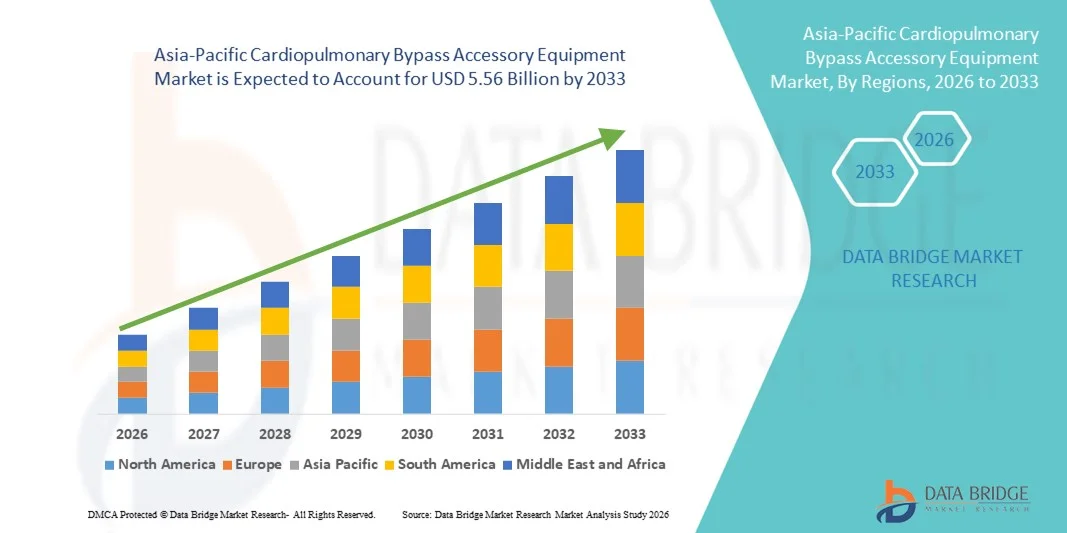
- The Asia-Pacific cardiopulmonary bypass accessory equipment market size was valued at USD 2.94 billion in 2025 and is expected to reach USD 5.56 billion by 2033, at a CAGR of 8.3% during the forecast period
- The market growth is largely fueled by rising prevalence of cardiovascular diseases, increasing healthcare expenditure, and rapid technological advancement in extracorporeal circulation systems and accessory components
- Furthermore, growing demand for safer, more efficient cardiopulmonary bypass solutions and improvements in cardiac care accessibility are establishing these accessories as essential elements of modern surgical practice. Converging factors such as government initiatives to upgrade healthcare facilities and rising patient awareness about advanced cardiac interventions are accelerating the adoption of cardiopulmonary bypass accessory equipment across the region, significantly boosting industry growth
Asia-Pacific Cardiopulmonary Bypass Accessory Equipment Market Analysis
- Cardiopulmonary bypass accessory equipment, including oxygenators, cannulas, tubing sets, and pumps, are increasingly vital components of modern cardiac surgery, enabling safe and effective heart–lung support during complex procedures in hospitals and specialized cardiac centers due to their precision, reliability, and compatibility with advanced surgical systems
- The escalating demand for these accessories is primarily fueled by the rising prevalence of cardiovascular diseases, increasing number of cardiac surgeries, and growing focus on improving surgical outcomes through advanced extracorporeal circulation technologies
- China dominated the Asia-Pacific cardiopulmonary bypass accessory equipment market with the largest revenue share of 35.8% in 2025, driven by rapid expansion of cardiac care infrastructure, government healthcare initiatives, and rising adoption of advanced bypass systems in top-tier hospitals, with a significant increase in cardiac surgeries in metropolitan areas fueling market growth
- India is expected to be the fastest growing country in the market during the forecast period, due to increasing investments in healthcare infrastructure, rising patient awareness, and expanding cardiac surgery volumes in both public and private hospitals
- Oxygenator segment dominated the cardiopulmonary bypass accessory equipment market in the region with a 42.3% share in 2025, driven by its critical role in gas exchange during bypass procedures and its compatibility with various surgical setups
Report Scope and Asia-Pacific Cardiopulmonary Bypass Accessory Equipment Market Segmentation
|
Attributes |
Asia-Pacific Cardiopulmonary Bypass Accessory Equipment Key Market Insights |
|
Segments Covered |
|
|
Countries Covered |
Asia-Pacific
|
|
Key Market Players |
|
|
Market Opportunities |
|
|
Value Added Data Infosets |
In addition to the insights on market scenarios such as market value, growth rate, segmentation, geographical coverage, and major players, the market reports curated by the Data Bridge Market Research also include in-depth expert analysis, patient epidemiology, pipeline analysis, pricing analysis, and regulatory framework |
Asia-Pacific Cardiopulmonary Bypass Accessory Equipment Market Trends
Technological Advancements and Integration with Minimally Invasive Surgery
- A significant and accelerating trend in the Asia-Pacific cardiopulmonary bypass accessory equipment market is the integration of advanced oxygenators, tubing sets, and cannulas with minimally invasive and robotic-assisted cardiac surgeries, enhancing procedural efficiency, safety, and patient outcomes
- For instance, the latest modular bypass systems allow seamless compatibility with robotic surgical platforms, enabling surgeons to perform complex procedures with improved precision and reduced operative times
- Advanced sensors and monitoring devices integrated into bypass equipment enable real-time detection of blood flow, pressure, and oxygenation, providing more intelligent alerts during surgery. For instance, some oxygenator models incorporate AI-driven monitoring to predict perfusion irregularities and improve patient safety
- The integration of cardiopulmonary bypass accessories with surgical workflow management systems allows centralized monitoring of multiple parameters, ensuring that all surgical team members can track patient vitals and machine performance simultaneously
- This trend toward more connected, intelligent, and procedure-specific bypass solutions is fundamentally reshaping clinical expectations for cardiac surgery. Consequently, companies such as Medtronic and Terumo are developing modular, sensor-enabled bypass equipment compatible with minimally invasive cardiac interventions
- The demand for bypass accessories that offer seamless integration with advanced surgical technologies is growing rapidly across both public and private hospitals, as cardiac surgeons increasingly prioritize efficiency, patient safety, and precision outcomes
- The growing interest in hybrid operating rooms, combining imaging systems and advanced bypass equipment, is further driving demand for integrated and versatile cardiopulmonary bypass accessories
Asia-Pacific Cardiopulmonary Bypass Accessory Equipment Market Dynamics
Driver
Rising Cardiovascular Disease Burden and Expanding Cardiac Surgeries
- The increasing prevalence of cardiovascular diseases across Asia-Pacific countries, coupled with growing volumes of cardiac surgeries, is a significant driver for the heightened demand for cardiopulmonary bypass accessory equipment
- For instance, in March 2025, Terumo Corporation announced the launch of an advanced oxygenator system for high-volume cardiac centers in China, aiming to enhance bypass efficiency and safety during complex surgeries
- As hospitals expand cardiac care services and patient awareness rises, bypass accessories with enhanced monitoring, disposable tubing, and improved oxygenators offer a compelling upgrade over older surgical setups
- Furthermore, the growing number of cardiac centers and government initiatives to expand healthcare infrastructure are making advanced bypass equipment essential for modern cardiac surgery procedures
- Improved device ergonomics, ease of setup, and compatibility with multiple cardiac interventions are key factors propelling the adoption of bypass accessories in both public and private hospitals. The trend toward standardization of disposable components and modular setups further contributes to market growth
- For instance, India’s increasing cardiac surgery volume in tier-1 and tier-2 cities is driving hospitals to invest in high-performance bypass equipment for better patient outcomes
- Increasing collaborations between device manufacturers and hospital networks to provide training, service, and maintenance support is further accelerating adoption across Asia-Pacific healthcare facilities
Restraint/Challenge
High Costs and Regulatory Compliance Hurdles
- The high cost of advanced cardiopulmonary bypass accessories, coupled with stringent regulatory requirements across APAC countries, poses a significant challenge to wider market penetration
- For instance, new devices must comply with both national medical device regulations and international safety standards, which can delay product launches and adoption in smaller hospitals
- Addressing cost and regulatory hurdles through local manufacturing, bulk procurement, and adherence to regional certification protocols is crucial for building hospital trust. Companies such as Medtronic and Getinge emphasize compliance and quality certifications to reassure healthcare providers
- Furthermore, limited trained personnel to operate advanced bypass systems in some regions and the perceived complexity of modular setups can hinder adoption in smaller healthcare facilities
- Overcoming these challenges through government support programs, training initiatives, and cost optimization strategies will be vital for sustained growth in the APAC cardiopulmonary bypass accessory equipment market
- For instance, some hospitals in Southeast Asia delay adoption of advanced bypass equipment due to budget constraints and complex approval processes
- In addition, the need to maintain strict sterilization and single-use protocols for disposable bypass accessories increases operational costs, limiting adoption in smaller or resource-constrained hospitals
Asia-Pacific Cardiopulmonary Bypass Accessory Equipment Market Scope
The market is segmented on the basis of product, operation, application, age, end user, and distribution channel.
- By Product
On the basis of product, the market is segmented into oxygenator, ECMO machine, pumps, cannula, temperature monitors, heat exchanger, filters, tubing clamps, hemoconcentrators, system panel, sensor and accessories, cardioplegia control, reservoir, bubble detector, electronic gas blender, electrical venous occluder, venous line clamp and accessories. The oxygenator segment dominated the market with the largest revenue share of 42.3% in 2025, driven by its critical role in gas exchange during cardiopulmonary bypass procedures and its compatibility with a wide range of surgical setups. Hospitals prioritize oxygenators due to their reliability, ease of integration with various bypass systems, and improvements in membrane technology enhancing patient safety. High adoption in both adult and pediatric cardiac surgeries also strengthens the segment’s market position. Modular oxygenators that allow single-use disposables are increasingly preferred for infection control and operational efficiency. Advanced oxygenators with integrated sensors are enabling real-time monitoring during surgery, improving perfusion accuracy. Innovations in low-prime oxygenators for minimally invasive surgeries further expand adoption across tertiary care hospitals.
The pumps segment is anticipated to witness the fastest growth at a CAGR of 14.5% from 2026 to 2033, fueled by technological advances in electrically operated and AI-assisted perfusion pumps. These pumps provide precise blood flow control during surgery, reduce human error, and integrate with advanced monitoring systems. The growing demand for minimally invasive and hybrid cardiac procedures further contributes to pump adoption. Continuous innovation in compact, portable pump designs enhances usability across hospitals and cardiac centers. For instance, some hospitals in Japan and India are adopting automated pumps for high-volume surgeries to improve efficiency. Rising awareness of perfusionist workflow optimization and reduced intraoperative complications also drives adoption.
- By Operation
On the basis of operation, the market is segmented into manually operated, electrically operated, and battery-operated devices. The electrically operated segment dominated the market with a 51.2% share in 2025, driven by widespread hospital adoption of automated systems for precision and safety during complex cardiac surgeries. Electrically operated devices reduce perfusionist workload, allow integration with monitoring systems, and improve consistency in flow rates and oxygenation levels. Hospitals prefer these systems for large-scale cardiac procedures and high-volume surgical centers due to their reliability. They are particularly favored in adult and geriatric cardiac surgeries where precise control is essential. Advanced electrically operated pumps and monitors also enable real-time data logging for post-operative analysis. Continuous maintenance and calibration support provided by manufacturers reinforce hospital preference for electrically operated devices.
The battery-operated segment is expected to witness the fastest growth at a CAGR of 15.2% from 2026 to 2033, fueled by demand in ambulatory surgical centers, emergency cardiac care, and remote hospitals where electrical supply may be limited. Portable battery-operated pumps, oxygenators, and monitors provide flexibility and continuity of care. Improvements in battery efficiency and reliability allow their use in transport cases and smaller facilities. Hospitals with hybrid operating rooms and mobile cardiac units increasingly rely on battery-powered devices. Integration with compact monitoring systems also supports adoption in ICUs and pediatric cardiac care. Rising focus on uninterrupted patient care during power fluctuations further drives this segment.
- By Application
On the basis of application, the market is segmented into cardiac surgery, cardiac surgery oxygenators, acute respiratory failure treatment, lung cancer, transplant operation, and others. The cardiac surgery segment dominated the market with a revenue share of 47.5% in 2025, driven by the increasing number of cardiac procedures in APAC countries such as China, India, and Japan. Hospitals and cardiac centers prioritize high-quality bypass accessories for adult, pediatric, and geriatric surgeries. Rising cardiovascular disease prevalence and government initiatives to expand cardiac care infrastructure contribute to dominance. High adoption of oxygenators, pumps, and cannulas in major cardiac centers further strengthens market leadership. Hospitals benefit from modular bypass systems that improve surgical efficiency and reduce post-operative complications. The focus on reducing surgical risks and enhancing patient outcomes drives continued investment in this segment.
The acute respiratory failure treatment segment is expected to witness the fastest growth at a CAGR of 16.1% from 2026 to 2033, fueled by rising demand for ECMO machines and oxygenation devices in ICUs across APAC. Growing awareness of respiratory care and increasing lung disease prevalence drive adoption. Expansion of tertiary hospitals in urban and semi-urban regions further supports growth. ECMO integration with advanced monitoring devices enhances precision in patient management. Some hospitals are deploying portable ECMO systems for emergency respiratory care, boosting uptake. Rising government and private hospital investments in respiratory support technology also contribute to the rapid growth of this segment.
- By Age
On the basis of age, the market is segmented into adult, geriatric, and pediatric. The adult segment dominated the market with a revenue share of 54.7% in 2025, due to the higher incidence of cardiovascular diseases in adults and the large number of cardiac surgeries performed in hospitals across APAC. Hospitals invest in advanced bypass equipment to manage complex adult cardiac cases. Adult-specific oxygenators and pumps are preferred for flow capacity and compatibility with standard perfusion protocols. High adoption rates in metropolitan hospitals and private cardiac centers support dominance. Advanced monitoring accessories for adults further enhance perfusion safety. Integration of adult bypass equipment with hybrid operating rooms improves surgical efficiency and patient outcomes.
The pediatric segment is anticipated to witness the fastest growth at a CAGR of 15.8% from 2026 to 2033, driven by rising awareness of congenital heart disease management, increasing neonatal and pediatric cardiac surgeries, and miniaturized oxygenators, cannulas, and pumps. Specialized pediatric bypass systems reduce trauma and improve safety. Adoption is increasing in children’s hospitals and tertiary cardiac centers. Technological advances allow better perfusion control for smaller patients. Modular pediatric systems improve workflow for surgical teams. Training programs for pediatric perfusionists further support adoption across APAC.
- By End User
On the basis of end user, the market is segmented into hospitals, cardiac centers, research and academic institutions, ambulatory surgical centers, and others. The hospitals segment dominated the market with a revenue share of 59.4% in 2025, driven by large volumes of cardiac surgeries and well-equipped surgical infrastructure in tertiary hospitals. Hospitals invest in complete bypass setups, including oxygenators, pumps, monitors, and disposable accessories. High patient throughput and advanced surgical suites contribute to dominance. Hospitals benefit from direct manufacturer support for maintenance and training. The segment also sees strong adoption for adult, pediatric, and geriatric cardiac care. Established procurement processes and quality certifications reinforce hospital preference.
The cardiac centers segment is expected to witness the fastest growth at a CAGR of 16.3% from 2026 to 2033, fueled by specialized cardiac care centers in urban APAC regions. These centers increasingly adopt modular, sensor-enabled bypass equipment for precise cardiac surgeries. Expansion of private cardiac centers and collaborations with device manufacturers for training and service support drive adoption. Centers focus on patient outcome optimization and high-volume surgeries. Integration with minimally invasive and hybrid surgical systems further supports growth. Rising investments in private cardiac care infrastructure also boost market expansion.
- By Distribution Channel
On the basis of distribution channel, the market is segmented into direct tender, third-party distributor, and retail sales. The direct tender segment dominated the market with a revenue share of 63.2% in 2025, due to large hospitals and government institutions procuring equipment directly from manufacturers for quality, service support, and bulk discounts. Direct procurement ensures compliance with specifications and long-term service contracts. Hospitals handling high-volume surgeries prefer direct tender for reliability. Tertiary care centers adopt integrated bypass solutions through tenders. Established relationships with manufacturers facilitate training and maintenance support. Bulk orders reduce cost per unit and ensure timely delivery for critical surgeries.
The third-party distributor segment is expected to witness the fastest growth at a CAGR of 15.9% from 2026 to 2033, driven by increasing penetration in tier-2 and tier-3 cities, small-scale hospitals, and ambulatory surgical centers. Distributors provide faster delivery, flexible payment options, and multi-brand solutions. Smaller hospitals benefit from local service support and convenience. Adoption is rising in hospitals with limited procurement infrastructure. Distributors also offer bundled solutions including consumables and disposables. Growing network of distributors across APAC supports wider accessibility of advanced bypass technologies.
Asia-Pacific Cardiopulmonary Bypass Accessory Equipment Market Regional Analysis
- China dominated the Asia-Pacific cardiopulmonary bypass accessory equipment market with the largest revenue share of 35.8% in 2025, driven by rapid expansion of cardiac care infrastructure, government healthcare initiatives, and rising adoption of advanced bypass systems in top-tier hospitals, with a significant increase in cardiac surgeries in metropolitan areas fueling market growth
- Hospitals and cardiac centers in China highly prioritize patient safety, reliability, and integration of modular bypass accessories such as oxygenators, pumps, and cannulas, leading to strong demand for high-quality, sensor-enabled equipment
- This widespread adoption is further supported by government healthcare initiatives, growing patient awareness about cardiovascular diseases, and investments in modern surgical facilities, establishing cardiopulmonary bypass accessories as essential tools in both public and private hospitals
The China Cardiopulmonary Bypass Accessory Equipment Market Insight
The China cardiopulmonary bypass accessory equipment market captured the largest revenue share of 35.8% in 2025, fueled by rapid expansion of cardiac care infrastructure and increasing volumes of cardiac surgeries. Hospitals and cardiac centers are prioritizing advanced oxygenators, pumps, and cannulas to enhance patient safety and procedural efficiency. Growing awareness of cardiovascular diseases, coupled with government healthcare initiatives, is further driving adoption. Integration of modular and sensor-enabled bypass equipment into surgical workflows is becoming standard in top-tier hospitals. Moreover, rising investments in tertiary care facilities and high-volume cardiac centers are supporting sustained market growth across both adult and pediatric segments.
Japan Cardiopulmonary Bypass Accessory Equipment Market Insight
The Japan market is gaining momentum due to advanced cardiac care infrastructure, a strong base of experienced cardiac surgeons, and increasing demand for minimally invasive surgeries. Hospitals are adopting sensor-enabled oxygenators, automated pumps, and monitoring accessories to optimize perfusion and reduce surgical risks. Integration with hybrid operating rooms and advanced imaging systems is enhancing surgical precision. Japan’s high emphasis on patient safety and technological innovation is driving consistent adoption. In addition, the growing geriatric population is increasing demand for reliable bypass equipment for complex cardiac procedures. The country’s regulatory support and well-developed hospital network further strengthen market growth.
India Cardiopulmonary Bypass Accessory Equipment Market Insight
The India market accounted for the largest market revenue share in APAC after China in 2025, driven by rapid urbanization, expanding cardiac surgery volumes, and growing healthcare infrastructure. Hospitals and cardiac centers are increasingly adopting modular and portable bypass systems for adult, pediatric, and geriatric patients. Government initiatives for cardiac care, along with the rise of private cardiac centers, are accelerating adoption. Training programs for perfusionists and collaborations with device manufacturers support proper utilization of advanced bypass accessories. Rising awareness of congenital and acquired heart disease, coupled with affordable solutions from domestic manufacturers, is boosting the overall market penetration in India.
South Korea Cardiopulmonary Bypass Accessory Equipment Market Insight
The South Korea market is expanding due to rising cardiac surgery volumes and increasing investments in hospital infrastructure for advanced surgical care. Hospitals are adopting modular oxygenators, pumps, and ECMO machines to improve surgical efficiency and patient outcomes. Emphasis on high-quality patient care, integration of monitoring systems, and demand for minimally invasive procedures are fueling growth. Government initiatives promoting cardiac care infrastructure further enhance adoption. In addition, South Korea’s focus on research, innovation, and advanced medical technology supports faster uptake of sensor-enabled and automated bypass systems.
Asia-Pacific Cardiopulmonary Bypass Accessory Equipment Market Share
The Asia-Pacific Cardiopulmonary Bypass Accessory Equipment industry is primarily led by well-established companies, including:
- Medtronic (Ireland)
- Getinge AB (Sweden)
- LivaNova PLC (U.K.)
- Terumo Corporation (Japan)
- Edwards Lifesciences Corporation (U.S.)
- EUROSETS S.r.l. (Italy)
- Boston Scientific Corporation (U.S.)
- Abbott (U.S.)
- SCHNELL Medical Corp. (Switzerland)
- NIPRO CORPORATION (Japan)
- XENIOS AG (Germany)
- Teleflex Incorporated (U.S.)
- APC Cardiovascular Ltd (U.K.)
- Braile Biomedica Ltda (Brazil)
- Fresenius Medical Care AG & Co. KGaA (Germany)
- B. Braun SE (Germany)
- MC3 Cardiopulmonary (U.S.)
- MicroPort Scientific Corporation (China)
- Surge Cardiovascular (U.S.)
- BD (U.S.)
What are the Recent Developments in Asia-Pacific Cardiopulmonary Bypass Accessory Equipment Market?
- In July 2025, Medtronic’s VitalFlow ECMO system received CE Mark approval in Europe, signaling broader regulatory endorsement and enhanced global availability of the technology; while the approval is not specific to Asia‑Pacific, the CE Mark often precedes and supports expanded adoption and distribution in APAC healthcare markets
- In September 2024, Medtronic launched VitalFlow™, a new Extracorporeal Membrane Oxygenation (ECMO) system designed to bridge bedside care and intra‑hospital transport, offering a simplified, configurable one‑system solution for critical cardiopulmonary support. This introduction expands advanced ECMO options that are central to cardiopulmonary bypass accessory usage and emergency cardiopulmonary support
- In August 2023, LivaNova unveiled the Essenz In‑Line Blood Monitor with U.S. FDA 510(k) clearance and CE Mark approval, enhancing intra‑operative monitoring capabilities which are critical accessories during cardiopulmonary bypass and related procedures
- In March 2023, LivaNova PLC received U.S. FDA 510(k) clearance for its Essenz Heart‑Lung Machine, a cardiopulmonary bypass system designed to improve workflow efficiency and support individualized perfusion during bypass procedures. FDA clearance and global rollout plans influence adoption and clinical confidence in APAC cardiothoracic centers
- In March 2023, multiple industry news outlets reported LivaNova’s FDA nod for its Essenz perfusion system an integrated heart‑lung machine and monitor highlighting its potential impact on data‑driven perfusion care during cardiopulmonary bypass procedures. This development underscores clinical progress in core CPB support technologies relevant to APAC surgical programs

- Interactive Data Analysis Dashboard
- Company Analysis Dashboard for high growth potential opportunities
- Research Analyst Access for customization & queries
- Competitor Analysis with Interactive dashboard
- Latest News, Updates & Trend analysis
- Harness the Power of Benchmark Analysis for Comprehensive Competitor Tracking
Data collection and base year analysis are done using data collection modules with large sample sizes. The stage includes obtaining market information or related data through various sources and strategies. It includes examining and planning all the data acquired from the past in advance. It likewise envelops the examination of information inconsistencies seen across different information sources. The market data is analysed and estimated using market statistical and coherent models. Also, market share analysis and key trend analysis are the major success factors in the market report. To know more, please request an analyst call or drop down your inquiry.
The key research methodology used by DBMR research team is data triangulation which involves data mining, analysis of the impact of data variables on the market and primary (industry expert) validation. Data models include Vendor Positioning Grid, Market Time Line Analysis, Market Overview and Guide, Company Positioning Grid, Patent Analysis, Pricing Analysis, Company Market Share Analysis, Standards of Measurement, Global versus Regional and Vendor Share Analysis. To know more about the research methodology, drop in an inquiry to speak to our industry experts.
Data Bridge Market Research is a leader in advanced formative research. We take pride in servicing our existing and new customers with data and analysis that match and suits their goal. The report can be customized to include price trend analysis of target brands understanding the market for additional countries (ask for the list of countries), clinical trial results data, literature review, refurbished market and product base analysis. Market analysis of target competitors can be analyzed from technology-based analysis to market portfolio strategies. We can add as many competitors that you require data about in the format and data style you are looking for. Our team of analysts can also provide you data in crude raw excel files pivot tables (Fact book) or can assist you in creating presentations from the data sets available in the report.













