


What is the Asia-Pacific Cargo Inspection Market Size and Growth Rate?
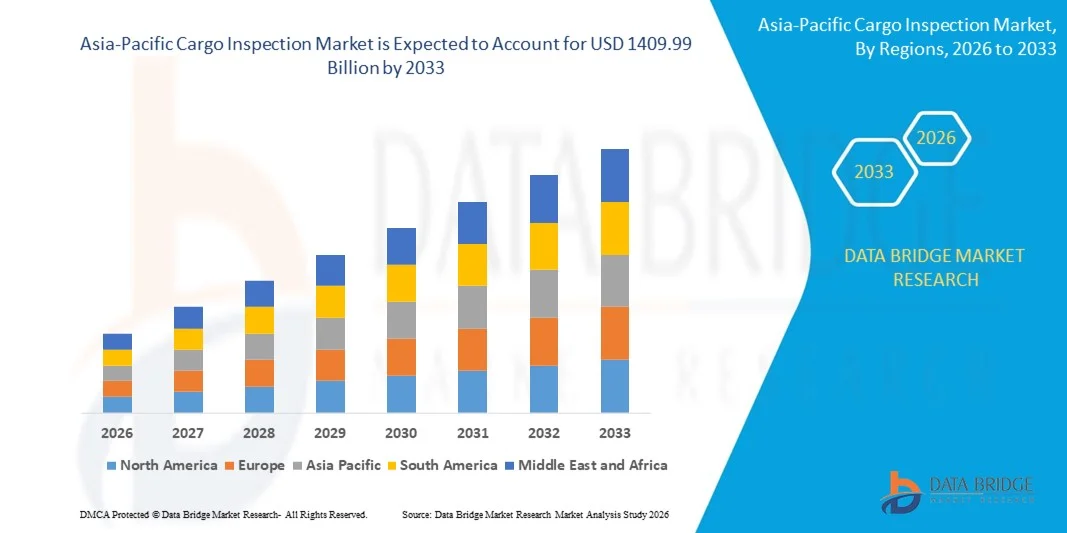
- As per Data Bridge Market Research Analysis the Asia-Pacific cargo inspection market size was valued at USD 976.43 billion in 2025 and is expected to reach USD 1409.99 billion by 2033, at a CAGR of 4.70% during the forecast period
- In the Cargo Inspection market, the integration of cutting-edge technology such as Quantum Clocks enhances precision and reliability
- Quantum Clocks utilize atomic properties to achieve unparalleled accuracy, revolutionizing applications in telecommunications, navigation systems, and scientific research. This innovation elevates timing device capabilities, meeting the increasingly stringent demands of modern industries
Market Size & Forecast
- Global Market Value (2025): USD 976.43 billion
- Expected Market Value (2033): USD 1409.99 billion
- Forecast CAGR (2026–2033): 4.70%
What are the Major Takeaways of Cargo Inspection Market?
- The rising popularity of smartphones, tablets, wearables, and other consumer electronics fuels demand for integrated Cargo Inspection. Essential for communication, data processing, and multimedia functions, these devices rely on precise timing for seamless operation. As consumer expectations for performance and connectivity grow, and the need for accurate timing solutions in electronics
- The China cargo inspection market dominated the Asia-Pacific region with the largest revenue share of 44.2% in 2024, driven by rapid industrial automation, significant growth in processed foods, beverages, and packaged goods, and large-scale investments in automated processing and packaging lines
- India is witnessing the fastest growth rate of 9.1%, supported by increasing processed food production, growing adoption of automated meat, dairy, and beverage processing systems, and strict adherence to food safety and hygiene regulations
- The Oil industry segment dominated the market with the largest revenue share of 38.2% in 2024, driven by the critical need for accurate fuel verification, cargo safety, and compliance in large-scale oil shipments
Report Scope and Cargo Inspection Market Segmentation
|
Attributes |
Cargo Inspection Key Market Insights |
|
Segments Covered |
|
|
Countries Covered |
Asia-Pacific
|
|
Key Market Players |
|
|
Market Opportunities |
|
|
Value Added Data Infosets |
In addition to the insights on market scenarios such as market value, growth rate, segmentation, geographical coverage, and major players, the market reports curated by the Data Bridge Market Research also include in-depth expert analysis, pricing analysis, brand share analysis, consumer survey, demography analysis, supply chain analysis, value chain analysis, raw material/consumables overview, vendor selection criteria, PESTLE Analysis, Porter Analysis, and regulatory framework. |
What is the Key Trend in the Cargo Inspection Market?
Integration of AI-Driven Automation and Predictive Inspection Solutions
- A key trend shaping the Cargo Inspection market is the adoption of AI-powered automation platforms and predictive analytics that enable real-time cargo monitoring, anomaly detection, and risk assessment, enhancing overall inspection efficiency
- Advanced inspection devices now leverage AI to optimize scanning routes, detect irregularities, and automatically flag damaged or non-compliant goods, reducing human error and improving operational throughput
- Integration with IoT sensors and cloud-enabled platforms allows remote monitoring, predictive maintenance, and centralized reporting, supporting logistics, ports, and warehousing operations
- These technological innovations improve speed, accuracy, and traceability, especially in high-volume shipping environments, cross-border logistics, and industrial supply chains. Cargo Inspection solutions are becoming indispensable for ensuring safety, compliance, and operational reliability
- Key players such as SGS SA, Bureau Veritas, Intertek, ALS Limited, and Cotecna are investing in AI-assisted scanning, robotics, and software analytics to create intelligent inspection ecosystems, setting a benchmark for efficiency and automation
- The convergence of AI, predictive analysis, and smart sensing is expected to drive widespread adoption across logistics and industrial sectors, establishing Cargo Inspection as a critical tool for next-generation supply chain management
What are the Key Drivers of Cargo Inspection Market?
- Rising global trade volumes, stricter safety regulations, and increasing demand for real-time cargo verification are primary drivers of the Cargo Inspection market
- For instance, in 2024, several ports in Asia-Pacific deployed AI-enabled scanning systems to accelerate customs clearance while ensuring compliance with international safety standards
- Growing e-commerce shipments, cross-border transportation, and industrial logistics require faster, reliable, and automated inspection solutions to minimize delays and reduce operational risk
- Advancements in AI, machine learning, high-resolution imaging, and X-ray/CT scanning technologies have enhanced inspection accuracy, detection speed, and adaptability to various cargo types
- Integration of cloud computing and IoT connectivity allows real-time reporting and centralized monitoring, further boosting adoption in shipping, rail, and aviation sectors
- Overall, the market is driven by the need for higher operational efficiency, regulatory compliance, and risk mitigation in increasingly complex supply chains
Which Factor is Challenging the Growth of the Cargo Inspection Market?
- High initial investment, equipment maintenance costs, and technology calibration requirements remain significant challenges for Cargo Inspection adoption, particularly in small ports or logistics providers
- For instance, AI-powered scanners with high-resolution imaging and robotics require specialized training and infrastructure, limiting accessibility for cost-sensitive operators
- Environmental factors such as vibration, temperature variation, and dust can impact device performance, especially in harsh or outdoor logistics environments
- Supply chain constraints for advanced sensors, semiconductors, and specialized software modules can cause delays in deployment and service upgrades
- Furthermore, data privacy, regulatory compliance, and integration with existing enterprise systems require careful planning, which can slow adoption in certain regions
- To overcome these barriers, companies are focusing on modular, scalable, and cost-optimized solutions with predictive maintenance, robust testing, and remote monitoring capabilities to sustain global market expansion across logistics, industrial, and transportation verticals
How is the Cargo Inspection Market Segmented?
The market is segmented on the basis of industry type, cargo type, offering, inspection type, technology, and port types.
- By Industry Type
On the basis of industry type, the cargo inspection market is segmented into Agriculture, Oil, Mining, Metal, Petrochemicals, Gas, Chemical, Medical Devices, Automotive, Machine Manufacturing, and Others. The Oil industry segment dominated the market with the largest revenue share of 38.2% in 2024, driven by the critical need for accurate fuel verification, cargo safety, and compliance in large-scale oil shipments. Inspection solutions for oil facilitate measurement, sampling, and verification, ensuring efficient logistics and risk mitigation.
The Mining segment is projected to witness the fastest CAGR from 2025 to 2032, fueled by growing demand for high-value minerals, stricter quality regulations, and advanced inspection techniques for bulk cargo such as iron ore, coal, and metals. This adoption supports operational efficiency and loss prevention across global mining operations.
- By Cargo Type
On the basis of cargo type, the market is segmented into Grains, LPG, LNG, Coal, Iron Ore, RO-RO, Cruise, Fertilizers, and Others. The Coal segment dominated the market with a 34.7% revenue share in 2024, due to large-scale bulk handling, high-volume exports, and strict energy regulatory compliance requirements. Coal inspections involve quality validation, moisture content checks, and safety audits, which are critical for shipping and storage.
The LNG segment is expected to grow at the fastest CAGR from 2025 to 2032, driven by rising global demand for clean energy, growth in LNG terminals, and the adoption of advanced scanning and sampling technologies for high-value liquid cargo. This trend accelerates adoption of automated and AI-assisted inspection solutions.
- By Offering
On the basis of offering, the market is segmented into Product and Services. The Services segment dominated the Cargo Inspection market with the largest revenue share of 57.3% in 2024, fueled by demand for third-party inspection, auditing, verification, and consulting services across shipping, ports, and industrial operations. Service offerings provide compliance assurance, reporting, and end-to-end cargo monitoring, making them critical for large-scale logistics networks.
The Product segment is projected to register the fastest CAGR from 2025 to 2032, driven by advancements in automated scanners, handheld devices, IoT-enabled sensors, and cloud-connected inspection equipment. Increasing adoption of smart inspection hardware in ports, warehouses, and industrial facilities is accelerating product deployment globally.
- By Inspection Type
On the basis of inspection type, the market is segmented into Bunker Quantity Survey, Hold & Hatch Inspection Hold Survey, Draft Survey, Cargo Damage Survey, Cargo Lashing/Handling/Logistics, Cargo Tally Verification Draft Survey, Cargo Survey, Pre-Shipment Inspection, Cargo Sampling (Oil), Cargo Measurement (Oil), Proof and Inspection of Asset, Pre-Vetting Inspection, Pre-Purchase Vessel Inspection, Vessel On/Off Hire Survey, Vessel Condition and Damage Survey, Cleanliness ISM Preparation Audit, Marine Warranty Survey, Navigation Audit, and Others.
The Cargo Sampling (Oil) segment dominated the market with a 29.5% revenue share in 2024, as accurate sampling ensures compliance, quality verification, and safe transportation. The Pre-Purchase Vessel Inspection segment is expected to grow at the fastest CAGR from 2025 to 2032, driven by increasing ship acquisitions, trade expansion, and regulatory scrutiny, necessitating advanced inspection protocols and high-precision tools.
- By Technology
On the basis of technology, the market is segmented into Non-Intrusive Inspection Technology and Nondestructive Evaluation (NDE) Technology. The Non-Intrusive Inspection Technology segment dominated the market with a 62.1% revenue share in 2024, due to its ability to scan cargo without physical contact, enhancing safety and reducing inspection time for bulk shipments.
The NDE Technology segment is projected to grow at the fastest CAGR from 2025 to 2032, driven by adoption of X-ray, ultrasonic, and imaging technologies for high-value or sensitive cargo, ensuring detailed analysis without compromising integrity.
- By Port Types
On the basis of port types, the market is segmented into Sea Ports, Inland Ports, Dry Ports, and Warmwater Ports. The Sea Ports segment dominated the market with a 54.8% revenue share in 2024, due to high trade volumes, bulk cargo handling, and presence of major shipping lanes.
The Dry Ports segment is expected to witness the fastest CAGR from 2025 to 2032, supported by increasing intermodal transport, inland logistics hubs, and demand for faster, secure cargo movement in landlocked regions.
Which Region Holds the Largest Share of the Cargo Inspection Market?
- The China cargo inspection market dominated the Asia-Pacific region with the largest revenue share of 44.2% in 2024, driven by rapid industrial automation, significant growth in processed foods, beverages, and packaged goods, and large-scale investments in automated processing and packaging lines
- Extensive adoption of robotics, conveyor systems, cold-chain handling equipment, and AI-enabled smart factory solutions is strengthening the region’s market leadership. Strong regulatory emphasis on food safety, modernization of processing infrastructure, and integration of IoT-, AI-, and sensor-enabled technologies position China as the most technology-driven regional market
- Continuous investments in logistics optimization, material handling, and packaging automation further accelerate adoption of advanced Cargo Inspection systems across industries.
India Cargo Inspection Market Insight
India is witnessing the fastest growth rate of 9.1%, supported by increasing processed food production, growing adoption of automated meat, dairy, and beverage processing systems, and strict adherence to food safety and hygiene regulations. Deployment of robotic palletizing, cold storage solutions, and smart conveyor systems enhances operational efficiency and scalability. Government initiatives promoting food processing infrastructure, Make in India programs, and investments in sustainable technologies are reinforcing India’s position as a high-growth market in Asia-Pacific. Rising startup activity in agri-tech and logistics further fuels demand for innovative Cargo Inspection solutions.
Japan Cargo Inspection Market Insight
In Japan, the market is expanding steadily, driven by advanced automation in food and beverage manufacturing, modernization of processing plants, and growing demand for packaged and ready-to-eat foods. Adoption of conveyor systems, robotics, and cold-chain handling equipment improves production throughput and efficiency. Strong regulatory focus on food safety, precision standards, and integration of IoT-enabled inspection technologies positions Japan as a key stable market within Asia-Pacific. Continuous investment in next-generation packaging automation and inspection devices ensures consistent growth in this mature market.
South Korea Cargo Inspection Market Insight
In South Korea, the market is growing at a healthy pace, fueled by investments in automated processing and packaging facilities, high consumer demand for processed foods, and advanced cold-chain logistics. Integration of robotics, smart conveyors, and sensor-driven equipment enhances operational efficiency across manufacturing plants. Supportive government programs for food safety standards, technology adoption, and digitalization of industrial infrastructure strengthen South Korea’s contribution to regional growth. Rising exports of processed goods and adoption of AI-enabled quality inspection solutions further drive market expansion
Which are the Top Companies in Cargo Inspection Market?
The cargo inspection industry is primarily led by well-established companies, including:
- SGS SA (Switzerland)
- Bureau Veritas (France)
- Intertek Group plc (U.K.)
- Eurofins Scientific (Luxembourg)
- ALS Limited (Australia)
- Cotecna Inspection SA (Switzerland)
- Alex Stewart International (Latvia)
- AHK Group Ltd (U.K.)
- Peterson and Control Union (Netherlands)
- Wakefield Inspection Services (U.K.)
- Marine Inspection LLC (U.S.)
- Qtech Control Limited (U.K.)
- CISCO (U.S.)
- WK Webster (U.K.)
- Brookes Bell LLP (U.K.)
- TÜV SÜD (Germany)
- Hitachi, Ltd. (Japan)
- Smiths Detection Group Ltd. (U.K.)
What are the Recent Developments in Global Cargo Inspection Market?
- In February 2025, SGS entered into a strategic partnership with Hurricane Commerce to integrate its proprietary D-TECT® non-intrusive inspection and AI image analysis platform with Hurricane’s data intelligence solutions, significantly improving customs clearance efficiency by enhancing detection of misdeclared shipments, verifying HS codes, and identifying restricted or prohibited goods, reinforcing SGS’s leadership in advanced Cargo Inspection technologies
- In January 2025, SGS and Bureau Veritas ended negotiations regarding a potential USD 30 billion all-stock merger, which would have created the world’s largest testing, inspection, and certification (TIC) entity, highlighting the challenges of consolidation at this scale and emphasizing strategic alignment complexities, underlining the competitive dynamics in the Cargo Inspection industry
- In March 2022, National Cargo Bureau, a U.S.-based container inspection company, launched a remote container inspection service based on a web-based container inspection database and access portal, enabling customers to remotely assess and inspect container transport units with assistance from NCB surveyor staff, streamlining inspection processes and improving operational efficiency
- In May 2021, DNV GL launched a Mobile Inspection App designed to assist ship owners and managers in digitizing and optimizing workflow, recording, and follow-up of safety inspections onboard, providing onshore personnel immediate access to inspection results, and enabling efficient monitoring and performance improvements through advanced dashboards
- In February 2021, TÜV SÜD was accredited as an inspections and approval agency for unportable tanks by the U.S. Department of Transportation (DOT) under international regulations such as ADR/RID, IMDG Code, and TPED, helping the company attract more customers and enhancing growth opportunities in the global Cargo Inspection market

- Interactive Data Analysis Dashboard
- Company Analysis Dashboard for high growth potential opportunities
- Research Analyst Access for customization & queries
- Competitor Analysis with Interactive dashboard
- Latest News, Updates & Trend analysis
- Harness the Power of Benchmark Analysis for Comprehensive Competitor Tracking
Asia Pacific Cargo Inspection Market, Supply Chain Analysis and Ecosystem Framework
To support market growth and help clients navigate the impact of geopolitical shifts, DBMR has integrated in-depth supply chain analysis into its Asia Pacific Cargo Inspection Market research reports. This addition empowers clients to respond effectively to global changes affecting their industries. The supply chain analysis section includes detailed insights such as Asia Pacific Cargo Inspection Market consumption and production by country, price trend analysis, the impact of tariffs and geopolitical developments, and import and export trends by country and HSN code. It also highlights major suppliers with data on production capacity and company profiles, as well as key importers and exporters. In addition to research, DBMR offers specialized supply chain consulting services backed by over a decade of experience, providing solutions like supplier discovery, supplier risk assessment, price trend analysis, impact evaluation of inflation and trade route changes, and comprehensive market trend analysis.
Data collection and base year analysis are done using data collection modules with large sample sizes. The stage includes obtaining market information or related data through various sources and strategies. It includes examining and planning all the data acquired from the past in advance. It likewise envelops the examination of information inconsistencies seen across different information sources. The market data is analysed and estimated using market statistical and coherent models. Also, market share analysis and key trend analysis are the major success factors in the market report. To know more, please request an analyst call or drop down your inquiry.
The key research methodology used by DBMR research team is data triangulation which involves data mining, analysis of the impact of data variables on the market and primary (industry expert) validation. Data models include Vendor Positioning Grid, Market Time Line Analysis, Market Overview and Guide, Company Positioning Grid, Patent Analysis, Pricing Analysis, Company Market Share Analysis, Standards of Measurement, Global versus Regional and Vendor Share Analysis. To know more about the research methodology, drop in an inquiry to speak to our industry experts.
Data Bridge Market Research is a leader in advanced formative research. We take pride in servicing our existing and new customers with data and analysis that match and suits their goal. The report can be customized to include price trend analysis of target brands understanding the market for additional countries (ask for the list of countries), clinical trial results data, literature review, refurbished market and product base analysis. Market analysis of target competitors can be analyzed from technology-based analysis to market portfolio strategies. We can add as many competitors that you require data about in the format and data style you are looking for. Our team of analysts can also provide you data in crude raw excel files pivot tables (Fact book) or can assist you in creating presentations from the data sets available in the report.













