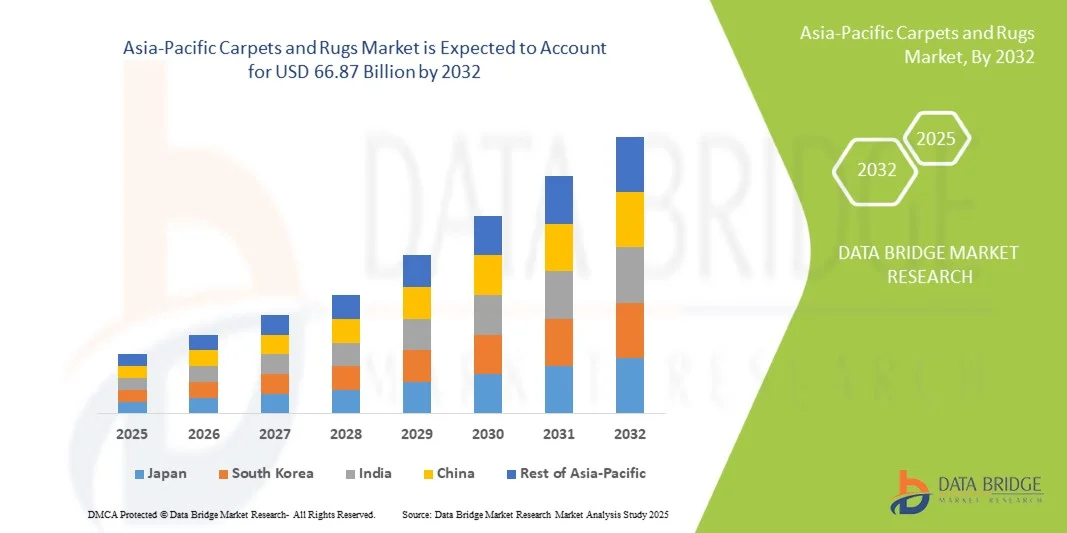
Asia-Pacific Carpets and Rugs Market Size
- The Asia-Pacific carpets and rugs market size was valued at USD 42.59 billion in 2024 and is expected to reach USD 66.87 billion by 2032, at a CAGR of 5.80% during the forecast period
- Surge in the number of remodelling and renovation activities and rising urbanization and globalization are the major drivers that will influence the growth of carpets and rugs market
- Furthermore, rising consumer interest in interior decoration, expansion of transportation and construction industry, rising demand for environment friendly carpets and increase in the adoption of carpet tiles will accelerate the carpets and rugs market growth rate. However, high cost associated with raw materials will hamper the growth of the carpets and rugs market
Asia-Pacific Carpets and Rugs Market Analysis
- Growing number of construction activities in developing countries and increasing importance of organised retailing will provide beneficial opportunities for the carpets and rugs market growth. Disposal of waste will challenge the carpets and rugs market growth rate
- China dominated the carpets and rugs market in 2024, driven by strong demand from residential, commercial, and hospitality sectors, along with large-scale infrastructure and real estate development
- Japan is expected to witness the highest compound annual growth rate (CAGR) in the Asia-Pacific carpets and rugs market due to increasing adoption of smart, sustainable, and technologically advanced flooring solutions. The country’s focus on premium home décor, eco-conscious living, and innovation in tufting and weaving technologies is boosting demand for high-quality carpets and rugs
- The carpet segment dominated the market with a 58% revenue share in 2024, owing to its extensive use in residential and commercial spaces for aesthetic enhancement, insulation, and comfort
Report Scope and Asia-Pacific Carpets and Rugs Market Segmentation
|
Attributes |
Asia-Pacific Carpets and Rugs Key Market Insights |
|
Segments Covered |
|
|
Countries Covered |
Asia-Pacific
|
|
Key Market Players |
|
|
Market Opportunities |
|
|
Value Added Data Infosets |
In addition to the insights on market scenarios such as market value, growth rate, segmentation, geographical coverage, and major players, the market reports curated by the Data Bridge Market Research also include in-depth expert analysis, pricing analysis, brand share analysis, consumer survey, demography analysis, supply chain analysis, value chain analysis, raw material/consumables overview, vendor selection criteria, PESTLE Analysis, Porter Analysis, and regulatory framework. |
Asia-Pacific Carpets and Rugs Market Trends
“Increasing Adoption of Smart Manufacturing and Sustainable Material Integration”
- A major and accelerating trend in the Asia-Pacific carpets and rugs market is the increasing adoption of smart manufacturing technologies and eco-friendly materials. Companies are leveraging automation, digital weaving systems, and sustainable fibers to enhance product quality, reduce waste, and meet environmental regulations.
- For instance, Interface, Inc., Tarkett, and emerging APAC-based firms have integrated AI-enabled production monitoring and closed-loop recycling systems to optimize material use and reduce carbon emissions. These initiatives are driving the development of zero-waste production models and circular supply chains in the region. Companies are also collaborating with local suppliers to source recycled yarns and biodegradable fibers to meet increasing regulatory and consumer demands
- Manufacturers in the Asia-Pacific region are focusing on biodegradable fibers, recycled yarns, and water-efficient dyeing techniques to align with global sustainability goals and customer expectations for eco-conscious home décor. These efforts are supported by government incentives in countries such as India and China for eco-friendly manufacturing practices. As a result, end-users are increasingly prioritizing carpets made from certified sustainable materials
- The integration of IoT-based production control and digital design software enables real-time process optimization and seamless pattern customization, minimizing human error. In APAC, this approach is helping mid-size manufacturers compete with global brands by offering personalized rugs and faster time-to-market. Digital twin simulations allow manufacturers to forecast production bottlenecks and energy consumption, reducing operational costs while improving design accuracy
- This trend toward smart, sustainable, and tech-driven carpet production is transforming industry dynamics, encouraging companies to innovate for both efficiency and environmental responsibility. Regional players are investing in R&D centers focusing on advanced fiber composites and low-impact dyeing techniques. Adoption of cloud-based supply chain management in APAC also improves resource allocation and transparency across multiple production facilities
- Rising demand for eco-labeled flooring solutions in residential, commercial, and hospitality sectors continues to propel adoption of sustainable and automated manufacturing practices. Countries such as Australia, Japan, and South Korea are seeing increased government-backed green building certifications, further incentivizing manufacturers to produce low-impact carpets. Consumer preference for hypoallergenic, low-VOC, and easy-to-maintain rugs is also supporting growth in premium eco-friendly product lines
Asia-Pacific Carpets and Rugs Market Dynamics
Driver
“Growing Preference For Aesthetic Interior Designs And Eco-Friendly Flooring”
- The growing preference for aesthetic interior designs and eco-friendly flooring is driving the demand for modern carpets and rugs. Consumers in urban centers such as Shanghai, Mumbai, and Sydney are increasingly seeking durable, customizable, and recyclable flooring solutions. Rising disposable incomes and exposure to global design trends are further encouraging adoption of high-quality carpets
- For instance, in 2024, MOHAWK INDUSTRIES, INC., along with APAC players such as Godrej Carpets and Orient Bell, expanded its ReCover sustainable carpet line, featuring recyclable fibers and low-emission materials. Local brands are also introducing innovative designs using recycled polyester and natural fibers to capture environmentally conscious consumers
- Rapid urbanization and housing development across emerging APAC economies are boosting demand for decorative and functional flooring solutions. Smart city projects and commercial real estate expansions are driving large-scale orders for aesthetically appealing and durable carpets. In addition, the hospitality and retail sectors in Southeast Asia are increasingly specifying eco-friendly and customizable flooring options
- Technological advancements in tufting machines, 3D weaving, and stain-resistant coatings are enhancing product performance and consumer appeal. APAC manufacturers are integrating precision robotics and automated color matching systems to reduce human error and improve quality consistency. These improvements also support faster turnaround times for customized orders
- The growing awareness of indoor air quality and wellness is encouraging the use of low-VOC and natural material-based rugs, promoting healthier living spaces. Consumers in Japan, South Korea, and Australia are particularly attentive to allergens and chemical emissions, driving demand for certified eco-friendly and natural fiber carpets
Restraint/Challenge
“High Manufacturing And Raw Material Costs”
- High manufacturing and raw material costs continue to hinder market expansion, especially for small and medium manufacturers striving to adopt sustainable production methods. Rising import costs for natural fibers in APAC countries and increased energy prices contribute to overall production expenses. Many SMEs are finding it challenging to invest in automation or green technologies despite growing consumer demand
- Dependence on synthetic materials such as nylon and polyester poses challenges in achieving full recyclability, limiting the transition to circular manufacturing. APAC manufacturers are balancing cost and sustainability by blending recycled polyester with bio-based fibers, yet full adoption remains limited. Consumers’ growing environmental awareness is pressuring companies to innovate without significantly increasing product prices
- Fluctuations in crude oil prices directly impact synthetic fiber costs, creating instability in production expenses. Companies such as Beaulieu International Group, Balta Industries nv., and APAC-based manufacturers such as Century Carpets are investing in bio-based alternatives and regional supply diversification to mitigate this risk. Government incentives for sustainable raw materials in China and India are also supporting this transition
- Environmental regulations on chemical dyes and waste management increase operational complexity for manufacturers operating across multiple APAC regions. Compliance with local standards in Japan, South Korea, and Australia requires investment in water treatment, effluent recycling, and low-impact chemical formulations. Companies are adopting closed-loop dyeing systems to meet regulatory requirements while maintaining profitability
- To overcome these challenges, the industry is shifting toward cost-efficient recycling, bio-based raw materials, and digitalized production systems to ensure long-term competitiveness and compliance. Regional manufacturers are exploring partnerships with technology providers to implement AI, IoT, and automation, enhancing both sustainability and operational efficiency. Government and private sector collaboration in APAC is also accelerating adoption of green manufacturing practices
Asia-Pacific Carpets and Rugs Market Scope
The market is segmented on the basis of type, product, material, application and distribution channel.
• By Type
On the basis of type, the carpets and rugs market is segmented into carpets and rugs. The carpet segment dominated the market with a 58% revenue share in 2024, owing to its extensive use in residential and commercial spaces for aesthetic enhancement, insulation, and comfort. Carpets are preferred for large surface coverage and sound absorption properties, especially in offices, hotels, and educational institutions.
The rug segment is expected to witness the fastest growth rate during 2025–2032, driven by the growing demand for customizable, portable, and easy-to-maintain decorative floor coverings. The rise of modern interior designs and home décor trends emphasizing texture layering and color contrast further supports the growing adoption of rugs, particularly in urban households and hospitality spaces.
• By Product
On the basis of product, the market is segmented into Woven, Tufted, Knotted, Needle-Punched, Flat-Weave, Hooked, and Others. The tufted segment held the largest market share of 44% in 2024, attributed to its cost-effectiveness, rapid production process, and versatility in pattern customization. Tufted carpets and rugs dominate residential and commercial sectors due to their durability and comfort underfoot.
The woven segment is expected to witness the fastest growth rate during 2025–2032, as premium consumers increasingly favor handcrafted and high-end woven products offering intricate designs and superior quality. The demand for artistic and luxurious woven carpets is gaining traction in hospitality and heritage architecture projects, supporting market expansion in developed economies.
• By Material
On the basis of material, the carpets and rugs market is divided into Synthetic Fiber and Natural Fiber. The synthetic fiber segment dominated the market with a 63% revenue share in 2024, due to its affordability, stain resistance, and wide color availability. Materials such as nylon, polyester, and polypropylene are extensively used in high-traffic areas for their durability and low maintenance.
The natural fiber segment is expected to witness the fastest growth rate during 2025–2032, fueled by the growing consumer preference for eco-friendly, biodegradable, and sustainable flooring options. Increasing use of wool, jute, and sisal aligns with global sustainability initiatives and supports manufacturers in achieving green certifications, particularly in Asia-Pacific and North America.
• By Application
On the basis of application, the market is segmented into Residential, Commercial, Industrial, and Institutional. The residential segment dominated the market with a 54% revenue share in 2024, driven by rapid urbanization, rising disposable incomes, and increasing investment in home renovation and décor. Carpets and rugs are widely used for comfort, aesthetic appeal, and temperature control in households.
The commercial segment is expected to witness the fastest growth rate during 2025–2032, supported by expanding office spaces, hospitality projects, and retail infrastructure. The trend toward noise reduction, safety, and luxurious ambiance in commercial interiors continues to propel product demand in hotels, airports, and corporate offices.
• By Distribution Channel
On the basis of distribution channel, the market is segmented into Supermarkets/Hypermarkets, Specialty Stores, Online, and Others. The specialty stores segment accounted for the largest share of 49% in 2024, as consumers prefer physical inspection, tactile experience, and personalized design consultation before purchase. Specialty outlets provide access to premium and custom-made carpet collections with expert guidance.
The online segment is expected to witness the fastest growth rate during 2025–2032, driven by the rise of e-commerce platforms, virtual showrooms, and direct-to-consumer sales models. Digital visualization tools and AR-enabled room previews are enhancing buyer confidence, encouraging online purchases across domestic and international markets.
Asia-Pacific Carpets and Rugs Market Regional Analysis
- China dominated the carpets and rugs market in 2024, driven by strong demand from residential, commercial, and hospitality sectors, along with large-scale infrastructure and real estate development.
- Rapid industrialization and government-backed urban development projects have significantly increased the use of modern flooring solutions
- Moreover, the country’s expanding export capacity, supported by advanced manufacturing facilities and cost-efficient production, has strengthened China’s position as a global hub for carpet and rug manufacturing
Japan Carpets and Rugs Market Insight
Japan is expected to witness the fastest growth rate during 2025–2032, fueled by a rising preference for minimalist, eco-friendly, and high-quality interior décor. Increasing awareness of sustainable living and the adoption of recycled and low-VOC materials are driving demand for modern flooring solutions. In addition, the growing renovation of aging infrastructure, coupled with advancements in smart manufacturing and customizable design technologies, is supporting the expansion of the carpets and rugs market across Japan.
Asia-Pacific Carpets and Rugs Market Share
The Asia-Pacific carpets and rugs industry is primarily led by well-established companies, including:
- Chemsport Technologies Pvt Ltd. (India)
- Saif Carpets (India)
- Haima Group (China)
- Welspun Flooring Ltd. (India)
- Shaw Hospitality India Pvt. Ltd. (India)
- Shenzhen Shanhua Carpet Co., Ltd. (China)
- Tai Ping Carpets International Ltd. (Hong Kong)
- Jiangsu Kaili Carpet Co., Ltd. (China)
- Classic Carpets Industries Ltd. (India)
- Shandong Jincheng Carpet Co., Ltd. (China)
- Obeetee Pvt. Ltd. (India)
- Handmade World Carpet (India)

- Interactive Data Analysis Dashboard
- Company Analysis Dashboard for high growth potential opportunities
- Research Analyst Access for customization & queries
- Competitor Analysis with Interactive dashboard
- Latest News, Updates & Trend analysis
- Harness the Power of Benchmark Analysis for Comprehensive Competitor Tracking
Data collection and base year analysis are done using data collection modules with large sample sizes. The stage includes obtaining market information or related data through various sources and strategies. It includes examining and planning all the data acquired from the past in advance. It likewise envelops the examination of information inconsistencies seen across different information sources. The market data is analysed and estimated using market statistical and coherent models. Also, market share analysis and key trend analysis are the major success factors in the market report. To know more, please request an analyst call or drop down your inquiry.
The key research methodology used by DBMR research team is data triangulation which involves data mining, analysis of the impact of data variables on the market and primary (industry expert) validation. Data models include Vendor Positioning Grid, Market Time Line Analysis, Market Overview and Guide, Company Positioning Grid, Patent Analysis, Pricing Analysis, Company Market Share Analysis, Standards of Measurement, Global versus Regional and Vendor Share Analysis. To know more about the research methodology, drop in an inquiry to speak to our industry experts.
Data Bridge Market Research is a leader in advanced formative research. We take pride in servicing our existing and new customers with data and analysis that match and suits their goal. The report can be customized to include price trend analysis of target brands understanding the market for additional countries (ask for the list of countries), clinical trial results data, literature review, refurbished market and product base analysis. Market analysis of target competitors can be analyzed from technology-based analysis to market portfolio strategies. We can add as many competitors that you require data about in the format and data style you are looking for. Our team of analysts can also provide you data in crude raw excel files pivot tables (Fact book) or can assist you in creating presentations from the data sets available in the report.